
Introduction: Endotoxin Testing Is Entering a New Phase
For decades, bacterial endotoxin testing has been closely associated with traditional lysate-based methods, including gel-clot, turbidimetric, and chromogenic assays.
That landscape is changing.
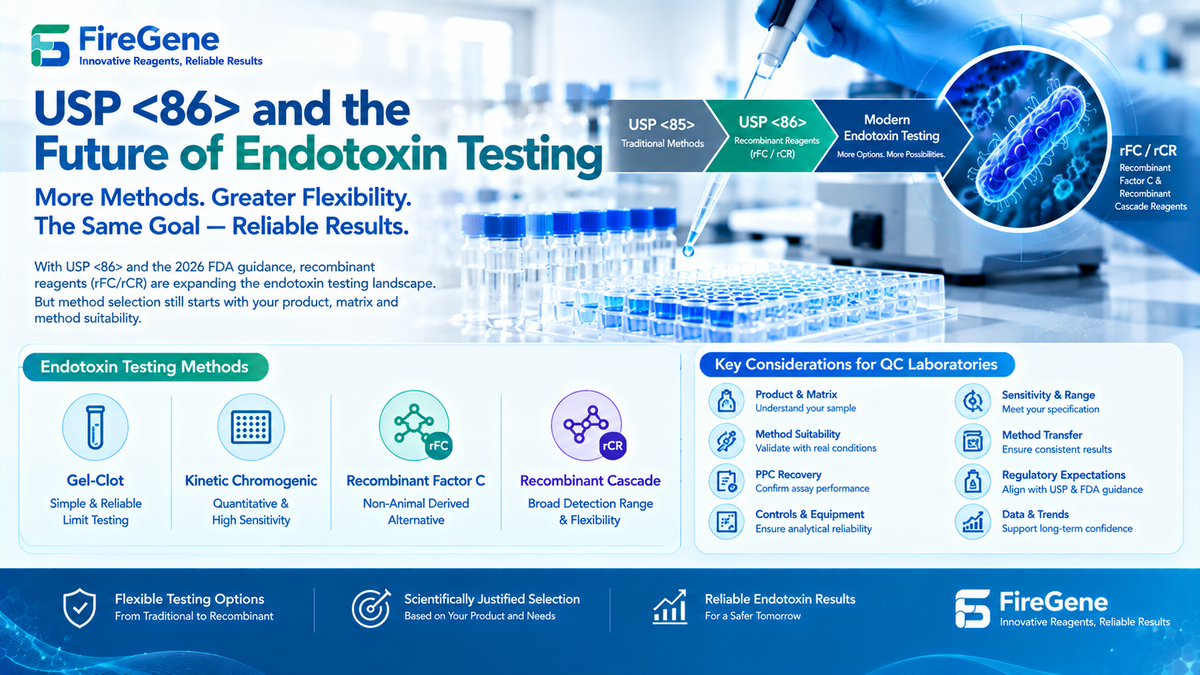
The introduction of USP <86> Bacterial Endotoxins Test Using Recombinant Reagents has expanded the compendial framework for endotoxin testing by providing additional techniques based on non-animal-derived reagents. USP describes recombinant Factor C (rFC) and recombinant cascade reagent (rCR) approaches as additional techniques to the bacterial endotoxin tests described in USP <85>.
At the same time, the FDA's March 2026 revision of its Pyrogen and Endotoxins Testing: Questions and Answers guidance reflects a broader regulatory approach that accommodates recombinant reagents while emphasizing that the selected method must be suitable for its intended purpose.
For QC laboratories, this does not simply mean replacing one reagent with another.
The more important question is:
How should laboratories select, verify, transfer, and control an endotoxin testing method as the available technologies continue to expand?
The answer requires looking beyond the reagent itself.
Method suitability, matrix interference, sensitivity, standardization, controls, equipment, analyst training, data interpretation, and product-specific performance all remain important.
This article explains what QC laboratories should understand about the evolving endotoxin testing landscape and how to build a robust testing strategy in 2026.
1. What Is USP <86>?
USP <86> is the Bacterial Endotoxins Test Using Recombinant Reagents chapter.
It provides additional endotoxin testing techniques using non-animal-derived reagents. The chapter includes methods based on:
- Recombinant Factor C (rFC)
- Recombinant cascade reagents (rCR)
These reagents are designed to detect or quantify endotoxins from Gram-negative bacteria by using recombinant proteins corresponding to components of the horseshoe crab endotoxin-recognition pathway.
This is an important development because traditional lysate-based endotoxin assays and recombinant methods approach endotoxin detection through related biological pathways but use different reagent systems.
For laboratories evaluating a new method, therefore, the relevant question is not simply:
“Is this reagent recombinant or non-recombinant?”
Instead:
“Is the selected method scientifically suitable for this product, matrix, specification, and intended use?”
That distinction becomes increasingly important as laboratories evaluate alternative endotoxin testing technologies.
2. USP <85> and USP <86> Are Not Simply “Old vs. New”
It can be tempting to describe the evolution of endotoxin testing as a straightforward transition from traditional LAL/TAL assays to recombinant methods.
That is too simplistic.
USP <85> remains the established Bacterial Endotoxins Test framework and describes fundamental approaches including gel-clot and photometric methods. FDA's 2026 guidance continues to reference USP <85>, USP <161>, and AAMI ST72 when discussing pyrogen and endotoxin testing.
USP <86> adds further techniques using recombinant reagents.
In practice, laboratories may therefore encounter multiple legitimate methodological options.
The appropriate choice depends on factors such as:
- Product type
- Matrix complexity
- Endotoxin limit
- Required sensitivity
- Quantitative versus limit testing
- Existing laboratory equipment
- Method history
- Validation or verification requirements
- Regulatory expectations
- Testing throughput
- Supply-chain considerations
A laboratory should therefore avoid selecting a method solely because it is newer.
Likewise, a laboratory should not assume that a traditional method is automatically preferable simply because it has been used for many years.
Method selection should be scientifically justified for the intended application.
3. Why Recombinant Endotoxin Testing Is Receiving More Attention
Several factors are driving increased interest in recombinant endotoxin testing.
3.1 Non-Animal-Derived Reagents
One of the most visible differences is the reagent source.
Traditional lysate-based assays depend on biological material obtained from horseshoe crabs.
Recombinant approaches use recombinant proteins instead.
USP's description of <86> specifically identifies these methods as techniques using non-animal-derived reagents.
This provides laboratories with an alternative testing strategy and supports the broader movement toward reducing reliance on animal-derived materials.
3.2 Greater Method Diversity
Historically, laboratories often framed endotoxin testing around variations of LAL or TAL methodology.
The increasing availability of recombinant approaches adds another dimension to method selection.
This can be particularly useful for organizations operating multiple laboratories or developing standardized global QC procedures.
Instead of asking only:
Which endotoxin reagent should we buy?
laboratories increasingly need to ask:
Which endotoxin testing platform best fits our product portfolio and long-term QC strategy?
4. The Most Important Question: Does the Method Work for Your Matrix?
A sophisticated reagent does not automatically eliminate matrix interference.
This principle is fundamental to endotoxin testing.
A pharmaceutical formulation can contain components that:
- Inhibit the endotoxin reaction
- Enhance the reaction
- Bind endotoxin
- Mask endotoxin
- Alter endotoxin aggregation
- Affect optical detection
- Interact with assay components
USP guidance emphasizes the importance of evaluating interfering factors and product suitability. USP's updated guidance work also specifically addresses PPC criteria, test interferences, labware, equipment, routine testing, and OOS investigations.
This means that changing the reagent platform does not remove the need for method suitability work.
In fact, whenever a laboratory introduces a different analytical principle, method suitability becomes especially important.
5. Method Suitability Is the Bridge Between Technology and the Product
A method can be scientifically valid in general but unsuitable for a specific sample.
This distinction is critical.
Imagine a laboratory has successfully demonstrated that a particular endotoxin method can detect standard endotoxin in water.
That does not automatically demonstrate that the same method will perform correctly in:
- A monoclonal antibody formulation
- A peptide drug
- An mRNA-LNP formulation
- A protein-rich intermediate
- A surfactant-containing formulation
- A highly concentrated API
- A complex process sample
The matrix can change the behavior of the assay.
Therefore, method suitability should be demonstrated using the actual material or a scientifically justified representative matrix.
FDA's 2026 guidance specifically states that sponsors using recombinant reagents should verify assay suitability for the intended purpose. The agency also notes that verification experiments should consider the complexity of the material being tested.
This is one of the most important principles for laboratories considering a transition to a new endotoxin method.
6. Positive Product Control Remains Critical
One of the most important tools for evaluating endotoxin assay suitability is the Positive Product Control (PPC).
The purpose of the PPC is to determine whether the sample matrix affects endotoxin recovery under the selected test conditions.
A method may produce a negative sample result, but a negative result alone does not prove that the sample is free of detectable endotoxin if the matrix suppresses the assay response.
This is why a robust endotoxin workflow should evaluate:
Sample result + negative control + standard curve/control performance + PPC recovery
rather than relying on the sample result alone.
USP's guidance materials specifically address PPC criteria and test interference as important components of bacterial endotoxin testing.
7. Recombinant Does Not Mean “Interference-Free”
This is one of the most important misconceptions laboratories should avoid.
A recombinant reagent can reduce dependence on animal-derived lysate.
It does not mean that every pharmaceutical matrix will automatically become compatible with the assay.
Matrix effects can still occur.
For example, a formulation containing proteins, lipids, surfactants, or other functional excipients may interact with endotoxin or with the analytical system.
Therefore, laboratories should continue to evaluate:
- Sample dilution
- Maximum Valid Dilution (MVD)
- PPC recovery
- Endotoxin recovery
- Sample preparation
- Potential adsorption
- Chemical interference
- Optical interference
- Detection range
The fundamental analytical question remains:
Can the method reliably detect the endotoxin that is actually present in this product?
8. Why Dilution Still Matters
Dilution is one of the most practical tools for reducing matrix interference.
If a product interferes with the endotoxin assay at a high concentration, dilution may reduce the concentration of the interfering component.
However, dilution cannot be unlimited.
The selected dilution must remain scientifically justified and within the applicable MVD.
USP's endotoxin testing framework describes the use of dilution and the importance of not exceeding the MVD when addressing interference.
This creates an important balance:
Too little dilution → potential interference
Too much dilution → endotoxin may fall below the method's useful detection range
The optimal testing condition therefore depends on the relationship between:
- Endotoxin limit
- Assay sensitivity
- Sample concentration
- Matrix interference
- MVD
For laboratories performing quantitative endotoxin testing, this relationship should be established before routine testing begins.
9. What About Kinetic Chromogenic Endotoxin Testing?
Kinetic chromogenic testing remains an important quantitative endotoxin testing approach.
Instead of simply reporting whether a clot forms, a kinetic chromogenic assay monitors the development of a measurable chromogenic response over time and relates the reaction behavior to endotoxin concentration through a calibrated standard curve.
This can provide laboratories with quantitative information useful for:
- Process monitoring
- Raw material testing
- Intermediate testing
- Finished-product testing
- Trend analysis
- Method development
- Research applications
However, quantitative data should not be confused with automatically reliable data.
The laboratory still needs to demonstrate:
- Appropriate standard curve performance
- Suitable sample dilution
- Acceptable PPC recovery
- Appropriate controls
- Adequate sensitivity
- Repeatability
- Matrix compatibility
FireGene's Kinetic Chromogenic Endotoxin Test Kit is designed for quantitative endotoxin testing and can be incorporated into workflows where kinetic chromogenic analysis is appropriate.
For laboratories new to kinetic testing, FireGene's guide to kinetic chromogenic endotoxin assays provides additional background on assay principles and workflow.
10. Gel-Clot Testing Still Has an Important Role
The growing interest in recombinant and quantitative methods should not lead laboratories to overlook gel-clot testing.
Gel-clot assays remain a straightforward approach for endotoxin detection and are particularly useful when a limit test is appropriate.
Advantages can include:
- Simple visual interpretation
- Limited instrumentation requirements
- Straightforward workflow
- Useful application for appropriate limit tests
- Familiarity across many QC laboratories
FireGene's Gel-Clot Endotoxin Test Kit provides an option for laboratories using gel-clot methodology.
The appropriate method depends on the testing objective.
A laboratory performing routine screening does not necessarily have the same requirements as a high-throughput QC laboratory generating quantitative endotoxin trend data.
11. Standard Curves Are Still Fundamental to Quantitative Testing
When a quantitative endotoxin method is used, the standard curve becomes one of the most important analytical controls.
The curve establishes the relationship between the measured assay response and endotoxin concentration.
Laboratories should therefore evaluate:
- Curve range
- Curve fit
- Replicate consistency
- Control performance
- Outliers
- Sample positioning
- Dilution suitability
An attractive-looking curve does not automatically mean the entire analytical run is valid.
The standard curve should be interpreted together with the other required controls.
This is particularly important when laboratories use automated plate-based workflows, where a large amount of data can create an illusion of analytical certainty.
More data does not automatically equal better data.
12. Labware and Water Quality Still Matter
Changing the endotoxin reagent does not eliminate contamination risks from the laboratory environment.
Endotoxin can be introduced through:
- Water
- Containers
- Pipette tips
- Tubes
- Vials
- Sample-contact surfaces
- Reagent preparation
- Improper handling
USP guidance specifically identifies labware, equipment, and instruments as areas that require appropriate consideration in BET workflows.
This is why laboratories should maintain control over their entire analytical system.
FireGene's Pyrogen-Free Vials can support controlled sample handling, while Endotoxin Assay Water can be used where endotoxin-controlled water is required for appropriate assay preparation and dilution workflows.
The key principle is simple:
A sensitive assay cannot compensate for poor contamination control.
13. What Should Laboratories Consider Before Switching Methods?
A laboratory considering a transition from one endotoxin method to another should avoid treating the change as a simple reagent replacement.
A structured assessment should include several questions.
Product
What products will be tested?
Are they simple aqueous materials or complex biological formulations?
Specification
What endotoxin limit applies?
What sensitivity is required?
Matrix
Could proteins, lipids, surfactants, salts, or other excipients interfere?
Detection
Is the method qualitative or quantitative?
What analytical range is needed?
Equipment
Does the laboratory already have suitable instrumentation?
Controls
How will standard curves, PPCs, negative controls, and other system controls be managed?
Method Suitability
Has the method been evaluated using the intended material?
Transfer
If the method will be implemented at another site, can the performance be reproduced?
Training
Do analysts understand the new assay principle and its critical parameters?
Documentation
Are SOPs, validation or verification protocols, specifications, and investigation procedures updated?
This type of evaluation helps prevent a common mistake:
Choosing a method first and discovering its limitations after implementation.
14. Method Transfer Becomes More Important as Laboratories Standardize
Global pharmaceutical organizations increasingly operate endotoxin testing across multiple laboratories.
A method may be developed at one site and transferred to another.
When a new endotoxin platform is introduced, laboratories should therefore pay close attention to method transfer.
Important considerations can include:
- Reagent lot management
- Standard preparation
- Equipment configuration
- Incubation conditions
- Software settings
- Plate layout
- Analyst technique
- Sample preparation
- PPC performance
- Standard curve performance
- Acceptance criteria
A method that performs well in Laboratory A should not simply be assumed to perform identically in Laboratory B.
This is especially relevant when the two laboratories use different instruments, consumables, analysts, or sample-handling procedures.
15. How 2026 Changes the Method-Selection Conversation
The regulatory environment is becoming more flexible, but flexibility does not mean fewer responsibilities.
FDA's March 2026 guidance revision removed certain LAL-specific references to accommodate a broader scope that includes recombinant reagents. At the same time, FDA emphasized that laboratories and sponsors using recombinant reagents should verify that the assay is suitable for its intended purpose.
This creates an important message for QC laboratories:
More method options mean more responsibility for method selection and verification.
The question is no longer simply:
“Which endotoxin test is approved?”
A more useful framework is:
“Which method is appropriate for this product, under these conditions, for this intended purpose, and can we demonstrate that it performs reliably?”
That shift moves endotoxin testing away from a one-size-fits-all mindset and toward a more science-based analytical strategy.
16. A Practical Decision Framework for Endotoxin Method Selection
Before selecting an endotoxin method, QC laboratories can work through five questions.
Question 1: What are you testing?
Define the product or material.
Raw material?
Process intermediate?
Drug substance?
Drug product?
Medical device extract?
Research sample?
Question 2: What level of endotoxin must you detect?
The required sensitivity should be considered together with the applicable endotoxin limit and sample concentration.
Question 3: Does the matrix interfere?
Evaluate inhibition, enhancement, adsorption, masking, and other matrix effects.
Question 4: What type of result do you need?
Do you need:
A limit determination?
or
A quantitative concentration for monitoring and trending?
The answer can influence the most appropriate assay format.
Question 5: Can you demonstrate suitability?
This is the final checkpoint.
The selected method should be supported by appropriate experiments demonstrating that it performs as intended with the actual product or material.
If the answer to this question is unclear, the method-selection process is not complete.
17. What the Future of Endotoxin Testing May Look Like
The future is unlikely to be a single technology replacing every other endotoxin assay.
Instead, laboratories may increasingly operate within a multi-method endotoxin testing environment.
Depending on the application, organizations may use:
- Gel-clot testing
- Kinetic chromogenic testing
- Other photometric approaches
- Recombinant Factor C methods
- Recombinant cascade methods
- Different platforms for different product classes
This creates opportunities for greater flexibility.
But it also creates a need for stronger analytical governance.
Laboratories will need to maintain clear relationships between:
Method → Product → Matrix → Specification → Controls → Acceptance Criteria → Data Interpretation
The more complex the testing portfolio becomes, the more important this framework will be.
18. Endotoxin Testing Should Be Treated as a Lifecycle Strategy
Endotoxin testing should not be viewed as an isolated laboratory event.
A complete strategy may include:
Raw material control
↓
Water and equipment control
↓
Manufacturing process controls
↓
Sampling strategy
↓
Sample storage and handling
↓
Method suitability
↓
Endotoxin assay
↓
Data review
↓
Trend analysis
↓
OOS/deviation investigation
This lifecycle approach is particularly useful when products, formulations, equipment, or analytical methods change.
A new formulation may require a new interference assessment.
A new laboratory may require method transfer work.
A new assay platform may require verification.
A new reagent lot may require appropriate qualification.
The testing strategy therefore needs to evolve with the manufacturing and analytical process.
19. 2026 Endotoxin Testing Checklist
Before implementing or changing an endotoxin testing method, QC teams should consider:
Method
- Is the analytical principle appropriate?
- Is the required sensitivity achievable?
- Is the method qualitative or quantitative?
Product
- What is the endotoxin limit?
- How complex is the matrix?
- Are there known interference risks?
Controls
- Is the PPC strategy defined?
- Are negative controls appropriate?
- Are standard curves or sensitivity controls acceptable?
Sample Handling
- Are containers qualified?
- Is sample hold time controlled?
- Is storage temperature defined?
- Is sample mixing standardized?
Equipment
- Is the required reader or instrumentation qualified?
- Are critical instrument settings controlled?
Documentation
- Are SOPs current?
- Are method suitability or verification studies documented?
- Is the method-transfer strategy defined where applicable?
Lifecycle
- Are results trended?
- Are changes assessed?
- Are recurring atypical results investigated systematically?
Conclusion: The Best Endotoxin Method Is the One You Can Demonstrate to Be Suitable
The evolution of endotoxin testing in 2026 is not simply about moving from traditional assays to recombinant reagents.
It is about expanding the laboratory's options while placing greater emphasis on method suitability, product-specific performance, and scientific justification.
USP <86> adds recombinant endotoxin testing techniques to the broader compendial landscape, while FDA's 2026 guidance recognizes recombinant approaches and emphasizes verification of suitability for the intended application.
For QC laboratories, the practical priorities remain clear:
- Understand the product matrix
- Define the endotoxin requirement
- Select an appropriate analytical principle
- Evaluate interference
- Establish appropriate controls
- Demonstrate method suitability
- Control sample handling
- Maintain qualified labware and water
- Document method transfer when needed
- Trend and investigate results over the product lifecycle
The key question is no longer simply:
“Which endotoxin test should we use?”
It is:
“Which endotoxin testing strategy provides reliable, scientifically defensible results for this specific product and intended purpose?”
That is the question that should guide endotoxin method selection in 2026.
FireGene Endotoxin Testing
Ready to run your endotoxin assay?
FireGene offers a complete endotoxin testing toolkit — from TAL reagents and CSE standards to pyrogen-free consumables and LAL reagent water. All products are aligned with USP <85>, EP 2.6.14, and JP 4.01.


