
Introduction
Endotoxin control in biopharmaceutical manufacturing is often associated with raw materials, process water, equipment, and final drug products.
But there is another important part of the manufacturing process that deserves closer attention:
Chromatography resins, filtration membranes, and other downstream processing materials.
These materials come into direct or indirect contact with biological process streams and may be used repeatedly during manufacturing campaigns. If they are improperly prepared, stored, sanitized, or handled, they can become potential sources of microbial contamination and endotoxin.
This is particularly important for biologics manufactured through complex downstream purification workflows.
Protein A chromatography, ion-exchange chromatography, membrane filtration, ultrafiltration/diafiltration (UF/DF), and other purification technologies are routinely used to remove process-related impurities and concentrate or polish the product. However, purification equipment and consumables themselves must also remain under appropriate microbial and endotoxin control.
FDA documents have specifically identified chromatography resin and UF/DF membrane lifetime studies as areas where bioburden and endotoxin acceptance criteria should be established and monitored, including assessment of materials after sanitization and at the end of storage before sanitization.
This creates an important principle for downstream manufacturing:
A purification step should not become an uncontrolled source of endotoxin while it is being used to remove other impurities.
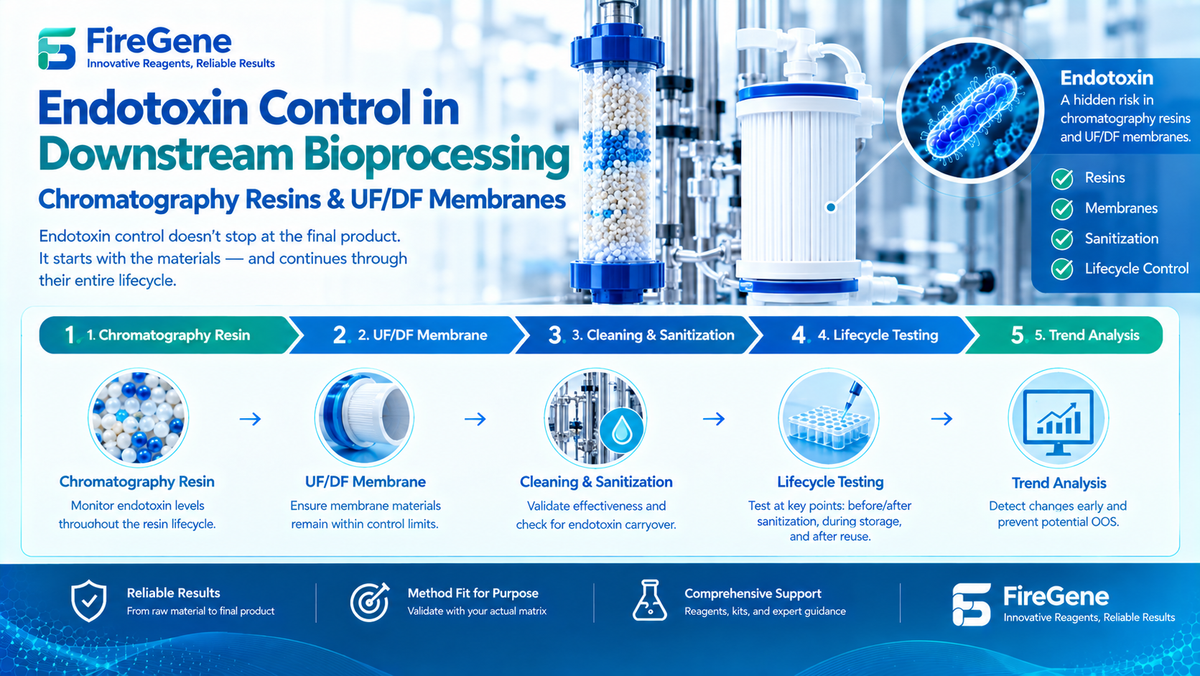
This article explains how endotoxin can enter downstream bioprocessing systems, why chromatography resins and UF/DF membranes require lifecycle control, how endotoxin testing can support process monitoring, and how QC laboratories can build a practical testing strategy.
1. Why Downstream Processing Matters for Endotoxin Control
A typical biologics purification process may include:
Harvest → Clarification → Protein A Chromatography → Viral Inactivation → Ion-Exchange Chromatography → Membrane Filtration → UF/DF → Final Formulation
Each stage has a different purpose.
Chromatography removes proteins, aggregates, host-cell impurities, DNA, and other process-related contaminants.
UF/DF adjusts concentration and buffer composition.
Membrane filtration provides clarification, virus removal, or other separation functions.
Yet every additional process step also introduces another opportunity for microbial contamination or endotoxin exposure.
Endotoxin may enter through:
- Process water
- Buffers
- Raw materials
- Resin preparation
- Membrane preparation
- Storage solutions
- Equipment surfaces
- Tubing and connectors
- Inadequate sanitization
- Improper storage
- Reuse of processing materials
- Handling during assembly
Once introduced into a downstream process, endotoxin can be difficult to remove completely.
Research on endotoxin control in biologics production has emphasized the importance of prevention and removal strategies involving chromatographic separations, endotoxin-removing membranes, and on-column washing approaches.
Therefore, endotoxin control should not begin only when the final drug substance reaches the QC laboratory.
It should begin much earlier.
2. Can Chromatography Resin Contribute to Endotoxin Risk?
Chromatography resin is designed to capture or separate target molecules and impurities.
Depending on the purification strategy, a resin may be exposed to:
- Cell culture harvest
- Clarified process intermediates
- High-protein solutions
- Buffers
- Cleaning solutions
- Sanitization solutions
- Storage solutions
If the resin is reused, the potential exposure becomes even more important.
The key question is not simply:
“Was the resin sanitized?”
The more useful question is:
“Can we demonstrate that the resin remains within established bioburden and endotoxin acceptance criteria throughout its intended lifecycle?”
This distinction is important because microbial control and endotoxin control are related but not interchangeable.
A sanitization process may reduce viable microorganisms without necessarily guaranteeing the removal of pre-existing endotoxin.
For that reason, resin lifecycle studies should consider both microbial and endotoxin attributes.
3. Protein A Resin and Endotoxin Control
Protein A chromatography is widely used for antibody purification.
The resin interacts directly with the antibody-containing process stream, making it an important component of the downstream purification train.
Potential endotoxin concerns include:
Resin preparation
The resin may require preparation, equilibration, or washing before use.
The quality of the water and buffers used during these steps can influence the microbial and endotoxin profile of the system.
Resin reuse
Reusable resin may be subjected to multiple production cycles.
Each cycle creates another opportunity for exposure to process materials and microorganisms.
Cleaning and sanitization
Cleaning and sanitization procedures must be appropriately defined and validated for the intended resin and manufacturing process.
Storage
Between campaigns, the resin may remain in a storage solution for a defined period.
The storage condition and duration can affect microbial control.
Pre-use testing
Depending on the manufacturing strategy and established control system, testing before reuse may provide useful evidence that the resin remains suitable.
The exact testing strategy should be established based on process knowledge, resin lifetime, sanitization validation, and applicable quality requirements.
4. Ion-Exchange Resins Present Similar Questions
Ion-exchange chromatography may be used for polishing or intermediate purification.
Anion-exchange and cation-exchange resins can have different chemical environments and operating conditions, but the underlying endotoxin-control principle remains the same.
The resin should not be treated as a passive material.
It is part of the manufacturing system.
Important variables include:
- Number of processing cycles
- Contact time
- Cleaning conditions
- Sanitization conditions
- Storage time
- Storage temperature
- Buffer composition
- Resin age
- Previous product exposure
- Microbial monitoring history
- Endotoxin monitoring history
As resin lifetime increases, historical data become increasingly valuable.
A resin that consistently demonstrates acceptable performance during early cycles may behave differently after extended use.
That is why lifecycle monitoring is more informative than relying exclusively on an initial qualification result.
5. UF/DF Membranes Are Another Important Control Point
Ultrafiltration and diafiltration are commonly used in biologics manufacturing for concentration and buffer exchange.
The membrane may remain in contact with the product stream for a significant period of time.
Potential endotoxin sources include:
- Membrane materials
- Housing components
- Process water
- Buffers
- Storage solutions
- Connections and tubing
- Inadequate cleaning
- Inadequate sanitization
- Extended storage
For reusable UF/DF systems, the question becomes similar to that of chromatography resin:
Does the membrane remain within established microbial and endotoxin limits throughout its validated operating and storage lifecycle?
FDA materials specifically identify UF/DF membrane lifetime studies and associated bioburden/endotoxin acceptance criteria as information relevant to manufacturing process control.
This makes membrane lifecycle management an important part of downstream endotoxin control.
6. Why “Sterile” Does Not Automatically Mean “Low Endotoxin”
One of the most common misconceptions in contamination control is treating sterility and endotoxin control as equivalent.
They are not.
A sterile material may have no viable microorganisms while still containing endotoxin.
This is because endotoxin is not itself a living organism.
Therefore:
Sterility Control ≠ Endotoxin Control
Similarly:
Bioburden Testing ≠ Endotoxin Testing
Bioburden testing provides information about viable microorganisms.
Endotoxin testing addresses bacterial endotoxin activity.
Both can contribute to a comprehensive microbial control strategy, but one cannot simply replace the other.
FDA's current 2026 guidance continues to address bacterial endotoxin testing as a distinct quality-control activity and describes gel-clot, photometric, and kinetic approaches for applicable products and components.
7. Resin and Membrane Lifetime Studies
A robust lifecycle strategy should evaluate the material at meaningful points throughout its intended use.
A conceptual study may include:
Initial Qualification
↓
Routine Production Cycles
↓
Intermediate Lifetime Point
↓
Maximum Validated Cycle
↓
Storage
↓
Post-Storage Sanitization
The exact design depends on the manufacturing process and material.
However, several questions should be addressed.
How many cycles can the resin or membrane safely support?
This should not be based solely on supplier recommendations.
Manufacturers should establish their own scientifically justified lifecycle criteria for the specific application.
Does endotoxin increase with repeated use?
Historical testing can help identify whether endotoxin levels remain stable or begin to trend upward.
Does sanitization restore the material to an acceptable condition?
Sanitization should be evaluated within the complete lifecycle strategy rather than assumed to provide unlimited recovery.
Does storage affect microbial or endotoxin status?
Long storage periods may introduce additional risks.
What happens at the end of the validated lifetime?
The maximum validated cycle should be supported by appropriate evidence rather than simply selected as an arbitrary number.
8. Endotoxin Testing Before and After Sanitization
One particularly useful approach is to consider testing at different points around the sanitization process.
For example:
End of Production Cycle → Storage → Pre-Sanitization Testing → Sanitization → Post-Sanitization Assessment
Why is the pre-sanitization point important?
Because it provides information about the condition of the material before the cleaning or sanitization procedure.
Without this information, it may be difficult to understand whether the sanitization procedure is actually controlling the accumulated microbial and endotoxin burden.
FDA review documentation has specifically described the importance of evaluating bioburden and endotoxin at the end of storage before sanitization when conducting resin and membrane lifetime studies.
This type of lifecycle information can also support a more evidence-based approach to cleaning and sanitization validation.
9. Sample Preparation Is Critical for Resin and Membrane Testing
Testing a resin or membrane is not necessarily the same as testing a liquid pharmaceutical sample.
The laboratory may need to evaluate an extract or rinse rather than the material itself.
That creates several analytical questions:
- What extraction solution should be used?
- What volume is appropriate?
- How long should the material be contacted with the extraction solution?
- Should the extraction be performed at a defined temperature?
- Does the material release interfering substances?
- Is the extraction solution endotoxin-free?
- Does the sample require dilution?
- Is PPC recovery acceptable?
These factors can significantly influence the final endotoxin result.
The laboratory should therefore establish a sample preparation procedure that is appropriate for the material being evaluated.
FireGene's guide to endotoxin testing sample preparation can be used as a supporting reference when developing dilution, interference, and recovery strategies.
10. Endotoxin Assay Water Matters
The extraction solution or rinse solution used for resin and membrane testing is itself part of the analytical system.
If the water contains endotoxin, the laboratory may generate:
- Elevated blanks
- Increased background
- False-positive signals
- Poor reproducibility
- Difficult-to-interpret recovery results
For this reason, laboratories should use water suitable for bacterial endotoxin testing.
FireGene's Endotoxin Assay Water is intended for endotoxin testing workflows and can be used for appropriate sample dilution and preparation.
This is a small detail that can have a large impact on data quality.
When investigating unexpected endotoxin results, laboratories should therefore evaluate not only the resin or membrane but also the complete extraction and testing system.
11. Positive Product Control and Matrix Interference
Extracts from chromatography resins and membranes can potentially contain substances that interfere with endotoxin detection.
Depending on the material and extraction conditions, the sample may cause:
- Inhibition
- Enhancement
- Background interference
- Unexpected kinetic behavior
A Positive Product Control (PPC) can help determine whether the test system is performing appropriately in the presence of the sample matrix.
The basic concept is:
Known Endotoxin Spike + Sample Matrix → Recovery Assessment
If the expected recovery is not obtained, the laboratory should investigate the test condition rather than immediately interpreting the result as a true endotoxin concentration.
Potential adjustments may include:
- Dilution
- Alternative sample preparation
- Modified extraction conditions
- Different assay conditions
- Further investigation of material extractables
Method suitability is therefore essential when establishing an endotoxin test for non-traditional sample types.
12. Choosing Between Gel-Clot and Kinetic Chromogenic Testing
Different downstream materials may require different analytical approaches.
Gel-Clot Endotoxin Testing
Gel-clot testing provides a relatively straightforward endpoint-based approach.
It can be useful when the testing objective is to determine whether endotoxin is below a defined sensitivity threshold.
FireGene's Gel-Clot Endotoxin Test Kit offers multiple sensitivity levels, including 0.03, 0.06, 0.125, 0.25, and 0.5 EU/mL.
For selected resin or membrane studies, this type of assay may be appropriate when a qualitative or semi-quantitative assessment is sufficient.
Kinetic Chromogenic Testing
Kinetic chromogenic testing provides quantitative information by monitoring the development of a chromogenic reaction over time.
This can be particularly useful during:
- Resin lifetime studies
- Membrane lifetime studies
- Sanitization studies
- Extraction optimization
- Method development
- Trend analysis
FireGene's Kinetic Chromogenic Endotoxin Test Kit provides a 96-well quantitative workflow with a listed range of 0.005–10 EU/mL and 405 nm detection.
The quantitative format can make it easier to compare endotoxin levels across multiple lifecycle points.
13. Trend Analysis Can Reveal Problems Before an OOS Result
One of the strongest reasons to monitor endotoxin in downstream materials is the ability to establish historical trends.
Consider a hypothetical resin lifecycle:
Cycle 1 → 0.02 EU/mL
Cycle 10 → 0.03 EU/mL
Cycle 20 → 0.05 EU/mL
Cycle 30 → 0.08 EU/mL
Cycle 40 → 0.15 EU/mL
Even if every result remains below the established acceptance criterion, the upward trend may deserve investigation.
Potential causes could include:
- Increasing resin age
- Incomplete cleaning
- Changes in sanitization effectiveness
- Storage conditions
- Increased microbial exposure
- Process-water changes
- Buffer preparation changes
This is where endotoxin testing becomes more than a release test.
It becomes a process-monitoring tool.
Trend analysis can provide an opportunity to investigate potential process drift before an actual OOS event occurs.
14. Common Mistakes in Resin and Membrane Endotoxin Testing
Mistake 1: Testing Only the New Material
A new resin or membrane may pass initial testing.
That does not demonstrate that the material remains suitable after repeated use.
Lifecycle testing is essential when the material is intended for reuse.
Mistake 2: Testing Only After Sanitization
Post-sanitization testing provides useful information, but without pre-sanitization data, it may be difficult to understand the microbial and endotoxin burden before the sanitization step.
Mistake 3: Ignoring Storage
A material may remain in storage between manufacturing campaigns.
Storage duration and conditions should therefore be incorporated into the lifecycle assessment.
Mistake 4: Assuming Supplier Qualification Is Enough
Supplier qualification establishes an important baseline.
However, once a material enters the manufacturer's process, its condition depends on actual operating conditions.
Process-specific lifecycle data remain important.
Mistake 5: Ignoring Extraction Recovery
An extraction method that does not recover endotoxin consistently can produce misleading results.
The laboratory should demonstrate that the chosen extraction and assay conditions are suitable.
Mistake 6: Using Excessive Dilution
Dilution can reduce matrix interference, but excessive dilution may push the endotoxin concentration below the useful analytical range.
MVD and assay sensitivity should be considered when establishing the final testing condition.
15. Building a Practical Downstream Endotoxin Control Strategy
A comprehensive strategy can be organized around five control layers.
Layer 1: Incoming Materials
Evaluate the endotoxin risk associated with:
- Resins
- Membranes
- Filters
- Tubing
- Buffers
- Process water
- Other manufacturing components
Layer 2: Preparation
Control:
- Water quality
- Cleaning
- Sanitization
- Assembly
- Storage
- Handling
Layer 3: In-Process Monitoring
Establish appropriate sampling points for:
- Process intermediates
- Resin extracts or rinses
- Membrane extracts or rinses
- Buffers
- Other critical process streams
Layer 4: Lifecycle Monitoring
Track:
- Number of cycles
- Storage duration
- Sanitization history
- Endotoxin results
- Bioburden results
- Cleaning performance
Layer 5: Trend and Investigation
Use historical data to identify:
- Gradual increases
- Abnormal variability
- Recurring contamination
- Process drift
- Potential equipment problems
This layered approach connects material control with process control and analytical testing.
16. Where Endotoxin Testing Fits Into Downstream Bioprocessing
Endotoxin testing should not operate as an isolated QC activity.
Instead, it should connect with the overall contamination-control strategy.
A simplified model is:
Water Quality
↓
Material Qualification
↓
Resin/Membrane Preparation
↓
Sanitization
↓
Process Use
↓
Storage
↓
Lifecycle Testing
↓
Trend Analysis
↓
Corrective Action
This creates a closed-loop control system.
When endotoxin results change, the laboratory can investigate the process rather than simply repeating the test.
This is especially important because endotoxin contamination can be difficult to remove once introduced into a complex manufacturing environment.
17. What Should Be Included in a Resin or Membrane Endotoxin SOP?
A practical SOP should clearly define:
Sampling
Specify:
- Sampling location
- Sampling timing
- Sample volume
- Frequency
- Number of replicates
Extraction
Define:
- Extraction solution
- Extraction volume
- Contact time
- Temperature
- Mixing procedure
Testing
Document:
- Endotoxin reagent
- Sensitivity
- Dilution
- PPC requirements
- Negative controls
- Standard controls
- Acceptance criteria
Lifecycle
Track:
- Resin or membrane identification
- Number of cycles
- Sanitization history
- Storage history
- Test results
- Deviations
- Maintenance activities
Data Review
Establish procedures for:
- Result trending
- OOS investigation
- OOT investigation
- CAPA
- Periodic lifecycle review
The more clearly these elements are defined, the easier it becomes to distinguish genuine process changes from analytical variability.
18. The Role of USP <85> and USP <86>
USP <85> remains a foundational chapter for bacterial endotoxin testing, while USP <86> provides additional techniques using recombinant reagents. USP describes <86> as providing alternative non-animal-derived approaches to the methods described in <85>.
USP's current guidance chapter <1085> also notes that increasing experience and the complexity of parenteral formulations have created a need for additional supporting information around the proper application of bacterial endotoxin testing.
For laboratories evaluating chromatography resins and UF/DF membranes, the important point is that method selection should be connected to the intended sample, analytical objective, and demonstrated method suitability.
The laboratory should not assume that a method is appropriate simply because it has been successfully used for another sample type.
19. A Practical Checklist for QC Laboratories
Before establishing routine endotoxin testing for a chromatography resin or UF/DF membrane, ask:
Material
- What material is being tested?
- Is it single-use or reusable?
- What is its intended lifetime?
Process
- What process stream contacts the material?
- What cleaning and sanitization procedures are used?
- How long is the material stored?
Sampling
- Where will samples be collected?
- Will testing occur before or after sanitization?
- Are lifecycle points included?
Extraction
- What extraction solution will be used?
- Has the extraction condition been demonstrated to recover endotoxin appropriately?
Assay
- Which endotoxin test method will be used?
- What sensitivity is required?
- Is the sample matrix inhibitory or enhancing?
Controls
- Is endotoxin-free water being used?
- Are negative controls acceptable?
- Is PPC recovery acceptable?
Lifecycle
- How will results be trended?
- What happens when endotoxin begins to increase?
- What is the maximum validated number of cycles?
These questions can help transform endotoxin testing from a one-time material check into a lifecycle-based contamination-control strategy.
20. How FireGene Can Support Downstream Endotoxin Testing
For laboratories developing endotoxin testing workflows for chromatography resins, UF/DF membranes, and other downstream processing materials, FireGene provides a range of TAL/LAL-based endotoxin testing products and supporting reagents.
The Kinetic Chromogenic Endotoxin Test Kit can support quantitative endotoxin analysis during research and method-development studies, including dilution and recovery evaluation.
The Gel-Clot Endotoxin Test Kit can provide a straightforward endpoint-based approach for applications where gel-clot testing is appropriate.
Control Standard Endotoxin can be used as a defined endotoxin control material in applicable testing workflows, while Endotoxin Assay Water can support sample preparation and dilution.
For laboratories working with complex extraction workflows, pyrogen-free consumables are also important. FireGene's Pyrogen-Free Vials can be incorporated into appropriate sample-handling procedures.
The broader principle remains:
Reliable endotoxin data require control of the entire analytical workflow—not just the endotoxin reagent.
Conclusion
Chromatography resins and UF/DF membranes are often viewed primarily as purification tools.
From an endotoxin-control perspective, however, they should also be considered critical process materials.
Their endotoxin profile can be influenced by:
- Material qualification
- Process water
- Buffer preparation
- Product exposure
- Cleaning
- Sanitization
- Storage
- Reuse
- Extraction conditions
- Lifecycle duration
For reusable materials, a single qualification test is rarely enough to describe the complete risk profile.
A stronger strategy combines:
Material Qualification + Sanitization Control + Lifecycle Studies + Endotoxin Testing + Bioburden Monitoring + Trend Analysis
FDA documentation has specifically highlighted the importance of bioburden and endotoxin acceptance criteria for chromatography resins and UF/DF membranes during lifecycle studies, including assessment before and after sanitization and during storage.
As biopharmaceutical manufacturing becomes increasingly sophisticated, downstream purification materials deserve the same level of analytical attention as other critical manufacturing inputs.
The objective is not simply to determine whether a resin or membrane “passes” an endotoxin test.
The objective is to understand how endotoxin risk changes throughout the material's lifecycle—and to establish controls before that risk reaches the product.
That is the foundation of a more proactive and data-driven endotoxin control strategy for modern biopharmaceutical manufacturing.
FireGene Endotoxin Testing
Ready to run your endotoxin assay?
FireGene offers a complete endotoxin testing toolkit — from TAL reagents and CSE standards to pyrogen-free consumables and LAL reagent water. All products are aligned with USP <85>, EP 2.6.14, and JP 4.01.


