
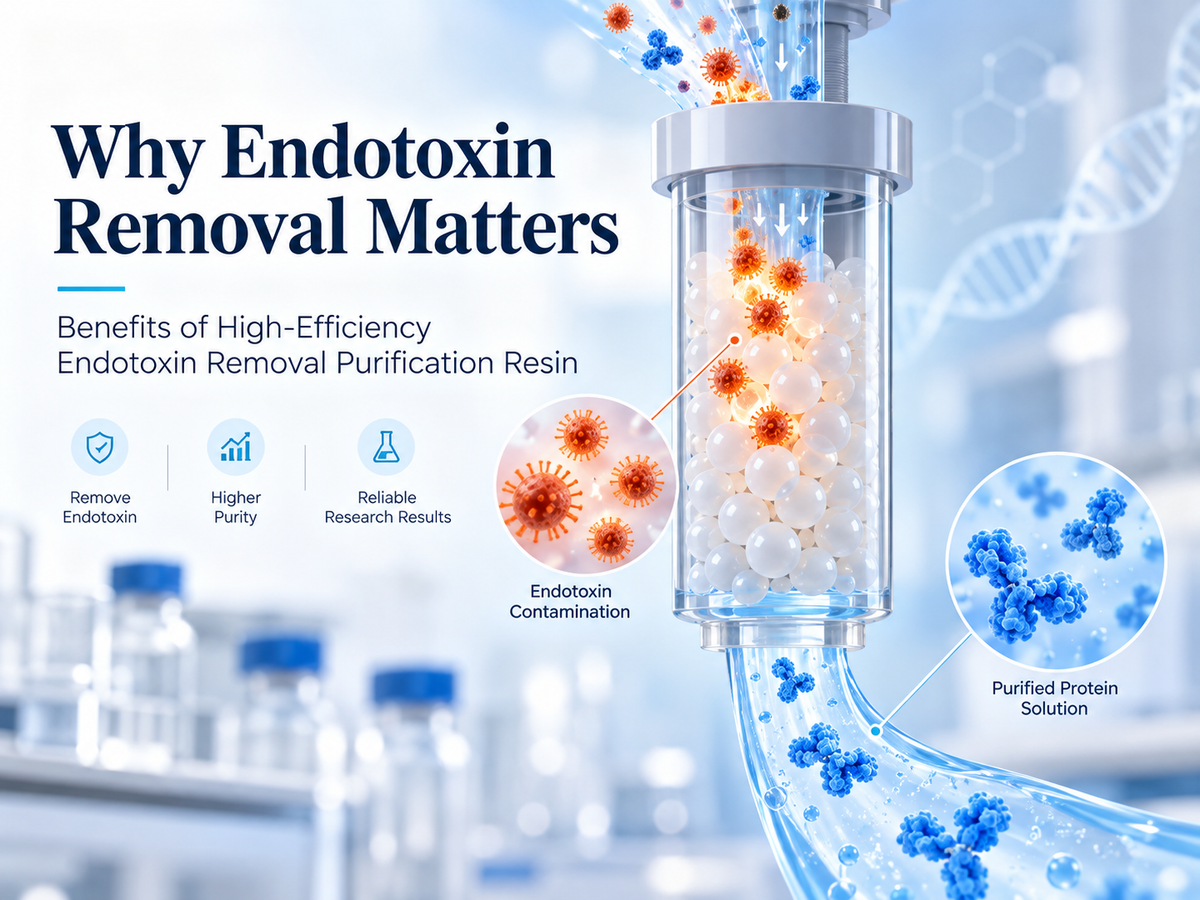
Endotoxin contamination is a significant challenge in protein purification, cell culture, immunological research, and biopharmaceutical development. Bacterial endotoxins, primarily lipopolysaccharides (LPS) derived from Gram-negative bacteria, can trigger inflammatory responses, interfere with biological assays, and compromise experimental reproducibility. Effective endotoxin removal is therefore essential for preparing high-quality biological samples. High-Efficiency Endotoxin Removal Purification Resin provides an adsorption-based approach to reducing endotoxin contamination while supporting protein recovery and preserving biological activity under suitable conditions. This article explores the consequences of excessive endotoxin levels, the limitations of conventional purification methods, the principles of endotoxin removal resins, and their applications in modern life science research.
1. What Is Endotoxin and Where Does It Come From?
Endotoxins are biologically active components of the outer membrane of Gram-negative bacteria, including Escherichia coli and Pseudomonas species. Their primary molecular component is lipopolysaccharide (LPS), which consists of lipid A, a core oligosaccharide, and an O-antigen region.
Lipid A is primarily responsible for the inflammatory activity of LPS.
Endotoxin contamination can occur during recombinant protein expression, bacterial cell disruption, purification, filtration, and sample handling.
Common contamination sources include bacterial expression systems, laboratory water, buffers, raw materials, equipment, and improperly controlled processing environments.
Unlike living bacteria, endotoxins cannot be reliably eliminated through conventional sterilization or standard sterile filtration alone. Their relative heat stability and ability to associate with biological molecules make them particularly challenging to remove.
Therefore, maintaining sterility does not necessarily guarantee that a sample has acceptably low endotoxin levels.
2. What Happens If Endotoxin Levels Are Too High?
Excessive endotoxin contamination can affect both experimental performance and biological safety.
Inflammatory Responses and Biological Risks
Endotoxins are potent activators of innate immunity.
When LPS interacts with the TLR4–MD-2 receptor complex, it activates intracellular signaling pathways involving NF-κB and MAPKs.
These pathways stimulate the release of inflammatory mediators, including tumor necrosis factor-alpha (TNF-α), interleukin-1 beta (IL-1β), and interleukin-6 (IL-6).
Inappropriate systemic exposure to endotoxins can cause fever, chills, hypotension, and severe inflammatory complications.
For parenteral biological products, endotoxin contamination therefore represents a major quality and safety concern.
Interference With Cell Culture Experiments
Endotoxin contamination can significantly alter cellular responses, particularly in endotoxin-sensitive immune cells.
For example, researchers investigating recombinant protein activity in macrophages may observe increased inflammatory cytokine production.
However, if the recombinant protein preparation contains LPS, the observed response may originate partly or entirely from endotoxin contamination rather than the protein itself.
This interference can produce misleading conclusions about biological activity.
Depending on the experimental model, endotoxins may also influence cellular metabolism, proliferation, differentiation, and signaling pathways.
Reduced Experimental Reproducibility
Variations in endotoxin contamination between sample batches can introduce unexpected biological differences.
Two preparations of the same recombinant protein may produce different experimental results simply because their endotoxin concentrations differ.
Such variability complicates data interpretation, quality control, and comparisons between experiments.
Effective endotoxin removal helps minimize these unwanted variables and supports more reproducible biological research.
3. Why Is Endotoxin Difficult to Remove From Protein Solutions?
Endotoxin removal is more complicated than ordinary impurity removal because LPS possesses amphiphilic properties.
Its structure contains both hydrophobic and hydrophilic regions, allowing interactions with proteins and other biological molecules.
Additionally, LPS can form aggregates or micellar structures in aqueous solutions.
These characteristics create several purification challenges.
First, endotoxins can associate strongly with target proteins, making physical separation difficult.
Second, conventional chromatography may not sufficiently distinguish endotoxins from proteins with similar interaction characteristics.
Third, aggressive purification conditions may cause protein precipitation, reduced recovery, or loss of biological activity.
Methods such as ultrafiltration, ion-exchange chromatography, detergent extraction, and affinity adsorption have been investigated for endotoxin removal.
However, no single approach is universally suitable for every protein preparation. The optimal strategy depends on protein properties, sample composition, and processing conditions.
4. What Is High-Efficiency Endotoxin Removal Purification Resin?
High-Efficiency Endotoxin Removal Purification Resin is a specialized chromatography or adsorption material designed to reduce bacterial endotoxin contamination in biological solutions.
Depending on its chemical composition, the resin may employ affinity interactions, electrostatic attraction, hydrophobic interactions, or combinations of these mechanisms.
In selective adsorption systems, endotoxin molecules bind to functional groups immobilized on the resin, while the desired proteins remain predominantly in the liquid phase.
The endotoxin-depleted sample can subsequently be collected for further purification, characterization, or research applications.
Different resin formulations may use functional groups derived from polylysine, polymyxin B, or other endotoxin-binding ligands.
Importantly, the adsorption mechanism and actual performance depend on the specific resin chemistry.
5. Key Benefits of High-Efficiency Endotoxin Removal Purification Resin
Efficient Reduction of Endotoxin Contamination
The primary objective of endotoxin removal resin is to selectively capture LPS and reduce its concentration in the processed sample.
Effective adsorption can help researchers obtain biological preparations with lower endotoxin burdens.
Performance should be evaluated using validated endotoxin assays and expressed through measurable parameters such as endotoxin removal percentage or logarithmic reduction value (LRV).
Preservation of Protein Recovery and Activity
Maintaining target protein integrity is critical during endotoxin removal.
Some conventional treatment methods involve chemical additives or processing conditions that may negatively affect sensitive proteins.
An appropriately selected endotoxin removal resin can support purification under relatively mild conditions, potentially reducing protein loss and structural changes.
However, protein recovery and biological activity must be experimentally verified for each target protein.
Improved Reliability of Biological Assays
By reducing unintended LPS-mediated stimulation, endotoxin removal resin can help minimize interference in cell-based experiments.
This is especially valuable for immunological assays, cytokine measurements, recombinant protein characterization, and inflammatory signaling studies.
Cleaner samples help researchers distinguish the biological effects of target molecules from those caused by contamination.
Streamlined Purification Workflows
Adsorption-based purification can be integrated into laboratory workflows using suitable column or batch-processing formats.
Depending on resin properties and operating conditions, these approaches may simplify endotoxin removal and reduce the need for multiple purification treatments.
For laboratories handling numerous biological samples, process compatibility and reproducibility are particularly important.
6. Applications of Endotoxin Removal Purification Resin
Recombinant Protein Purification
Recombinant proteins expressed in E. coli frequently require endotoxin control because bacterial cell disruption can release substantial amounts of LPS.
Endotoxin removal resin can provide an additional purification step to reduce contamination before biological characterization or downstream testing.
Antibody and Protein Research
Antibodies, enzymes, and other purified proteins may require low-endotoxin preparations for cell-based studies.
Adsorption-based endotoxin removal can be evaluated for these applications, provided the resin is compatible with the target molecule and formulation buffer.
Cell Culture and Immunology Research
Immune cell cultures are particularly sensitive to endotoxin contamination.
Reducing residual LPS in research reagents can help limit unintended receptor activation and improve confidence in experimental results.
This is particularly relevant to macrophage activation assays, cytokine profiling, and inflammatory pathway investigations.
Biopharmaceutical Process Development
Endotoxin control is an important consideration during the development of recombinant proteins, antibodies, and other biological products.
Endotoxin removal resins can be evaluated during downstream process development to determine their suitability for reducing process-related contamination.
For regulated manufacturing applications, additional validation and quality requirements apply.
7. How to Evaluate Endotoxin Removal Performance
Selecting an appropriate endotoxin removal resin requires evaluating more than endotoxin reduction alone.
Important performance parameters include:
Endotoxin removal efficiency: The percentage of endotoxin eliminated during purification.
Log reduction value: A logarithmic measure of endotoxin clearance.
Protein recovery: The proportion of the target protein retained after processing.
Biological activity: The functional integrity of the purified protein.
Binding capacity: The amount of endotoxin that the resin can adsorb under defined conditions.
Buffer compatibility: Performance across relevant pH and ionic-strength conditions.
For example, reducing endotoxin concentration from 1,000 EU/mL to 1 EU/mL represents a 99.9% concentration reduction, equivalent to a 3-log decrease when the compared sample volumes are equal.
This example is illustrative and does not represent a guaranteed resin specification.
Endotoxin testing should use a method verified as suitable for the sample matrix, including appropriate interference controls. Current FDA guidance recognizes bacterial endotoxin testing approaches that use conventional and qualified recombinant reagents.
8. Why Is Endotoxin Removal Essential for High-Quality Biological Research?
Reliable biological experiments depend on controlling impurities that can influence experimental outcomes.
Endotoxin contamination is particularly problematic because even relatively low concentrations may activate sensitive immune systems or interfere with biological measurements.
High-Efficiency Endotoxin Removal Purification Resin offers a practical approach to reducing this source of interference while supporting the preparation of biological samples.
Its value extends beyond contaminant removal to improving experimental consistency, protecting sample quality, and supporting downstream analytical reliability.
However, successful purification requires careful selection of resin chemistry, appropriate operating conditions, and verification of both endotoxin clearance and target molecule recovery.
Conclusion
Endotoxin contamination can compromise biological safety, interfere with cell-based experiments, and reduce the reliability of protein research.
Consequently, effective endotoxin removal is an essential consideration in recombinant protein purification, immunological investigations, and biopharmaceutical development.
High-Efficiency Endotoxin Removal Purification Resin provides an adsorption-based strategy for reducing bacterial endotoxins while helping preserve valuable biological samples.
When appropriately optimized and validated, this technology can support cleaner protein preparations, more consistent experimental results, and greater confidence in downstream research applications.
Frequently Asked Questions
Can endotoxins be removed by ordinary sterile filtration?
Not reliably. Conventional sterile filtration removes microorganisms but does not necessarily eliminate free or aggregated endotoxins.
Does endotoxin removal resin damage proteins?
Not necessarily. Compatibility depends on the resin chemistry, protein characteristics, and purification conditions. Protein recovery and activity should be confirmed experimentally.
How can researchers confirm successful endotoxin removal?
By measuring endotoxin levels before and after purification using a suitable validated or qualified assay, while also evaluating protein recovery and assay interference.


