
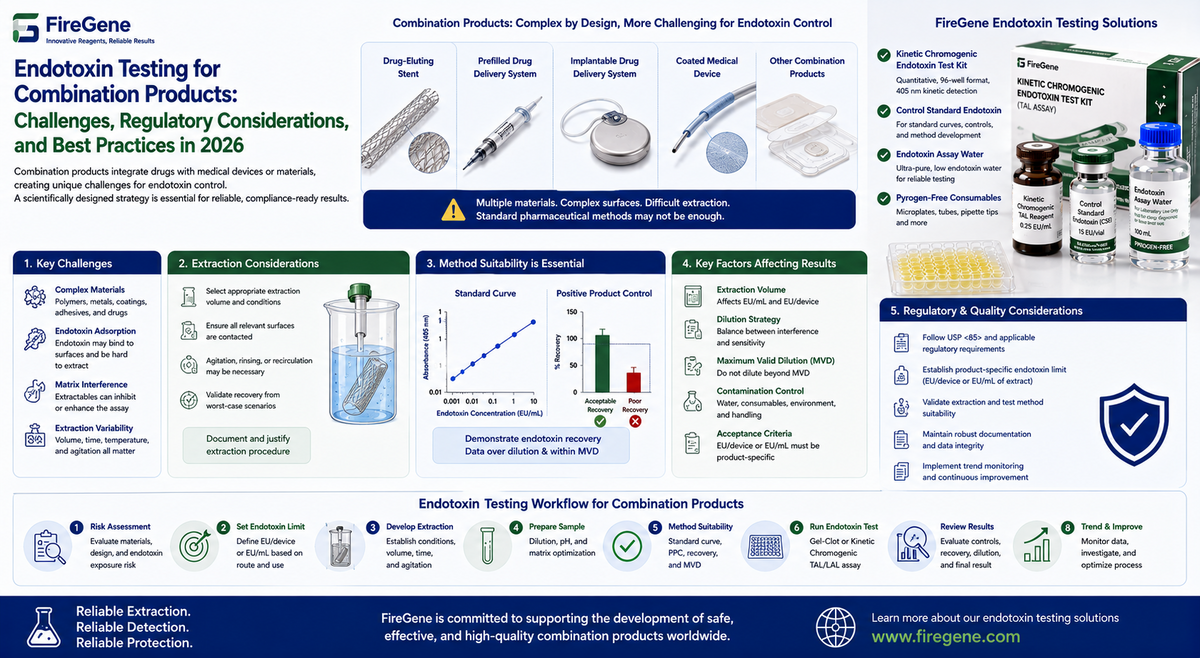
Introduction
Modern pharmaceutical development is increasingly moving beyond conventional dosage forms.
Products such as drug-eluting stents, prefilled delivery systems, drug-device combination products, implantable drug delivery systems, coated medical devices, and other integrated therapeutic platforms combine pharmaceutical ingredients with medical-device components.
These products can provide significant clinical advantages.
However, they also create new challenges for quality control laboratories.
One of the most important challenges is bacterial endotoxin testing.
Unlike a conventional injectable drug, a combination product may contain multiple materials, surfaces, coatings, polymers, active pharmaceutical ingredients, and delivery components. The laboratory may therefore need to determine not only whether endotoxin is present, but also how to extract endotoxin from the product, how to prepare the extract, how to establish an appropriate endotoxin limit, and whether the selected test method can accurately recover endotoxin from the resulting matrix.
This makes combination-product endotoxin testing fundamentally different from simply testing a conventional aqueous pharmaceutical solution.
A reliable strategy must connect:
Product design → endotoxin risk → extraction → sample preparation → method suitability → endotoxin testing → data interpretation → release decision
This article explains the major challenges and provides a practical framework for developing a robust endotoxin testing strategy for combination products in 2026.
1. What Are Combination Products?
A combination product generally integrates more than one regulated component or therapeutic function.
Examples can include:
- Drug-device combination products
- Drug-eluting implants
- Drug-coated medical devices
- Prefilled drug-delivery systems
- Implantable drug reservoirs
- Combination products containing pharmaceutical and device components
- Certain delivery systems incorporating biologically active substances
From an endotoxin perspective, this creates an important analytical question:
Which part of the product should actually be tested for endotoxin?
The answer depends on the product's design, intended use, route of administration, patient exposure, extraction strategy, and applicable regulatory requirements.
This is why combination-product endotoxin testing should begin with product-specific risk assessment, rather than simply selecting an assay kit.
FireGene's recent discussion of endotoxin limits for pharmaceutical products and medical devices also emphasizes that medical-device endotoxin requirements depend on factors such as intended use, tissue contact, extraction volume, and the way the device is evaluated.
2. Why Endotoxin Testing Is More Complicated for Combination Products
A conventional drug product may be dissolved in a relatively simple aqueous matrix.
A combination product may contain:
- Stainless steel
- Silicone
- Polyurethane
- Polycarbonate
- Polyethylene
- Other polymers
- Adhesives
- Surface coatings
- Drug formulations
- Lubricants
- Biodegradable materials
- Functional coatings
- Multiple device components
Each material can behave differently during endotoxin extraction and testing.
For example, endotoxin may:
- Remain in an aqueous phase
- Adsorb onto a surface
- Become associated with hydrophobic materials
- Be affected by extraction conditions
- Interact with formulation components
- Become difficult to recover from complex surfaces
Therefore, a negative result does not automatically demonstrate that the product is free of endotoxin.
The laboratory must first demonstrate that its extraction and analytical procedure is capable of recovering endotoxin from the product.
3. Sterility Does Not Equal Low Endotoxin
One of the most important concepts in combination-product quality control is that sterility and endotoxin control are separate quality attributes.
A manufacturing process may successfully eliminate viable microorganisms while leaving endotoxin behind.
This is because endotoxin is a structural component of Gram-negative bacterial cell membranes and can remain biologically active after bacterial cells are destroyed.
For combination products, this distinction becomes particularly important when products undergo:
- Sterilization
- Radiation
- Ethylene oxide treatment
- Heat treatment
- Chemical disinfection
A sterilization process should therefore not automatically be interpreted as an endotoxin-removal process.
This principle is also relevant when evaluating device manufacturing processes and depyrogenation strategies.
4. Start With an Endotoxin Risk Assessment
Before selecting a bacterial endotoxin test, manufacturers should ask:
Where could endotoxin enter the product?
Potential sources include:
- Raw materials
- Process water
- Manufacturing equipment
- Device components
- Coatings
- Packaging
- Handling
- Manufacturing environments
Where could endotoxin accumulate?
Potential accumulation sites may include:
- Internal lumens
- Porous materials
- Surface coatings
- Device interfaces
- Drug reservoirs
- Tubing
- Joints
- Complex geometries
Can the endotoxin be effectively extracted?
This is particularly important for products with:
- Hydrophobic surfaces
- Porous structures
- Complex internal geometries
- Multi-component construction
The objective is to identify the highest-risk locations and materials before designing the analytical method.
5. Extraction Is Often the Most Critical Step
For many combination products, the endotoxin assay itself is not necessarily the most difficult part.
The more difficult question may be:
How do we get endotoxin off the product and into a testable solution?
This is the purpose of an endotoxin extraction procedure.
Depending on the product, extraction may involve:
- Defined extraction volume
- Controlled temperature
- Controlled extraction time
- Agitation
- Rinsing
- Shaking
- Recirculation
- Multiple extraction steps
The extraction procedure should be scientifically justified and appropriately controlled.
An extraction procedure that is too weak may underestimate the actual endotoxin burden.
An extraction procedure that is unnecessarily aggressive may alter the product matrix and create analytical interference.
Therefore, extraction conditions should be treated as part of the analytical method, not merely as a sample-preparation detail.
6. Extraction Volume Can Change the Final Result
Combination-product endotoxin testing may report results in units such as:
EU/device
or
EU/mL of extract
These are not interchangeable without considering the extraction volume.
For example, if a device produces an extract containing:
0.5 EU/mL
and the total extraction volume is:
20 mL
the total recovered endotoxin burden is:
10 EU/device
This simple calculation illustrates why extraction volume matters.
Changing the extraction volume changes the measured concentration even when the total endotoxin burden remains unchanged.
Therefore, the laboratory should clearly document:
- Number of devices extracted
- Extraction volume
- Extraction conditions
- Dilution factor
- Final reported unit
7. Pooled Extraction Can Create an Additional Risk
Laboratories may sometimes consider testing several devices together to improve throughput.
However, pooled extraction requires careful justification.
For example, if five devices are extracted together and the pooled sample produces an acceptable result, the result may not necessarily demonstrate that every individual device contains an acceptable endotoxin burden.
One highly contaminated unit could potentially be masked by several low-endotoxin units.
Therefore, pooling strategies should be scientifically justified and consistent with the applicable testing requirements.
For critical combination products, individual-unit evaluation may provide stronger control than relying solely on pooled samples.
8. Endotoxin Limits Must Be Product-Specific
There is no universal endotoxin limit that applies to every combination product.
The applicable limit may depend on:
- Route of administration
- Patient exposure
- Dose
- Product type
- Device function
- Contact with blood
- Contact with cerebrospinal fluid
- Implantation
- Extraction strategy
- Applicable regulatory requirements
For pharmaceutical products, the commonly used endotoxin-limit framework is based on:
Endotoxin Limit = K / M
where the appropriate values depend on the product and route of administration.
However, medical-device and combination-product situations can require a different approach.
FireGene's recent guide on endotoxin limits explains why device limits may need to be expressed as EU/device and then converted into an equivalent extract concentration based on extraction volume.
Therefore, laboratories should not simply copy the endotoxin limit from another product.
9. EU/Device and EU/mL Are Different Concepts
This distinction is especially important for combination products.
Consider a hypothetical device with an allowable endotoxin burden of:
20 EU/device
If the device is extracted in:
40 mL
the corresponding concentration limit would be:
20 EU ÷ 40 mL = 0.5 EU/mL
But if the extraction volume changes to:
100 mL
the concentration becomes:
20 EU ÷ 100 mL = 0.2 EU/mL
The total allowable endotoxin burden has not changed.
Only the concentration of the extract has changed.
This is why extraction volume and endotoxin acceptance criteria must always be evaluated together.
10. Choosing the Right TAL/LAL Reagent
Once the extraction procedure has been established, the laboratory needs to select an appropriate endotoxin detection method.
Common TAL/LAL approaches include:
Gel-Clot TAL Assay
The Gel-Clot method provides a relatively simple qualitative or semi-quantitative approach.
It may be useful when:
- Testing volume is moderate
- A straightforward endpoint is sufficient
- Minimal instrumentation is preferred
Kinetic Chromogenic Endotoxin Assay
The kinetic chromogenic method provides quantitative endotoxin results by monitoring chromogenic reaction kinetics.
It can be particularly useful when laboratories need:
- Quantitative EU/mL data
- Higher throughput
- Objective optical measurement
- Automated calculations
- Standard curve-based quantification
- Data trending
FireGene's Kinetic Chromogenic Endotoxin Test Kit is based on a 96-well format and 405 nm kinetic absorbance measurement.
The method selected should ultimately be based on product characteristics, analytical requirements, validated performance, and applicable regulatory expectations.
11. Why Sample Matrix Interference Can Be a Major Problem
Combination products can create unusually complex sample matrices.
For example, an extract may contain substances originating from:
- Device polymers
- Coatings
- Adhesives
- Drug formulations
- Surfactants
- Buffers
- Preservatives
- Plastic components
- Lubricants
Some of these components may interfere with the TAL/LAL reaction.
Interference can produce:
- Inhibition
- Enhancement
- Poor recovery
- False-low results
- False-high results
- Unstable standard/sample relationships
This is why the laboratory should not assume that a commercial endotoxin reagent will automatically work for every combination-product extract.
FireGene's method-validation guide emphasizes that the analytical method must be demonstrated to be suitable for the specific sample matrix, rather than assuming that purchasing a validated reagent automatically validates the method for the product.
12. Positive Product Controls Are Essential
The Positive Product Control, or PPC, is particularly important for combination-product endotoxin testing.
The concept is straightforward:
Product extract + known endotoxin spike → endotoxin recovery
The objective is to determine whether the product matrix interferes with endotoxin detection.
A successful standard curve only demonstrates that the assay responds appropriately to known endotoxin standards.
It does not demonstrate that the product extract behaves correctly.
The PPC provides that additional evidence.
This distinction is fundamental:
Standard curve = analytical calibration
PPC = sample matrix suitability
Both should be considered when interpreting the result.
13. Dilution Can Help—But It Is Not a Universal Solution
If an extract shows inhibition or enhancement, dilution may help reduce matrix effects.
For example:
Undiluted extract
↓
1:2 dilution
↓
1:4 dilution
↓
1:8 dilution
The laboratory can evaluate whether endotoxin recovery improves as the interfering matrix is diluted.
However, excessive dilution creates another problem.
The endotoxin concentration may eventually fall below the assay's validated quantitative range.
Therefore, laboratories must balance:
Matrix interference
against
Analytical sensitivity
and
Maximum Valid Dilution
This is why sample dilution should be established through a scientifically justified method-suitability study.
14. The Maximum Valid Dilution Matters
The Maximum Valid Dilution, or MVD, defines an important boundary for endotoxin testing.
A dilution strategy cannot simply be increased indefinitely until the sample “passes.”
The laboratory must demonstrate that the selected dilution still allows the method to detect endotoxin at the applicable acceptance limit.
This is particularly important for low-endotoxin combination products where the required analytical sensitivity may be very high.
A good testing strategy therefore asks:
What is the lowest concentration the method needs to detect after extraction and dilution?
That question should be answered before routine testing begins.
15. Hydrophobic Materials Present a Special Challenge
Some combination-product components are highly hydrophobic.
This can complicate endotoxin extraction.
Endotoxin may associate with surfaces or behave differently depending on:
- Surface chemistry
- Ionic strength
- pH
- Temperature
- Extraction time
- Agitation
A laboratory should therefore demonstrate that the chosen extraction procedure provides adequate recovery from the actual product or a scientifically justified representative material.
Simply adding water and assuming that all endotoxin will immediately enter solution may not be sufficient for every product.
16. Complex Geometry Can Affect Extraction Efficiency
Consider a device containing:
- Narrow channels
- Internal lumens
- Porous regions
- Multiple chambers
- Coated surfaces
- Small interfaces
These structures can create areas that are difficult to access during extraction.
The laboratory should consider whether the extraction solution can physically contact all relevant surfaces.
In some cases, extraction may require:
- Agitation
- Rotation
- Recirculation
- Repeated rinsing
- Defined extraction sequences
The goal is not to create the most aggressive extraction possible.
The goal is to create a reproducible and scientifically justified extraction process.
17. Do Not Ignore the Drug Component
A combination product may contain a pharmaceutical formulation that itself interferes with endotoxin testing.
For example, formulations may contain:
- Polysorbates
- Proteins
- Chelating agents
- Surfactants
- High salt concentrations
- Preservatives
- Lipids
These components may affect the TAL/LAL reaction.
This is why the analytical laboratory should evaluate both:
Device-derived matrix
and
Drug-derived matrix
rather than assuming that only the device material creates interference.
FireGene's comprehensive endotoxin testing guide discusses matrix effects across biologics and other complex pharmaceutical products and emphasizes the importance of product-specific method suitability.
18. Contamination Control Begins Before the Assay
Combination-product endotoxin testing can involve multiple handling steps.
Each additional step creates another opportunity for contamination.
Potential contamination sources include:
- Extraction vessels
- Tubes
- Pipette tips
- Microplates
- Water
- Sample containers
- Laboratory surfaces
- Analysts
For highly sensitive assays, even small amounts of environmental endotoxin can influence results.
Therefore, laboratories should use appropriately controlled materials throughout the workflow.
FireGene provides Endotoxin Assay Water intended for endotoxin testing workflows, including reagent preparation, standard preparation, controls, and sample dilution.
FireGene also offers pyrogen-free consumables within its endotoxin testing portfolio.
19. Why Endotoxin Assay Water Matters
Water is easy to overlook because it appears chemically simple.
But in an endotoxin assay, water is part of the analytical system.
If water contains endotoxin, it can affect:
- Negative controls
- Standard dilutions
- PPC preparation
- Sample dilution
This is particularly important when testing combination-product extracts at very low endotoxin concentrations.
Appropriately qualified Endotoxin Assay Water can help minimize this source of analytical variability.
For more information, see FireGene's guide:
What Is Endotoxin Assay Water? A Guide to LAL Reagent Water
20. A Practical Combination-Product Endotoxin Workflow
A robust workflow can be organized into eight stages.
Stage 1 — Product Risk Assessment
Identify:
- Materials
- Drug components
- Contact surfaces
- Route of administration
- Patient exposure
- Potential endotoxin sources
↓
Stage 2 — Endotoxin Limit Establishment
Define the applicable:
- EU/device
- EU/mL
- EU/unit
- EU/mg
acceptance criterion.
↓
Stage 3 — Extraction Development
Establish:
- Extraction volume
- Temperature
- Time
- Agitation
- Number of devices
- Extraction vessel
↓
Stage 4 — Sample Preparation
Evaluate:
- pH
- Dilution
- Matrix effects
- Visual appearance
- Potential interference
↓
Stage 5 — Method Suitability
Evaluate:
- PPC recovery
- Standard curve
- Negative control
- Replicate performance
↓
Stage 6 — Routine Endotoxin Testing
Select an appropriate:
- Gel-Clot TAL Assay
- Kinetic Chromogenic TAL/LAL Assay
- Other validated BET approach
↓
Stage 7 — Data Review
Evaluate:
- Controls
- Standard curve
- PPC
- Dilution factors
- Final result
↓
Stage 8 — Trending and Investigation
Monitor:
- Batch-to-batch results
- Extraction variability
- Reagent lots
- Recurring interference
- OOS/OOT trends
21. Why Kinetic Chromogenic Testing Can Be Valuable for Combination Products
Combination-product laboratories often need to evaluate multiple extraction conditions and dilutions during method development.
A quantitative kinetic chromogenic assay can make this process more informative because it provides numerical endotoxin results rather than simply a positive/negative endpoint.
This can help laboratories compare:
- Extraction conditions
- Dilution levels
- Different product components
- Different batches
- Different reagent lots
The quantitative nature of kinetic chromogenic testing can therefore be particularly useful during method development and troubleshooting.
FireGene's Kinetic Chromogenic Endotoxin Test Kit is designed for quantitative endotoxin testing using a 96-well microplate format and kinetic absorbance measurement at 405 nm.
22. Standardization Is Critical for Multi-Component Products
A combination product can contain multiple components that are manufactured at different locations or by different suppliers.
This makes standardization important.
Laboratories should define:
- Extraction procedure
- Sample volume
- Dilution procedure
- Mixing procedure
- Incubation conditions
- Plate layout
- Calculation method
- Acceptance criteria
- Documentation requirements
Without standardized procedures, differences between analysts can become difficult to distinguish from genuine product variation.
23. What Should Be Investigated When an Extract Tests Positive?
A positive endotoxin result should not automatically be interpreted as a manufacturing failure.
The laboratory should first determine whether:
- The result is analytically valid.
- The standard curve passed.
- The negative control passed.
- PPC recovery was acceptable.
- Sample preparation was correct.
- The extraction procedure was followed.
- Contamination was ruled out.
- The result is reproducible.
- The product batch genuinely exceeds the applicable limit.
This structured approach prevents laboratories from confusing analytical failure with genuine product contamination.
FireGene's recent guide on reducing failed endotoxin testing emphasizes the importance of distinguishing true product OOS results from analytical problems before launching extensive investigations.
24. Common Mistakes in Combination-Product Endotoxin Testing
Mistake 1: Testing the Product Without Validating Extraction
If endotoxin cannot be efficiently extracted, a negative result may be misleading.
Mistake 2: Using the Wrong Extraction Volume
Extraction volume directly affects reported EU/mL.
Mistake 3: Ignoring Device Materials
Polymers, coatings, adhesives, and other materials may contribute to matrix interference.
Mistake 4: Assuming Sterilization Removes Endotoxin
Sterility and depyrogenation are not interchangeable concepts.
Mistake 5: Skipping PPC Evaluation
A passing standard curve does not prove sample suitability.
Mistake 6: Excessive Dilution
Too much dilution may push the sample below the quantitative range.
Mistake 7: Using Ordinary Laboratory Water
Water can become an unintended source of endotoxin contamination.
Mistake 8: Pooling Devices Without Scientific Justification
Pooling may reduce the ability to identify contamination in an individual unit.
Mistake 9: Reporting EU/mL Without Considering EU/device
The reported unit must match the established endotoxin limit.
Mistake 10: Treating Every Positive Result as a Product OOS
The analytical system should be evaluated before concluding that the product itself failed.
25. Regulatory Considerations in 2026
Regulatory expectations for endotoxin testing continue to evolve as pharmaceutical and medical-device products become more complex.
USP <85> remains a key reference for bacterial endotoxin testing, while USP <86> has expanded the compendial framework for bacterial endotoxins testing using recombinant reagents. FireGene's recent 2026 regulatory discussion also highlights the increasing importance of scientific justification, method suitability, risk-based contamination control, and data trending.
For combination products, laboratories should therefore avoid treating regulatory compliance as simply:
“Run an endotoxin assay and record the result.”
A stronger strategy demonstrates:
- Why the endotoxin limit was selected
- Why the extraction procedure is appropriate
- Why the test method is suitable
- How interference was evaluated
- How sample recovery was demonstrated
- How results are reviewed
- How deviations are investigated
The exact requirements should always be evaluated against the product's regulatory status, intended use, applicable pharmacopeia, and jurisdiction.
26. Building a Risk-Based Endotoxin Control Strategy
The strongest combination-product programs do not rely exclusively on final-product testing.
Instead, endotoxin control can be integrated throughout the product lifecycle:
Supplier Qualification
↓
Raw Material Control
↓
Component Manufacturing
↓
Water and Process Control
↓
Assembly
↓
Sterilization / Depyrogenation
↓
Extraction Method
↓
Endotoxin Testing
↓
Batch Release
↓
Trend Monitoring
This approach makes endotoxin testing part of the broader contamination-control strategy.
It also makes investigations easier because manufacturers have more information about where endotoxin could have entered the process.
27. How FireGene Supports Combination-Product Endotoxin Testing
FireGene provides a portfolio of endotoxin testing solutions that can support different stages of method development and routine testing.
Kinetic Chromogenic Endotoxin Test Kit
For laboratories requiring quantitative endotoxin results, the FireGene Kinetic Chromogenic Endotoxin Test Kit uses a 96-well format and 405 nm kinetic absorbance measurement.
FireGene Kinetic Chromogenic Endotoxin Test Kit
Control Standard Endotoxin
Control Standard Endotoxin can be used for standard preparation, controls, and method-development applications.
FireGene Control Standard Endotoxin
Endotoxin Assay Water
Appropriately qualified assay water supports standard preparation, reagent reconstitution, controls, and sample dilution.
FireGene Endotoxin Assay Water
Pyrogen-Free Consumables
Controlled consumables can help reduce the risk of introducing background endotoxin during sample preparation and testing.
For laboratories establishing a complete endotoxin workflow, these components can be integrated according to the validated analytical procedure.
28. Frequently Asked Questions
What is combination-product endotoxin testing?
It is the evaluation of bacterial endotoxin in products that combine pharmaceutical and medical-device components or functions. The testing strategy may involve product extraction, sample preparation, method suitability, and quantitative or qualitative endotoxin detection.
Why is extraction important?
Endotoxin may be associated with product surfaces or internal components. The laboratory must demonstrate that its extraction procedure can recover endotoxin sufficiently for reliable detection.
Should combination products be tested in EU/mL or EU/device?
The appropriate reporting unit depends on the product and applicable acceptance criterion. Medical-device-related testing may use EU/device, while extract testing may generate EU/mL. The two must be connected through the extraction procedure.
Can a sterile combination product contain endotoxin?
Yes. Sterilization and endotoxin removal are different processes. A product can meet sterility requirements while still containing biologically active endotoxin.
Why is PPC important?
PPC demonstrates whether the product extract interferes with endotoxin detection. It is an important part of method suitability.
Can dilution solve endotoxin interference?
Dilution can sometimes reduce matrix interference, but it must remain within the validated analytical range and applicable MVD.
Which endotoxin test method is best for combination products?
There is no universally best method. Gel-Clot and kinetic chromogenic TAL/LAL methods can both be appropriate when properly validated. The choice should consider product characteristics, extraction matrix, required sensitivity, throughput, equipment, and regulatory requirements.
Can I use a standard pharmaceutical endotoxin method for a device component?
Not automatically. The extraction procedure, device materials, endotoxin limit, sample matrix, and method suitability should be evaluated for the specific product.
Is Endotoxin Assay Water necessary?
Appropriately qualified assay water is important when preparing standards, controls, reagents, or sample dilutions because ordinary laboratory water can introduce background endotoxin.
Does a passing standard curve mean the product method is validated?
No. A standard curve demonstrates analytical calibration. Product-specific method suitability must additionally demonstrate that the sample matrix and extraction procedure allow reliable endotoxin recovery.
Conclusion
Combination products are changing the way pharmaceutical and medical-device manufacturers approach bacterial endotoxin control.
The challenge is no longer simply:
“Can we detect endotoxin?”
The more important question is:
“Can we reliably extract, detect, quantify, and interpret endotoxin from this specific product?”
A robust combination-product endotoxin strategy should therefore integrate:
- Product risk assessment
- Scientifically justified endotoxin limits
- Validated extraction
- Controlled sample preparation
- Appropriate TAL/LAL Reagent
- Method suitability
- PPC recovery
- Contamination control
- Reliable data analysis
- Risk-based investigation and trending
For complex combination products, the extraction procedure and sample matrix can be just as important as the endotoxin reagent itself.
And as pharmaceutical and medical-device technologies continue to converge, laboratories that treat endotoxin testing as an integrated analytical and quality system—not simply a final release test—will be better positioned to generate reliable, reproducible, and scientifically defensible results.
FireGene Endotoxin Testing
Ready to run your endotoxin assay?
FireGene offers a complete endotoxin testing toolkit — from TAL reagents and CSE standards to pyrogen-free consumables and LAL reagent water. All products are aligned with USP <85>, EP 2.6.14, and JP 4.01.


