
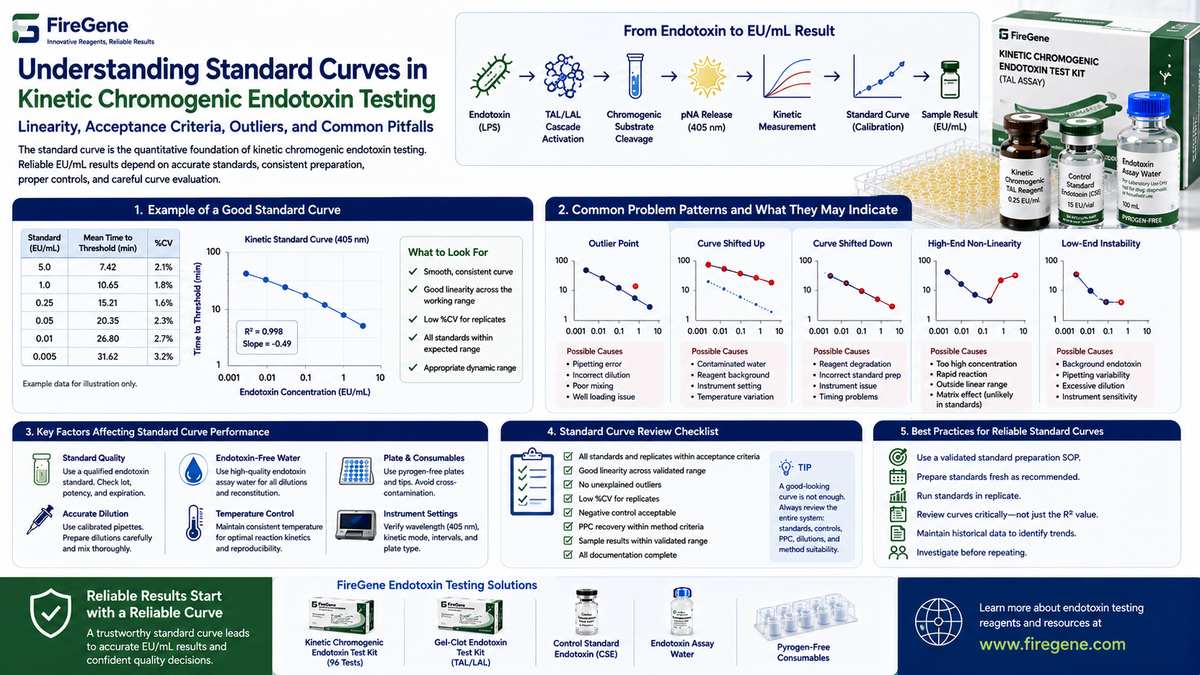
Introduction: Why the Standard Curve Is the Heart of Quantitative Endotoxin Testing
In kinetic chromogenic endotoxin testing, the final result is usually reported as an endotoxin concentration, such as EU/mL.
But the instrument does not directly “see” EU/mL.
Instead, it measures a change in optical absorbance during the enzymatic reaction. The analytical system then uses the relationship between known endotoxin concentrations and their corresponding kinetic responses to estimate the endotoxin concentration of an unknown sample.
That relationship is represented by the standard curve.
In other words:
Known endotoxin concentrations → measured kinetic response → standard curve → unknown sample concentration
This makes the standard curve much more than a routine part of the plate setup.
It is the quantitative foundation of the entire kinetic chromogenic endotoxin assay.
If the standard curve is poorly prepared, incorrectly interpreted, or affected by contamination or pipetting errors, even a technically perfect sample measurement can produce an unreliable final result.
This is especially important as pharmaceutical and biopharmaceutical laboratories increasingly use kinetic chromogenic assays for quantitative endotoxin testing, higher-throughput workflows, and data trending. FireGene's current Kinetic Chromogenic Endotoxin Test Kit uses a 96-well format and 405 nm kinetic absorbance measurement to generate quantitative endotoxin results.
So, how should laboratories understand and evaluate an endotoxin standard curve?
Let's take a closer look.
1. What Is an Endotoxin Standard Curve?
An endotoxin standard curve is a calibration relationship established using known concentrations of endotoxin.
In a kinetic chromogenic assay, a series of endotoxin standards is prepared from a qualified endotoxin standard and tested under the same reaction conditions as the samples.
The instrument monitors the reaction kinetically.
As endotoxin concentration increases, the enzymatic reaction generally proceeds more rapidly, producing a faster increase in chromogenic signal.
The system can therefore establish a relationship between:
Endotoxin concentration
and
Kinetic response
Depending on the instrument and software, the kinetic response may be represented by parameters such as reaction time to a defined absorbance threshold.
The resulting curve is then used to calculate the endotoxin concentration of unknown samples.
FireGene's Kinetic Chromogenic Endotoxin Test Kit uses Control Standard Endotoxin as part of the quantitative assay system and monitors the chromogenic reaction at 405 nm.
This is fundamentally different from a simple visual Gel-Clot endpoint.
In a Gel-Clot assay, the laboratory primarily determines whether a sample is above or below a defined sensitivity threshold.
In kinetic chromogenic testing, the objective is to determine how much endotoxin is present within the validated analytical range.
2. Why the Standard Curve Matters So Much
A common misconception is:
“If the sample wells look normal, the result should be reliable.”
Not necessarily.
A kinetic chromogenic endotoxin assay is a quantitative analytical system.
The sample result is calculated based on the behavior of the standards.
Therefore, problems with the standard curve can propagate directly into sample results.
For example, imagine that the actual endotoxin concentrations of the standards are:
0.01 EU/mL
0.05 EU/mL
0.25 EU/mL
1.0 EU/mL
5.0 EU/mL
If one standard is incorrectly prepared because of:
- Pipetting error
- Incorrect dilution
- Poor mixing
- Wrong standard concentration
- Contaminated water
- Incorrect well assignment
the resulting curve may become distorted.
The sample itself may not be the problem.
The calibration system may be.
This is why standard curve review should be one of the first steps in evaluating an unexpected kinetic chromogenic endotoxin result.
3. How the Kinetic Chromogenic Reaction Generates the Curve
The biological mechanism behind the assay is relatively complex, but the analytical concept is straightforward.
Bacterial endotoxin activates the TAL/LAL enzymatic cascade.
The general sequence is:
Endotoxin
↓
Factor C activation
↓
Factor B activation
↓
Proclotting enzyme activation
↓
Chromogenic substrate cleavage
↓
p-Nitroaniline release
↓
Increase in absorbance at 405 nm
The speed of the reaction is related to the amount of endotoxin present.
Higher endotoxin concentration generally produces a faster kinetic response.
Lower endotoxin concentration produces a slower response.
The instrument records this reaction dynamically.
The resulting data are converted into a standard curve and used to calculate unknown sample concentrations.
FireGene describes this mechanism for its Kinetic Chromogenic Endotoxin Test Kit, which uses 405 nm absorbance monitoring and quantitative calculation from the standard curve.
4. Standard Curve Preparation Starts With the Endotoxin Standard
A standard curve is only as reliable as the standard used to create it.
This means laboratories need to pay close attention to:
- Endotoxin standard identity
- Potency
- Lot information
- Reconstitution
- Storage
- Mixing
- Dilution
- Water quality
- Pipetting accuracy
FireGene's Control Standard Endotoxin is intended for applications including interference testing and positive controls and can be used in both Gel-Clot and Kinetic Chromogenic endotoxin testing workflows.
The standard should be handled according to the validated procedure and manufacturer's instructions.
This is particularly important because endotoxin solutions can be affected by adsorption and preparation conditions.
5. Why Endotoxin-Free Water Is Essential
One of the easiest ways to compromise a standard curve is to introduce endotoxin during standard preparation.
If the water used for reconstitution or dilution contains endotoxin, the laboratory may unintentionally increase the apparent concentration of the standards.
That can produce abnormal background or distorted standard behavior.
For kinetic chromogenic endotoxin testing, laboratories therefore use appropriate Endotoxin Assay Water for standard preparation and reagent reconstitution.
FireGene specifies Endotoxin Assay Water for reconstitution and dilution of its Kinetic Chromogenic Endotoxin Test Kit and Control Standard Endotoxin.
This is one reason that endotoxin testing should be considered as an entire analytical system rather than simply a reagent reaction.
6. Standard Curve Range Should Match the Intended Application
A standard curve should not be selected simply because it produces a large number of concentration points.
The range should be appropriate for the analytical method and the expected sample concentration.
For example, a sample expected to contain a very low endotoxin concentration may require a different dilution strategy than a highly contaminated process sample.
The laboratory should consider:
Expected endotoxin concentration
Endotoxin limit
Sample dilution
Method sensitivity
MVD
The objective is to ensure that the sample result falls within the validated quantitative range.
FireGene's current Kinetic Chromogenic Endotoxin Test Kit lists a detection range of 0.005–10 EU/mL, but the applicable working range for a specific product must be established through the laboratory's validated method and product-specific suitability evaluation.
7. What Does “Good Linearity” Actually Mean?
Linearity is one of the most frequently discussed characteristics of a quantitative assay.
In simple terms, it describes whether the analytical response changes predictably as endotoxin concentration changes.
However, laboratories should avoid reducing standard curve evaluation to a single number.
A high correlation coefficient does not automatically prove that an assay is suitable.
For example, a curve could have an apparently strong correlation while still containing:
- A poorly prepared standard
- An outlier
- A systematic pipetting error
- A concentration outside the reliable analytical range
- A problem with the lowest standard
Therefore, standard curve review should include the entire data pattern, not just a single statistical metric.
This principle is particularly important in regulated analytical environments.
8. Why the Lowest Standard Deserves Special Attention
The lowest concentration on the standard curve is often the most vulnerable point.
At very low endotoxin concentrations, the analytical signal can become more sensitive to:
- Background contamination
- Pipetting variability
- Water quality
- Reagent variation
- Environmental contamination
- Instrument noise
Suppose the lowest standard is expected to be:
0.005 EU/mL
but the measured response is unexpectedly close to the negative control.
The laboratory should not simply assume that everything is acceptable because the higher standards look excellent.
The low end of the curve may determine whether the assay can reliably quantify very low endotoxin concentrations.
This becomes particularly important for products with strict endotoxin limits.
9. The Highest Standard Can Also Cause Problems
The opposite problem occurs at the upper end.
A very high endotoxin concentration can produce a reaction that proceeds extremely rapidly.
If the reaction exceeds the intended analytical behavior of the system, the highest standard may not behave as expected.
Potential causes include:
- Incorrect standard preparation
- Excess endotoxin concentration
- Reaction timing issues
- Instrument configuration
- Reagent problems
Therefore, both ends of the curve should be evaluated.
A good standard curve should not simply have:
“something happening at every concentration.”
It should demonstrate appropriate analytical behavior across the validated range.
10. Why Replicates Matter
Replicates provide information about assay precision.
If two wells containing the same standard concentration produce substantially different kinetic responses, this may indicate a problem with:
- Pipetting
- Mixing
- Plate loading
- Timing
- Reagent addition
- Well contamination
- Instrument performance
This is one reason why consistent pipetting technique is so important.
At high throughput, even a small systematic pipetting error can affect many wells simultaneously.
For laboratories using automated liquid handlers, method-specific verification should still be performed to ensure that the automated system produces acceptable assay performance.
11. How to Recognize an Outlier Standard
Not every unusual point is automatically an outlier.
A standard may appear unusual because of:
- Genuine analytical variation
- Preparation error
- Pipetting error
- Contamination
- Instrument problems
Before removing any data point, laboratories should investigate why it is abnormal.
For example:
If one replicate is dramatically different from its paired replicate while all other standards behave normally, a pipetting or loading issue may be suspected.
But if the entire standard curve is shifted, the problem may be systemic.
Possible causes include:
- Reagent lot
- Standard preparation
- Temperature
- Reader configuration
- Water contamination
The key principle is:
Do not remove an inconvenient data point simply because it makes the curve look better.
Any exclusion of data should follow the validated method and documented laboratory procedures.
12. A Perfect-Looking Curve Can Still Produce a Bad Sample Result
This is one of the most important concepts in kinetic chromogenic endotoxin testing.
Suppose:
- Standard curve passes
- Controls pass
- Instrument works correctly
but the sample matrix strongly inhibits endotoxin detection.
The sample could still produce a misleading result.
This is why method suitability and PPC recovery remain essential.
The standard curve demonstrates that the analytical system can measure known endotoxin standards.
It does not automatically demonstrate that the product matrix behaves appropriately.
For a more detailed explanation, see FireGene's How to Validate an Endotoxin Test Method: A Step-by-Step Guide for USP <85> Compliance.
13. Standard Curve vs. Positive Product Control: What Is the Difference?
These two concepts are often confused.
Standard Curve
The standard curve establishes the relationship between:
Known endotoxin concentration → analytical response
It is used to quantify unknown samples.
Positive Product Control
The PPC evaluates whether the sample matrix interferes with endotoxin detection.
It essentially asks:
Can the assay recover a known amount of endotoxin when that endotoxin is present in this particular product matrix?
These are different questions.
The standard curve evaluates the calibration system.
The PPC evaluates matrix suitability.
Both are important.
14. Why Dilution Can Improve Quantitative Accuracy
Some products contain components that interfere with endotoxin detection.
Depending on the matrix, dilution can reduce the concentration of an interfering substance.
This is one reason laboratories often evaluate multiple dilutions during method development.
However, dilution is not simply:
“The more dilution, the better.”
Excessive dilution can push the endotoxin concentration below the assay's useful quantitative range.
Therefore, the laboratory needs to balance:
Matrix interference
against
Quantitative sensitivity
and
MVD limitations
This is where method development becomes a controlled optimization exercise rather than trial and error.
15. The Role of the Maximum Valid Dilution
The Maximum Valid Dilution (MVD) is an important concept when establishing endotoxin test methods.
In simplified terms, it represents the maximum dilution that can be used while still allowing the method to detect endotoxin at the applicable endotoxin limit.
The MVD therefore creates a practical boundary.
A laboratory may discover that a 1:100 dilution eliminates interference.
But if the validated MVD does not permit that dilution, the problem cannot simply be solved by continuing to dilute.
Alternative approaches may need to be evaluated.
This is why endotoxin method development should consider:
- Endotoxin limit
- Product concentration
- Assay sensitivity
- MVD
- Matrix interference
- PPC recovery
together.
16. What a Shifted Standard Curve Can Tell You
A standard curve that shifts from one run to another may provide valuable information.
For example, if the entire curve changes substantially after introducing a new reagent lot, the laboratory may need to investigate:
- Reagent lot performance
- Standard preparation
- Reconstitution
- Storage conditions
- Instrument conditions
Similarly, if the curve changes after moving to a different microplate reader, instrument configuration may need to be evaluated.
This is why historical standard curve records can be extremely useful.
Instead of treating every assay as an isolated event, laboratories can compare:
Current run
with
Historical runs
to identify trends.
17. Standard Curve Trends Can Become a QC Tool
The standard curve itself can become a source of quality information.
For example, a laboratory can track:
- Curve slope
- Curve range
- Control response
- Replicate variability
- Low-end behavior
- High-end behavior
- Run-to-run variation
Over time, these data may help identify gradual changes in:
- Reagent performance
- Instrument performance
- Analyst technique
- Laboratory environment
- Standard preparation
This is particularly relevant as pharmaceutical laboratories move toward more digital and trend-based QC workflows.
FireGene's discussion of global bacterial endotoxin testing trends in 2026 identifies digitalization, automated analysis, and data integrity as important directions for modern endotoxin testing.
18. Common Standard Curve Problems and What They May Indicate
Problem 1: The Entire Curve Is Shifted
Potential causes include:
- Reagent preparation
- Standard concentration
- Temperature
- Instrument settings
- New reagent lot
Problem 2: One Standard Is Abnormal
Potential causes include:
- Pipetting error
- Incorrect dilution
- Poor mixing
- Contamination
- Well loading problem
Problem 3: Replicates Are Highly Variable
Potential causes include:
- Pipetting inconsistency
- Timing differences
- Inadequate mixing
- Reagent distribution
- Plate handling
Problem 4: Low Standards Are Unstable
Potential causes include:
- Background endotoxin
- Water contamination
- Consumable contamination
- Instrument sensitivity
- Excessive dilution
Problem 5: High Standards Behave Abnormally
Potential causes include:
- Incorrect standard concentration
- Very rapid reaction
- Timing or reader configuration
- Preparation error
Problem 6: Standard Curve Passes but PPC Fails
This often points toward:
Sample matrix interference
rather than a standard curve problem.
In this situation, laboratories should evaluate dilution and method suitability rather than simply repeating the standard curve.
19. Don't Forget the Plate Itself
In a 96-well kinetic chromogenic assay, the microplate is part of the analytical system.
Potential issues include:
- Incorrect plate type
- Contamination
- Poor well condition
- Inconsistent loading
- Plate handling problems
For high-sensitivity endotoxin testing, even apparently minor contamination can become significant.
This is why laboratories should use appropriate endotoxin-controlled consumables.
FireGene provides pyrogen-free consumables as part of its broader endotoxin testing portfolio.
20. Reader Configuration Can Influence Standard Curve Performance
A kinetic chromogenic assay depends on optical measurement.
Therefore, the reader needs to be properly configured.
Important parameters can include:
- Wavelength
- Kinetic measurement mode
- Temperature
- Measurement interval
- Plate type
- Software calculation parameters
FireGene's Kinetic Chromogenic Endotoxin Test Kit specifies 405 nm kinetic absorbance detection and indicates compatibility with microplate readers capable of the required absorbance and kinetic functions.
Before introducing a new instrument, laboratories should evaluate it under the validated analytical procedure rather than assuming that every microplate reader will produce identical results.
21. Why Temperature Control Matters
The TAL/LAL enzymatic reaction is temperature dependent.
Changes in temperature can affect reaction kinetics and therefore alter the apparent relationship between endotoxin concentration and reaction response.
This means that a laboratory should not treat temperature as a minor operational detail.
A stable temperature helps maintain consistent kinetic behavior across:
- Standards
- Controls
- PPCs
- Samples
When troubleshooting unusual curves, temperature should therefore be considered alongside reagent preparation and instrument configuration.
22. Standard Curve Problems Can Be Prevented With Better Workflow Design
Troubleshooting is important.
But prevention is better.
A standardized workflow can include:
Before Testing
Verify:
- Reagent lot
- Standard lot
- Expiration
- Storage
- Water
- Consumables
- Reader settings
During Standard Preparation
Control:
- Pipetting
- Dilution sequence
- Mixing
- Labeling
- Timing
During Plate Preparation
Control:
- Plate map
- Well assignment
- Replicates
- Sample identification
During Measurement
Control:
- Temperature
- Wavelength
- Kinetic interval
- Instrument configuration
After Measurement
Review:
- Standard curve
- Controls
- PPC
- Replicates
- Sample dilution
- Final EU/mL
This turns the standard curve from a potential failure point into a controlled analytical component.
23. How Standard Curves Fit Into a Complete Endotoxin Testing Workflow
A reliable kinetic chromogenic endotoxin test can be viewed as a sequence:
Endotoxin Standard
↓
Standard Preparation
↓
Serial Dilution
↓
Standard Curve
↓
Sample Preparation
↓
PPC / Method Suitability
↓
Kinetic Reaction
↓
405 nm Detection
↓
Curve-Based Quantification
↓
EU/mL Result
↓
Quality Review
Each stage depends on the previous stage.
Therefore:
A quantitative endotoxin result is only as reliable as the weakest controlled step in the workflow.
FireGene's Step-by-Step Guide to the Kinetic Chromogenic Endotoxin Assay provides a practical overview of the complete assay workflow.
24. When Should You Repeat the Entire Assay?
A common mistake in QC laboratories is to immediately repeat an assay whenever the curve looks unusual.
Repeating may be appropriate, but the laboratory should first determine the likely cause.
Ask:
Is the standard curve invalid?
If yes, investigate the analytical run.
Did the PPC fail?
If yes, investigate matrix interference or method suitability.
Did only one replicate behave abnormally?
Investigate possible pipetting or loading issues.
Did the instrument show abnormal behavior?
Check instrument configuration and performance.
Did the negative control increase?
Investigate contamination.
The objective is to distinguish:
Random analytical variation
from
Systematic analytical failure
This distinction is critical for scientifically defensible QC investigations.
25. What Does USP <85> Mean for Standard Curve Evaluation?
USP <85> provides the framework for the Bacterial Endotoxins Test, including photometric approaches.
USP also provides additional guidance in General Chapter <1085>, Guidelines for Bacterial Endotoxins Testing, which discusses the background and proper application of compendial bacterial endotoxin testing. USP notes that <86>, Bacterial Endotoxins Test Using Recombinant Reagents, was added in USP–NF 2025 Issue 1.
However, laboratories should distinguish between:
A compendial analytical principle
and
the validation status of a specific commercial product or laboratory method.
For example, FireGene's current Kinetic Chromogenic Endotoxin Test Kit product page describes the method as a Kinetic Chromogenic LAL/TAL assay and references USP <85>, EP 2.6.14, and JP 4.01 applications, but the same page states that the product is for Research Use Only and is not licensed by FDA for end-product release of FDA-regulated pharmaceutical drugs, devices, or biologics.
Therefore, laboratories should always evaluate the applicable regulatory requirements, intended use, product status, and their own validated procedures before using any commercial endotoxin reagent for regulated release testing.
26. Standard Curve vs. Real-World Sample Quantification
It is useful to remember that a standard curve answers one question:
How does the assay respond to known endotoxin concentrations?
But the final sample result requires additional information.
For example:
Measured concentration
×
Dilution factor
=
Original sample concentration
Therefore, an apparently reasonable curve can still lead to an incorrect final result if the sample dilution factor is entered incorrectly.
This is another reason data integrity is so important in quantitative endotoxin testing.
27. Why Digital Data Management Is Becoming More Important
As laboratories increase testing volume, manual spreadsheets become increasingly difficult to control.
A modern workflow may connect:
Sample ID
↓
Plate Position
↓
Raw Kinetic Data
↓
Standard Curve
↓
Calculated EU/mL
↓
Dilution Factor
↓
Final Result
↓
Quality Review
↓
Historical Trend
This creates traceability from the original sample to the final reported result.
For laboratories performing large numbers of kinetic chromogenic assays, this can significantly improve review efficiency and reduce transcription errors.
28. Five Questions to Ask When Reviewing a Standard Curve
Before accepting a kinetic chromogenic endotoxin assay run, ask:
1. Are all standards behaving as expected?
Look beyond a single correlation statistic.
2. Are replicates consistent?
Unexpected variability may indicate preparation or pipetting problems.
3. Is the low end of the curve reliable?
This is particularly important for low-endotoxin products.
4. Did the PPC demonstrate acceptable recovery?
A good standard curve does not prove absence of sample interference.
5. Does the sample result fall within the validated analytical range?
A mathematically calculated result is not automatically an analytically valid result.
These five questions can prevent many common interpretation errors.
29. A Practical Standard Curve Review Checklist
For routine QC, laboratories can establish a standardized review checklist.
Before the run:
☐ Confirm standard identity and lot
☐ Confirm reagent lot and expiration
☐ Confirm Endotoxin Assay Water
☐ Confirm plate and consumables
☐ Confirm instrument settings
During preparation:
☐ Follow validated dilution scheme
☐ Mix standards consistently
☐ Use appropriate pipetting technique
☐ Maintain accurate sample identification
After measurement:
☐ Review standard curve
☐ Review replicates
☐ Review negative controls
☐ Review PPC
☐ Review sample dilution
☐ Confirm calculated EU/mL
☐ Document deviations
Before reporting:
☐ Confirm all method acceptance criteria
☐ Confirm result is within validated range
☐ Complete required quality review
This simple checklist can make a significant difference in routine testing consistency.
30. How FireGene's Kinetic Chromogenic Platform Supports Quantitative Testing
FireGene's Kinetic Chromogenic Endotoxin Test Kit is designed around a 96-well quantitative workflow.
The kit includes the major components needed for the assay, including:
- Kinetic Chromogenic TAL/LAL Reagent
- Control Standard Endotoxin
- Endotoxin Assay Water
- Reconstitution solution
- 96-well microplate
The product uses 405 nm kinetic absorbance detection and is designed for compatibility with standard microplate readers meeting the required specifications.
For laboratories that need individual components rather than a complete kit, FireGene also provides Control Standard Endotoxin, Endotoxin Assay Water, and pyrogen-free consumables separately.
This modular approach can be useful for laboratories developing or maintaining established endotoxin testing workflows.
31. Frequently Asked Questions
What is the purpose of a standard curve in kinetic chromogenic endotoxin testing?
The standard curve establishes the relationship between known endotoxin concentrations and the kinetic response of the assay, allowing unknown samples to be quantitatively expressed in EU/mL.
Does a high correlation coefficient mean the standard curve is acceptable?
Not necessarily. The complete standard curve, replicate behavior, controls, analytical range, and applicable method acceptance criteria should all be evaluated.
Why is my lowest endotoxin standard inconsistent?
Possible causes include pipetting variability, background endotoxin contamination, water quality, reagent issues, or the limits of the analytical range.
Can I remove an outlier from the standard curve?
Only according to the validated method and documented laboratory procedures. An outlier should be investigated rather than removed simply to improve curve statistics.
Why does my standard curve pass but my PPC fail?
The standard curve evaluates the response of the assay to known endotoxin standards, while PPC evaluates recovery in the product matrix. PPC failure may therefore indicate matrix interference.
Can dilution fix a poor standard curve?
No. Dilution is primarily a strategy for sample matrix interference. A poor standard curve should first be investigated for standard preparation, reagent, water, pipetting, instrument, or contamination issues.
What wavelength is used for kinetic chromogenic endotoxin testing?
FireGene's Kinetic Chromogenic Endotoxin Test Kit uses kinetic absorbance monitoring at 405 nm.
Do I need a dedicated endotoxin reader?
Not necessarily. FireGene specifies compatibility with standard microplate readers capable of the required absorbance and kinetic measurement functions.
Why is Endotoxin Assay Water important?
It minimizes the risk that endotoxin contamination from the dilution medium will affect standards, controls, or samples. FireGene specifies Endotoxin Assay Water for standard preparation and reagent reconstitution in its kinetic chromogenic workflow.
Is kinetic chromogenic testing automatically compliant with USP <85>?
No. The analytical principle may be recognized under applicable compendial requirements, but a laboratory must establish appropriate method suitability and validation for its specific product and intended use. Commercial product regulatory status and intended use must also be considered.
Conclusion: A Reliable Endotoxin Result Starts With a Reliable Standard Curve
The standard curve is the quantitative foundation of kinetic chromogenic endotoxin testing.
It connects:
Known Endotoxin Concentration
to
Kinetic Reaction
to
Optical Signal
to
EU/mL Result
But a standard curve should never be evaluated in isolation.
Reliable endotoxin testing requires a complete analytical system that includes:
- Qualified endotoxin standards
- Endotoxin-controlled water and consumables
- Accurate dilution
- Consistent pipetting
- Appropriate instrument settings
- Standard curve evaluation
- PPC and method suitability
- Validated sample dilution
- Data integrity
- Documented quality review
For pharmaceutical and biopharmaceutical laboratories, the real goal is not simply to obtain a curve that “looks good.”
The goal is to establish a reproducible, controlled, scientifically defensible relationship between endotoxin concentration and analytical response.
As quantitative endotoxin testing becomes increasingly integrated with high-throughput QC, digital data systems, and process trend monitoring, understanding the standard curve will become even more important.
And when a result looks unusual, the first question should not always be:
“Is the sample contaminated?”
Sometimes the better question is:
“What is the standard curve telling us about the analytical system?”
FireGene Endotoxin Testing
Ready to run your endotoxin assay?
FireGene offers a complete endotoxin testing toolkit — from TAL reagents and CSE standards to pyrogen-free consumables and LAL reagent water. All products are aligned with USP <85>, EP 2.6.14, and JP 4.01.


