
Introduction
Monoclonal antibodies (mAbs) have become one of the most important classes of biopharmaceutical products, transforming the treatment of cancer, autoimmune disorders, infectious diseases, and rare genetic conditions. Over the past two decades, advances in recombinant DNA technology, cell culture engineering, and downstream purification have enabled the rapid expansion of antibody-based therapeutics, making biologics one of the fastest-growing segments of the global pharmaceutical industry.
Despite these advances, monoclonal antibody manufacturing remains an exceptionally complex process. Unlike traditional small-molecule drugs, mAbs are produced in living cells through multi-stage upstream and downstream manufacturing operations involving cell culture media, buffers, chromatography resins, filtration systems, and numerous biological raw materials. Each stage introduces potential contamination risks that must be carefully controlled to ensure product quality and patient safety.
Among the most critical quality attributes monitored throughout manufacturing is bacterial endotoxin. Endotoxins are lipopolysaccharides (LPS) derived from the outer membrane of Gram-negative bacteria. Even trace amounts introduced into injectable biologics can trigger fever, inflammation, hypotension, or severe pyrogenic reactions. Because monoclonal antibodies are typically administered intravenously or subcutaneously, effective endotoxin control is an essential component of pharmaceutical quality systems.
However, endotoxin testing for monoclonal antibodies presents unique analytical challenges. High protein concentrations, surfactants such as Polysorbate 20 and Polysorbate 80, stabilizing excipients, and increasingly complex formulations can interfere with traditional TAL/LAL assays. Phenomena such as matrix interference and Low Endotoxin Recovery (LER) have made analytical method development more demanding than ever before.
As regulatory expectations continue to evolve, manufacturers are expected not only to perform compliant bacterial endotoxin testing but also to demonstrate scientific understanding of formulation-specific risks through robust method validation, method suitability testing, and comprehensive quality risk management.
In this guide, we explore the critical control points for endotoxin testing throughout monoclonal antibody manufacturing, discuss common analytical challenges, review current regulatory expectations, and present practical best practices for developing reliable, reproducible, and GMP-compliant endotoxin testing programs.
Why Endotoxin Control Is Critical for Monoclonal Antibodies
Unlike many oral pharmaceuticals, monoclonal antibodies bypass the body's natural protective barriers and are administered directly into the bloodstream or surrounding tissues. Consequently, even extremely low concentrations of bacterial endotoxins may provoke clinically significant immune responses.
Potential consequences of endotoxin contamination include:
- Pyrogenic reactions
- Cytokine release
- Fever
- Hypotension
- Batch rejection
- Manufacturing delays
- Product recalls
- Regulatory observations
- Increased production costs
- Patient safety risks
Although sterile filtration removes viable microorganisms, it does not eliminate endotoxins. Therefore, preventing endotoxin contamination throughout the manufacturing process is just as important as maintaining microbiological sterility.
This distinction explains why endotoxin testing remains a mandatory quality control activity even when products have successfully passed sterility testing.
Where Endotoxins Can Enter the Manufacturing Process
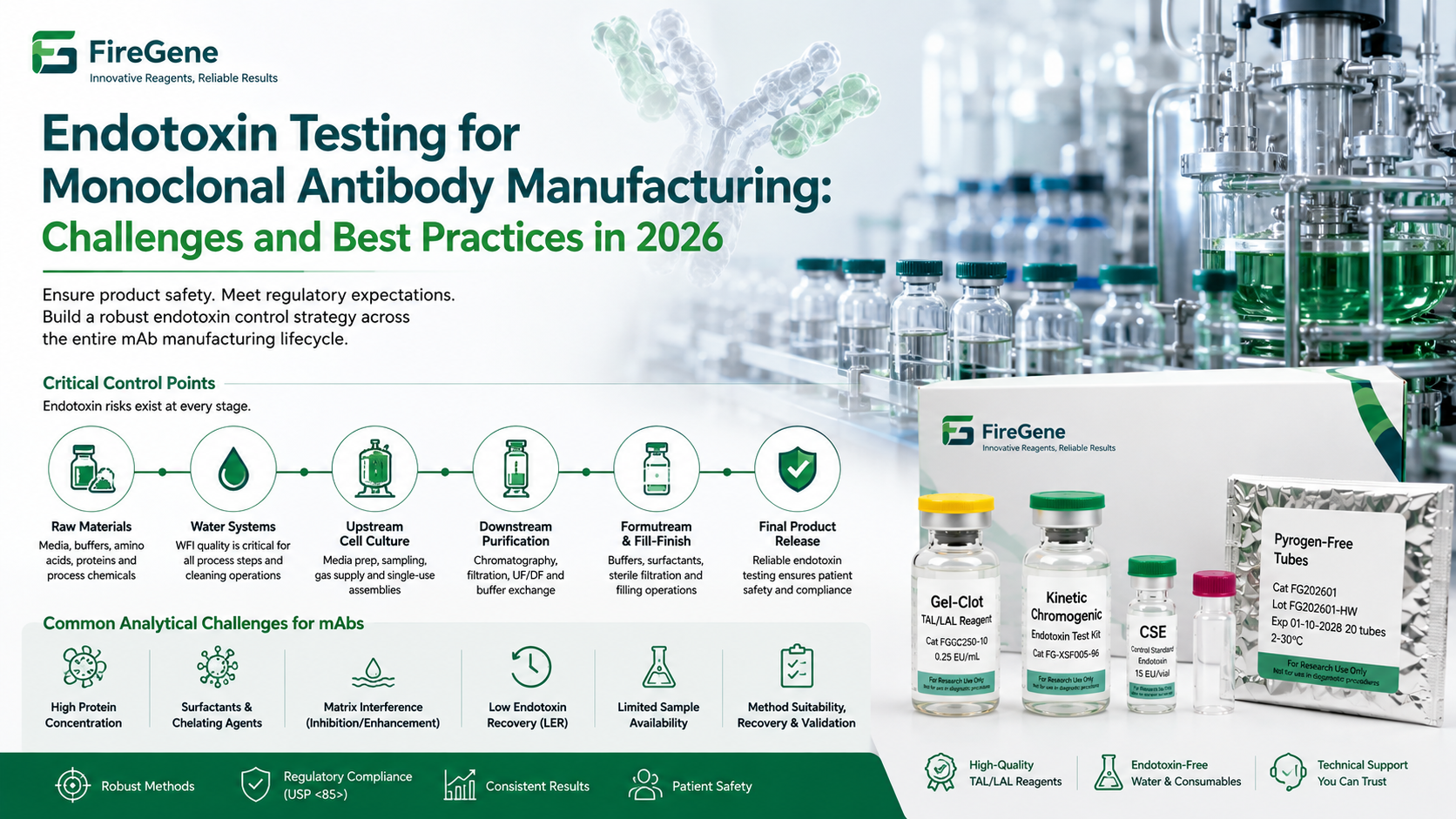
One common misconception is that endotoxin contamination occurs only during final filling or packaging. In reality, Gram-negative bacterial endotoxins can be introduced at multiple stages throughout the manufacturing lifecycle.
Understanding these critical control points enables manufacturers to implement effective contamination prevention strategies rather than relying solely on end-product testing.
Raw Materials
Every manufacturing campaign begins with raw materials, many of which originate from biological sources.
Potential endotoxin sources include:
- Cell culture media
- Amino acid supplements
- Growth factors
- Cytokines
- Recombinant enzymes
- Buffer components
- Process chemicals
Supplier qualification, incoming material testing, and risk assessments are essential for minimizing contamination at this stage.
Water Systems
Water is used extensively throughout monoclonal antibody manufacturing for media preparation, buffer production, equipment cleaning, chromatography operations, and formulation.
Poorly maintained Water for Injection (WFI) systems remain one of the most common sources of endotoxin contamination within pharmaceutical facilities.
Routine monitoring of pharmaceutical water systems should include:
- Endotoxin testing
- Microbial monitoring
- Trend analysis
- Sanitization verification
Upstream Cell Culture
Chinese Hamster Ovary (CHO) cells remain the dominant expression system for therapeutic monoclonal antibodies.
Although bioreactors operate under highly controlled conditions, contamination risks still exist through:
- Media preparation
- Sampling procedures
- Gas supply systems
- Single-use assemblies
- Operator interventions
Maintaining robust contamination control throughout upstream processing reduces the likelihood of downstream endotoxin investigations.
Downstream Purification
Chromatography columns, filtration devices, ultrafiltration systems, and buffer exchange operations all represent potential points where endotoxins may accumulate or be introduced if cleaning procedures are inadequate.
While purification processes often reduce endotoxin levels, manufacturers should never assume complete endotoxin removal unless this has been specifically demonstrated during process validation.
Final Formulation and Fill-Finish
The final manufacturing stages involve formulation buffers, stabilizers, surfactants, sterile filtration, filling operations, and container closure systems.
Because endotoxin contamination introduced at this stage cannot typically be removed afterward, strict aseptic controls and validated depyrogenation procedures remain essential.
Unique Challenges of Endotoxin Testing for Monoclonal Antibody Products
Although the bacterial endotoxin test described in USP <85> is well established, monoclonal antibody (mAb) products often present analytical challenges that are less common with traditional injectable drugs. Modern antibody formulations contain complex biological components specifically designed to improve protein stability, extend shelf life, and maintain therapeutic efficacy. These same formulation components, however, can influence endotoxin detection if they are not properly evaluated during method development.
Understanding these product-specific challenges is essential for developing reliable endotoxin testing methods.
Challenge 1: High Protein Concentrations
Monoclonal antibody formulations frequently contain protein concentrations ranging from tens to hundreds of milligrams per milliliter.
While these high concentrations are beneficial for reducing injection volume and improving patient convenience, they may affect the TAL/LAL enzymatic cascade in several ways:
- Increased sample viscosity
- Reduced mixing efficiency
- Altered reaction kinetics
- Greater potential for matrix interference
For highly concentrated antibody products, laboratories often evaluate multiple dilution strategies during method suitability testing to identify conditions that minimize analytical interference while remaining within the Maximum Valid Dilution (MVD).
Challenge 2: Complex Formulation Excipients
Unlike conventional injectables, monoclonal antibodies rarely consist of protein alone.
Typical formulations include carefully selected excipients such as:
- Polysorbate 20
- Polysorbate 80
- Histidine
- Citrate
- Trehalose
- Sucrose
- Arginine
- Glycine
- Sodium chloride
These excipients improve protein stability during storage and transportation, but they may also influence endotoxin recovery.
For example:
- Surfactants may alter endotoxin aggregation.
- Chelating agents may change the structural stability of endotoxin complexes.
- Highly concentrated sugars may alter sample viscosity.
- Buffer composition may influence assay performance.
Consequently, every formulation should undergo product-specific method suitability testing rather than relying on previously validated methods.
Challenge 3: Low Endotoxin Recovery (LER)
One of the most widely discussed analytical challenges in monoclonal antibody manufacturing is Low Endotoxin Recovery (LER).
Unlike traditional assay inhibition, LER develops over time after endotoxin has been added to the formulation.
A freshly prepared endotoxin spike may initially produce acceptable recovery. However, after storage, the measured endotoxin concentration gradually decreases despite the endotoxin remaining physically present within the sample.
Current research suggests that interactions between endotoxins, surfactants, chelating agents, and other formulation components may reduce the ability of endotoxin aggregates to activate the TAL/LAL enzymatic cascade.
Because many commercial monoclonal antibody formulations contain both surfactants and chelating agents, manufacturers should consider LER during method development and validation.
Internal Link Suggestion
Naturally link to:
Understanding Low Endotoxin Recovery (LER): Mechanisms, Regulatory Perspectives, and Practical Solutions in 2026
Challenge 4: Matrix Interference
Matrix interference remains one of the most common reasons for failed endotoxin method suitability studies.
Unlike LER, which develops during storage, matrix interference occurs during the assay itself.
Potential causes include:
- High protein concentration
- Extreme pH
- Surfactants
- Preservatives
- Buffer components
- High ionic strength
- Novel formulation excipients
These factors may inhibit or enhance the TAL/LAL reaction, leading to inaccurate endotoxin measurements.
Fortunately, properly designed Positive Product Controls (PPCs) and spike recovery studies help identify these issues before routine batch release testing begins.
Challenge 5: Limited Sample Availability During Development
Although commercial manufacturing generally provides sufficient material for analytical testing, early clinical development often does not.
During Phase I and Phase II development, laboratories may have access to only limited quantities of purified antibody.
This constraint requires careful planning of:
- Method validation
- Recovery studies
- Method suitability testing
- Stability studies
- Investigation procedures
Efficient study design minimizes sample consumption while generating sufficient analytical evidence to support regulatory submissions.
Regulatory Expectations for Endotoxin Testing
Global regulatory agencies expect manufacturers to demonstrate that endotoxin testing methods are scientifically appropriate for the specific product being analyzed.
Although regulatory guidance continues to evolve, several expectations remain consistent across international pharmacopeias and GMP regulations.
Manufacturers should demonstrate:
- Compliance with USP <85>, European Pharmacopoeia 2.6.14, or other applicable compendial requirements
- Successful method suitability testing
- Acceptable endotoxin recovery
- Appropriate Positive Product Controls (PPCs)
- Scientifically justified Maximum Valid Dilution (MVD)
- Comprehensive method validation
- Investigation procedures for unexpected results
- Data integrity throughout the analytical process
Rather than viewing endotoxin testing as a standalone laboratory activity, regulators increasingly evaluate how endotoxin control integrates into the manufacturer's overall Pharmaceutical Quality System (PQS).
Selecting the Appropriate Endotoxin Testing Method
Selecting the most appropriate TAL/LAL assay depends on the product, testing objectives, laboratory workflow, and regulatory requirements.
Gel-Clot TAL/LAL Assay
The Gel-Clot method remains the compendial reference standard for qualitative endotoxin limit testing.
Key advantages include:
- Straightforward procedure
- Minimal instrumentation
- Excellent robustness
- Strong regulatory acceptance
- Cost-effective routine testing
It remains an excellent choice for laboratories performing pharmacopeial limit tests or lower-throughput quality control.
Kinetic Chromogenic TAL/LAL Assay
For many biologics manufacturers, the Kinetic Chromogenic method offers significant operational advantages.
Benefits include:
- Quantitative endotoxin measurements
- Higher analytical sensitivity
- Broad dynamic range
- Automated calculations
- Reduced manual interpretation
- Improved laboratory productivity
- Electronic audit trails for GMP compliance
These advantages make kinetic assays particularly suitable for manufacturers managing multiple antibody products or high-throughput QC laboratories.
Best Practices for Reliable Endotoxin Testing in Monoclonal Antibody Manufacturing
Leading biopharmaceutical manufacturers generally follow several principles to improve endotoxin testing reliability.
Perform Method Suitability Early
Evaluate matrix interference during analytical development rather than after commercial manufacturing begins.
Include Comprehensive Recovery Studies
Spike recovery experiments help verify that endotoxins remain detectable within the specific antibody formulation.
Investigate LER Risk
Products containing surfactants and chelating agents should be assessed for potential Low Endotoxin Recovery using scientifically designed time-course studies.
Standardize Laboratory Procedures
Validated SOPs covering reagent preparation, sample dilution, instrument operation, and result interpretation improve reproducibility while reducing analyst-to-analyst variability.
Trend Analytical Performance
Routine monitoring of PPC recovery, recovery studies, water system data, and endotoxin testing results helps identify emerging quality issues before they affect commercial manufacturing.
Use High-Quality TAL/LAL Reagents
Reliable endotoxin testing begins with consistent analytical reagents.
FireGene's portfolio—including Gel-Clot TAL/LAL Reagents, Kinetic Chromogenic Endotoxin Test Kits, Control Standard Endotoxin (CSE), Endotoxin-Free Water, and Pyrogen-Free Consumables—supports method development, validation, routine QC testing, and regulatory compliance throughout the monoclonal antibody manufacturing lifecycle.
FireGene Solutions for Monoclonal Antibody Endotoxin Testing
Reliable endotoxin testing in monoclonal antibody manufacturing depends on a combination of scientifically validated methods, consistent laboratory practices, and high-quality analytical reagents. From early-stage process development to commercial batch release, laboratories require endotoxin testing solutions that deliver accuracy, reproducibility, and regulatory compliance.
FireGene offers a comprehensive portfolio of bacterial endotoxin testing products designed to support every stage of monoclonal antibody development and manufacturing, including:
- Gel-Clot TAL/LAL Reagents for compendial qualitative endotoxin limit testing
- Kinetic Chromogenic Endotoxin Test Kits for sensitive quantitative analysis and high-throughput QC laboratories
- Control Standard Endotoxin (CSE) for method suitability testing, Positive Product Controls (PPCs), and recovery studies
- Endotoxin-Free Water for reagent preparation and sample dilution
- Pyrogen-Free Tubes and Consumables to reduce the risk of laboratory contamination
When integrated into a robust quality control program, these solutions help manufacturers improve analytical consistency, reduce repeat testing, and support compliance with USP <85>, EP 2.6.14, GMP requirements, and global pharmacopeial expectations.
Case Study: Optimizing Endotoxin Testing for a Monoclonal Antibody Product
A biopharmaceutical company developing a therapeutic monoclonal antibody encountered inconsistent endotoxin recovery during analytical method validation. Initial system suitability tests met acceptance criteria, but Positive Product Control (PPC) recoveries varied between manufacturing batches, raising concerns about the reliability of routine release testing.
The quality control team began a structured investigation.
First, they confirmed that instrument calibration, reagent integrity, standard curve performance, and analyst technique all met internal quality standards. Because no obvious analytical issues were identified, attention shifted to the product formulation.
The antibody formulation contained Polysorbate 80, a citrate buffer, and a high protein concentration—components known to influence endotoxin behavior in certain biologic products.
The laboratory implemented a comprehensive optimization plan that included:
- Evaluating multiple sample dilution factors while remaining within the Maximum Valid Dilution (MVD)
- Performing additional spike recovery studies using Control Standard Endotoxin (CSE)
- Comparing freshly prepared and stored Positive Product Controls (PPCs)
- Reviewing storage conditions and sample handling procedures
- Expanding method suitability testing to include additional manufacturing lots
The revised strategy demonstrated consistent endotoxin recovery across multiple batches and confirmed that earlier variability was linked to formulation-specific matrix effects rather than assay failure.
By incorporating product-specific recovery studies and standardized laboratory procedures into the validation program, the company successfully established a robust endotoxin testing method suitable for routine commercial manufacturing.
This example illustrates an important principle: successful endotoxin testing for monoclonal antibodies requires an understanding of both analytical science and formulation-specific product characteristics.
Frequently Asked Questions (FAQ)
1. Why is endotoxin testing important for monoclonal antibodies?
Monoclonal antibodies are typically administered by injection or infusion. Even trace amounts of bacterial endotoxins can trigger fever, inflammation, hypotension, or other pyrogenic reactions, making endotoxin testing a critical component of product quality and patient safety.
2. Which stages of monoclonal antibody manufacturing carry the highest endotoxin risk?
Potential contamination sources exist throughout the manufacturing process, including raw materials, pharmaceutical water systems, upstream cell culture, downstream purification, formulation, and fill-finish operations. Effective endotoxin control requires monitoring critical control points across the entire manufacturing lifecycle.
3. Can sterile products still contain endotoxins?
Yes. Sterility testing detects viable microorganisms, whereas endotoxin testing detects bacterial lipopolysaccharides (LPS). A product may be sterile but still contain endotoxins if contamination occurred before bacteria were removed or destroyed.
4. What analytical challenges are unique to monoclonal antibodies?
Common challenges include:
- High protein concentrations
- Matrix interference
- Low Endotoxin Recovery (LER)
- Surfactant-containing formulations
- Complex buffer systems
- Limited sample availability during development
These factors require product-specific method validation.
5. What is method suitability testing?
Method suitability testing demonstrates that the selected endotoxin assay performs correctly for a specific product matrix and is not affected by inhibition or enhancement. It is a key requirement for validating bacterial endotoxin testing methods.
6. What is Low Endotoxin Recovery (LER)?
LER describes the time-dependent reduction in measurable endotoxin within certain formulations, often associated with endotoxin masking. It differs from immediate assay inhibition and should be evaluated separately during method development.
7. Which endotoxin testing method is best for monoclonal antibodies?
The choice depends on the application. Gel-Clot TAL/LAL assays are well suited for qualitative limit testing, while Kinetic Chromogenic TAL/LAL assays are often preferred for quantitative analysis, higher sensitivity, automated data acquisition, and improved laboratory efficiency.
8. How often should endotoxin methods be re-evaluated?
Manufacturers should review endotoxin methods whenever significant changes occur, such as:
- Product reformulation
- Manufacturing process changes
- Raw material changes
- Equipment upgrades
- New analytical instrumentation
- Unexpected analytical trends identified through quality monitoring
9. How can manufacturers reduce endotoxin testing failures?
Best practices include:
- Performing comprehensive method suitability testing
- Conducting recovery studies
- Monitoring PPC performance
- Investigating potential LER
- Standardizing laboratory procedures
- Using validated TAL/LAL reagents
- Trending analytical performance over time
10. How does FireGene support monoclonal antibody manufacturers?
FireGene provides a complete bacterial endotoxin testing portfolio—including Gel-Clot TAL/LAL Reagents, Kinetic Chromogenic Endotoxin Test Kits, Control Standard Endotoxin (CSE), Endotoxin-Free Water, and Pyrogen-Free Consumables—to support method validation, routine quality control, recovery studies, and regulatory compliance throughout biologics manufacturing.
Key Takeaways
Monoclonal antibody manufacturing presents unique challenges for bacterial endotoxin testing due to increasingly complex formulations, high protein concentrations, and evolving regulatory expectations.
The key lessons from this guide include:
- Endotoxin control should be integrated throughout the entire monoclonal antibody manufacturing process—from raw material qualification to final product release.
- Product-specific method suitability testing is essential for identifying matrix interference before routine QC testing begins.
- Recovery studies and Positive Product Controls (PPCs) help verify analytical accuracy and support reliable endotoxin detection.
- Manufacturers should proactively evaluate the risk of Low Endotoxin Recovery (LER), particularly for formulations containing surfactants and chelating agents.
- Selecting appropriate TAL/LAL reagents, standardizing laboratory procedures, and trending analytical performance improve reproducibility and strengthen GMP compliance.
- A science-based endotoxin control strategy reduces analytical uncertainty, improves manufacturing efficiency, and helps ensure patient safety.
Conclusion
As monoclonal antibodies continue to drive innovation in oncology, immunology, and rare disease treatment, maintaining rigorous endotoxin control has become more important than ever. The complexity of modern biologic formulations demands more than routine compliance with USP <85>—it requires a thorough understanding of product-specific risks, analytical method performance, and lifecycle quality management.
By identifying critical control points throughout manufacturing, performing comprehensive method suitability testing and recovery studies, evaluating the potential for Low Endotoxin Recovery (LER), and implementing standardized quality control procedures, manufacturers can build endotoxin testing programs that are both scientifically robust and operationally efficient.
Ultimately, reliable bacterial endotoxin testing is not simply a regulatory obligation; it is an essential safeguard for product quality and patient safety. Laboratories that invest in validated methods, high-quality TAL/LAL reagents, and continuous process improvement will be better equipped to reduce analytical variability, accelerate batch release, meet global regulatory expectations, and support the successful commercialization of monoclonal antibody therapies.
FireGene Endotoxin Testing
Ready to run your endotoxin assay?
FireGene offers a complete endotoxin testing toolkit — from TAL reagents and CSE standards to pyrogen-free consumables and LAL reagent water. All products are aligned with USP <85>, EP 2.6.14, and JP 4.01.


