
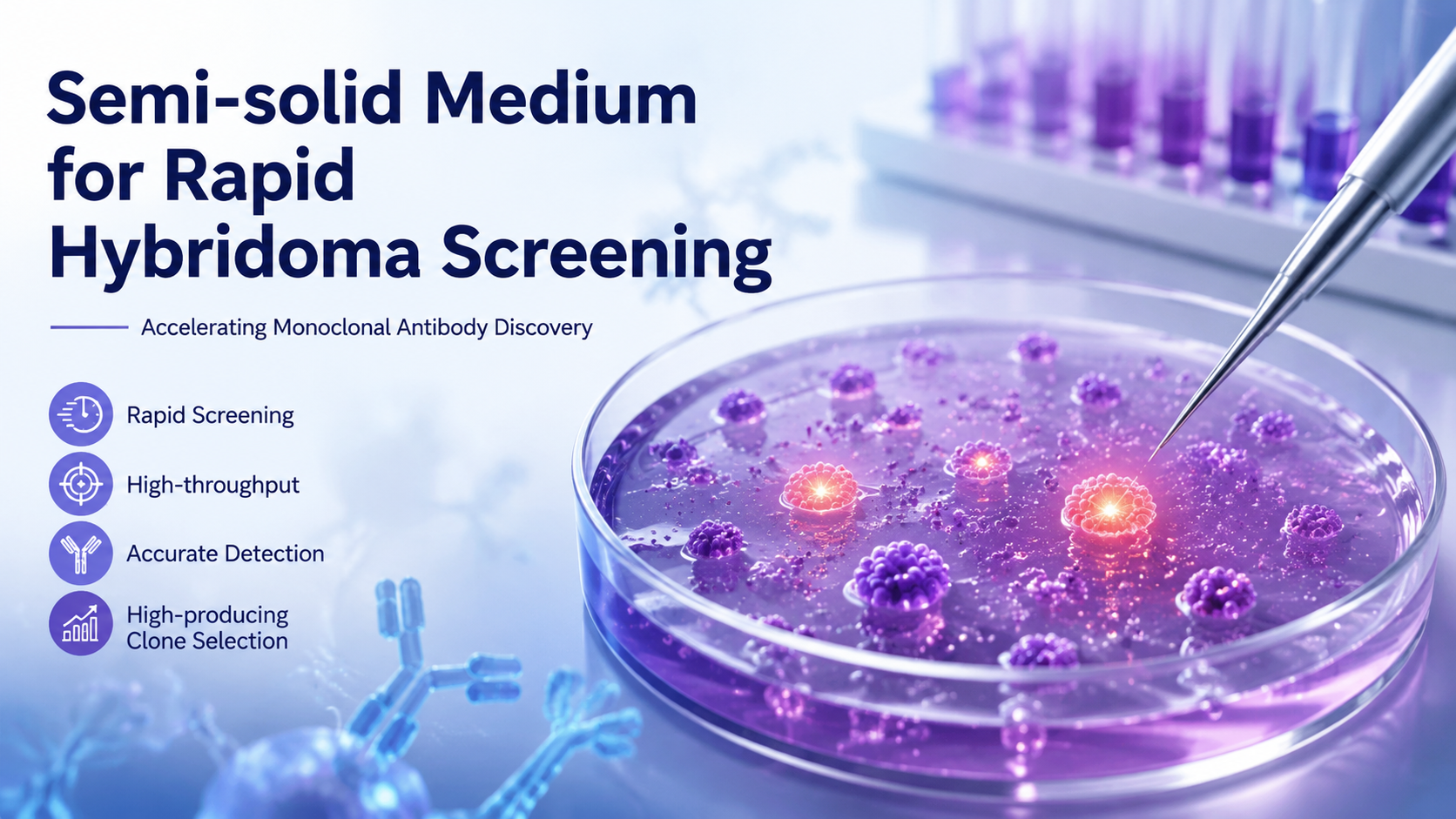
Semi-solid medium technology has become an advanced platform for accelerating hybridoma screening and monoclonal antibody discovery. By combining antibody-secreting cell detection with spatially confined colony growth, semi-solid screening systems enable rapid identification of high-producing hybridoma clones while reducing labor-intensive screening steps. Compared with traditional limiting dilution and ELISA-based workflows, semi-solid hybridoma screening improves clone recovery, shortens development timelines, and supports efficient antibody discovery pipelines. This technology is widely applied in therapeutic antibody development, diagnostic antibody production, and research antibody generation.
1. Introduction to Hybridoma Screening
Hybridoma technology remains one of the most important methods for generating monoclonal antibodies. Developed through the fusion of antibody-producing B cells with immortal myeloma cells, hybridomas combine the antibody specificity of B cells with the unlimited growth capacity of myeloma cells.
A typical hybridoma development workflow includes:
1. Immunization of host animals with target antigens
2. Isolation of antibody-producing B cells
3. Cell fusion with myeloma cells
4. Selection of hybridoma clones
5. Screening for antigen-specific antibody production
6. Expansion and antibody characterization
The major challenge occurs during the screening stage. Thousands of hybridoma colonies may be generated after fusion, but only a small percentage produce antibodies with the desired specificity, affinity, and functionality.
Traditional screening approaches often require:
· Multiple rounds of cell dilution
· Large numbers of culture wells
· Time-consuming ELISA testing
· Repeated clone expansion
Semi-solid medium technology provides a more efficient solution by enabling direct visualization and selection of antibody-producing hybridoma clones.
2. What Is Semi-solid Medium for Hybridoma Screening?
Semi-solid medium is a specialized cell culture matrix containing components that create a soft, gel-like environment. Unlike liquid culture systems where cells freely disperse, semi-solid media physically restrict cell movement, allowing individual hybridoma cells to grow into localized colonies.
The semi-solid environment enables:
· Single-cell colony formation
· Local antibody accumulation
· Direct identification of antibody-secreting clones
· High-throughput screening
During incubation, each hybridoma cell grows into a colony while secreting antibodies into its surrounding microenvironment. Fluorescence-based detection methods can identify colonies producing antibodies against the target antigen.
3. Principle of Rapid Hybridoma Screening Using Semi-solid Medium
The screening process is based on the combination of clonal growth and antibody secretion detection.
Step 1: Hybridoma Cell Preparation
After cell fusion and selection, hybridoma populations are prepared and mixed with semi-solid screening medium.
The medium provides:
· Nutrients for hybridoma growth
· Physical support for colony formation
· Detection reagents for antibody secretion analysis
Step 2: Colony Formation in Semi-solid Matrix
Individual hybridoma cells remain locally confined within the semi-solid environment.
Each cell develops into a colony containing genetically identical daughter cells.
Advantages:
· Maintains clonality
· Prevents cell mixing
· Enables direct comparison between colonies
Step 3: Antibody Secretion Detection
As hybridoma colonies grow, secreted antibodies accumulate around the colonies.
Detection systems can identify colonies based on:
· Antigen-specific antibody binding
· Fluorescent signal intensity
· Antibody secretion level
High-producing hybridoma clones generate stronger signals and can be selected for further expansion.
Step 4: Clone Recovery and Expansion
Selected colonies are recovered directly from the semi-solid medium and transferred into liquid culture.
The recovered clones can then undergo:
· Secondary screening
· Antibody affinity analysis
· Isotype determination
· Functional validation
· Large-scale production
4. Advantages of Semi-solid Hybridoma Screening Technology
4.1 Faster Clone Identification
Traditional hybridoma screening may require weeks of:
· Cell expansion
· Supernatant collection
· ELISA testing
Semi-solid screening allows researchers to identify promising antibody-producing clones earlier by detecting secretion directly at the colony level.
4.2 High-throughput Screening Capability
Semi-solid platforms support screening of thousands of hybridoma colonies simultaneously.
This improves:
· Screening capacity
· Clone selection efficiency
· Antibody discovery speed
4.3 Improved Detection of High-producing Clones
Not all antibody-positive hybridomas produce antibodies at the same level.
Semi-solid screening enables researchers to prioritize clones with:
· Strong antibody secretion
· High productivity
· Stable growth characteristics
This is particularly valuable for therapeutic antibody development.
4.4 Reduced Screening Workload
Compared with traditional well-based screening, semi-solid systems reduce:
· Manual pipetting
· Repeated culture transfers
· ELISA screening rounds
This helps laboratories save time and resources during antibody discovery.
5. Applications of Semi-solid Hybridoma Screening

5.1 Therapeutic Monoclonal Antibody Development
Semi-solid hybridoma screening supports discovery of antibodies for:
· Cancer immunotherapy
· Autoimmune disease treatment
· Infectious disease research
· Targeted biological therapies
By rapidly identifying high-performing clones, researchers can accelerate antibody development programs.
5.2 Diagnostic Antibody Production
Monoclonal antibodies are essential components of diagnostic assays, including:
· ELISA kits
· Immunohistochemistry reagents
· Rapid diagnostic tests
· Molecular detection platforms
Semi-solid screening helps generate antibodies with:
· High specificity
· Strong binding affinity
· Consistent performance
5.3 Research Antibody Discovery
Research laboratories use hybridoma screening technology to develop antibodies targeting:
· Proteins
· Cell surface markers
· Signaling molecules
· Biomarkers
These antibodies support applications such as:
· Flow cytometry
· Western blotting
· Immunofluorescence
· Cell biology studies
6. Semi-solid Medium vs Traditional Hybridoma Screening
|
Feature |
Traditional Screening |
Semi-solid Screening |
|
Screening method |
ELISA-based testing |
Colony-based secretion detection |
|
Screening speed |
Multiple rounds required |
Rapid identification |
|
Throughput |
Moderate |
High |
|
Clone visualization |
Indirect |
Direct colony detection |
|
Labor requirement |
High |
Reduced |
|
Identification of high producers |
Limited |
Improved |
7. Role of Fluorescence-Based Semi-solid Screening
Modern semi-solid hybridoma screening platforms often integrate fluorescence detection technology.
Fluorescence-based systems provide:
· High sensitivity
· Visual identification of positive clones
· Quantitative comparison of antibody secretion
· Automated image analysis compatibility
Compared with endpoint assays, fluorescence screening provides earlier information about clone performance.
8. Future Perspectives
The combination of semi-solid culture systems with automated imaging, artificial intelligence analysis, and high-throughput platforms is expected to further improve monoclonal antibody discovery.
Future developments may include:
· Automated colony picking
· AI-assisted clone ranking
· Integrated antibody characterization workflows
· Single-cell antibody discovery platforms
These advances will help researchers shorten antibody development cycles and improve discovery efficiency.
Conclusion
Semi-solid medium technology represents a powerful advancement in hybridoma screening by enabling rapid identification of antibody-producing clones within a controlled microenvironment. Through localized colony growth and sensitive antibody secretion detection, this approach improves screening efficiency, reduces workflow complexity, and accelerates monoclonal antibody discovery. As antibody-based therapeutics and diagnostics continue to expand, semi-solid hybridoma screening platforms will play an increasingly important role in biotechnology research and development.


