
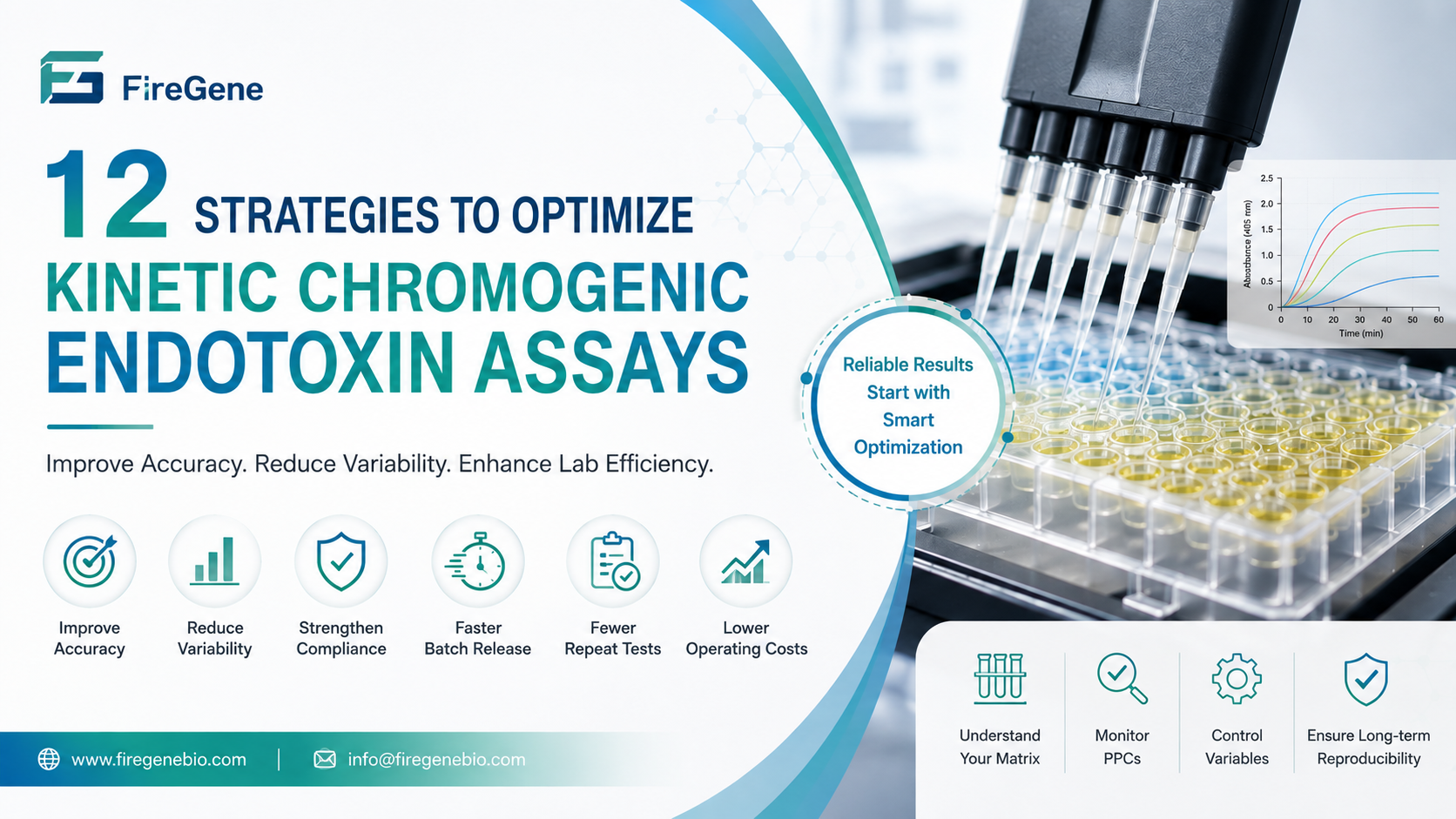
How to Optimize Kinetic Chromogenic Endotoxin Assays: 12 Proven Strategies to Improve Accuracy, Precision, and Laboratory Efficiency

Introduction

The Kinetic Chromogenic TAL/LAL assay has become one of the most widely adopted quantitative methods for bacterial endotoxin testing in pharmaceutical quality control. Compared with traditional Gel-Clot assays, kinetic chromogenic methods provide higher sensitivity, automated data analysis, broader dynamic range, and significantly improved laboratory efficiency.

These advantages have made kinetic chromogenic assays the preferred choice for manufacturers of injectable drugs, biologics, monoclonal antibodies, vaccines, medical devices, and cell and gene therapy products.

However, achieving accurate and reproducible endotoxin results requires more than simply following the assay protocol.

Even laboratories using validated instruments and qualified reagents may occasionally experience:

  • Unexpected assay variability
  • High coefficient of variation (CV)
  • Poor standard curve performance
  • Failed Positive Product Controls (PPCs)
  • Inconsistent spike recovery
  • Method suitability failures
  • Out-of-specification (OOS) investigations

In most cases, these issues are not caused by the assay itself. Instead, they arise from subtle factors such as improper reagent handling, pipetting inconsistencies, matrix interference, environmental contamination, instrument settings, or inadequate laboratory standardization.

The good news is that many of these problems are preventable.

By implementing a systematic optimization strategy, pharmaceutical quality control laboratories can significantly improve assay precision, reduce repeat testing, shorten investigation time, and strengthen compliance with USP <85> and global pharmacopeial requirements.

In this guide, we present 12 practical strategies that help laboratories optimize kinetic chromogenic endotoxin assays, improve data quality, and maximize operational efficiency.


Why Optimization Matters

Optimization is often overlooked because laboratories assume that following the manufacturer's instructions alone is sufficient.

In reality, endotoxin testing is influenced by multiple variables, including:

  • Reagent quality
  • Operator technique
  • Instrument calibration
  • Sample preparation
  • Environmental control
  • Product matrix
  • Laboratory workflow

Small improvements across these areas can produce substantial gains in assay performance.

Benefits include:

  • Higher assay reproducibility
  • Lower analyst-to-analyst variation
  • Reduced OOS investigations
  • Fewer repeat tests
  • Faster batch release
  • Better regulatory readiness
  • Lower laboratory operating costs

Strategy 1: Use High-Quality TAL/LAL Reagents

Reliable results begin with consistent analytical reagents.

Laboratories should ensure:

  • Qualified reagent suppliers
  • Proper refrigerated storage
  • Lot-to-lot consistency
  • Expiration monitoring
  • Correct reconstitution procedures

Using validated TAL/LAL reagents minimizes analytical variability and provides a stable foundation for routine quality control.


Strategy 2: Standardize Pipetting Techniques

Pipetting errors remain one of the largest contributors to assay variability.

Best practices include:

  • Routine pipette calibration
  • Reverse pipetting for viscous samples
  • Consistent aspiration speed
  • Proper tip immersion depth
  • Avoiding air bubbles
  • Changing tips between transfers

Even a few microliters of variation can significantly affect kinetic measurements.


Strategy 3: Optimize Standard Curve Preparation

A high-quality standard curve is essential for accurate endotoxin quantification.

Laboratories should:

  • Prepare fresh dilutions
  • Mix thoroughly without foaming
  • Use endotoxin-free water
  • Avoid excessive storage after preparation
  • Verify acceptance criteria before analyzing samples

Poor standard curves often lead to repeat testing and delayed batch release.


Strategy 4: Control Laboratory Environment

Environmental factors can influence assay consistency.

Maintain:

  • Stable room temperature
  • Controlled humidity
  • Clean work surfaces
  • Minimal airborne contamination
  • Dedicated endotoxin testing areas

Reducing environmental variability improves long-term reproducibility.


Strategy 5: Verify Microplate Reader Performance

Routine instrument qualification should include:

  • Wavelength verification (405 nm)
  • Temperature accuracy (37°C)
  • Optical performance
  • Timing accuracy
  • Software validation

Preventive maintenance reduces unexpected instrument-related failures.


Strategy 6: Minimize Matrix Interference Before Routine Testing

One of the most common reasons for inconsistent kinetic chromogenic assay results is matrix interference. Product-specific components may inhibit or enhance the enzymatic reaction, leading to inaccurate endotoxin measurements.

Common sources of interference include:

  • High protein concentrations
  • Surfactants (e.g., Polysorbate 20 and Polysorbate 80)
  • Chelating agents
  • High salt concentrations
  • Extreme pH values
  • Preservatives
  • Lipid-based formulations
  • Novel excipients used in biologics

Rather than assuming a compendial method will work for every formulation, laboratories should evaluate interference during method development.

Recommended practices include:

  • Performing method suitability testing before routine analysis
  • Testing multiple dilution factors
  • Using Positive Product Controls (PPCs)
  • Monitoring spike recovery throughout validation

A proactive approach helps prevent unexpected failures during commercial batch release.

Internal Link Suggestion

Naturally link to:

Why Endotoxin Testing Fails During Method Suitability Testing: Understanding Inhibition, Enhancement, and Matrix Interference


Strategy 7: Monitor Positive Product Controls (PPCs) Carefully

Positive Product Controls are one of the most valuable indicators of assay performance.

A PPC confirms that the product matrix does not interfere with endotoxin detection and demonstrates that the analytical method remains suitable for the sample being tested.

Unexpected PPC failures should never be ignored.

Instead, laboratories should investigate:

  • Sample preparation procedures
  • Pipetting accuracy
  • Dilution calculations
  • Reagent preparation
  • Instrument performance
  • Product formulation
  • Storage conditions

Trending PPC performance over time can also reveal gradual analytical changes before they develop into significant quality issues.


Strategy 8: Validate the Maximum Valid Dilution (MVD)

Dilution is one of the simplest and most effective methods for reducing matrix interference. However, excessive dilution may reduce endotoxin concentrations below the assay's analytical sensitivity.

This balance is addressed through the Maximum Valid Dilution (MVD).

During method development, laboratories should:

  • Calculate the product-specific MVD
  • Evaluate several dilution factors
  • Confirm acceptable spike recovery
  • Document the final dilution strategy

Operating within the validated MVD helps maintain assay sensitivity while minimizing product-related interference.


Strategy 9: Evaluate Endotoxin Recovery During Validation

Even when method suitability appears acceptable, laboratories should verify that endotoxins remain detectable within the product matrix.

Recovery studies provide this evidence.

Well-designed recovery studies include:

  • Known endotoxin spikes using Control Standard Endotoxin (CSE)
  • Multiple dilution factors
  • Replicate testing
  • Positive Product Controls
  • Standard curve verification

These studies increase confidence that routine endotoxin testing accurately reflects product quality.


Strategy 10: Assess the Risk of Low Endotoxin Recovery (LER)

For biologics and advanced therapeutics, optimization should include an assessment of Low Endotoxin Recovery (LER).

Products containing surfactants, chelating agents, lipid nanoparticles, or complex proteins may experience a gradual reduction in measurable endotoxin after storage.

To evaluate LER risk, laboratories should consider:

  • Time-course recovery studies
  • Comparison of fresh and stored spiked samples
  • Product-specific formulation assessments
  • Trending recovery data over time

Addressing LER during validation is far more efficient than investigating unexplained analytical variability after commercialization.


Strategy 11: Standardize SOPs and Analyst Training

Even highly automated kinetic chromogenic assays depend on consistent laboratory technique.

Standard Operating Procedures (SOPs) should clearly define:

  • Reagent storage and reconstitution
  • Sample preparation
  • Pipetting procedures
  • Plate layout
  • Incubation timing
  • Instrument operation
  • Data review
  • Acceptance criteria

Regular analyst competency assessments help reduce operator-to-operator variability and improve long-term reproducibility.


Strategy 12: Trend Data Instead of Reacting to Individual Failures

Leading pharmaceutical laboratories do not evaluate endotoxin results in isolation.

Instead, they continuously monitor analytical performance across:

  • Standard curve parameters
  • PPC recovery
  • Spike recovery
  • Coefficient of variation (CV)
  • Instrument qualification records
  • Environmental monitoring
  • Water system testing
  • Product-specific endotoxin results

Trend analysis allows laboratories to identify gradual changes before they trigger Out-of-Specification (OOS) results, reducing investigations and improving overall QC efficiency.


FireGene Solutions for Optimizing Kinetic Chromogenic Endotoxin Assays

Optimizing a kinetic chromogenic assay requires both a well-designed analytical strategy and dependable reagents. FireGene provides a complete bacterial endotoxin testing portfolio to support pharmaceutical manufacturers throughout method development, validation, and routine quality control.

Our solutions include:

These products help laboratories improve assay consistency, reduce repeat testing, and support compliance with USP <85>, EP 2.6.14, and GMP requirements.


Case Study: Improving Assay Precision in a Pharmaceutical QC Laboratory

A pharmaceutical quality control laboratory performing routine kinetic chromogenic endotoxin testing noticed increasing variability in Positive Product Control (PPC) recovery across several product batches. Although no Out-of-Specification (OOS) results had occurred, the trend raised concerns about long-term assay reliability.

A systematic review identified several opportunities for improvement:

  • Pipettes were recalibrated and standardized across analysts.
  • Fresh standard curves were prepared immediately before each analytical run.
  • Plate layouts were redesigned to reduce edge effects.
  • Sample dilution procedures were standardized within the validated Maximum Valid Dilution (MVD).
  • Analyst training was refreshed to reinforce consistent pipetting and timing practices.

Within several weeks, the laboratory observed a measurable reduction in coefficient of variation (CV), improved PPC consistency, and fewer repeat analyses. By focusing on process optimization rather than isolated troubleshooting, the laboratory strengthened analytical performance and improved overall testing efficiency.

This case highlights that consistent endotoxin testing depends on disciplined laboratory practices as much as on the analytical method itself.


Frequently Asked Questions (FAQ)

1. What is a Kinetic Chromogenic Endotoxin Assay?

A Kinetic Chromogenic Endotoxin Assay is a quantitative bacterial endotoxin test that measures the increase in yellow color produced when endotoxins activate the TAL/LAL enzymatic cascade. The time required to reach a predefined absorbance threshold is inversely proportional to the endotoxin concentration, allowing accurate quantification over a broad dynamic range.


2. Why is the Kinetic Chromogenic method widely used in pharmaceutical QC laboratories?

Compared with traditional Gel-Clot assays, the Kinetic Chromogenic method offers several advantages:

  • Quantitative endotoxin measurements
  • High analytical sensitivity
  • Broad dynamic range
  • Automated result calculation
  • Higher throughput using 96-well microplates
  • Reduced operator subjectivity
  • Electronic data records that support GMP compliance

These benefits make it particularly well suited for routine quality control, biologics manufacturing, and validation studies.


3. What are the most common causes of assay variability?

Several factors can contribute to inconsistent results, including:

  • Pipetting inaccuracies
  • Poor reagent handling
  • Incorrect preparation of standard curves
  • Matrix interference
  • Instrument calibration issues
  • Environmental contamination
  • Improper sample storage
  • Analyst-to-analyst variability

Implementing standardized laboratory procedures and routine equipment qualification can significantly reduce these sources of variability.


4. How can laboratories improve the accuracy of kinetic chromogenic assays?

Accuracy can be improved by:

  • Using validated TAL/LAL reagents
  • Preparing fresh endotoxin standards
  • Regularly calibrating pipettes
  • Verifying microplate reader performance
  • Performing method suitability testing
  • Monitoring Positive Product Controls (PPCs)
  • Standardizing sample preparation procedures
  • Trending assay performance over time

Optimization should be viewed as an ongoing process rather than a one-time validation exercise.


5. Why is method suitability testing important?

Method suitability testing confirms that a product matrix does not inhibit or enhance the TAL/LAL reaction. It demonstrates that the assay can accurately detect endotoxins within a specific formulation and is a fundamental requirement for USP <85> compliance.


6. What role do Positive Product Controls (PPCs) play?

Positive Product Controls verify that endotoxins can be successfully recovered from the product matrix during each analytical run.

Consistent PPC recovery provides confidence that the assay is functioning correctly and that sample-specific interference is not affecting the results.


7. Can kinetic chromogenic assays be used for biologics and monoclonal antibodies?

Yes. Kinetic Chromogenic TAL/LAL assays are widely used for testing:

  • Monoclonal antibodies
  • Recombinant proteins
  • Vaccines
  • Cell and gene therapy products
  • Injectable pharmaceuticals
  • Medical devices
  • Pharmaceutical water systems

However, complex formulations should always undergo product-specific method validation and method suitability testing before routine use.


8. How often should laboratory instruments be qualified?

Microplate readers, pipettes, incubators, and other critical equipment should be calibrated, qualified, and maintained according to internal quality procedures and GMP requirements. Routine preventive maintenance helps minimize unexpected analytical failures.


9. How can laboratories reduce Out-of-Specification (OOS) investigations?

Many OOS investigations can be prevented by:

  • Optimizing analytical methods
  • Performing comprehensive recovery studies
  • Investigating matrix interference early
  • Monitoring Long-Term Positive Product Control (PPC) trends
  • Training laboratory personnel
  • Standardizing SOPs
  • Using qualified reagents and consumables
  • Implementing continuous data trending

Preventive quality management is generally more efficient than reactive troubleshooting.


10. How does FireGene support kinetic chromogenic endotoxin testing?

FireGene provides a comprehensive portfolio of endotoxin testing solutions, including Kinetic Chromogenic Endotoxin Test Kits, Gel-Clot TAL/LAL Reagents, Control Standard Endotoxin (CSE), Endotoxin-Free Water, and Pyrogen-Free Consumables. These products are designed to support analytical method development, validation, routine quality control, recovery studies, and regulatory compliance across pharmaceutical and biotechnology laboratories.


Key Takeaways

Optimizing a Kinetic Chromogenic Endotoxin Assay is not achieved through a single adjustment but through the consistent application of best practices across the entire analytical workflow. From reagent preparation and pipetting accuracy to instrument qualification and data trending, every step contributes to the reliability of endotoxin testing.

The most important points to remember are:

  • Use high-quality, validated TAL/LAL reagents and certified endotoxin-free consumables to establish a reliable testing foundation.
  • Standardize pipetting techniques, reagent preparation, and laboratory SOPs to minimize analyst-to-analyst variability.
  • Verify standard curve quality, microplate reader performance, and environmental conditions before each analytical run.
  • Perform product-specific method suitability testing and recovery studies to identify matrix interference early.
  • Assess the risk of Low Endotoxin Recovery (LER) for biologics and other complex formulations.
  • Monitor Positive Product Controls (PPCs), spike recovery, and long-term analytical trends to detect subtle performance changes before they result in OOS investigations.
  • Continuous optimization improves assay precision, reduces repeat testing, accelerates batch release, and strengthens GMP compliance.

By integrating these strategies into routine laboratory practice, pharmaceutical manufacturers can enhance both the scientific reliability and operational efficiency of their bacterial endotoxin testing programs.


Conclusion

The Kinetic Chromogenic TAL/LAL assay has become the preferred quantitative method for bacterial endotoxin testing in modern pharmaceutical quality control because it combines high sensitivity, automation, and reproducibility. However, obtaining reliable results requires much more than following a standard operating procedure. Every aspect of the analytical workflow—from reagent quality and instrument qualification to sample preparation, method suitability testing, and data review—plays a critical role in assay performance.

As pharmaceutical products continue to evolve, particularly in biologics, monoclonal antibodies, vaccines, and advanced cell and gene therapies, laboratories must also adapt their endotoxin testing strategies. Proactively addressing matrix interference, evaluating Low Endotoxin Recovery (LER), conducting comprehensive recovery studies, and implementing robust quality management practices help ensure that endotoxin results accurately reflect product safety.

Organizations that embrace continuous optimization rather than reactive troubleshooting are better positioned to reduce analytical variability, minimize Out-of-Specification (OOS) investigations, improve laboratory productivity, and meet the increasingly rigorous expectations of global regulatory agencies.

With validated methods, standardized workflows, and high-quality endotoxin testing reagents, pharmaceutical laboratories can build a reliable, efficient, and future-ready quality control program that supports timely product release while safeguarding patient health.

FireGene Endotoxin Testing

Ready to run your endotoxin assay?

FireGene offers a complete endotoxin testing toolkit — from TAL reagents and CSE standards to pyrogen-free consumables and LAL reagent water. All products are aligned with USP <85>, EP 2.6.14, and JP 4.01.

Endotoxin assay