
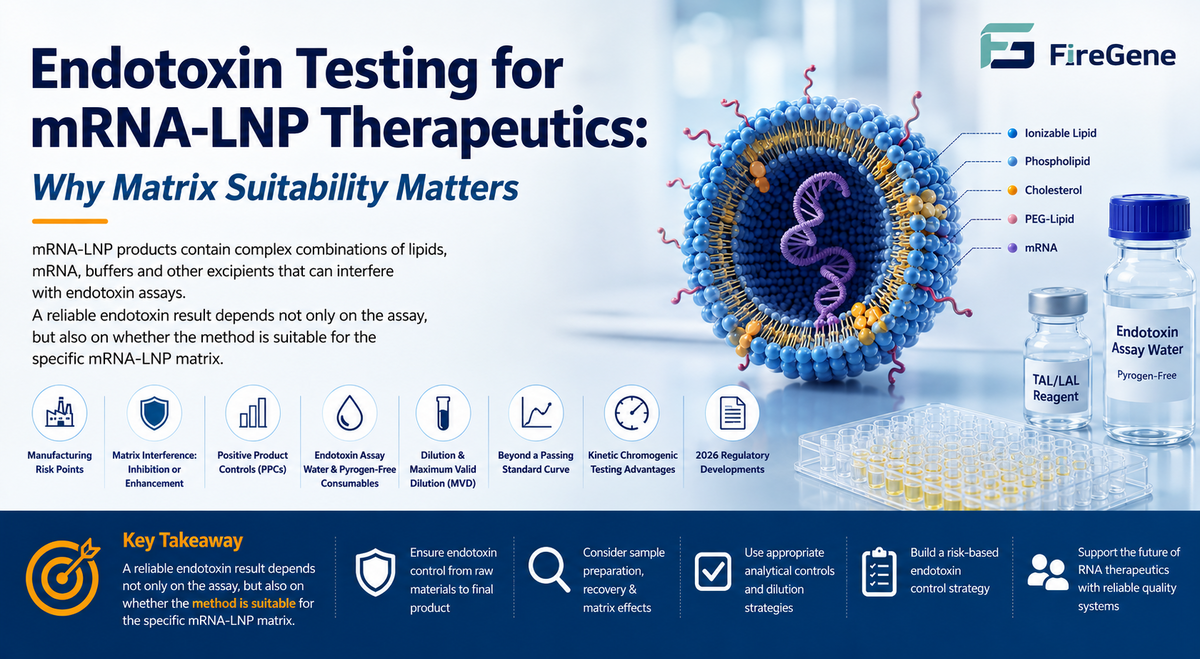
Introduction
The rapid development of mRNA therapeutics and lipid nanoparticle (LNP) delivery systems is reshaping modern drug development.
What began with the large-scale deployment of mRNA vaccines has expanded into a broader therapeutic platform that includes:
- Preventive vaccines
- Cancer immunotherapy
- Protein replacement
- Gene-editing applications
- Personalized vaccines
- Rare-disease therapies
- Other RNA-based medicines
As these products move from research and clinical development toward commercial manufacturing, quality-control laboratories face a growing analytical challenge:
How can endotoxin be reliably detected in an mRNA-LNP formulation without allowing the formulation itself to interfere with the assay?
This question is particularly important because mRNA-LNP products are not simple aqueous pharmaceutical solutions.
They contain multiple lipid components, nucleic acids, buffers, salts, stabilizers, and other formulation ingredients. The resulting matrix can behave very differently from conventional small-molecule drug products.
For endotoxin testing laboratories, this means that assay selection alone is not enough.
A successful testing strategy must consider:
Raw materials → manufacturing process → LNP formulation → sample preparation → matrix interference → dilution → endotoxin recovery → quantitative testing → batch release
In 2026, this integrated approach is becoming increasingly important as regulators and manufacturers place greater emphasis on scientifically justified analytical methods and product-specific method suitability.
1. Why Endotoxin Testing Matters for mRNA-LNP Products
Endotoxin is a bacterial-derived pyrogen that can trigger strong inflammatory responses.
For parenteral products, controlling endotoxin is therefore an essential part of product safety.
This applies directly to mRNA-LNP products administered by injection.
The USP draft guidance on analytical procedures for mRNA vaccine quality identifies endotoxin as a safety attribute and USP <85> as an applicable test method.
Similarly, the EMA's 2025 draft guideline on mRNA vaccine quality lists bacterial endotoxin among the safety tests for finished mRNA vaccines.
WHO's regulatory considerations for mRNA vaccines also state that each lot should be tested for endotoxin and that appropriate specifications should be established.
Therefore, endotoxin testing should not be viewed as an optional characterization test.
For an injectable mRNA-LNP product, it is an important component of the overall microbiological and safety-control strategy.
2. Why mRNA-LNP Products Are Different
A conventional aqueous pharmaceutical formulation may contain relatively simple components such as:
- Water
- Buffer
- Active pharmaceutical ingredient
- Stabilizer
An mRNA-LNP formulation can be substantially more complex.
Typical components may include:
- mRNA
- Ionizable lipids
- Phospholipids
- Cholesterol
- PEG-lipids
- Buffer components
- Salts
- Cryoprotectants
- Stabilizers
The LNP itself is a nanoscale delivery system designed to protect mRNA and facilitate cellular uptake.
This creates an important analytical problem.
The same components that make the formulation effective for drug delivery may also influence the behavior of the endotoxin assay.
As a result:
A validated endotoxin reagent does not automatically mean that every mRNA-LNP formulation is analytically suitable for direct testing.
Product-specific method suitability remains critical.
3. Where Can Endotoxin Enter the mRNA-LNP Manufacturing Process?
Endotoxin contamination can originate from multiple points in the manufacturing lifecycle.
Potential sources include:
Raw Materials
Water, buffers, excipients, and processing materials can introduce endotoxin if they are not appropriately controlled.
Process Equipment
Manufacturing equipment and fluid-contact surfaces can become contamination sources when cleaning and sanitization are inadequate.
Single-Use Components
Single-use bags, tubing, connectors, filters, and other components may require appropriate endotoxin specifications.
Manufacturing Water
Water is particularly important because endotoxin can be introduced through water systems and remain present even when viable microorganisms are no longer detectable.
Personnel and Handling
Poor aseptic practices can introduce microbial contamination and consequently increase endotoxin risk.
Manufacturing Environment
Although endotoxin is not simply equivalent to airborne microbial contamination, poor environmental control can contribute to overall microbiological risk.
Therefore, final-product endotoxin testing should be considered one component of a broader contamination-control strategy.
4. Endotoxin Control Starts Before the Final Product
One of the biggest mistakes is waiting until final-product testing to think about endotoxin.
A stronger strategy begins with raw materials and process controls.
The basic concept is:
Control the source → Control the process → Test the product
rather than:
Make the product → Test for endotoxin → Investigate failure
For mRNA-LNP manufacturing, this means evaluating endotoxin risk associated with:
- Raw materials
- Water
- Equipment
- Single-use systems
- Filtration
- Mixing
- Formulation
- Filling
- Storage
This approach can reduce the probability of discovering an unexpected endotoxin excursion at final release.
5. Why LNPs Can Create Matrix Interference
One of the most important analytical challenges is matrix interference.
The endotoxin assay relies on a biological reaction that can be affected by sample composition.
An mRNA-LNP formulation may contain multiple components capable of altering the assay environment.
Potential effects include:
- Inhibition
- Enhancement
- Poor endotoxin recovery
- Nonlinear response
- Increased variability
- Unexpected dilution behavior
A sample can therefore produce a result that looks acceptable while the analytical method itself is not performing properly.
This is why method suitability is essential.
6. What Does Endotoxin Inhibition Mean?
Suppose a known amount of endotoxin is added to an mRNA-LNP sample.
If the assay recovers significantly less endotoxin than expected, the sample may be inhibiting the assay reaction.
Conceptually:
Known endotoxin spike
↓
mRNA-LNP matrix
↓
Endotoxin assay
↓
Measured endotoxin < expected endotoxin
This can create a dangerous analytical scenario.
The product may appear to contain very little endotoxin simply because the formulation is suppressing the assay response.
Therefore:
A low endotoxin result is not automatically a reliable endotoxin result.
The laboratory must establish that the analytical method can detect endotoxin accurately in the actual product matrix.
7. What Does Enhancement Mean?
The opposite problem can also occur.
The formulation may cause the assay response to appear stronger than expected.
This is known as enhancement.
Potential consequences include:
- Artificially elevated endotoxin results
- Increased batch variability
- Difficult investigations
- Potential false OOS results
Both inhibition and enhancement are reasons why product-specific method suitability should be demonstrated.
8. Why Dilution Is Often Important for mRNA-LNP Testing
When matrix interference occurs, dilution can sometimes reduce the effect.
For example:
mRNA-LNP sample
↓
1:2 dilution
↓
1:4 dilution
↓
1:8 dilution
↓
1:16 dilution
As the product matrix becomes less concentrated, interference may decrease.
However, dilution introduces another problem:
Sensitivity.
If the sample is diluted too much, the endotoxin concentration may fall below the assay's validated quantitative range.
Therefore, the laboratory must balance:
Matrix interference
against
Analytical sensitivity
This is one reason why Maximum Valid Dilution, or MVD, is an important consideration in endotoxin method development.
9. Maximum Valid Dilution in mRNA-LNP Endotoxin Testing
MVD represents the maximum dilution that can be used while still allowing the method to detect endotoxin at the applicable limit.
The basic concept can be represented as:
MVD = Endotoxin Limit / λ
where λ represents the assay sensitivity under the applicable testing framework.
The practical importance is straightforward.
If a formulation requires a 1:100 dilution to eliminate matrix interference but the MVD only supports 1:20 dilution, simply increasing the dilution to 1:100 is not an acceptable solution.
The laboratory may instead need to reconsider:
- Sample preparation
- Extraction or dilution strategy
- Assay sensitivity
- Product formulation
- Alternative validated analytical approaches
This is why dilution should be established during method development rather than improvised during routine testing.
10. Positive Product Control Is Critical
The Positive Product Control (PPC) provides one of the most important pieces of evidence for sample suitability.
The principle is:
Product sample + known endotoxin spike → measure recovery
The recovery result helps determine whether the product matrix interferes with the endotoxin assay.
This creates an important distinction:
Standard Curve
Demonstrates that the assay responds appropriately to known endotoxin standards.
PPC
Demonstrates that the product matrix allows reliable endotoxin detection.
These are not the same thing.
A perfect standard curve cannot compensate for poor sample recovery.
11. Why the Standard Curve Can Look Perfect While the Product Result Is Wrong
Imagine the following situation.
The endotoxin standards generate an excellent calibration curve.
The negative control passes.
The instrument performs normally.
The assay therefore appears to be working perfectly.
But the mRNA-LNP sample contains a component that inhibits endotoxin detection.
The final product result may be artificially low.
This is exactly why product-specific PPC recovery is so important.
The lesson is:
Instrument performance + standard curve performance ≠ complete method suitability.
The sample matrix must also be evaluated.
12. Kinetic Chromogenic Endotoxin Testing for mRNA-LNP Products
For laboratories handling multiple samples, formulations, dilutions, and development batches, the kinetic chromogenic endotoxin assay can provide a useful quantitative approach.
Instead of relying only on a visible clot endpoint, the method monitors the development of a chromogenic reaction over time.
This provides:
- Quantitative results
- Kinetic measurements
- Standard curve-based calculation
- Potentially higher throughput
- Easier numerical trending
A 96-well format can also be useful for method-development studies involving multiple sample dilutions and PPC conditions.
FireGene's Kinetic Chromogenic Endotoxin Test Kit uses a 96-well format with kinetic absorbance detection at 405 nm, making it suitable for laboratories that already have compatible microplate-reading capabilities.
FireGene Kinetic Chromogenic Endotoxin Test Kit
13. When Gel-Clot Testing May Still Be Useful
Kinetic chromogenic testing is not automatically the best method for every situation.
The Gel-Clot TAL Assay can still be useful when laboratories need:
- A straightforward endpoint
- Minimal instrumentation
- Routine qualitative or semi-quantitative testing
- A robust confirmatory approach
The appropriate method should be determined by:
- Product characteristics
- Required sensitivity
- Matrix behavior
- Throughput
- Laboratory equipment
- Validation strategy
- Regulatory expectations
The goal is not to select the most technologically advanced assay.
The goal is to select a method that is fit for purpose.
14. Endotoxin Assay Water Matters More Than You Might Think
When endotoxin limits are low, background contamination becomes increasingly important.
Water used for:
- Standard preparation
- Sample dilution
- Reagent reconstitution
- Control preparation
must be appropriately controlled.
Otherwise, the laboratory may introduce endotoxin into the assay without realizing it.
This can influence:
- Negative controls
- Standards
- PPCs
- Sample results
FireGene Endotoxin Assay Water is designed for use in endotoxin testing workflows where endotoxin-controlled water is required.
FireGene Endotoxin Assay Water
15. Why Pyrogen-Free Consumables Are Important
The same principle applies to consumables.
Potential contamination sources include:
- Pipette tips
- Tubes
- Vials
- Microplates
- Sample containers
If a consumable contributes background endotoxin, it can compromise the reliability of a highly sensitive assay.
For this reason, laboratories should use appropriately controlled consumables throughout the testing workflow.
This is especially important when working close to the lower end of the assay's quantitative range.
16. mRNA Itself Is Not the Only Analytical Concern
It is easy to focus on the RNA component because mRNA is the defining active ingredient.
But from an endotoxin-testing perspective, the entire formulation matters.
Potentially relevant factors include:
- RNA concentration
- Lipid concentration
- LNP concentration
- Buffer composition
- Ionic strength
- pH
- Stabilizers
- Cryoprotectants
- Surfactants
- Other excipients
The endotoxin assay interacts with the final formulation—not just the active pharmaceutical ingredient.
Therefore, method suitability should ideally be demonstrated using the actual product matrix or a scientifically justified representative matrix.
17. Why Formulation Changes Can Affect Endotoxin Testing
Suppose an mRNA-LNP platform changes:
- Ionizable lipid concentration
- PEG-lipid concentration
- Buffer
- pH
- Stabilizer
- RNA concentration
The resulting formulation may behave differently in the endotoxin assay.
This means that a method previously demonstrated to be suitable for one formulation should not automatically be assumed to be suitable for every formulation.
A formulation change should therefore trigger an appropriate analytical impact assessment.
The question should be:
Could this formulation change alter endotoxin recovery or assay interference?
If yes, additional method-suitability work may be necessary.
18. A Practical Method-Suitability Workflow
A practical mRNA-LNP endotoxin method-development workflow can look like this:
Step 1 — Establish the Endotoxin Limit
Determine the applicable acceptance criterion based on the product, dose, route, and regulatory framework.
↓
Step 2 — Characterize the Formulation
Identify:
- Active ingredient
- Lipids
- Buffers
- Excipients
- Concentrations
- pH
↓
Step 3 — Select the Endotoxin Assay
Evaluate:
- Gel-Clot
- Kinetic Chromogenic
- Other validated approaches
↓
Step 4 — Perform Dilution Screening
Test a scientifically justified dilution series.
↓
Step 5 — Evaluate PPC Recovery
Determine whether endotoxin can be recovered from the product matrix.
↓
Step 6 — Establish the Valid Dilution Range
Select a dilution that balances:
Matrix interference + assay sensitivity + MVD
↓
Step 7 — Validate the Procedure
Establish:
- Precision
- Accuracy/recovery
- Range
- Controls
- Acceptance criteria
↓
Step 8 — Implement Routine Testing
Monitor:
- Batch results
- PPC recovery
- Standard curves
- Control performance
- OOS/OOT trends
19. What Should a Good Endotoxin Method-Suitability Study Demonstrate?
A robust study should provide evidence that:
The assay detects endotoxin
The standard curve should meet the applicable acceptance criteria.
The sample does not cause unacceptable interference
PPC recovery should demonstrate acceptable recovery under the validated conditions.
The dilution strategy works
Results should remain reliable within the selected dilution range.
The method is reproducible
Replicate measurements should show appropriate precision.
The method is sufficiently sensitive
The validated procedure should be capable of detecting endotoxin at the applicable specification.
The controls behave appropriately
Negative controls, standards, PPCs, and other relevant controls should meet predefined requirements.
20. Common Endotoxin Testing Mistakes for mRNA-LNP Products
Mistake 1: Testing the Undiluted Formulation Without Screening
The formulation may inhibit or enhance the assay.
Mistake 2: Assuming USP <85> Automatically Means the Product Method Is Valid
A compendial method provides the analytical framework, but product-specific suitability still needs to be demonstrated.
Mistake 3: Looking Only at R²
A strong standard curve does not prove that the product matrix is suitable.
Mistake 4: Ignoring PPC Recovery
PPC is critical for detecting matrix-related problems.
Mistake 5: Diluting Until the Sample Passes
Dilution must remain scientifically justified and within the applicable MVD and validated range.
Mistake 6: Using Ordinary Water
Background endotoxin in laboratory water can compromise low-level testing.
Mistake 7: Ignoring Formulation Changes
Changes to lipids, buffers, excipients, or concentration can potentially change matrix behavior.
Mistake 8: Treating Sterility and Endotoxin as the Same Attribute
A sterile product can still contain endotoxin.
Mistake 9: Focusing Only on Final Product Testing
Endotoxin control should begin with raw materials and manufacturing processes.
21. Regulatory Expectations in 2026
The regulatory environment around endotoxin testing is continuing to develop.
In March 2026, FDA issued its revised Pyrogen and Endotoxins Testing: Questions and Answers guidance. The document discusses testing recommendations and acceptance criteria in USP <85>, USP <161>, and AAMI ST72 and covers gel-clot, photometric, and kinetic testing approaches.
At the same time, USP has expanded the compendial landscape with USP <86>, Bacterial Endotoxins Test Using Recombinant Reagents, which became official in 2025. USP also describes <1085> as additional guidance intended to support the proper application of bacterial endotoxin testing, particularly as parenteral formulations become more complex.
For mRNA products, regulatory expectations also increasingly emphasize broader product characterization.
EMA's 2025 draft mRNA vaccine guideline, for example, includes testing of:
- mRNA identity
- Lipid identity
- RNA concentration
- Encapsulation
- LNP size
- PDI
- RNA integrity
- Potency
- Sterility
- Bacterial endotoxin
This illustrates an important point:
Endotoxin testing is one part of a much broader mRNA-LNP quality-control strategy.
22. Why 2026 Is an Important Year for Endotoxin Testing
Three trends are particularly important.
Trend 1: More Complex Formulations
RNA therapeutics increasingly rely on sophisticated delivery systems.
Trend 2: Greater Emphasis on Method Suitability
Complex formulations make it increasingly difficult to assume that a generic testing procedure will perform identically across products.
Trend 3: Expansion of Alternative Endotoxin Technologies
The availability of recombinant-reagent approaches under USP <86> adds another option to the endotoxin-testing landscape.
Together, these trends are pushing endotoxin testing toward a more risk-based, product-specific, and scientifically justified model.
23. Building a Better mRNA-LNP Endotoxin Control Strategy
A strong program should connect five levels of control:
Level 1 — Raw Materials
Control endotoxin contribution from:
- Water
- Buffers
- Lipids
- Excipients
- Processing materials
Level 2 — Manufacturing Process
Control:
- Equipment
- Single-use components
- Process conditions
- Cleaning
- Environmental contamination
Level 3 — Formulation
Evaluate:
- Matrix effects
- Dilution behavior
- Product concentration
- pH
- Excipient effects
Level 4 — Analytical Testing
Control:
- Reagents
- Water
- Consumables
- Standards
- PPCs
- Instrument performance
Level 5 — Data Review
Trend:
- Endotoxin results
- PPC recovery
- Standard curves
- Batch variability
- Reagent lots
- OOS/OOT events
This layered approach is more robust than relying on one final endotoxin test.
24. How FireGene Can Support mRNA-LNP Endotoxin Testing
FireGene's endotoxin testing portfolio can support laboratories developing quantitative and routine endotoxin workflows for complex pharmaceutical matrices.
Kinetic Chromogenic Endotoxin Test Kit
The FireGene Kinetic Chromogenic Endotoxin Test Kit provides quantitative endotoxin testing in a 96-well format with 405 nm kinetic detection.
Kinetic Chromogenic Endotoxin Test Kit
It can be particularly useful when laboratories need to compare multiple dilutions, PPC conditions, and samples during method development.
Control Standard Endotoxin
Control Standard Endotoxin can support endotoxin standard preparation and method-development activities.
Control Standard Endotoxin (CSE)
Endotoxin Assay Water
Endotoxin-controlled water helps minimize background endotoxin during standard preparation, sample dilution, and reagent preparation.
Pyrogen-Free Consumables
Appropriately controlled consumables can help reduce the risk of introducing background endotoxin during sample preparation and testing.
25. Frequently Asked Questions
Do mRNA-LNP products require endotoxin testing?
For injectable mRNA vaccine products, endotoxin is recognized as a safety attribute in relevant regulatory and pharmacopeial frameworks. USP's mRNA vaccine analytical draft identifies endotoxin testing using USP <85>, while EMA's mRNA vaccine quality guideline includes bacterial endotoxin among safety tests.
The exact testing strategy and specification should be established based on the product and applicable regulatory requirements.
Why can LNP formulations interfere with endotoxin assays?
The lipid, buffer, salt, stabilizer, and other formulation components can alter assay behavior, potentially resulting in inhibition or enhancement.
Can I test an mRNA-LNP formulation directly?
Not necessarily. Direct testing should only be used when the method has demonstrated suitability for the specific formulation.
Is dilution always necessary?
No. Dilution is a tool for managing matrix interference, not a mandatory step. The appropriate sample preparation should be established experimentally.
Why is PPC important?
PPC helps demonstrate that the product matrix does not prevent reliable endotoxin detection.
Is kinetic chromogenic testing suitable for mRNA-LNP products?
It can be suitable when the method has been demonstrated to perform appropriately for the specific formulation and meets applicable analytical and regulatory requirements.
Can a passing standard curve prove that the formulation is free of endotoxin?
No. The standard curve evaluates assay response to known endotoxin standards. Product-specific recovery and method suitability are also required.
What happens if PPC recovery fails?
The laboratory should investigate potential matrix interference, sample preparation, dilution, reagent issues, and other analytical factors before interpreting the endotoxin result as a true product result.
Can changing the lipid formulation affect endotoxin testing?
Potentially. Changes in formulation composition can alter matrix behavior and therefore should be evaluated for their impact on endotoxin method suitability.
Is recombinant endotoxin testing an option?
USP <86> provides a compendial framework for bacterial endotoxin testing using recombinant reagents. Whether it is appropriate for a specific mRNA-LNP product depends on the validated method and applicable regulatory requirements.
Conclusion
The rapid expansion of mRNA-LNP therapeutics is creating a new generation of pharmaceutical products with increasingly complex analytical challenges.
For endotoxin testing, the central challenge is not simply detecting endotoxin.
It is demonstrating that the entire analytical workflow can reliably detect endotoxin in the actual product matrix.
A robust mRNA-LNP endotoxin strategy should therefore integrate:
Raw material control
→
Manufacturing contamination control
→
Formulation assessment
→
Sample preparation
→
Dilution optimization
→
PPC recovery
→
TAL/LAL Reagent selection
→
Quantitative endotoxin testing
→
Data trending
This is particularly important as regulatory expectations continue to evolve.
The FDA's 2026 revised endotoxin guidance, the continued development of USP <86>, and emerging regulatory frameworks for mRNA products all point toward a more scientifically justified approach to endotoxin testing.
For mRNA-LNP manufacturers, the most reliable question is therefore not:
“Does the endotoxin test pass?”
but:
“Have we demonstrated that our endotoxin test is scientifically suitable for this specific mRNA-LNP formulation?”
That shift—from simply performing an assay to demonstrating method suitability, matrix compatibility, and analytical reliability—will be increasingly important for endotoxin testing in 2026 and beyond.
FireGene Endotoxin Testing
Ready to run your endotoxin assay?
FireGene offers a complete endotoxin testing toolkit — from TAL reagents and CSE standards to pyrogen-free consumables and LAL reagent water. All products are aligned with USP <85>, EP 2.6.14, and JP 4.01.


