
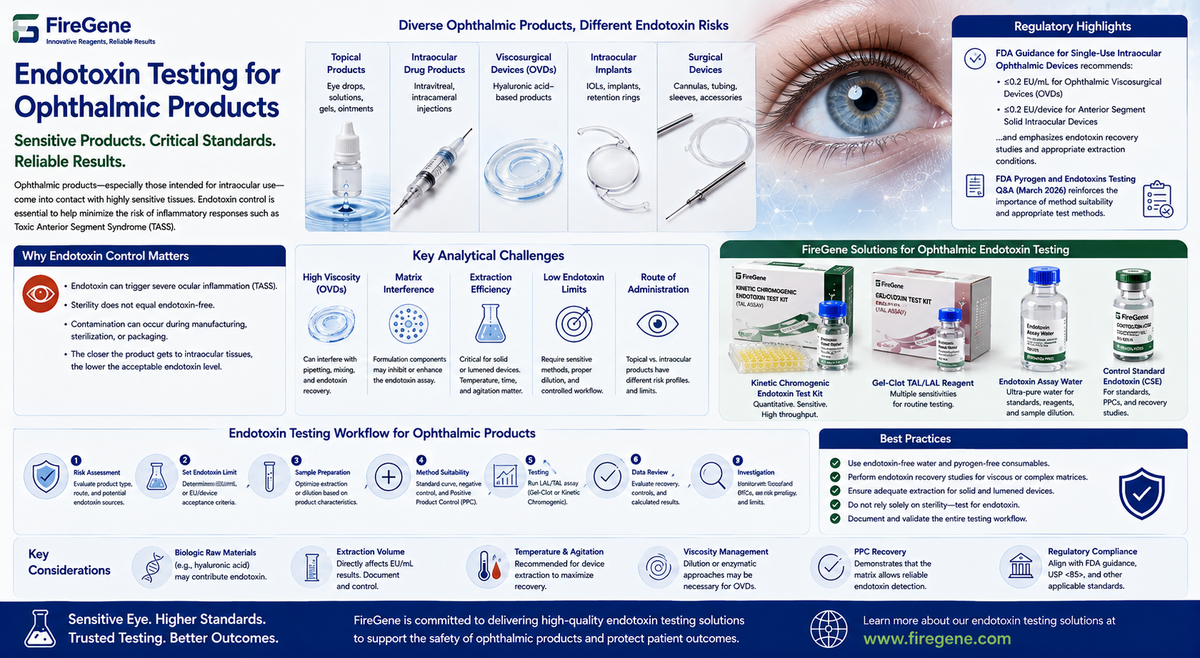
Introduction
The eye is an unusually sensitive biological environment.
That is why endotoxin testing for ophthalmic products cannot always be approached in exactly the same way as endotoxin testing for conventional injectable drugs.
Ophthalmic products include a broad range of dosage forms and applications, including:
- Topical eye drops
- Ophthalmic solutions and suspensions
- Ophthalmic gels
- Ophthalmic ointments
- Intraocular fluids
- Ophthalmic viscosurgical devices (OVDs)
- Intraocular lenses (IOLs)
- Intraocular implants
- Single-use intraocular surgical instruments and accessories
The regulatory and analytical considerations can differ significantly depending on where the product comes into contact with the eye.
For a topical eye drop, the endotoxin risk profile may be different from that of an injectable ophthalmic product.
For an intraocular device, the concern is even more direct: endotoxin can be introduced into highly sensitive ocular tissues during surgery.
FDA specifically developed guidance for endotoxin testing of single-use intraocular ophthalmic devices because endotoxin contamination has been associated with Toxic Anterior Segment Syndrome (TASS) following intraocular surgery.
This creates a critical principle for pharmaceutical and medical-device manufacturers:
The closer a product gets to sensitive intraocular tissues, the more important product-specific endotoxin control and method suitability become.
In 2026, this topic is particularly relevant because FDA's March 2026 revision of its broader Pyrogen and Endotoxins Testing: Questions and Answers guidance further emphasizes appropriate endotoxin-testing methods, acceptance criteria, and method suitability.
1. Why Endotoxin Testing Is Especially Important for Ophthalmic Products
Endotoxin is primarily associated with the outer membrane of Gram-negative bacteria.
Unlike viable bacteria, endotoxin can remain after microorganisms have been destroyed.
This means:
Sterility ≠ endotoxin-free
A product can satisfy a microbial sterility requirement and still contain endotoxin.
For ophthalmic products, this distinction can be especially important.
FDA's intraocular-device guidance notes that endotoxin contamination has been associated with TASS, a sterile inflammatory condition affecting the anterior segment of the eye after intraocular surgery.
This is why endotoxin control should be considered independently from:
- Sterility testing
- Bioburden testing
- Particulate testing
- Container-closure testing
Each addresses a different aspect of product quality.
2. Not All Ophthalmic Products Have the Same Endotoxin Risk
One of the biggest mistakes in ophthalmic endotoxin testing is treating every ophthalmic product as if it had the same risk.
It does not.
Consider three broad categories.
Topical Ophthalmic Products
These are applied to the surface of the eye.
Examples include:
- Eye drops
- Ophthalmic gels
- Ointments
- Suspensions
The need for endotoxin limits and testing depends on the product, formulation, intended use, and applicable regulatory requirements.
Intraocular Drug Products
These may be injected directly into the eye.
Examples include products intended for:
- Intravitreal administration
- Intracameral administration
- Other intraocular routes
Because the product bypasses many of the body's external barriers, endotoxin control becomes particularly important.
Intraocular Devices
These include:
- Intraocular lenses
- Ophthalmic viscosurgical devices
- Intraocular implants
- Certain surgical accessories
- Cannulated or lumened ophthalmic devices
These products can require specialized extraction and endotoxin-testing strategies.
FDA's specific guidance covers devices used within the eye, including intraocular fluids, anterior-segment solid devices, glaucoma devices, and certain irrigation/aspiration sleeves and tubing.
3. The Special Risk of Intraocular Endotoxin
The eye is not simply a smaller version of another injection site.
Ocular tissues can respond strongly to inflammatory stimuli.
This is one reason FDA established specific recommendations for intraocular devices.
The FDA guidance explains that TASS has been associated with endotoxin contamination and that intraocular devices can potentially become contaminated during manufacturing, sterilization, or packaging.
This means endotoxin control needs to cover the entire product lifecycle.
Potential sources include:
- Raw materials
- Process water
- Cleaning processes
- Manufacturing equipment
- Device surfaces
- Packaging
- Sterilization processes
- Handling
- Storage
4. What Is Toxic Anterior Segment Syndrome?
Toxic Anterior Segment Syndrome (TASS) is a sterile inflammatory reaction occurring in the anterior segment of the eye following intraocular surgery.
Unlike an infectious postoperative complication, TASS is not necessarily caused by viable microorganisms.
Instead, inflammatory substances—including endotoxin in certain cases—can trigger the reaction.
FDA's guidance was developed specifically in response to the risk of TASS and its association with endotoxin-contaminated ophthalmic products and devices.
This makes TASS an important reminder that:
A sterile product is not necessarily a pyrogenically safe product.
5. Endotoxin Can Enter Ophthalmic Products in Multiple Ways
Manufacturers should consider endotoxin risk from the earliest stages of product development.
Raw Materials
Biologically derived materials can be particularly important.
For example, FDA's intraocular-device guidance specifically discusses sodium hyaluronate-based OVDs and identifies biological-origin raw materials as potential endotoxin sources.
Water
Water-containing manufacturing processes create additional endotoxin-control considerations.
Water systems should therefore be appropriately monitored and controlled.
This connects directly with the broader FireGene discussion of Why Water System Monitoring Is the Foundation of Reliable Endotoxin Testing.
Manufacturing Equipment
Equipment surfaces can become contaminated if cleaning and depyrogenation processes are inadequate.
Packaging
Endotoxin contamination can potentially occur through packaging and handling processes.
Sterilization
Sterilization should not automatically be interpreted as endotoxin removal.
6. Ophthalmic Viscosurgical Devices Present a Unique Challenge
Ophthalmic viscosurgical devices, commonly called OVDs, are widely used during ophthalmic surgery.
They may contain viscous materials such as hyaluronic-acid-based formulations.
This creates an unusual analytical problem.
The product may be:
- Highly viscous
- Polymer-rich
- Biologically derived
- Difficult to dilute
- Capable of interacting with endotoxin
FDA specifically notes that the viscosity of OVDs can interfere with bacterial endotoxin testing and recommends recovery studies using known endotoxin spikes during BET method validation.
This is a perfect example of why a commercial endotoxin reagent cannot simply be assumed to work identically across all ophthalmic matrices.
7. Why Viscosity Can Interfere With Endotoxin Testing
Highly viscous ophthalmic formulations can create several analytical problems.
A viscous sample may affect:
- Mixing
- Pipetting accuracy
- Endotoxin accessibility
- Reaction kinetics
- Sample homogeneity
- Dilution accuracy
As a result, the laboratory could observe unexpectedly low or variable endotoxin recovery.
This can create a dangerous situation:
True endotoxin concentration
↓
Poor sample accessibility
↓
Incomplete endotoxin recovery
↓
Artificially low test result
Therefore, laboratories should evaluate the sample matrix rather than assuming that the measured result represents the total endotoxin burden.
8. Endotoxin Recovery Is Critical for Ophthalmic Products
A recovery study is one of the most important elements of ophthalmic endotoxin method development.
The basic concept is:
Known endotoxin spike + ophthalmic product
↓
BET
↓
Measured endotoxin
↓
Calculate recovery
If the expected endotoxin spike is not recovered appropriately, the laboratory needs to investigate potential causes.
Possible factors include:
- Viscosity
- Binding
- Matrix interference
- Dilution
- pH
- Formulation components
- Inadequate mixing
- Extraction efficiency
FDA's intraocular-device guidance specifically recommends endotoxin-spike recovery studies for OVD method validation.
For a broader explanation of how to design and interpret recovery studies, see FireGene's Endotoxin Recovery Studies Explained.
9. Endotoxin Limits for Ophthalmic Products Are Not One-Size-Fits-All
The endotoxin limit depends heavily on the product and route.
This is particularly important for ophthalmic products because the acceptable limit can differ dramatically between:
- Ophthalmic drug products
- Intraocular fluids
- Solid intraocular devices
- Single-use surgical accessories
FDA's intraocular-device guidance provides specific recommendations.
For OVDs, the guidance recommends a release endotoxin limit of:
≤0.2 EU/mL
For anterior-segment solid intraocular devices, FDA recommends:
≤0.2 EU/device
These are FDA recommendations for the products covered by that guidance, not universal limits for every ophthalmic product.
That distinction is essential.
Manufacturers should establish the applicable specification based on the product, intended use, route, regulatory framework, and relevant standards.
10. Why EU/mL and EU/device Matter
Consider a solid intraocular device.
The acceptance criterion may be expressed as:
EU/device
But the laboratory may perform an extraction and measure:
EU/mL
These values must be connected through the extraction procedure.
For example, if:
0.2 EU/device
is the applicable limit and the device is extracted into:
40 mL
then the equivalent concentration is:
0.2 EU ÷ 40 mL = 0.005 EU/mL
This demonstrates why sample preparation and extraction volume are not secondary details.
They directly influence the analytical sensitivity required from the endotoxin method.
11. Extraction Is a Critical Step for Intraocular Devices
Solid ophthalmic devices cannot always be placed directly into a conventional endotoxin reaction mixture.
Instead, endotoxin is typically extracted into an appropriate solution before testing.
FDA's guidance recommends that the extraction conditions be selected with consideration of:
- Device size
- Endotoxin limit
- Assay sensitivity
- Extraction efficiency
For solid intraocular devices, the guidance discusses a standard 40 mL/device extraction ratio, while allowing adjustment for small devices under the applicable framework.
The extraction process therefore becomes part of the analytical method.
A poor extraction method can produce a misleadingly low result even when the endotoxin assay itself is functioning perfectly.
12. Temperature and Agitation Can Influence Extraction
FDA's intraocular-device guidance recommends extraction at 37–40°C with agitation for at least 60 minutes to maximize extraction efficiency for the products covered by its recommendations. For cannulated or lumened devices, the guidance describes filling the fluid pathway with pre-warmed extraction medium and maintaining it at approximately 37°C for at least 60 minutes.
This illustrates an important principle:
The extraction procedure should be scientifically justified for the specific device rather than treated as a generic sample-preparation step.
For ophthalmic products with complex surfaces or internal fluid paths, extraction conditions may determine whether endotoxin is actually accessible to the assay.
13. Cannulated and Lumened Ophthalmic Devices Need Special Attention
Some ophthalmic surgical accessories contain:
- Tubing
- Sleeves
- Internal channels
- Fluid pathways
In these products, endotoxin may reside on the internal surface rather than the exterior.
Therefore, simply immersing the device in extraction solution may not provide adequate exposure.
The extraction strategy may need to ensure that the fluid pathway itself is contacted by the extraction medium.
FDA specifically includes irrigation/aspiration sleeves and tubing within the scope of its intraocular-device endotoxin recommendations.
This is a good example of why device geometry can influence endotoxin testing.
14. Why Method Suitability Cannot Be Skipped
A common misconception is:
“The endotoxin reagent is validated, so our product method is already validated.”
This is incorrect.
The reagent manufacturer can demonstrate reagent performance.
But the laboratory still needs to demonstrate that the specific ophthalmic product or device extract does not interfere with the assay.
This principle applies across:
- Gel-Clot
- Kinetic Chromogenic
- Kinetic Turbidimetric
- Other validated endotoxin approaches
FireGene's guide How to Validate an Endotoxin Test Method explains this distinction in detail.
15. Positive Product Controls Help Demonstrate Matrix Suitability
The Positive Product Control, or PPC, is particularly valuable for complex ophthalmic products.
The workflow is:
Ophthalmic sample
Known endotoxin spike
↓
Endotoxin assay
↓
Recovery calculation
A successful PPC provides evidence that the product matrix allows endotoxin to be detected.
If PPC recovery fails, the laboratory should investigate:
- Inhibition
- Enhancement
- Viscosity
- pH
- Sample dilution
- Extraction
- Reagent conditions
A standard curve alone cannot answer these questions.
16. Kinetic Chromogenic Endotoxin Testing for Ophthalmic Products
For quantitative ophthalmic endotoxin testing, a kinetic chromogenic endotoxin assay can provide useful numerical data.
The method monitors the development of a chromogenic reaction and calculates endotoxin concentration against a standard curve.
Potential advantages include:
- Quantitative EU/mL results
- Objective optical detection
- Multiple samples per plate
- Numerical trend analysis
- Evaluation of multiple dilutions
- Easier comparison of recovery experiments
FireGene's Kinetic Chromogenic Endotoxin Test Kit uses a 96-well format and 405 nm kinetic absorbance detection. The product page specifies a stated detection range of 0.005–10 EU/mL and compatibility with microplate readers capable of 405 nm absorbance measurement.
For ophthalmic applications, however, the critical point is not simply choosing a quantitative assay.
The method must first demonstrate suitability for the specific ophthalmic matrix or device extract.
17. Gel-Clot Testing Still Has a Place
The Gel-Clot TAL/LAL method can remain useful for laboratories that prefer:
- A straightforward endpoint
- Minimal instrumentation
- Simple routine testing
- Qualitative or semi-quantitative results
FireGene offers Gel-Clot TAL/LAL Reagent with sensitivities including 0.03, 0.06, 0.125, 0.25, and 0.5 EU/mL.
The appropriate sensitivity should be selected based on:
- Product endotoxin limit
- Sample concentration
- Extraction volume
- Required sensitivity
- Applicable dilution
- Validated method
For particularly low-limit intraocular products, the required sensitivity should be evaluated carefully before selecting the test configuration.
18. Endotoxin Assay Water Should Not Be Overlooked
When testing at very low endotoxin levels, laboratory background becomes increasingly important.
Water may be used for:
- Sample dilution
- Standard preparation
- Reagent preparation
- Control preparation
If the water itself contains endotoxin, it can contribute background signal.
FireGene's Endotoxin Assay Water is specifically intended for endotoxin testing workflows, including sample dilution, negative controls, and CSE dissolution/dilution. The product page states a specification of less than 0.005 EU/mL and describes compatibility with gel-clot and chromogenic LAL/TAL assays.
For low-endotoxin ophthalmic applications, controlled water and appropriately qualified consumables should therefore be considered part of the analytical system.
19. Why Viscous Products May Require More Than Dilution
Dilution is one common strategy for reducing matrix interference.
But highly viscous ophthalmic products can create a difficult trade-off.
Suppose an OVD has strong interference at the original concentration.
The laboratory might attempt:
1:2 dilution
↓
1:4 dilution
↓
1:8 dilution
↓
1:16 dilution
As dilution increases, interference may decrease.
But the endotoxin concentration also decreases.
At some point, the sample may fall below the assay's useful detection range.
FDA's OVD guidance discusses this problem and notes that for high-molecular-weight hyaluronic-acid OVDs, an endotoxin-free enzyme may potentially be used to break down large molecules and improve endotoxin accessibility, avoiding reliance on very high dilution factors.
This is a particularly interesting example of how sample preparation can be just as important as reagent selection.
20. The Importance of Matrix-Specific Validation
Ophthalmic formulations can contain:
- Hyaluronic acid
- Polymers
- Surfactants
- Salts
- Buffers
- Preservatives
- Lipids
- Proteins
- Other excipients
Each can potentially affect endotoxin detection differently.
Therefore, method suitability should be demonstrated using the actual formulation whenever practical.
For devices, the actual device material and extraction process should be considered.
For formulations, the final product matrix is generally more informative than testing only individual raw materials.
21. Sterilization Does Not Eliminate Endotoxin Risk
Ophthalmic products may undergo:
- Steam sterilization
- Filtration
- Radiation
- Ethylene oxide
- Other sterilization approaches
But manufacturers should avoid assuming:
Sterilization = Depyrogenation
These are different concepts.
A sterilization process targets viable microorganisms.
Endotoxin control requires a separate strategy.
FDA specifically notes that intraocular devices can potentially acquire endotoxin during manufacturing, sterilization, or packaging.
Therefore, endotoxin specifications and testing should remain part of the overall quality strategy.
22. Endotoxin Testing Should Begin With Raw Materials
For some ophthalmic products, the most effective endotoxin strategy begins before formulation.
Raw materials should be assessed according to their endotoxin risk.
This is particularly important for:
- Biologically derived materials
- Hyaluronic acid
- Proteins
- Natural polymers
- Water-containing ingredients
FireGene's recent article Endotoxin Testing for Raw Materials and Excipients provides a broader framework for controlling endotoxin before materials enter pharmaceutical manufacturing.
This upstream strategy can reduce the burden on downstream purification and final-product testing.
23. A Practical Ophthalmic Endotoxin Testing Workflow
A robust workflow can be structured as follows.
Step 1 — Define the Product
Determine whether the product is:
- Topical
- Injectable
- Intraocular fluid
- Implant
- Surgical accessory
↓
Step 2 — Establish the Applicable Endotoxin Limit
Determine whether the specification should be expressed as:
- EU/mL
- EU/device
- EU/unit
- Another scientifically justified unit
↓
Step 3 — Identify Endotoxin Sources
Evaluate:
- Raw materials
- Water
- Equipment
- Packaging
- Manufacturing process
↓
Step 4 — Develop Sample Preparation
For formulations:
- Dilution
- Mixing
- pH
- Viscosity management
For devices:
- Extraction volume
- Temperature
- Agitation
- Internal fluid-path exposure
↓
Step 5 — Select TAL/LAL Reagent
Evaluate:
- Gel-Clot
- Kinetic Chromogenic
- Other validated approaches
↓
Step 6 — Perform Method Suitability
Evaluate:
- Standard curve
- Negative control
- PPC
- Recovery
- Precision
↓
Step 7 — Establish Routine Testing
Define:
- Sampling plan
- Acceptance criteria
- Calculation
- Documentation
↓
Step 8 — Trend the Data
Monitor:
- Endotoxin levels
- PPC recovery
- Batch variability
- Raw material trends
- Reagent lot effects
24. Common Mistakes in Ophthalmic Endotoxin Testing
Mistake 1: Treating All Ophthalmic Products the Same
Topical eye drops and intraocular implants do not necessarily have the same endotoxin risk.
Mistake 2: Ignoring the Route of Administration
The intended site of exposure is fundamental to endotoxin risk assessment.
Mistake 3: Using an Inappropriate Extraction Volume
For device testing, extraction volume directly affects the reported concentration.
Mistake 4: Testing Viscous OVDs Without Recovery Studies
Viscosity can interfere with BET performance.
Mistake 5: Diluting Until the Sample Passes
Dilution must remain within the scientifically justified and validated range.
Mistake 6: Ignoring Internal Fluid Paths
For lumened devices, endotoxin may be located inside the fluid pathway.
Mistake 7: Assuming Sterility Means Pyrogen Safety
Sterility and endotoxin control are separate requirements.
Mistake 8: Using Ordinary Laboratory Water
Low-level testing can be affected by background endotoxin.
Mistake 9: Looking Only at the Standard Curve
A good standard curve does not prove sample suitability.
Mistake 10: Ignoring Raw Material Endotoxin
For biologically derived ophthalmic materials, upstream endotoxin control can be critical.
25. Regulatory Perspective in 2026
The regulatory environment surrounding endotoxin testing is becoming broader rather than narrower.
FDA's March 2026 Pyrogen and Endotoxins Testing: Questions and Answers provides updated recommendations concerning USP <85>, USP <161>, and AAMI ST72 and recognizes gel-clot, photometric, and kinetic testing approaches.
At the same time, USP <86> has expanded the compendial framework to include bacterial endotoxin testing using recombinant reagents. USP notes that users should verify that the selected method is suitable for the intended material, drug substance, or drug product.
For ophthalmic products, USP <771> remains an important quality framework for ophthalmic products, which are defined as sterile products intended for application to ocular structures and surrounding spaces.
For intraocular devices, FDA's dedicated guidance remains particularly relevant, with current FDA device-classification pages continuing to reference the guidance in 2026.
The broader direction is clear:
Product-specific risk assessment + method suitability + scientifically justified testing
is becoming more important than simply performing a generic endotoxin assay.
26. How FireGene Can Support Ophthalmic Endotoxin Testing
FireGene's endotoxin testing portfolio can support laboratories working with pharmaceutical, biological, and medical-device samples.
Kinetic Chromogenic Endotoxin Test Kit
For laboratories requiring quantitative results, the FireGene Kinetic Chromogenic Endotoxin Test Kit provides a 96-well format with kinetic 405 nm absorbance detection.
This can be useful during:
- Method development
- Dilution screening
- Recovery studies
- Routine quantitative testing
- Batch trending
Gel-Clot TAL/LAL Reagent
For laboratories that prefer a simple endpoint method, FireGene Gel-Clot TAL/LAL Reagent provides multiple sensitivity options.
Control Standard Endotoxin
CSE can support:
- Standard preparation
- PPC studies
- Recovery experiments
- Method development
Endotoxin Assay Water
FireGene Endotoxin Assay Water can be used for sample dilution, CSE preparation, controls, and reagent workflows.
The important point is that these products should be incorporated into a validated, product-specific endotoxin testing method, rather than treated as standalone compliance solutions.
27. Frequently Asked Questions
Do all ophthalmic products require the same endotoxin limit?
No. The applicable endotoxin requirement depends on the product, route of administration, intended use, and regulatory framework.
Are topical eye drops subject to the same endotoxin requirements as intraocular products?
Not necessarily. The risk associated with direct intraocular exposure can be substantially different from topical administration. The applicable specification should be determined based on the specific product and regulatory requirements.
What is the FDA endotoxin limit for intraocular solid devices?
FDA's dedicated guidance recommends ≤0.2 EU/device for anterior-segment solid intraocular devices covered by the guidance.
What is the FDA recommendation for OVDs?
For OVDs within the scope of the guidance, FDA recommends a release limit of ≤0.2 EU/mL.
Why is endotoxin testing difficult for OVDs?
High viscosity and polymeric components can interfere with endotoxin detection and reduce recovery.
Is dilution enough to solve OVD interference?
Not always. Excessive dilution can reduce the detectable endotoxin concentration. FDA discusses alternative sample-preparation considerations for certain high-molecular-weight hyaluronic-acid OVDs.
Can I use kinetic chromogenic testing for ophthalmic products?
Potentially, yes. The method can provide quantitative results, but product-specific method suitability must be demonstrated.
Why do I need a PPC?
PPC helps demonstrate that the ophthalmic matrix or device extract does not cause unacceptable interference with endotoxin detection.
Can sterilization eliminate endotoxin?
Sterilization and depyrogenation are different processes. Endotoxin should therefore be controlled independently.
Is Endotoxin Assay Water important for ophthalmic testing?
Yes. When testing at low endotoxin levels, endotoxin-controlled water helps reduce background contamination during sample preparation and standard/control preparation.
Conclusion
Endotoxin testing for ophthalmic products requires a more specialized mindset than conventional pharmaceutical endotoxin testing.
The key question is not simply:
“Does the sample contain endotoxin?”
It is:
“Can we reliably detect and quantify endotoxin at the clinically and regulatorily relevant level in this specific ophthalmic matrix or device?”
For topical products, intraocular drugs, OVDs, IOLs, implants, and surgical accessories, the analytical strategy can differ significantly.
A robust program should integrate:
Product risk assessment
→
Route-specific endotoxin limit
→
Raw material control
→
Validated extraction or sample preparation
→
Matrix interference evaluation
→
PPC recovery
→
Appropriate TAL/LAL Reagent
→
Sensitive quantitative or qualitative testing
→
Data trending and investigation
The experience with intraocular products also demonstrates why endotoxin control cannot be reduced to a final QC test.
For products entering the eye, sterility alone is not enough.
Reliable endotoxin testing requires control of the entire analytical chain—from raw materials and manufacturing water to extraction, dilution, reagent selection, recovery, and final interpretation.
As pharmaceutical and medical-device technologies continue to converge, ophthalmic endotoxin testing will increasingly depend on product-specific, risk-based, and scientifically justified analytical strategies.
And for manufacturers working with intraocular products, one principle should remain central:
The lower the endotoxin limit—and the more sensitive the biological site—the less room there is for an inadequately validated testing method.
FDA: Pyrogen and Endotoxins Testing – Questions and Answers (2026)
FDA: Endotoxin Testing Recommendations for Single-Use Intraocular Ophthalmic Devices
FireGene Endotoxin Testing
Ready to run your endotoxin assay?
FireGene offers a complete endotoxin testing toolkit — from TAL reagents and CSE standards to pyrogen-free consumables and LAL reagent water. All products are aligned with USP <85>, EP 2.6.14, and JP 4.01.


