
Introduction
Peptides are increasingly used in pharmaceutical development, biotechnology research, cell-based assays, and animal studies. Because peptides may be administered to biological systems or used in sensitive in vitro experiments, endotoxin contamination is an important quality and safety parameter.
Endotoxins are lipopolysaccharide components associated with the outer membrane of Gram-negative bacteria. Even very low levels can potentially trigger inflammatory responses or interfere with biological experiments. For this reason, peptide samples intended for pharmaceutical, animal, or cell-based applications may require appropriate bacterial endotoxin testing (BET).
However, peptide endotoxin testing is not simply a matter of measuring an endotoxin concentration. The appropriate acceptance criterion depends on the intended use, dosage, route of administration, sample concentration, and analytical method.
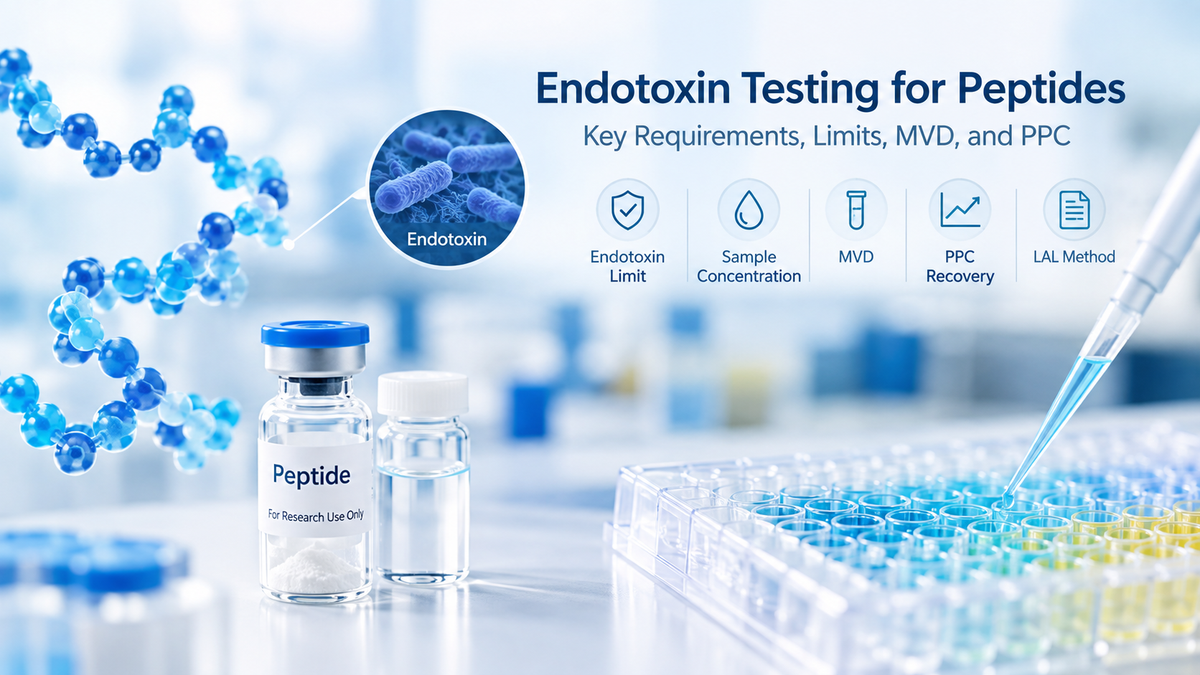
This article explains the major considerations for endotoxin testing of peptide samples, including endotoxin limits, sample dilution, Maximum Valid Dilution (MVD), Positive Product Control (PPC), and LAL assay performance.
1. Why Is Endotoxin Testing Important for Peptides?
Peptides can be highly sensitive biological materials, and endotoxin contamination may affect both product safety and experimental reliability.
For example, endotoxin contamination in peptide preparations may:
· Trigger unwanted inflammatory responses
· Affect animal studies
· Alter immune-cell activity
· Influence cell-based assay results
· Introduce variability between experiments
· Compromise the interpretation of biological data
· Create concerns during pharmaceutical development
Importantly, endotoxin contamination can originate from multiple stages of peptide production and handling, including raw materials, water, equipment, containers, purification processes, and manufacturing environments.
Therefore, endotoxin control should be considered throughout the peptide workflow rather than only at the final testing stage.
2. What Is the Endotoxin Limit for Peptides?
One of the most important questions in peptide endotoxin testing is:
How much endotoxin is acceptable?
There is no single universal endotoxin limit that applies to every peptide.
The appropriate limit depends on factors such as:
· Intended application
· Route of administration
· Maximum dose
· Patient or animal exposure
· Sample concentration
· Applicable regulatory or pharmacopoeial requirements
For pharmaceutical products, the endotoxin limit is generally established based on the maximum dose that can be administered within a defined period.
 A commonly used calculation concept is:
Endotoxin Limit = K / M
where:
· K represents the permitted endotoxin exposure
· M represents the maximum dose administered per kilogram within the relevant time period
The resulting limit may be expressed as EU/mL, EU/mg, or EU/dose, depending on the product and testing strategy.
Therefore, it is not appropriate to automatically assign one fixed value such as "≤0.5 EU/mg" to every peptide.
3. EU/mL vs. EU/mg: Which Is Better for Peptides?
The appropriate unit depends on how the peptide sample is characterized.
EU/mL
EU/mL is commonly used when testing a peptide solution.
For example:
Peptide concentration: 2 mg/mL
Endotoxin result: 0.05 EU/mL
This format is particularly convenient for liquid samples.
EU/mg
EU/mg can be useful when the peptide is evaluated according to its mass concentration or when establishing a product-specific specification.
For example:
Endotoxin level: 0.02 EU/mg peptide
When converting between EU/mL and EU/mg, the peptide concentration must be considered.
For example:
EU/mg = EU/mL ÷ peptide concentration (mg/mL)
This distinction is important when comparing endotoxin results from different peptide preparations.
4. LAL Testing for Peptide Samples
The Limulus Amebocyte Lysate (LAL) assay is widely used for bacterial endotoxin testing.
Several LAL formats are available, including:
· Gel-clot method
· Kinetic turbidimetric method
· Kinetic chromogenic method
For quantitative peptide endotoxin testing, the kinetic chromogenic method can be particularly useful because it provides quantitative results based on the relationship between endotoxin concentration and reaction kinetics.
However, peptide samples can sometimes interfere with the LAL reaction.
This makes sample suitability testing an important part of the analytical procedure.
5. Why Can Peptides Interfere with LAL Assays?
A peptide preparation is rarely composed of peptide molecules alone. The formulation may also contain:
· Buffers
· Salts
· Stabilizers
· Surfactants
· Excipients
· Preservatives
· Other formulation components
These substances may influence the LAL reaction.
Depending on the sample matrix, the assay may experience either:
Inhibition
The sample suppresses the LAL reaction, potentially causing the measured endotoxin concentration to appear lower than the actual concentration.
Enhancement
The sample increases the apparent response, potentially producing an artificially high endotoxin result.
This is particularly important because a very low endotoxin result does not automatically prove that the peptide sample is free from endotoxin interference.
6. PPC: A Critical Control for Peptide Endotoxin Testing
One of the most important controls for peptide samples is the Positive Product Control (PPC).
PPC evaluates whether the peptide sample matrix interferes with endotoxin detection.
In a typical PPC experiment, a known amount of endotoxin is added to the peptide sample. The assay then measures how much of the added endotoxin can be recovered.
A commonly used acceptance range for LAL PPC recovery is:
50%–200%
For example:
|
PPC Result |
General Interpretation |
|
80% |
Acceptable |
|
105% |
Acceptable |
|
180% |
Acceptable |
|
35% |
Potential inhibition |
|
250% |
Potential enhancement |
If PPC recovery falls outside the established acceptance range, the sample may require further investigation and potentially greater dilution or modification of the sample preparation.
7. What Is MVD in Peptide Endotoxin Testing?
Maximum Valid Dilution (MVD) is another important parameter.
MVD represents the maximum dilution at which the sample can be diluted while still allowing the endotoxin test to demonstrate compliance with the applicable endotoxin limit.
A simplified relationship is:
MVD = Endotoxin Limit ÷ λ
where λ represents the labeled sensitivity of the endotoxin reagent under the applicable test conditions.
For example, if:
· Endotoxin limit = 1.0 EU/mL
· LAL sensitivity = 0.01 EU/mL
then:
MVD = 1.0 ÷ 0.01 = 100
The sample may therefore have a maximum valid dilution of 1:100 under this simplified example.
The actual calculation and application should follow the applicable analytical method and pharmacopoeial requirements.
8. Why Is Sample Dilution Important?
Dilution can be extremely useful when testing peptide samples.
If the peptide matrix causes LAL inhibition or enhancement, dilution can reduce the concentration of interfering substances.
For example:
Undiluted peptide → strong matrix interference
↓
1:5 dilution → reduced interference
↓
1:10 dilution → acceptable PPC recovery
↓
Endotoxin result → suitable for interpretation
However, dilution should not be performed arbitrarily.
The selected dilution should:
1. Reduce matrix interference
2. Maintain adequate assay sensitivity
3. Remain within the MVD
4. Produce acceptable PPC recovery
5. Meet the requirements of the validated analytical procedure
Therefore, the highest possible dilution is not necessarily the best dilution.
9. Important Endotoxin Testing Parameters for Peptides
When establishing a peptide endotoxin testing method, laboratories should consider several parameters together.
|
Parameter |
Why It Matters |
|
Endotoxin Limit |
Defines the maximum acceptable endotoxin level |
|
Sample Concentration |
Needed to interpret EU/mL or EU/mg |
|
LAL Sensitivity |
Determines assay detection capability |
|
MVD |
Defines the maximum valid dilution |
|
PPC Recovery |
Evaluates sample inhibition/enhancement |
|
Standard Curve |
Supports quantitative assay validity |
|
Negative Control |
Helps identify background contamination |
|
Replicates |
Improve confidence in quantitative results |
These parameters should be evaluated as an integrated testing strategy rather than individually.
10. Kinetic Chromogenic Endotoxin Testing for Peptides
For quantitative peptide analysis, the kinetic chromogenic LAL assay offers several advantages.
The method monitors the development of a chromogenic reaction over time. The measured reaction response is correlated with endotoxin concentration through a validated standard curve.
Potential advantages include:
· Quantitative endotoxin measurement
· High sensitivity
· Broad analytical applications
· Suitable for low endotoxin levels
· Ability to evaluate sample dilution
· Compatibility with microplate-based workflows
However, quantitative performance depends on appropriate controls, reagent handling, standard curve performance, and sample suitability.
For this reason, a peptide endotoxin test should not rely solely on the final numerical result.
11. Common Mistakes in Peptide Endotoxin Testing
Mistake 1: Using the same endotoxin limit for every peptide
Different peptides may have different applications and dosing conditions.
Better approach: Establish the acceptance criterion based on the intended use and applicable requirements.
Mistake 2: Reporting only EU/mL
EU/mL does not always provide enough information for comparing peptide products with different concentrations.
Better approach: Consider both sample concentration and the appropriate reporting unit.
Mistake 3: Ignoring PPC recovery
A low endotoxin result may be unreliable if the sample strongly inhibits the assay.
Better approach: Evaluate PPC recovery as part of sample suitability.
Mistake 4: Diluting beyond MVD
Excessive dilution may reduce assay sensitivity to an unacceptable level.
Better approach: Select a dilution that addresses matrix interference while remaining within the valid analytical range.
Mistake 5: Assuming a clean peptide is endotoxin-free
Peptide purity and endotoxin purity are not the same thing.
A peptide can have high chemical purity while still containing biologically significant endotoxin contamination.
12. Recommended Workflow for Peptide Endotoxin Testing
A practical peptide endotoxin testing workflow can be summarized as:
Define → Prepare → Dilute → Verify → Test → Evaluate
Step 1: Define the endotoxin limit
Determine the appropriate acceptance criterion based on the peptide's intended use.
Step 2: Characterize the sample
Record peptide concentration, formulation, buffer composition, and other relevant matrix components.
Step 3: Select the LAL method
Choose gel-clot, kinetic turbidimetric, or kinetic chromogenic testing according to the analytical requirements.
Step 4: Determine an appropriate dilution
Calculate MVD and evaluate potential sample interference.
Step 5: Perform PPC testing
Confirm that the peptide matrix does not cause unacceptable inhibition or enhancement.
Step 6: Perform endotoxin testing
Analyze the sample using appropriate standards and controls.
Step 7: Evaluate the result
Compare the endotoxin result with the established endotoxin limit and confirm that all assay validity criteria have been met.
Conclusion
Endotoxin testing for peptides requires more than simply obtaining a low EU/mL value. A reliable testing strategy should consider the peptide's intended application, endotoxin limit, sample concentration, LAL sensitivity, MVD, PPC recovery, dilution strategy, and assay controls.
For peptide samples, PPC recovery is especially important because formulation components and peptide matrices can potentially inhibit or enhance the LAL reaction. Appropriate dilution can help minimize matrix effects, but the dilution must remain within the applicable MVD.
For research, preclinical, and pharmaceutical peptide development, a well-designed endotoxin testing strategy helps ensure that the reported result is both analytically valid and relevant to the intended application.


