
Introduction
Single-cell technologies have transformed modern biomedical research by enabling researchers to investigate cellular heterogeneity at unprecedented resolution. In skin biology, single-cell RNA sequencing (scRNA-seq) and other single-cell analysis platforms have provided new insights into epidermal differentiation, immune regulation, skin regeneration, aging, and disease mechanisms.
However, obtaining reliable single-cell data starts with one of the most critical experimental steps: tissue dissociation.
Mouse skin is a highly complex tissue composed of multiple cell types embedded within a dense extracellular matrix (ECM). Conventional dissociation methods often face challenges such as incomplete digestion, low cell recovery, reduced viability, and loss of fragile cell populations. Therefore, selecting an optimized mouse skin dissociation kit is essential for preparing high-quality single-cell suspensions.
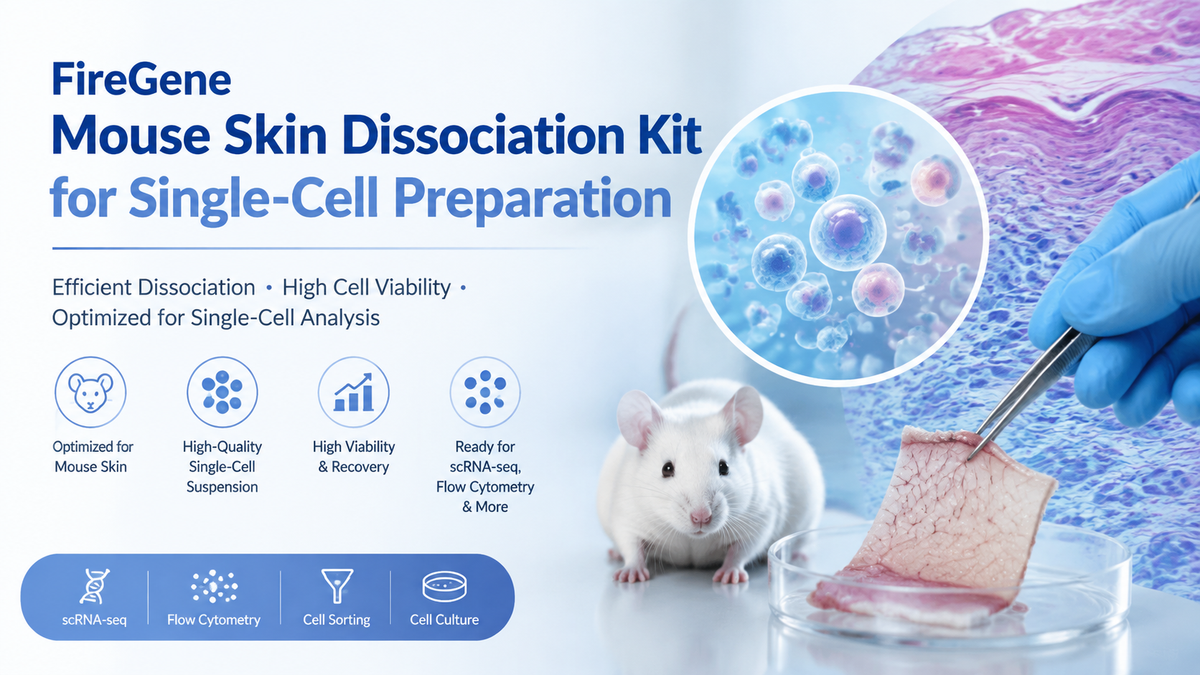
The FireGene Mouse Skin Dissociation Kit is designed to efficiently dissociate mouse skin tissue while maintaining cellular integrity and viability, providing researchers with a reliable solution for single-cell preparation, scRNA-seq, flow cytometry, and primary cell studies.
1. Why Is Mouse Skin Dissociation Challenging?
Skin is one of the most complex organs in mammals. It consists of multiple layers, including the epidermis, dermis, and underlying connective tissue. Each layer contains specialized cell populations with different biological functions.
Major cell populations in mouse skin include:
· Keratinocytes
· Fibroblasts
· Immune cells
· Endothelial cells
· Pericytes
· Stem and progenitor cells
· Stromal populations
Unlike simple tissues, skin contains abundant extracellular matrix components, including:
· Collagen
· Elastin
· Laminin
· Fibronectin
· Proteoglycans
These ECM structures provide mechanical support but also create barriers during single-cell preparation.
An inefficient dissociation process may result in:
· Incomplete tissue digestion
· Low single-cell yield
· Increased cell aggregates
· Excessive cell death
· Loss of specific cell populations
· Poor-quality sequencing data
Therefore, an optimized skin tissue dissociation protocol is required to balance efficient ECM breakdown with preservation of cellular characteristics.
2. Importance of High-Quality Single-Cell Preparation for Skin Research
Single-cell analysis depends heavily on the quality of the starting cell suspension.
A successful single-cell preparation should provide:
High Cell Viability
Living cells are essential for downstream applications such as:
· scRNA-seq
· Flow cytometry
· Cell sorting
· Functional assays
Damaged or dying cells may release intracellular contents, increasing background RNA contamination and affecting sequencing quality.
Efficient Cell Recovery
Skin contains many rare cell populations. Poor dissociation efficiency can result in the loss of important biological information.
High cell recovery helps researchers better characterize:
· Immune infiltration
· Fibroblast diversity
· Epidermal cell differentiation
· Tissue regeneration pathways
Preservation of Cell Surface Markers
For applications such as flow cytometry and fluorescence-activated cell sorting (FACS), maintaining cell surface proteins is critical.
Harsh digestion conditions may damage:
· CD markers
· Receptors
· Membrane proteins
An optimized dissociation system helps maintain accurate cell identification and classification.
3. FireGene Mouse Skin Dissociation Kit: Optimized for Single-Cell Research
The FireGene Mouse Skin Dissociation Kit provides an optimized enzymatic solution specifically developed for mouse skin tissue preparation.
Unlike general tissue digestion reagents, this kit is formulated to address the unique characteristics of skin tissue.
Key advantages include:
3.1 Skin-Specific Enzymatic Dissociation
The kit uses a carefully optimized enzyme formulation to efficiently break down skin ECM components while minimizing cellular damage.
This allows researchers to obtain:
· More complete tissue dissociation
· Higher-quality single-cell suspensions
· Better preservation of cellular diversity
3.2 Improved Single-Cell Suspension Quality
A common challenge in skin research is obtaining a uniform cell suspension without excessive debris or cell clumping.
The FireGene Mouse Skin Dissociation Kit helps improve:
· Cell dispersion
· Suspension uniformity
· Downstream experimental consistency
High-quality single-cell suspensions are particularly important for microfluidic-based platforms used in single-cell sequencing.
3.3 Compatible with Multiple Downstream Applications
The prepared cells can be used for a wide range of research applications, including:
Single-Cell RNA Sequencing (scRNA-seq)
Single-cell transcriptomics allows researchers to analyze gene expression patterns at the individual cell level.
Applications include:
· Skin development studies
· Aging research
· Regenerative medicine
· Immune microenvironment analysis
· Dermatological disease models
Flow Cytometry and Cell Sorting
High-quality skin cell suspensions are suitable for:
· Immune cell profiling
· Cell population identification
· Marker expression analysis
· FACS sorting
Primary Cell Culture
Researchers can isolate skin-derived cells for:
· In vitro functional studies
· Cell signaling research
· Differentiation experiments
4. Applications of Mouse Skin Single-Cell Analysis

4.1 Skin Development Research
Skin development involves complex interactions between epidermal cells, fibroblasts, and signaling pathways.
Single-cell analysis enables researchers to identify:
· Cell lineage transitions
· Developmental trajectories
· Gene expression changes
4.2 Skin Aging Studies
Aging affects multiple skin cell populations.
Mouse skin single-cell analysis can reveal:
· Fibroblast functional changes
· Immune aging patterns
· Altered extracellular matrix remodeling
· Cellular senescence pathways
4.3 Wound Healing and Regeneration Research
Skin regeneration requires coordinated interactions between multiple cell types.
Single-cell approaches help researchers study:
· Inflammatory responses
· Fibroblast activation
· Epidermal repair mechanisms
· Tissue remodeling processes
4.4 Skin Immunology Research
The skin contains an important immune network involving:
· T cells
· Macrophages
· Dendritic cells
· Other immune populations
Single-cell sequencing provides detailed insights into immune cell composition and activation states.
5. Mouse Skin Dissociation Workflow for Single-Cell Preparation
A typical workflow includes:
Step 1: Tissue Collection
Fresh mouse skin samples are collected and processed under optimized conditions.
Step 2: Tissue Preparation
Skin tissue is mechanically minced into smaller fragments to increase enzyme accessibility.
Step 3: Enzymatic Dissociation
The FireGene Mouse Skin Dissociation Kit is applied to digest ECM components and release individual cells.
Step 4: Filtration and Cleaning
The resulting suspension is filtered to remove undigested tissue fragments.
Step 5: Cell Quality Assessment
Researchers evaluate:
· Cell concentration
· Viability
· Cell morphology
· Single-cell suspension quality
Step 6: Downstream Analysis
Prepared cells can be used for:
· scRNA-seq
· Flow cytometry
· Cell sorting
· Molecular analysis
6. Advantages of Using an Optimized Mouse Skin Dissociation Kit
Compared with conventional laboratory-developed protocols, a specialized dissociation kit offers several benefits:
Reproducibility
Optimized reagents reduce variation between experiments.
Convenience
Pre-formulated solutions simplify workflow preparation and improve experimental efficiency.
Better Data Quality
Improved cell preparation contributes to:
· Higher-quality sequencing libraries
· More accurate cell clustering
· Reliable biological interpretation
Conclusion
High-quality tissue dissociation is the foundation of successful single-cell analysis. Because mouse skin contains complex extracellular matrix structures and diverse cellular populations, traditional dissociation approaches may not always provide optimal results.
The FireGene Mouse Skin Dissociation Kit offers an efficient and reliable solution for preparing mouse skin single-cell suspensions. By combining optimized enzymatic digestion with compatibility for advanced downstream applications, this kit supports researchers studying skin biology, regeneration, aging, immunity, and disease mechanisms.
For researchers performing mouse skin scRNA-seq, flow cytometry, or single-cell preparation, selecting a specialized skin dissociation solution can significantly improve experimental consistency and data quality.


