
Introduction
Endotoxin control should not begin with finished product release.
For pharmaceutical manufacturers, one of the most effective ways to reduce endotoxin risk is to identify and control potential contamination before raw materials and excipients enter the manufacturing process.
Raw materials, buffers, excipients, process additives, and other manufacturing inputs can become potential sources of bacterial endotoxin. If contaminated materials are introduced into a production process, downstream removal can be difficult—particularly when endotoxin becomes associated with proteins, surfaces, membranes, or complex formulation components.
This makes raw material endotoxin testing an important part of a broader pharmaceutical quality strategy.
The challenge, however, is that not every raw material requires exactly the same testing approach.
Different materials can have very different characteristics:
- Powders may require reconstitution before testing.
- Highly concentrated solutions may require dilution.
- Proteins can interact with endotoxin.
- Surfactants can affect endotoxin recovery.
- Buffers can cause inhibition or enhancement.
- Lipid-containing materials may require specialized sample preparation.
- Certain materials may have naturally high matrix interference.
As a result, a reliable raw material endotoxin testing program requires more than simply applying the same TAL/LAL Reagent procedure to every incoming material.
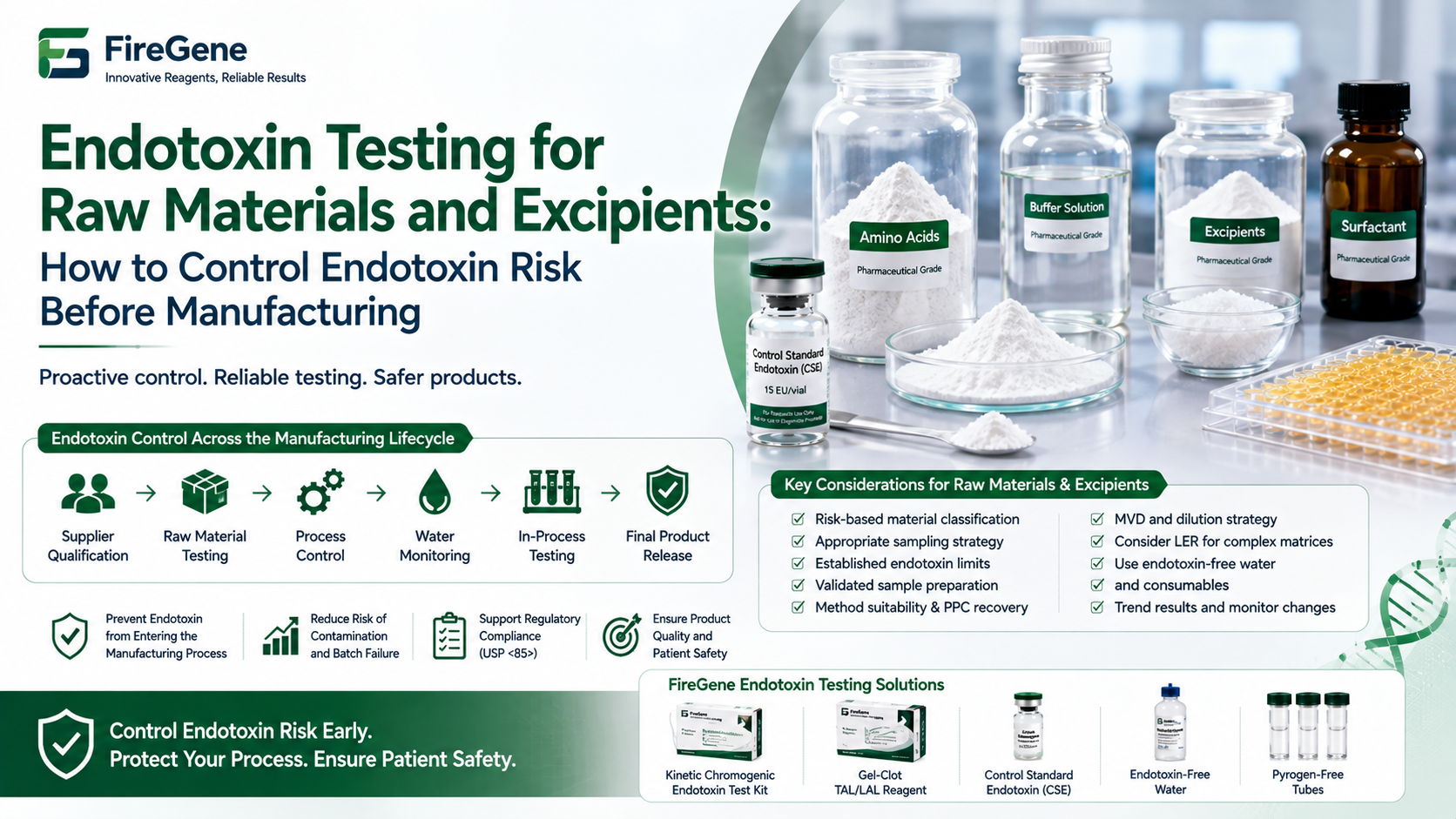
Manufacturers need to consider supplier qualification, material risk, sampling, sample preparation, endotoxin limits, method suitability, recovery, testing frequency, and long-term trending.
This guide explains how to build a practical, risk-based endotoxin testing strategy for pharmaceutical raw materials and excipients.
1. Why Raw Material Endotoxin Control Matters
Endotoxin introduced through raw materials can propagate through multiple stages of pharmaceutical manufacturing.
Consider a simplified manufacturing pathway:
Raw Material → Process Solution → Intermediate → Drug Substance → Drug Product → Final Release
If an endotoxin source enters at the beginning of this process, downstream controls may not always eliminate it.
This is particularly important when endotoxin can:
- Bind to proteins
- Associate with particles
- Adsorb onto equipment surfaces
- Persist through filtration
- Interact with formulation components
- Become masked during processing
Therefore, preventing endotoxin from entering the process is generally preferable to relying exclusively on final product testing.
A lifecycle-based strategy should combine incoming material qualification with in-process controls and final product testing.
For a broader framework, see FireGene's guide on How to Perform Endotoxin Risk Assessment Throughout the Pharmaceutical Manufacturing Lifecycle, which discusses how endotoxin risks can be evaluated from raw materials through final product release.
2. Which Raw Materials Should Be Evaluated?
Not every material presents the same endotoxin risk.
Manufacturers should classify materials according to factors such as:
- Intended use
- Contact with the final product
- Manufacturing process
- Microbial susceptibility
- Water content
- Supplier controls
- Material origin
- Processing conditions
- Potential endotoxin burden
Higher-risk materials may include:
- Pharmaceutical-grade water
- Buffers
- Amino acids
- Proteins
- Peptides
- Carbohydrates
- Biological raw materials
- Animal-derived materials
- Fermentation-derived materials
- Surfactants
- Excipients used in injectable formulations
The specific risk profile depends heavily on the manufacturing process and product.
A risk-based approach is therefore preferable to applying an identical testing program to every raw material.
3. Supplier Qualification Is the First Line of Defense
Endotoxin control begins before the material arrives at the pharmaceutical facility.
Supplier qualification should evaluate whether the supplier has adequate controls for:
- Microbial contamination
- Endotoxin contamination
- Water quality
- Manufacturing hygiene
- Cleaning
- Storage
- Transportation
- Batch traceability
Supplier documentation may include:
- Certificate of Analysis (CoA)
- Endotoxin test results
- Microbial specifications
- Manufacturing information
- Change notification procedures
- Quality agreements
However, supplier documentation should not automatically replace the manufacturer's own risk-based incoming material controls.
The appropriate balance between supplier testing and internal verification should be established through the pharmaceutical quality system.
4. Supplier CoA Does Not Automatically Mean "Endotoxin-Free"
A common mistake is to assume that a supplier's CoA eliminates the need for internal evaluation.
A CoA provides information about the tested batch according to the supplier's procedures. It does not necessarily demonstrate that the material will behave identically under the receiving laboratory's endotoxin test conditions.
Differences may exist in:
- Sampling
- Test method
- Reagent system
- Sample dilution
- Detection sensitivity
- Acceptance criteria
- Laboratory conditions
For critical materials, manufacturers should establish appropriate supplier qualification and verification strategies.
This is especially important when the raw material is used in sterile injectable or biologic manufacturing.
5. Sampling Is a Critical Part of Raw Material Endotoxin Testing
Even a highly sensitive endotoxin assay cannot compensate for an unrepresentative sample.
Sampling plans should consider:
- Number of containers
- Batch size
- Material homogeneity
- Supplier packaging
- Storage conditions
- Potential contamination points
For powders and heterogeneous materials, the sampling strategy becomes particularly important.
A single sample taken from one container may not adequately represent an entire raw material batch if contamination is unevenly distributed.
Sampling procedures should therefore be established according to the material's risk profile and the organization's validated quality system.
6. Establish an Appropriate Endotoxin Limit
Before testing a raw material, laboratories should understand what endotoxin acceptance criterion applies.
This is not always as straightforward as applying the final product endotoxin specification.
The appropriate limit may depend on:
- Intended use
- Concentration in the final product
- Maximum amount introduced into the process
- Route of administration
- Final product endotoxin limit
- Manufacturing dilution
- Process capability
A raw material used at a very low concentration may contribute relatively little to the final endotoxin burden.
Conversely, a highly concentrated excipient used in large quantities could represent a significant source of endotoxin.
Therefore, raw material limits should be scientifically justified as part of the overall endotoxin risk assessment.
7. Raw Material Testing Requires Appropriate Sample Preparation
Raw materials can be analytically challenging.
For example:
Powders
May require controlled dissolution or extraction before endotoxin testing.
Highly concentrated solutions
May require dilution to reduce matrix interference.
Proteins
May interact with endotoxin and potentially contribute to recovery problems.
Surfactants
Can interfere with the endotoxin reaction or influence endotoxin availability.
Lipid-containing materials
May create optical or physical interference in certain assay formats.
The sample preparation procedure should therefore be established and validated for the specific material.
FireGene's Endotoxin Testing Sample Preparation: A Practical Guide to Dilution, Interference, Recovery, and Reliable Results provides a useful framework for evaluating dilution, MVD, PPC recovery, pH, storage, and other sample preparation factors.
8. Method Suitability Is Not Optional for Difficult Matrices
A raw material may appear simple but still interfere with endotoxin detection.
For example, a material may produce:
- Low recovery
- High recovery
- Nonlinear results
- Unexpected dilution behavior
- Poor replicate agreement
These results may indicate inhibition or enhancement.
Before routine testing, the laboratory should demonstrate that the selected endotoxin test method can reliably detect endotoxin in the presence of the material matrix.
This is particularly important when introducing:
- New raw materials
- New suppliers
- New formulations
- New concentrations
- New manufacturing processes
FireGene's How to Validate an Endotoxin Test Method: A Step-by-Step Guide for USP <85> Compliance provides a detailed discussion of endotoxin limit calculation, MVD, PPC recovery, inhibition/enhancement, and method suitability.
9. Use PPC Recovery to Confirm Reliable Detection
Positive Product Control recovery is particularly useful when testing raw materials.
A known amount of endotoxin is added to the material, and the measured recovery is compared with the expected amount.
This helps answer a critical question:
Can the selected endotoxin test method actually detect endotoxin in this raw material matrix?
If recovery is acceptable, the laboratory gains confidence that the matrix is not significantly interfering with the assay.
If recovery is poor, the laboratory may need to investigate:
- Sample dilution
- pH
- Buffer composition
- Surfactants
- Chelating agents
- Protein concentration
- Sample preparation
- Storage conditions
10. Be Careful With Excessive Dilution
Dilution can reduce matrix interference, but excessive dilution can compromise analytical sensitivity.
The Maximum Valid Dilution (MVD) provides an important boundary.
For example, if the calculated MVD is 1:100, the laboratory should not simply dilute the sample 1:500 because recovery improves.
The test must still be capable of detecting endotoxin at the applicable limit.
The goal is to find a dilution that balances:
Matrix Compatibility + Analytical Sensitivity + Recovery + Reproducibility
This principle applies to both raw materials and finished pharmaceutical products.
11. Proteins and Biologic Raw Materials Require Special Attention
Protein-based raw materials can present unique endotoxin testing challenges.
Endotoxin may interact with:
- Protein surfaces
- Aggregates
- Surfactants
- Buffers
- Metal ions
These interactions can affect endotoxin availability and recovery.
In some cases, apparent low recovery may not simply represent conventional assay inhibition.
This is where Low Endotoxin Recovery (LER) becomes an important consideration.
FireGene's detailed article Understanding Low Endotoxin Recovery (LER): Mechanisms, Regulatory Perspectives, and Practical Solutions in 2026 explains how formulation components can contribute to endotoxin masking and why time-dependent recovery studies may be necessary for certain complex materials.
12. Raw Material Endotoxin Testing vs. Final Product Testing
Raw material testing and finished product testing serve different purposes.
Raw Material Testing
The primary objective is to prevent contaminated materials from entering the manufacturing process.
In-Process Testing
The objective is to monitor whether endotoxin control remains effective during manufacturing.
Final Product Testing
The objective is to verify that the finished product meets its established endotoxin requirements.
These three layers should complement each other.
A strong endotoxin control strategy therefore looks more like:
Supplier Qualification → Incoming Material Control → Process Control → Water Monitoring → In-Process Testing → Finished Product Testing
rather than:
Finished Product Test → Pass/Fail
13. Why Pharmaceutical Water Requires Separate Monitoring
Water is one of the most important raw materials in pharmaceutical manufacturing.
Unlike many solid excipients, water can support microbial growth if the system is not properly controlled.
Potential endotoxin sources include:
- Biofilm
- Stagnant areas
- Dead legs
- Storage tanks
- Distribution loops
- Poor sanitization
- Sampling errors
Water system monitoring should therefore combine microbial and endotoxin control rather than relying on a single final test.
FireGene's Knowledge Center includes dedicated resources on pharmaceutical water and endotoxin control, including How to Choose the Correct Water Grade and Key Factors to Prevent Failure in Endotoxin Testing.
14. How to Choose Between Gel-Clot and Kinetic Chromogenic Testing
The appropriate assay format depends on the material, laboratory workflow, and testing objectives.
Gel-Clot TAL/LAL Reagent
Gel-clot testing can be attractive when laboratories need:
- Simple qualitative testing
- Straightforward equipment
- Limit testing
- Lower-throughput workflows
Kinetic Chromogenic Method
The kinetic chromogenic method can be advantageous when laboratories need:
- Quantitative EU/mL results
- Standard curves
- Higher throughput
- Automated data analysis
- Data trending
- Greater analytical flexibility
FireGene's Kinetic Chromogenic Endotoxin Test Kit uses a 96-well format and kinetic absorbance measurement at 405 nm, making it suitable for laboratories that need quantitative endotoxin measurements and higher-throughput workflows.
The method should ultimately be selected based on demonstrated suitability for the specific raw material.
15. Trending Raw Material Endotoxin Results
One of the most valuable practices in raw material control is long-term data trending.
Suppose a supplier's material produces endotoxin results such as:
0.02 → 0.03 → 0.05 → 0.07 → 0.10 EU/g
Each individual result may remain below the established specification.
But the trend may indicate a developing problem.
Potential explanations could include:
- Supplier process changes
- Water quality deterioration
- Increased microbial burden
- Storage problems
- Manufacturing process changes
Trend analysis can therefore provide an early-warning system.
This is especially valuable for critical raw materials where a sudden failure could interrupt production.
16. What Should Happen When a Raw Material Fails?
An endotoxin failure should not automatically be interpreted as a simple supplier failure.
The investigation should consider:
Supplier-related causes
- Manufacturing contamination
- Water system problems
- Cleaning failures
- Process changes
Material-related causes
- Degradation
- Storage conditions
- Container integrity
- Microbial growth
Laboratory-related causes
- Contaminated consumables
- Incorrect dilution
- Matrix interference
- Reagent problems
- Instrument issues
A structured investigation is essential before determining the final disposition of the material.
This principle is particularly important because false-positive endotoxin results can create unnecessary material rejection and manufacturing delays.
FireGene has also discussed this issue in False Positive Endotoxin Results? Hidden Sources of Endotoxin Contamination Every QC Laboratory Should Know.
17. Building a Risk-Based Raw Material Endotoxin Program
A practical raw material program can be divided into five levels.
Level 1: Supplier Qualification
Evaluate supplier quality systems, manufacturing controls, and endotoxin management.
Level 2: Material Risk Classification
Classify materials according to their potential contribution to final product endotoxin risk.
Level 3: Incoming Verification
Establish appropriate CoA review, identity testing, microbial testing, and endotoxin verification.
Level 4: Periodic Requalification
Review supplier performance, endotoxin trends, deviations, and changes.
Level 5: Continuous Trending
Monitor endotoxin data over time and investigate emerging trends before failures occur.
This approach allows QC resources to focus on materials that present the greatest risk.
18. Practical Checklist for Raw Material Endotoxin Testing
Before approving an incoming raw material, QC teams should ask:
Supplier
- Is the supplier qualified?
- Is the supplier's endotoxin control process understood?
- Are quality agreements in place?
- Is change notification controlled?
Material
- Is the material used in a sterile product?
- Does it have significant endotoxin risk?
- Is the material homogeneous?
- Are storage conditions controlled?
Analytical Method
- Has the endotoxin limit been established?
- Has MVD been calculated?
- Has method suitability been demonstrated?
- Is PPC recovery acceptable?
Laboratory
- Is endotoxin-free water being used?
- Are pyrogen-free consumables available?
- Are pipettes qualified?
- Is the instrument properly maintained?
Trending
- Are historical endotoxin results reviewed?
- Are supplier trends monitored?
- Are OOT results investigated?
- Are changes communicated through the quality system?
Frequently Asked Questions
1. Should every pharmaceutical raw material be tested for endotoxin?
Not necessarily at the same frequency or using the same approach. Testing should be based on the material's intended use, risk profile, manufacturing process, supplier controls, and potential contribution to final product endotoxin burden.
2. Can a supplier's CoA replace internal endotoxin testing?
Not automatically. The appropriate verification strategy should be established through supplier qualification and the pharmaceutical quality system.
3. Why can raw materials interfere with endotoxin testing?
Raw materials may contain proteins, surfactants, salts, buffers, chelating agents, or other components that interfere with the TAL/LAL reaction or alter endotoxin availability.
4. What should I do if PPC recovery is below 50%?
Investigate potential inhibition, review sample preparation, and evaluate additional dilution levels within the MVD. The laboratory should identify and document the root cause rather than simply repeating the test.
5. Can raw material endotoxin be removed during manufacturing?
Some manufacturing processes may reduce endotoxin levels, but manufacturers should not assume that downstream processing will reliably eliminate all endotoxin. Prevention at the raw material stage remains an important control strategy.
6. Should raw material endotoxin results be trended?
Yes. Trending can identify gradual changes in supplier or material performance before an individual batch exceeds specification.
7. Can the same endotoxin test method be used for all raw materials?
Not necessarily. Different raw material matrices may behave differently. Method suitability should be demonstrated where required.
8. What is the role of CSE in raw material testing?
Control Standard Endotoxin can be used to prepare standards and Positive Product Controls for method suitability and recovery studies, supporting evaluation of whether the material matrix interferes with endotoxin detection.
Key Takeaways
Effective endotoxin control begins before manufacturing begins.
The most important principles are:
- Raw materials and excipients can be important sources of endotoxin risk.
- Supplier qualification is the first layer of control.
- A supplier CoA should be evaluated within a broader quality strategy.
- Sampling must be representative of the material batch.
- Endotoxin limits should be scientifically established.
- Sample preparation must account for the specific material matrix.
- Method suitability and PPC recovery are critical for difficult materials.
- MVD should be treated as a maximum, not automatically as the preferred dilution.
- Protein- and surfactant-containing materials may require additional evaluation for LER.
- Raw material results should be trended over time.
- Incoming material control should complement—not replace—process and final product endotoxin testing.
Conclusion
Endotoxin testing is often associated with finished pharmaceutical products, but effective endotoxin control starts much earlier.
Raw materials and excipients can introduce endotoxin into a manufacturing process long before the final product reaches the QC laboratory. Once contamination enters a complex pharmaceutical process, removing or accurately tracking it can become considerably more difficult.
A strong raw material endotoxin program therefore combines supplier qualification, risk classification, representative sampling, appropriate analytical methods, method suitability, recovery testing, incoming verification, and long-term data trending.
For complex pharmaceutical materials, the analytical challenge goes beyond simply asking whether endotoxin is present. Laboratories must also demonstrate that their selected endotoxin testing method can reliably detect endotoxin within the specific material matrix.
This is where appropriate TAL/LAL Reagent selection, endotoxin-free water, qualified consumables, validated sample preparation, and robust PPC recovery studies become essential.
FireGene's endotoxin testing portfolio—including Kinetic Chromogenic Endotoxin Test Kits, Gel-Clot TAL/LAL Reagents, Control Standard Endotoxin, Endotoxin-Free Water, and pyrogen-free consumables—can support laboratories across method development, incoming material testing, recovery studies, and routine endotoxin testing.
Ultimately, the most effective endotoxin strategy is not simply:
“Test the finished product.”
It is:
“Control endotoxin risk before it reaches the finished product.”
FireGene Endotoxin Testing
Ready to run your endotoxin assay?
FireGene offers a complete endotoxin testing toolkit — from TAL reagents and CSE standards to pyrogen-free consumables and LAL reagent water. All products are aligned with USP <85>, EP 2.6.14, and JP 4.01.


