
Introduction
High-quality single-cell suspensions are essential for many modern cell biology workflows, including single-cell RNA sequencing (scRNA-seq), flow cytometry, cell sorting, primary cell culture, and cellular phenotyping. However, obtaining a uniform suspension of individual cells can be challenging, particularly when working with primary tissues, dissociated samples, or fragile cell populations.
One common problem is cell clumping. During tissue dissociation and sample preparation, cells may aggregate because of cell damage, extracellular DNA released from dead cells, residual tissue fragments, or insufficient dissociation. Cell aggregates can interfere with accurate cell counting, reduce sample uniformity, and negatively affect downstream applications.
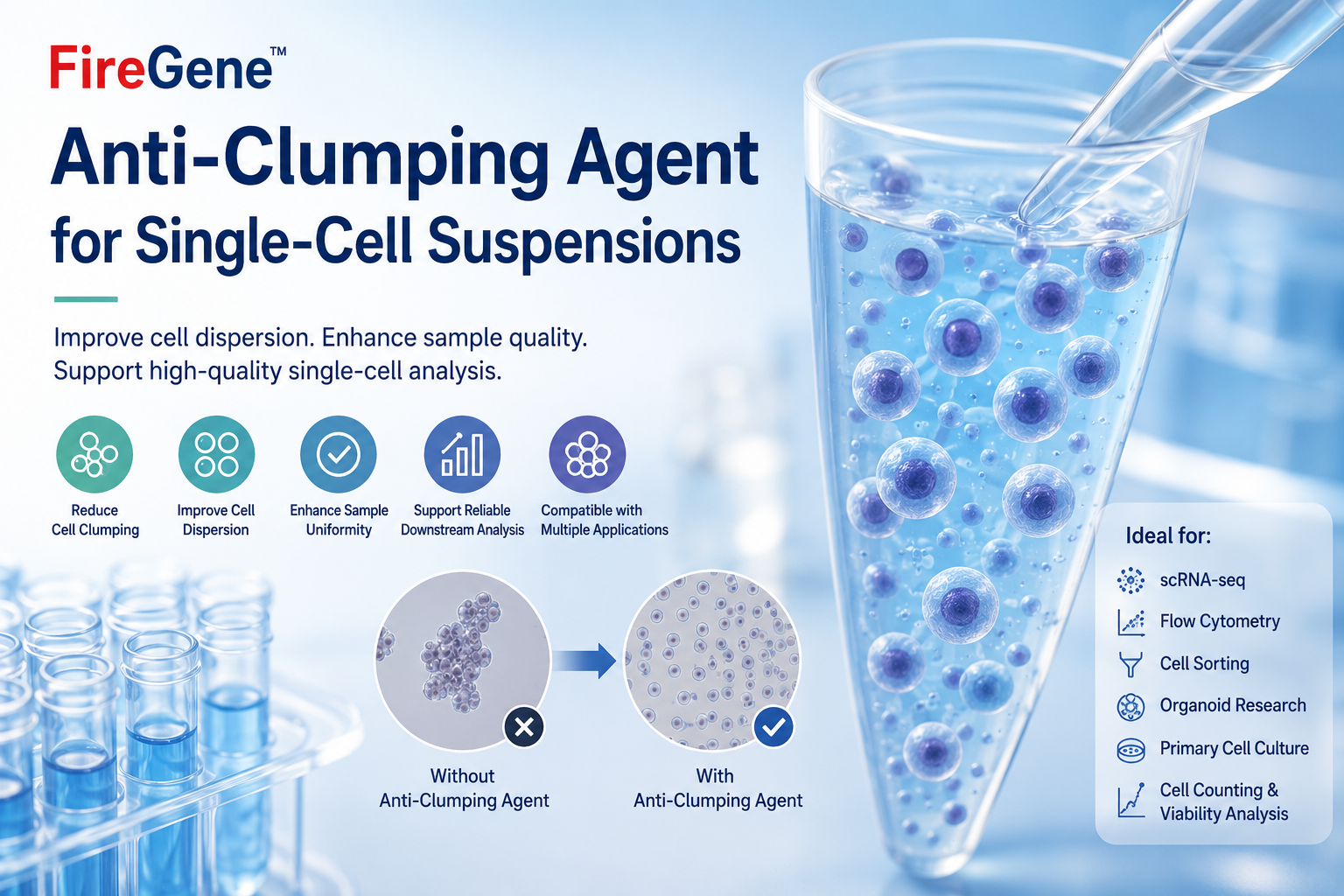
FireGene™ Anti-Clumping Agent for Single-Cell Suspensions is designed to help researchers minimize cell aggregation and improve the quality and consistency of single-cell suspensions. By supporting better cell dispersion, an anti-clumping reagent can become an important component of workflows that require high-quality individual cell populations.
1. What Is an Anti-Clumping Agent for Single-Cell Suspensions?
An anti-clumping agent is a reagent used during cell suspension preparation to help reduce unwanted aggregation between cells. Its purpose is to promote a more homogeneous distribution of individual cells throughout the suspension.
Cell clumping can occur at several stages of sample processing. For example, enzymatic tissue dissociation may release cells from the extracellular matrix, but the resulting suspension can still contain damaged cells, cellular debris, and extracellular components that encourage aggregation.
This is particularly important when preparing samples for applications that require individual cells rather than clusters.
A high-quality single-cell suspension should ideally contain:
Well-dispersed individual cells
Minimal cell aggregates
Low levels of cellular debris
High cell viability
Consistent cell concentration
Suitable sample quality for downstream analysis
FireGene™ Anti-Clumping Agent can be incorporated into appropriate single-cell suspension workflows to help maintain cell dispersion and improve sample handling.
2. Why Does Cell Clumping Occur?
Understanding the causes of cell aggregation is important when optimizing single-cell preparation.
2.1 Extracellular DNA
When cells are damaged or die during tissue dissociation, intracellular DNA can be released into the surrounding solution. Extracellular DNA can increase the viscosity of the suspension and promote interactions between cells and cellular debris.
As a result, cells may become increasingly difficult to separate into individual populations.
2.2 Incomplete Tissue Dissociation
Tissues are complex structures composed of cells, extracellular matrix, and connective components. If tissue dissociation is incomplete, small tissue fragments may remain in the suspension and contribute to cell aggregation.
This issue can be particularly relevant when processing solid tissues or samples containing dense extracellular matrix.
2.3 High Cell Concentration
Cell suspensions containing very high concentrations of cells are more likely to experience cell-to-cell interactions. When cells are densely packed, aggregation can occur during mixing, centrifugation, or sample storage.
Appropriate dilution and sample handling can therefore be important for maintaining a uniform suspension.
2.4 Cell Damage and Debris
Mechanical stress, prolonged enzymatic digestion, or unsuitable processing conditions can damage cells and increase the amount of debris in the sample. Dead cells and debris may interact with viable cells and contribute to aggregate formation.
Therefore, anti-clumping strategies are often used together with optimized dissociation and debris-removal procedures.
3. Why Is Cell Dispersion Important for Single-Cell Analysis?
Single-cell technologies depend on the ability to accurately isolate and analyze individual cells. If cells remain aggregated, the quality and interpretation of downstream experiments may be affected.
For single-cell RNA sequencing, for example, cell aggregates can increase the likelihood of capturing multiple cells together. This can contribute to doublets or multiplets and complicate downstream data analysis.
A well-dispersed suspension can help researchers achieve:
More consistent cell loading
Improved cell counting accuracy
Better representation of different cell populations
Reduced aggregate-related sample loss
More reliable downstream analysis
For flow cytometry and fluorescence-activated cell sorting (FACS), aggregates may also interfere with sample flow and affect the identification or sorting of individual cells.
For these reasons, controlling cell aggregation is an important part of single-cell sample preparation.
4. Applications of FireGene™ Anti-Clumping Agent
FireGene™ Anti-Clumping Agent can be considered for a variety of workflows where maintaining dispersed cell suspensions is important.
4.1 Single-Cell RNA Sequencing
scRNA-seq enables researchers to characterize gene expression at the individual-cell level. Sample preparation is a critical step because the quality of the initial cell suspension can directly influence downstream sequencing performance.
An anti-clumping reagent can help researchers maintain a more uniform cell suspension during preparation and handling.
Potential applications include:
Cell type identification
Gene expression profiling
Cellular heterogeneity analysis
Rare cell population studies
Cell-state characterization
Cell-cell communication research
4.2 Flow Cytometry and Cell Sorting
Flow cytometry requires cells to pass individually through the detection system. Aggregated cells can complicate sample analysis and may interfere with sorting efficiency.
Maintaining a well-dispersed suspension can support more consistent flow cytometry and cell sorting workflows.
4.3 Primary Cell Research
Primary cells can be more sensitive to mechanical and enzymatic stress than established cell lines. During isolation and preparation, unwanted aggregation may occur easily.
Anti-clumping strategies can therefore be useful when preparing primary cell suspensions for downstream experiments such as phenotyping, culture, and functional studies.
4.4 Organoid and Tissue-Derived Cell Preparation
Organoid and tissue-derived samples often require enzymatic or mechanical dissociation before individual cells can be analyzed.
During these workflows, cell clusters and debris may remain after dissociation. Incorporating an appropriate anti-clumping reagent into the sample preparation workflow can help researchers obtain a more homogeneous suspension.
5. Benefits of Using an Anti-Clumping Reagent
The main benefit of an anti-clumping agent is improved cell dispersion, but its value extends to several aspects of experimental workflow optimization.
Improved Suspension Uniformity
Reducing cell aggregation helps create a more homogeneous suspension, making samples easier to mix, count, and process.
Better Cell Handling
A well-dispersed suspension is generally easier to pipette and transfer between tubes or instruments, which can reduce sample handling difficulties.
Support for Accurate Cell Counting
Large aggregates may be counted as individual objects or may interfere with automated cell counters. Better dispersion can contribute to more reliable cell concentration measurements.
Improved Downstream Workflow Compatibility
Many single-cell technologies require relatively uniform suspensions. Improving sample quality before loading can help researchers optimize downstream workflows.
Reduced Sample Loss
Large aggregates may become trapped during filtration or removed during sample preparation. Maintaining better dispersion may help researchers preserve more of the desired cell population.
6. How to Optimize a Single-Cell Suspension Workflow
An anti-clumping reagent is only one component of a successful single-cell preparation strategy. Researchers should also consider the entire workflow.
First, optimize the tissue dissociation procedure. The choice of enzymes, digestion time, temperature, and mechanical disruption can significantly affect cell yield and viability.
Second, minimize unnecessary mechanical stress. Excessive pipetting or vigorous mixing may damage sensitive cells and increase debris formation.
Third, remove unwanted debris when necessary. Specialized debris-removal or dead-cell removal reagents may complement anti-clumping strategies, particularly for samples with substantial amounts of damaged material.
Fourth, control cell concentration. Overly concentrated suspensions can increase the probability of cell-cell interactions.
Finally, inspect the suspension before downstream processing. Researchers can evaluate cell concentration, viability, aggregate formation, and overall sample appearance to determine whether additional optimization is required.
7. FireGene™ Anti-Clumping Agent in Modern Single-Cell Research
The increasing adoption of single-cell sequencing and advanced cell analysis technologies has created greater demand for high-quality sample preparation reagents.
Single-cell workflows often involve multiple preparation steps, from tissue dissociation and filtration to cell counting and instrument loading. Even when each individual step appears straightforward, sample quality can gradually decline if cell aggregation, debris, or cell damage is not controlled.
FireGene™ Anti-Clumping Agent provides a practical approach for researchers who need to maintain dispersed cell suspensions during sample preparation.
It can be integrated into workflows involving tissue-derived cells, primary cells, organoid preparations, and other applications where maintaining individual cell populations is important.
Conclusion
Obtaining a high-quality single-cell suspension is a fundamental requirement for reliable single-cell analysis. Cell clumping, extracellular DNA, cellular debris, incomplete dissociation, and excessive cell concentration can all compromise suspension quality and create challenges for downstream applications.
FireGene™ Anti-Clumping Agent for Single-Cell Suspensions is designed to support better cell dispersion and more consistent sample preparation. By helping reduce unwanted cell aggregation, it can complement tissue dissociation, cell filtration, counting, and downstream single-cell analysis workflows.
For researchers working with scRNA-seq, flow cytometry, cell sorting, primary cells, organoids, and tissue-derived samples, effective control of cell aggregation can contribute to a more reliable and reproducible experimental workflow.


