
Introduction
For sterile injectable drugs, sterility is only one part of product safety.
A product can pass sterility testing and still contain bacterial endotoxins capable of causing serious pyrogenic reactions. This is because sterilization and endotoxin control address fundamentally different risks.
Sterility testing is designed to determine whether viable microorganisms are present under defined test conditions. Endotoxin testing, by contrast, detects biologically active lipopolysaccharide components associated primarily with the outer membrane of Gram-negative bacteria.
Because endotoxins can remain biologically active even after microorganisms have been destroyed, sterilization does not automatically make a product endotoxin-free.
This distinction is particularly important for sterile injectable drugs because they bypass many of the body's natural protective barriers and can introduce contaminants directly into the bloodstream or tissues.
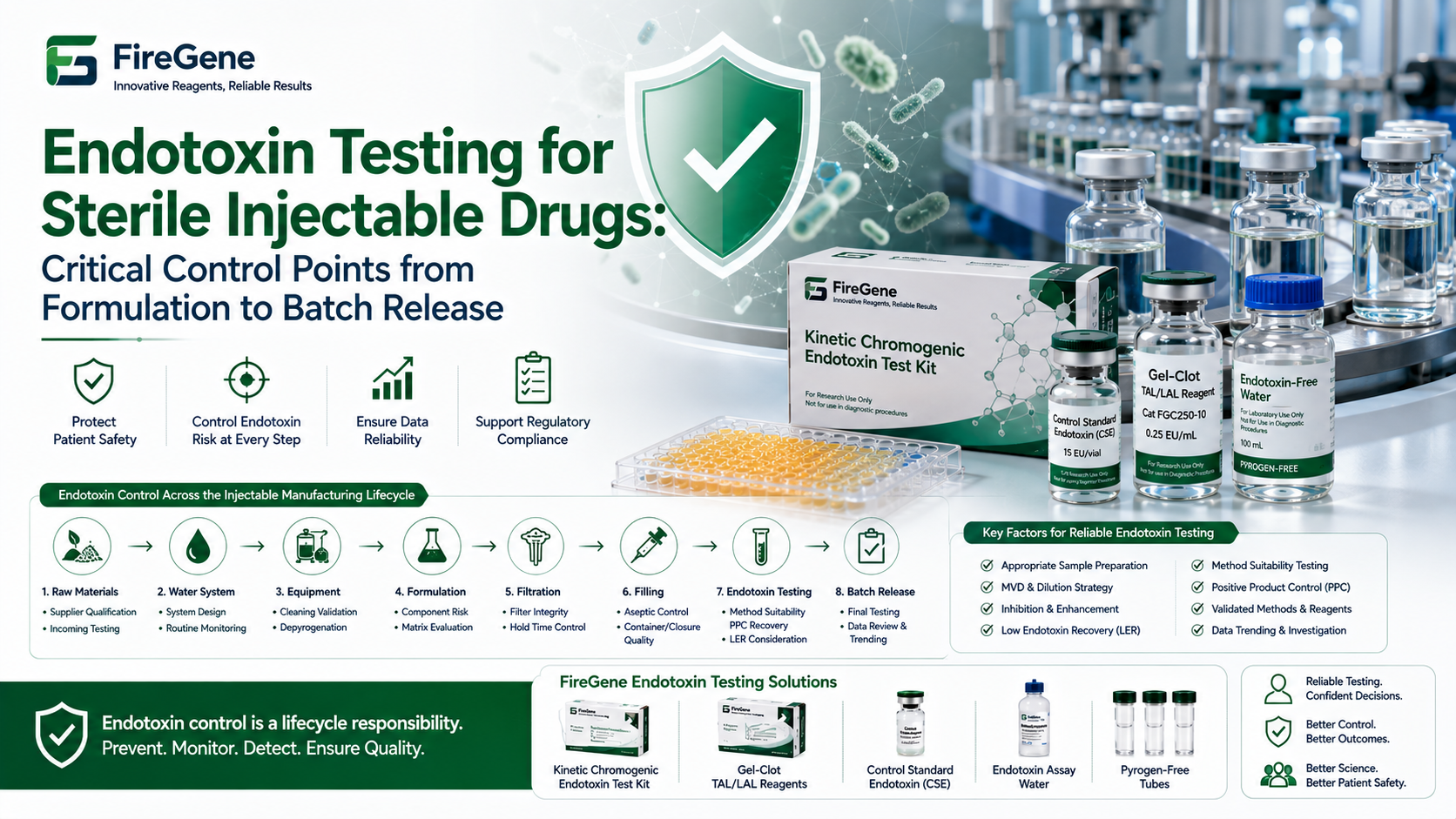
For pharmaceutical manufacturers, reliable endotoxin control therefore needs to extend across the entire manufacturing lifecycle:
Raw Materials → Water System → Manufacturing Equipment → Formulation → Filtration → Filling → Final Product → Batch Release
Endotoxin testing is one of the key analytical controls within this system, but effective control depends on much more than simply testing the final vial.
In this guide, we examine the major endotoxin control points for sterile injectable drugs and explain how pharmaceutical QC laboratories can build a more reliable testing strategy.
1. Why Endotoxin Control Is Critical for Injectable Drugs
Endotoxins are primarily lipopolysaccharides (LPS) associated with Gram-negative bacterial cell membranes.
Their biological activity means that very small amounts can trigger inflammatory and pyrogenic responses.
For injectable pharmaceutical products, this creates a particularly important quality concern.
Unlike a contaminating microorganism that may potentially be detected through microbial testing, endotoxin can remain present after bacteria have been eliminated.
This leads to a critical principle:
Microbial control and endotoxin control are related, but they are not interchangeable.
A robust pharmaceutical contamination control strategy therefore needs to address both.
For an overview of why sterility does not guarantee an endotoxin-free product, see FireGene's article Why Sterility Does Not Guarantee Endotoxin-Free Products.
2. Where Can Endotoxin Enter an Injectable Drug Manufacturing Process?
Endotoxin contamination can originate from multiple sources.
Common potential sources include:
- Raw materials
- Pharmaceutical water
- Excipients
- Manufacturing equipment
- Containers and closures
- Process solutions
- Personnel handling
- Environmental contamination
- Inadequately controlled cleaning processes
- Biofilm formation in water systems
The risk is not necessarily limited to one manufacturing stage.
For example:
Contaminated Raw Material
↓
Process Solution
↓
Drug Substance
↓
Final Formulation
↓
Filled Product
A relatively small contamination event early in the process may become difficult to trace once the material has moved through multiple manufacturing stages.
This is why endotoxin control is increasingly being approached as a lifecycle risk management problem rather than a simple final-product testing requirement.
3. Raw Materials Are the First Critical Control Point
Raw materials and excipients can represent an important source of endotoxin risk.
Materials derived from biological systems, water-based manufacturing processes, fermentation, or other microbial-sensitive processes deserve particular attention.
Potentially relevant materials include:
- Amino acids
- Sugars
- Proteins
- Peptides
- Buffers
- Surfactants
- Biological excipients
- Process intermediates
The appropriate level of testing should be based on material risk, intended use, supplier qualification, and the potential contribution of the material to the final product.
FireGene recently addressed this topic in Endotoxin Testing for Raw Materials and Excipients: How to Control Endotoxin Risk Before Manufacturing.
The key concept is simple:
Preventing endotoxin from entering the process is generally more effective than trying to remove or investigate it later.
4. Pharmaceutical Water Is a Major Endotoxin Risk
Water is one of the most important materials in sterile pharmaceutical manufacturing.
It can come into contact with:
- Raw materials
- Manufacturing equipment
- Containers
- Process solutions
- Final formulations
Poorly controlled water systems can support microbial growth and biofilm formation.
Potential risk areas include:
- Storage tanks
- Distribution loops
- Dead legs
- Stagnant sections
- Sampling points
- Inadequate sanitization
- Poor maintenance
Importantly, water can meet certain microbial requirements while still presenting an endotoxin problem.
This is why pharmaceutical water monitoring should include appropriate endotoxin control.
FireGene's article Why Water System Monitoring Is the Foundation of Reliable Endotoxin Testing explores why water system control is fundamental to reliable endotoxin testing.
For laboratory testing itself, appropriately qualified Endotoxin Assay Water is also important because ordinary laboratory water can introduce background endotoxin into highly sensitive assays. FireGene's Endotoxin Assay Water is specified at less than 0.005 EU/mL and is intended for applications including reagent reconstitution and standard preparation.
5. Manufacturing Equipment Can Become an Endotoxin Reservoir
Endotoxin does not only exist in the product itself.
It can also become associated with manufacturing equipment and process-contact surfaces.
Potential sources include:
- Stainless-steel tanks
- Filling lines
- Transfer tubing
- Pumps
- Valves
- Filters
- Mixing vessels
- Holding tanks
This is particularly important because endotoxin can be difficult to remove once it becomes associated with surfaces.
Cleaning validation and depyrogenation strategies should therefore consider endotoxin removal—not merely microbial reduction.
For equipment and components exposed to high temperatures, validated depyrogenation processes can be an important part of the contamination control strategy.
FireGene's guide on Dry Heat Depyrogenation Validation and Endotoxin Challenge Vials provides a deeper discussion of this topic.
6. Formulation Can Change Endotoxin Detectability
One of the most challenging aspects of endotoxin testing is that the pharmaceutical formulation itself can affect the assay.
Formulation components may include:
- Proteins
- Surfactants
- Chelating agents
- Salts
- Buffers
- Preservatives
- Lipids
These components can interfere with the endotoxin detection reaction.
The result may be:
Inhibition
The assay produces a lower response than expected.
Enhancement
The assay produces a higher response than expected.
Endotoxin masking
Endotoxin becomes less available for detection under certain formulation conditions.
This is particularly relevant to biologics and other complex injectable formulations.
Therefore, a validated endotoxin reagent does not automatically mean that every injectable formulation can be tested without additional method suitability work.
7. Sample Preparation Can Determine Whether the Test Succeeds
Before performing the endotoxin test, laboratories need to establish an appropriate sample preparation procedure.
Important parameters include:
- Sample dilution
- MVD
- pH
- Mixing
- Storage
- Holding time
- Container compatibility
- Sample concentration
The objective is to minimize matrix interference while maintaining adequate sensitivity.
A common mistake is to assume that maximum dilution is always the best solution.
It is not.
Excessive dilution may reduce interference but can also reduce the endotoxin concentration below the useful analytical range.
The laboratory therefore needs to identify a scientifically justified dilution within the applicable MVD.
For a more detailed discussion, see FireGene's Endotoxin Testing Sample Preparation: A Practical Guide to Dilution, Interference, Recovery, and Reliable Results.
8. Method Suitability Is Essential for Complex Injectable Products
Before routine testing begins, laboratories need to demonstrate that the selected endotoxin test method performs appropriately with the actual product matrix.
This is generally addressed through Method Suitability Testing, including inhibition/enhancement assessment and Positive Product Control (PPC) recovery.
The fundamental question is:
Can this method reliably detect endotoxin in this specific injectable formulation?
This is different from asking whether the TAL/LAL Reagent itself works correctly.
A commercial reagent may pass its own quality specifications while the pharmaceutical formulation still interferes with the assay.
FireGene's detailed How to Validate an Endotoxin Test Method: A Step-by-Step Guide for USP <85> Compliance covers the validation workflow, including endotoxin limits, MVD, PPC recovery, inhibition, enhancement, and troubleshooting.
9. Positive Product Control Provides a Critical Check
PPC recovery helps demonstrate that a known amount of endotoxin can be detected in the presence of the product.
This is particularly useful when testing:
- Monoclonal antibodies
- Recombinant proteins
- Peptides
- Vaccines
- Lipid-containing formulations
- High-concentration biologics
Poor recovery can indicate that the product matrix is interfering with the test.
Rather than simply repeating the assay, laboratories should investigate the reason for poor recovery.
Potential corrective strategies may include:
- Additional dilution
- Alternative sample preparation
- Appropriate pH adjustment
- Evaluation of formulation effects
- Investigation of endotoxin masking
The goal is not simply to make the result pass.
The goal is to demonstrate that the analytical method can accurately detect endotoxin.
10. Low Endotoxin Recovery Requires Special Attention
For certain injectable biologics, conventional inhibition is not the only concern.
Low Endotoxin Recovery (LER) can occur when endotoxin becomes masked or less detectable due to interactions with formulation components.
This is especially relevant when formulations contain combinations such as:
- Protein
- Surfactant
- Chelating agent
- Specific buffer systems
LER can be difficult to recognize because the laboratory may obtain apparently low endotoxin results.
In some cases, simply increasing dilution does not solve the problem.
This is why laboratories working with complex injectable biologics should understand the difference between:
Assay inhibition
and
Endotoxin masking / LER
FireGene's Understanding Low Endotoxin Recovery (LER): Mechanisms, Regulatory Perspectives, and Practical Solutions in 2026 provides a dedicated discussion of this issue.
11. Choosing the Right Endotoxin Test Method
Sterile injectable products can be evaluated using different bacterial endotoxin testing approaches.
The major compendial formats include:
Gel-Clot
The gel-clot method provides a relatively straightforward qualitative or limit-test format.
It can be useful when:
- Throughput is relatively low
- Simple equipment is preferred
- A limit result is sufficient
- Visual endpoint interpretation is acceptable
Kinetic Chromogenic
The kinetic chromogenic method provides quantitative endotoxin measurement through a colorimetric reaction.
It can be particularly useful when laboratories need:
- Quantitative EU/mL data
- Standard curves
- Higher throughput
- Automated calculation
- Data trending
- Objective optical measurement
FireGene's Kinetic Chromogenic Endotoxin Test Kit uses a 96-well format with kinetic absorbance detection at 405 nm. It is designed for quantitative bacterial endotoxin testing and can work with standard microplate readers capable of the required absorbance and kinetic measurements.
Kinetic Turbidimetric
This method measures changes in turbidity associated with the endotoxin-triggered reaction.
The appropriate method should ultimately be selected based on:
- Product characteristics
- Required sensitivity
- Matrix behavior
- Laboratory equipment
- Throughput
- Validated method performance
- Applicable regulatory requirements
Method selection should never be based solely on familiarity.
12. Control the Final Container and Closure System
Endotoxin control should also extend to the final container.
Potential considerations include:
- Vials
- Syringes
- Cartridges
- Stopper systems
- Transfer components
- Packaging materials that contact the product
A component can be sterile while still requiring appropriate endotoxin control.
This is another example of why sterility and endotoxin control should be treated as separate but complementary quality attributes.
For laboratory testing, pyrogen-free reaction tubes and other controlled consumables are similarly important because contaminated laboratory materials can introduce endotoxin into the assay itself.
13. Final Product Testing Is the Last Analytical Barrier
Final product endotoxin testing provides an important confirmation that the finished product meets its established endotoxin requirements.
However, final testing should not be considered the only endotoxin control.
A robust strategy uses multiple layers:
Supplier Qualification
↓
Raw Material Control
↓
Water System Monitoring
↓
Equipment Cleaning & Depyrogenation
↓
Process Controls
↓
Formulation Controls
↓
Method Suitability
↓
Final Product Endotoxin Test
↓
Batch Release
This layered approach provides significantly greater control than relying on one final analytical result.
14. What Causes Failed Endotoxin Tests in Injectable Products?
When an injectable product fails endotoxin testing, the investigation should begin systematically.
Potential causes can be grouped into several categories.
Product-related
- True endotoxin contamination
- Matrix inhibition
- Enhancement
- LER
- Sample degradation
Process-related
- Water system contamination
- Equipment contamination
- Cleaning failure
- Process interruption
- Raw material contamination
Laboratory-related
- Contaminated consumables
- Incorrect dilution
- Poor pipetting
- Reagent preparation errors
- Incorrect incubation
- Instrument problems
Environmental
- Laboratory contamination
- Poor handling
- Improper storage
- Sample exposure
A failed result should therefore not automatically be attributed to the product or to the TAL/LAL Reagent.
FireGene's article False Positive Endotoxin Results? Hidden Sources of Endotoxin Contamination Every QC Laboratory Should Know discusses common laboratory contamination sources and investigation strategies.
15. Trending Can Strengthen Injectable Drug Quality Control
A single endotoxin result provides limited information.
Long-term trending can provide much more insight.
QC laboratories can monitor:
- Raw material endotoxin levels
- Water system endotoxin
- In-process samples
- Final product results
- PPC recovery
- Standard curve performance
- Method suitability results
For example, a gradual increase in endotoxin results may indicate a developing problem even if every individual batch remains within specification.
Trend analysis can therefore help identify:
- Supplier deterioration
- Water system changes
- Cleaning problems
- Process drift
- Increasing laboratory variability
This shifts endotoxin control from reactive testing toward proactive quality management.
16. A Practical Endotoxin Control Workflow for Injectable Drugs
A practical lifecycle workflow can be organized into eight stages.
Stage 1: Risk Assessment
Identify potential endotoxin sources throughout manufacturing.
Stage 2: Supplier Qualification
Evaluate raw material and excipient suppliers.
Stage 3: Incoming Material Testing
Apply risk-based endotoxin testing and verification.
Stage 4: Process Monitoring
Monitor water, equipment, and critical process points.
Stage 5: Method Suitability
Demonstrate that the selected endotoxin test can detect endotoxin in the product matrix.
Stage 6: Routine Endotoxin Testing
Perform validated testing according to the approved analytical procedure.
Stage 7: Investigation
Investigate OOS, OOT, abnormal PPC recovery, or unexpected trends.
Stage 8: Continuous Improvement
Use trend data, deviations, CAPA, and change control to strengthen the overall endotoxin control strategy.
17. Best Practices for Pharmaceutical QC Laboratories
To improve the reliability of endotoxin testing for sterile injectable drugs, laboratories should consider the following practices.
Use qualified endotoxin-free materials
Water, tubes, pipette tips, plates, and other assay-contact materials should be appropriately controlled.
Standardize sample preparation
Small differences in dilution or handling can significantly affect sensitive assays.
Establish product-specific suitability
Do not assume that a method suitable for one formulation will automatically work for another.
Monitor PPC recovery
PPC data can reveal developing matrix interference before routine results become unreliable.
Control reagent storage
TAL/LAL Reagent is biologically active and should be stored and handled according to the manufacturer's requirements.
FireGene has previously discussed How Improper Storage of TAL/LAL Reagents Can Affect Endotoxin Test Results.
Trend results
Do not look only at pass/fail outcomes.
Investigate systematically
Separate laboratory error, matrix effects, process contamination, and genuine product contamination.
18. Why Kinetic Chromogenic Testing Can Be Valuable for High-Throughput QC
For manufacturing facilities with large numbers of injectable products or samples, quantitative kinetic chromogenic testing can provide operational advantages.
A 96-well plate format allows laboratories to process multiple samples and controls in one analytical run.
The kinetic measurement also provides objective numerical data rather than relying on visual interpretation.
FireGene's Kinetic Chromogenic Endotoxin Test Kit uses a 405 nm absorbance readout and provides quantitative EU/mL results through a standard curve.
This type of workflow can be useful for:
- Routine QC
- Process development
- Raw material screening
- Water testing
- Method suitability
- Recovery studies
- Trend analysis
However, the method still needs to demonstrate suitability for the specific sample matrix.
High throughput does not replace analytical validation.
Frequently Asked Questions
Is endotoxin testing required for sterile injectable drugs?
Endotoxin testing is a critical quality control consideration for many injectable pharmaceutical products, with applicable requirements depending on the product, route of administration, compendial framework, and regulatory strategy.
Can a sterile injectable product still contain endotoxin?
Yes. Sterility and endotoxin are different quality attributes. A product may contain endotoxin even when viable microorganisms are not detected.
What is the most common source of endotoxin?
Potential sources include contaminated water, raw materials, process equipment, environmental contamination, and laboratory materials. The most important source depends on the manufacturing process.
Why is water so important in endotoxin control?
Water can contact many materials and process surfaces and can support microbial growth if poorly controlled. Water system biofilms are a particularly important potential source of endotoxin.
Does dilution always solve endotoxin test interference?
No. Dilution can reduce some forms of matrix inhibition, but it must remain within the MVD. Dilution may also be insufficient when LER or endotoxin masking is involved.
What does PPC recovery tell the laboratory?
PPC recovery helps demonstrate that the product matrix does not significantly interfere with endotoxin detection under the tested conditions.
Can I use the same endotoxin method for different injectable products?
Not automatically. Each product matrix should be evaluated for method suitability. A method that works well for one formulation may not perform identically with another.
Why should endotoxin results be trended?
Trending can identify gradual changes in process or laboratory performance that may not be obvious from individual pass/fail results.
Key Takeaways
For sterile injectable drugs, reliable endotoxin control requires a lifecycle approach.
The most important principles are:
- Sterility does not guarantee endotoxin-free status.
- Endotoxin risk can originate from raw materials, water, equipment, and process environments.
- Pharmaceutical water systems require continuous and appropriate monitoring.
- Cleaning and depyrogenation are important parts of endotoxin control.
- Complex formulations can interfere with TAL/LAL Reagent assays.
- Sample dilution must balance interference reduction and analytical sensitivity.
- Method Suitability Testing should be established before routine product testing.
- PPC recovery provides important evidence of method performance.
- LER requires additional attention for certain biologic formulations.
- Final product testing should be one layer of a broader contamination control strategy.
- Long-term data trending can identify emerging endotoxin risks before they become major quality events.
Conclusion
Endotoxin testing for sterile injectable drugs is not simply a final quality control test performed before batch release.
It is part of a much larger contamination control strategy that begins with raw materials and extends through water systems, manufacturing equipment, formulation, filling, analytical testing, and final product release.
The increasing complexity of injectable pharmaceuticals makes this approach even more important.
Modern products may contain proteins, peptides, surfactants, lipids, advanced delivery systems, and other formulation components that can create analytical challenges such as inhibition, enhancement, and Low Endotoxin Recovery.
At the same time, increasingly sophisticated manufacturing processes create more potential contamination pathways.
The most reliable strategy is therefore to combine:
Risk Assessment + Prevention + Monitoring + Method Suitability + Reliable Endotoxin Testing + Data Trending
rather than relying on a single final test.
FireGene provides a range of TAL/LAL Reagent-based solutions—including Kinetic Chromogenic Endotoxin Test Kits, Gel-Clot TAL/LAL Reagents, Control Standard Endotoxin, Endotoxin Assay Water, and pyrogen-free consumables—to support laboratories across different stages of endotoxin testing and quality control.
Ultimately, effective endotoxin management is about more than obtaining a passing result.
It is about building a testing and contamination-control system in which every result is reliable, reproducible, scientifically justified, and meaningful for pharmaceutical quality decisions.
FireGene Endotoxin Testing
Ready to run your endotoxin assay?
FireGene offers a complete endotoxin testing toolkit — from TAL reagents and CSE standards to pyrogen-free consumables and LAL reagent water. All products are aligned with USP <85>, EP 2.6.14, and JP 4.01.


