
Introduction
Endotoxin testing is entering a new phase.
For decades, the bacterial endotoxin test has been closely associated with Limulus Amebocyte Lysate (LAL), including traditional gel-clot, kinetic turbidimetric, and kinetic chromogenic approaches. These methods remain important tools for pharmaceutical quality control.
However, the endotoxin testing landscape is changing rapidly.
The pharmaceutical industry is increasingly demanding:
- Quantitative rather than purely qualitative results
- Higher testing throughput
- More objective data interpretation
- Better automation
- Improved data traceability
- Greater compatibility with complex biologics
- Reduced dependence on animal-derived reagents
- More standardized alternative endotoxin testing technologies
At the same time, regulatory and pharmacopoeial discussions around recombinant reagent-based bacterial endotoxin testing are accelerating.
USP <86>, Bacterial Endotoxins Test Using Recombinant Reagents, provides additional techniques using nonanimal-derived reagents, including recombinant Factor C and recombinant cascade reagent approaches. USP also emphasizes that laboratories must verify suitability for the specific material, drug substance, or drug product being tested.
This evolution makes kinetic chromogenic endotoxin testing particularly relevant in 2026.
But there is an important distinction:
Kinetic chromogenic testing is not one single technology.
It can refer to traditional LAL/TAL-based kinetic chromogenic assays as well as newer recombinant cascade reagent (rCR) approaches.
Understanding the differences—and knowing when each approach is appropriate—is becoming increasingly important for pharmaceutical QC laboratories.
1. What Is Kinetic Chromogenic Endotoxin Testing?
The kinetic chromogenic method is a quantitative bacterial endotoxin testing technique based on color development.
In a typical assay, endotoxin activates a cascade reaction within the reagent.
The reaction ultimately results in cleavage of a synthetic chromogenic substrate, producing a colored compound.
The instrument monitors the change in absorbance over time.
Instead of simply asking:
Is endotoxin present?
the kinetic chromogenic method can determine:
How much endotoxin is present?
This quantitative capability is one of the main reasons kinetic chromogenic assays have become increasingly attractive for pharmaceutical QC.
The assay can evaluate the relationship between endotoxin concentration and reaction kinetics, generating a standard curve from which unknown samples can be quantified.
USP's description of photometric endotoxin testing distinguishes kinetic chromogenic testing from endpoint chromogenic testing: kinetic methods evaluate either the time required to reach a defined absorbance or the rate of color development.
2. Why Is Kinetic Chromogenic Testing Trending in 2026?
Several trends are converging.
2.1 Pharmaceutical Products Are Becoming More Complex
Modern pharmaceutical pipelines increasingly include:
- Monoclonal antibodies
- Recombinant proteins
- Peptides
- Vaccines
- Cell and gene therapy products
- Lipid-containing formulations
- Advanced injectable formulations
These products can create complex analytical matrices.
A simple pass/fail approach is often insufficient when laboratories need to understand:
- Endotoxin concentration
- Recovery
- Dilution behavior
- Matrix interference
- Long-term trends
Quantitative kinetic testing provides significantly more analytical information.
2.2 QC Laboratories Need Higher Throughput
Traditional testing workflows can become inefficient when laboratories need to test:
- Multiple raw materials
- Water samples
- In-process samples
- Finished products
- Multiple manufacturing batches
- Method suitability samples
- Recovery studies
A 96-well kinetic chromogenic format can consolidate many standards, controls, samples, and replicates into a single analytical run.
This makes the format particularly attractive for laboratories managing large testing volumes.
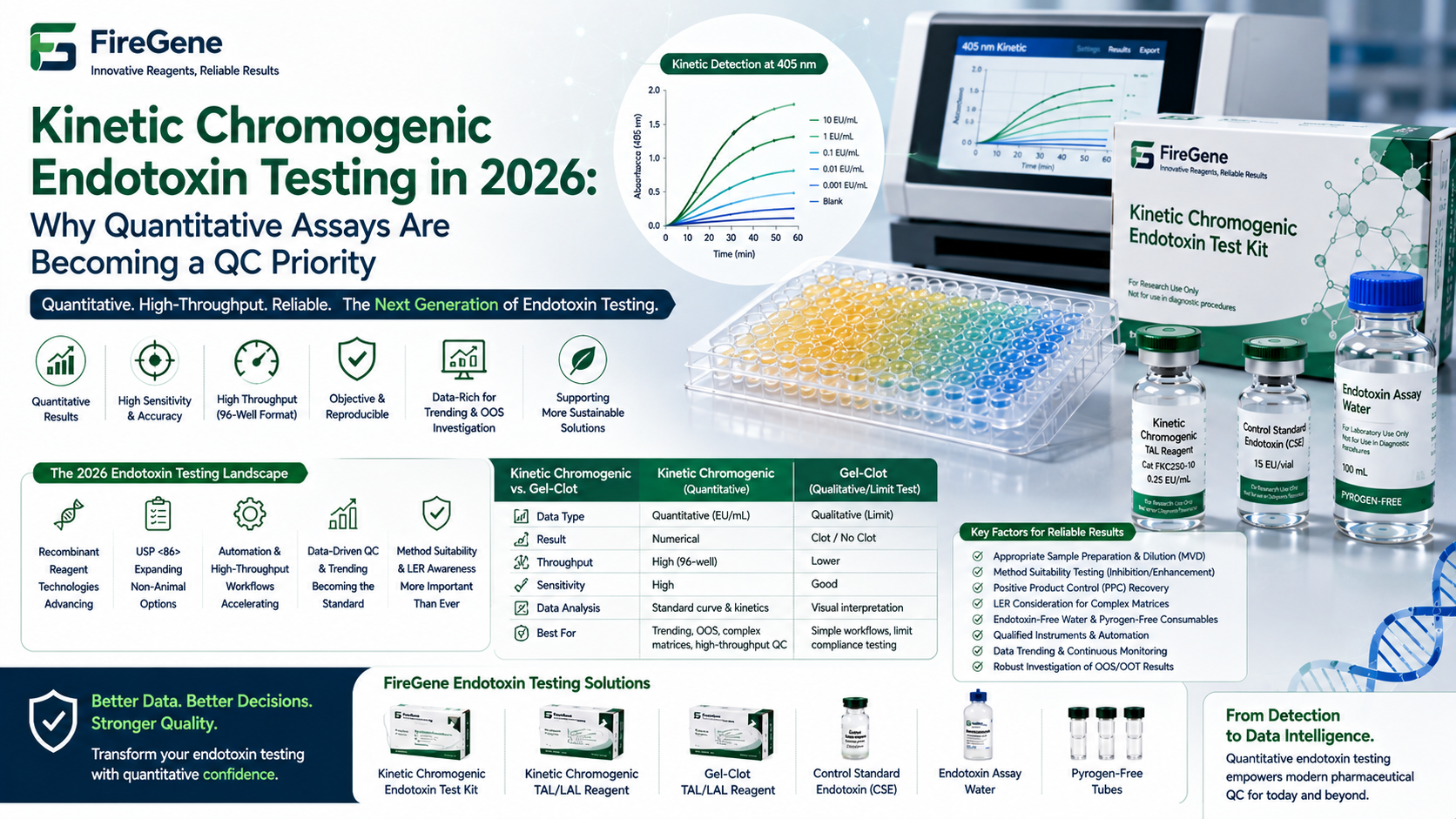
FireGene's Kinetic Chromogenic Endotoxin Test Kit is designed around a 96-well format with absorbance detection at 405 nm, supporting quantitative endotoxin testing workflows.
FireGene Kinetic Chromogenic Endotoxin Test Kit
3. How Does a Kinetic Chromogenic Assay Work?
The basic workflow can be simplified into several stages:
Endotoxin enters the reaction system
↓
Endotoxin activates the enzymatic cascade
↓
Activated enzymes cleave the chromogenic substrate
↓
A colored product is generated
↓
Absorbance changes over time
↓
Instrument calculates reaction kinetics
↓
Sample concentration is calculated from the standard curve
The greater the endotoxin concentration, the faster the reaction generally progresses within the assay's validated dynamic range.
This kinetic relationship provides the analytical basis for quantitative endotoxin determination.
4. Why the 405 nm Readout Matters
Kinetic chromogenic assays typically monitor absorbance in the visible range associated with the chromophore generated during the reaction.
FireGene's kinetic chromogenic assay uses a 405 nm detection wavelength.
This means the laboratory needs an appropriate microplate reader capable of:
- 405 nm absorbance detection
- Kinetic measurements
- Temperature control when required
- Appropriate plate compatibility
- Data acquisition and analysis
The instrument is therefore part of the analytical system.
Choosing a reagent without considering the reader can create unnecessary compatibility problems.
Before implementation, laboratories should confirm:
Reagent → Plate → Reader → Software → Incubation Conditions
are all compatible.
5. Kinetic Chromogenic vs. Gel-Clot: Why Quantification Matters
Gel-clot testing remains valuable because it is straightforward and requires relatively simple equipment.
However, the information generated is fundamentally different.
Gel-clot testing is primarily based on whether a clot forms under defined conditions.
Kinetic chromogenic testing generates quantitative optical data.
This difference can be particularly useful when laboratories need to:
- Compare batches
- Trend endotoxin levels
- Investigate OOS/OOT results
- Evaluate process changes
- Study raw materials
- Perform recovery studies
- Monitor water systems
- Optimize dilution strategies
In other words:
Gel-clot answers a limit-test question.
Kinetic chromogenic testing can provide a quantitative analytical picture.
Neither approach is universally "better." The appropriate method depends on the product, intended use, validated method, equipment, throughput, and regulatory requirements.
6. The Bigger 2026 Trend: From LAL to Recombinant Reagents
One of the most important developments in endotoxin testing is the increasing attention on recombinant reagent technologies.
Traditional LAL reagents depend on components derived from horseshoe crab blood.
Recombinant technologies instead reproduce relevant endotoxin detection pathways using recombinant proteins.
Two important approaches include:
Recombinant Factor C (rFC)
The assay uses recombinant Factor C as the endotoxin recognition component.
Recombinant Cascade Reagent (rCR)
The reagent can incorporate recombinant components corresponding to multiple parts of the endotoxin-responsive cascade.
USP <86> specifically addresses bacterial endotoxin testing using recombinant reagents and includes recombinant reagent-based approaches.
This is important because it means the future of endotoxin testing is not simply about improving existing assays.
It is also about redefining the biological source of the reagent itself.
7. USP <86> Is Changing the Conversation
USP <85> remains the foundational bacterial endotoxin testing chapter for conventional BET approaches.
USP <86> adds another dimension by addressing recombinant reagent-based testing.
However, laboratories should not interpret the emergence of USP <86> as meaning that every recombinant reagent can automatically be substituted into every existing endotoxin method.
USP explicitly states that laboratories are responsible for reviewing the supplier's validation package and verifying that the method is suitable for the specific product or material. Supplemental data may also be requested by regulatory authorities.
This leads to a critical principle:
Compendial recognition of a technology does not eliminate product-specific method suitability.
The laboratory still needs to demonstrate that the chosen method works for its actual matrix.
8. A Major 2026 Study Strengthens the Case for Recombinant Kinetic Chromogenic Testing
A recent multi-center study published in 2026 evaluated recombinant cascade reagent kinetic chromogenic assays across 11 laboratories.
The study examined five recombinant cascade reagents and evaluated:
- Accuracy
- Precision
- Linearity
- Detection capability
- Product suitability
- Consistency with traditional LAL
The study included 34 pharmaceutical products and 105 batches, along with naturally contaminated water samples.
The researchers reported acceptable recovery, precision, and linearity across the tested recombinant systems, with strong consistency between rCR and LAL measurements.
This is important because it moves the discussion beyond:
“Can recombinant reagents work?”
toward:
“How consistently can recombinant kinetic chromogenic testing perform across laboratories and pharmaceutical products?”
That is a much more important question for industrial adoption.
9. But LAL/TAL Kinetic Chromogenic Testing Is Not Going Away
The rise of recombinant technologies does not mean traditional LAL/TAL kinetic chromogenic testing suddenly becomes irrelevant.
Far from it.
Traditional LAL-based methods remain deeply established in pharmaceutical QC workflows.
They offer:
- Extensive historical experience
- Established laboratory procedures
- Existing validation data
- Familiarity among QC analysts
- Broad commercial availability
- Compatibility with established workflows
For many laboratories, replacing a validated endotoxin method is not a simple reagent purchase.
It may require:
- Method verification
- Comparability studies
- SOP changes
- Training
- Validation
- Regulatory assessment
- Data review
- Potential submission updates
Therefore, the realistic future is likely to involve coexistence and method-specific selection, rather than an immediate universal replacement of LAL with recombinant technologies.
10. Why Method Suitability Remains the Biggest Challenge
Whether the reagent is traditional LAL/TAL or recombinant, the same fundamental analytical question remains:
Does the product matrix interfere with endotoxin detection?
Potential problems include:
Inhibition
The sample suppresses the expected endotoxin response.
Enhancement
The sample increases the apparent endotoxin response.
Low Endotoxin Recovery
Endotoxin becomes less available for detection under certain formulation conditions.
Physical interference
The sample affects optical measurement or reaction conditions.
This is why laboratories cannot simply assume:
"The kinetic chromogenic assay is validated, so my product is automatically suitable."
The reagent's performance and the product's suitability are separate questions.
11. PPC Recovery Is Still Essential
Positive Product Control (PPC) recovery remains one of the most useful tools for evaluating matrix effects.
The concept is straightforward.
A known quantity of endotoxin is added to the product matrix.
The laboratory then determines how much of that endotoxin can be recovered.
If recovery is acceptable, the laboratory gains evidence that the matrix is not significantly interfering with detection under the tested conditions.
If recovery is poor, further investigation may be required.
Potential strategies include:
- Additional dilution
- Alternative sample preparation
- pH adjustment where justified
- Different sample concentration
- Investigation of formulation components
- Evaluation of LER
FireGene's previous guide, Why Endotoxin Testing Fails During Method Suitability Testing: Understanding Inhibition, Enhancement, and Matrix Interference, provides a deeper discussion of these problems.
12. LER Is Especially Important for Biologics
Low Endotoxin Recovery remains one of the most challenging issues in modern endotoxin testing.
Certain formulations can cause endotoxin to become masked or less detectable.
This can be particularly relevant to formulations containing combinations of:
- Proteins
- Surfactants
- Chelating agents
- Specific buffers
The result can be a deceptively low endotoxin result.
This is why modern kinetic chromogenic testing should not focus solely on instrument performance.
It must also consider endotoxin behavior within the formulation.
For a detailed explanation, see FireGene's Understanding Low Endotoxin Recovery (LER): Mechanisms, Regulatory Perspectives, and Practical Solutions in 2026.
13. Automation Is the Next Step for Kinetic Chromogenic Testing
One of the strongest advantages of kinetic assays is their compatibility with automated workflows.
A modern QC laboratory can potentially integrate:
Sample Preparation
↓
Automated Pipetting
↓
96-Well Plate Setup
↓
Kinetic Incubation
↓
Absorbance Measurement
↓
Standard Curve Calculation
↓
Result Review
↓
Electronic Data Capture
This can reduce manual operations and improve consistency.
Automation is particularly attractive for laboratories handling high sample volumes.
However, automation does not eliminate analytical risk.
It simply shifts some risks from manual pipetting toward:
- Software configuration
- Plate mapping
- Instrument qualification
- Data integrity
- Method configuration
- Automated dilution
Therefore, automated kinetic testing still requires appropriate validation and controls.
14. Why Quantitative Endotoxin Data Is Becoming More Valuable
Traditional QC workflows often emphasize:
Pass / Fail
But modern pharmaceutical quality systems increasingly value trends.
Consider a hypothetical dataset:
0.018 EU/mL
→
0.024 EU/mL
→
0.031 EU/mL
→
0.047 EU/mL
Every result might remain below the specification.
Yet the trend could indicate a developing problem.
Quantitative kinetic chromogenic data makes this type of trending easier.
Potential applications include:
- Supplier monitoring
- Water system trending
- Raw material monitoring
- Process monitoring
- Batch comparison
- OOT investigation
- CAPA effectiveness evaluation
This is one reason quantitative endotoxin testing is increasingly attractive beyond simple batch release.
15. Kinetic Chromogenic Testing and Pharmaceutical Water
Water systems are another area where quantitative endotoxin measurement can provide useful information.
Water can be sampled from:
- Purification systems
- Storage tanks
- Distribution loops
- Point-of-use locations
Long-term endotoxin trending can help laboratories identify changes in system performance.
For example:
Stable baseline → gradual increase → abnormal result
may provide more useful information than a simple binary result.
However, water testing still requires proper sampling strategy and contamination control.
The analytical method cannot compensate for poor sampling.
FireGene has previously explored this topic in Why Water System Monitoring Is the Foundation of Reliable Endotoxin Testing.
16. Why Sample Preparation Still Matters More Than the Instrument
It is easy to focus on the microplate reader when discussing kinetic chromogenic testing.
But the instrument is only one part of the analytical system.
A highly sophisticated reader cannot correct:
- Incorrect dilution
- Poor mixing
- Wrong sample pH
- Endotoxin contamination
- Improper storage
- Matrix interference
- Inappropriate sample concentration
Therefore:
Good Instrument + Poor Sample Preparation = Poor Data
whereas:
Validated Method + Controlled Sample Preparation + Qualified Reagent + Appropriate Instrument = Reliable Data
For laboratories implementing kinetic chromogenic testing, sample preparation should be treated as an analytical step—not merely a preliminary laboratory operation.
See FireGene's Endotoxin Testing Sample Preparation: A Practical Guide to Dilution, Interference, Recovery, and Reliable Results for more detail.
17. What Makes a Reliable Kinetic Chromogenic Workflow?
A robust workflow should address at least eight areas.
1. Reagent Quality
Use a qualified TAL/LAL or recombinant reagent system.
2. Standard Curve
Establish an appropriate standard curve according to the method and reagent instructions.
3. Instrument
Use a compatible reader with appropriate wavelength, kinetic capability, and temperature control.
4. Sample Preparation
Control dilution, pH, mixing, storage, and handling.
5. Method Suitability
Demonstrate that the product matrix does not invalidate the assay.
6. PPC Recovery
Monitor recovery to identify inhibition or enhancement.
7. Contamination Control
Use endotoxin-controlled water, consumables, and laboratory practices.
8. Data Review
Review standard curves, controls, replicate performance, and trends—not just the final calculated result.
18. Where Does FireGene Fit Into the 2026 Kinetic Chromogenic Landscape?
For laboratories that currently rely on TAL/LAL-based endotoxin testing, kinetic chromogenic assays remain a practical quantitative option.
FireGene's Kinetic Chromogenic Endotoxin Test Kit is designed for a 96-well format and 405 nm kinetic absorbance detection, making it suitable for laboratories equipped with compatible microplate readers.
Explore FireGene's Kinetic Chromogenic Endotoxin Test Kit
The broader FireGene endotoxin testing portfolio also includes:
- Kinetic Chromogenic TAL/LAL Reagent
- Gel-Clot TAL/LAL Reagent
- Control Standard Endotoxin
- Endotoxin Assay Water
- Pyrogen-free tubes and consumables
This allows laboratories to build different testing workflows according to their application, throughput, and analytical requirements.
19. Kinetic Chromogenic Endotoxin Testing: Best Practices for 2026
As laboratories modernize their endotoxin testing workflows, several best practices are becoming increasingly important.
Don't choose a method based only on speed
A faster assay is not automatically a better assay.
The method must provide reliable results for the specific product matrix.
Don't confuse compendial technology with automatic product suitability
USP recognition does not eliminate product-specific verification.
Treat PPC recovery as meaningful analytical data
Do not view PPC as a box that only needs to be checked.
It provides information about matrix behavior.
Use quantitative data for trending
Don't discard the information contained in numerical endotoxin results.
Evaluate LER for complex biologics
Low recovery can have mechanisms that go beyond simple assay inhibition.
Consider automation carefully
Automation can improve throughput but introduces its own validation and data integrity considerations.
Maintain endotoxin-free laboratory practices
Contamination from water, tubes, plates, pipette tips, or other materials can undermine even the best kinetic assay.
USP materials for recombinant endotoxin testing also emphasize the importance of endotoxin-controlled materials and laboratory controls.
20. The Future: From Endotoxin Testing to Endotoxin Data Management
The future of endotoxin testing is not simply about detecting endotoxin faster.
It is moving toward a broader concept:
Endotoxin Data Management
Imagine a QC system that continuously tracks:
- Raw material endotoxin
- Water system endotoxin
- Process samples
- Final product endotoxin
- PPC recovery
- Standard curve performance
- Supplier trends
- Historical OOS/OOT events
This creates a much more powerful quality picture.
Instead of asking:
"Did this batch pass?"
the laboratory can begin asking:
"Is our endotoxin control process becoming more or less stable?"
That is a fundamentally different quality philosophy.
Frequently Asked Questions
What is the kinetic chromogenic endotoxin test?
It is a quantitative bacterial endotoxin testing method that monitors color development over time following endotoxin-triggered activation of an enzymatic cascade.
What wavelength is commonly used?
FireGene's kinetic chromogenic assay uses 405 nm absorbance detection. The exact instrument settings should always follow the validated method and reagent manufacturer's instructions.
Is kinetic chromogenic better than gel-clot?
Not universally. Kinetic chromogenic testing provides quantitative results and can support higher-throughput workflows, while gel-clot testing offers a simple and established limit-test approach.
Is kinetic chromogenic testing covered by USP <85>?
Kinetic chromogenic testing is one of the photometric techniques described under bacterial endotoxin testing. USP <85> includes kinetic-chromogenic approaches using LAL reagents.
What is USP <86>?
USP <86> addresses bacterial endotoxin testing using recombinant reagents and provides additional nonanimal-derived approaches to bacterial endotoxin testing.
Does USP <86> mean LAL is obsolete?
No. Recombinant reagent technologies represent an expanding alternative, while LAL-based endotoxin testing remains widely established.
Can kinetic chromogenic testing be used for monoclonal antibodies?
It can be, but the specific product matrix must demonstrate method suitability. Protein formulations can present inhibition, enhancement, or LER challenges.
Why is PPC important?
PPC recovery helps demonstrate that the product matrix does not significantly interfere with endotoxin detection under the tested conditions.
Can kinetic chromogenic assays be automated?
Yes. Their microplate-based quantitative format makes them compatible with many automated workflows, provided the complete system is appropriately qualified and validated.
Conclusion
Kinetic chromogenic endotoxin testing is becoming increasingly relevant as pharmaceutical quality control moves toward quantitative, high-throughput, data-driven analytical workflows.
But the biggest change in 2026 is broader than simply adopting a faster endotoxin assay.
The industry is simultaneously experiencing several shifts:
Quantitative Testing
96-Well High-Throughput Workflows
Automation
Advanced Biologics
LER Awareness
Recombinant Reagents
USP <86>
Data Trending
Together, these trends are reshaping how pharmaceutical laboratories think about bacterial endotoxin testing.
Recent multi-center evidence has further strengthened the scientific case for recombinant cascade reagent kinetic chromogenic testing, demonstrating promising consistency with conventional LAL across a broad range of pharmaceutical products.
However, the fundamental principle remains unchanged:
A reliable endotoxin test is not defined only by the reagent. It is defined by the entire analytical method.
Reagent quality, sample preparation, dilution, instrument performance, PPC recovery, matrix suitability, contamination control, and data interpretation all contribute to the final result.
For pharmaceutical QC laboratories, the real opportunity in 2026 is therefore not simply to ask:
“Which endotoxin assay should we use?”
The better question is:
“Which endotoxin testing workflow provides reliable, quantitative, reproducible, and scientifically defensible data for our specific products?”
That is where kinetic chromogenic endotoxin testing can play an increasingly important role in the future of pharmaceutical quality control.


