
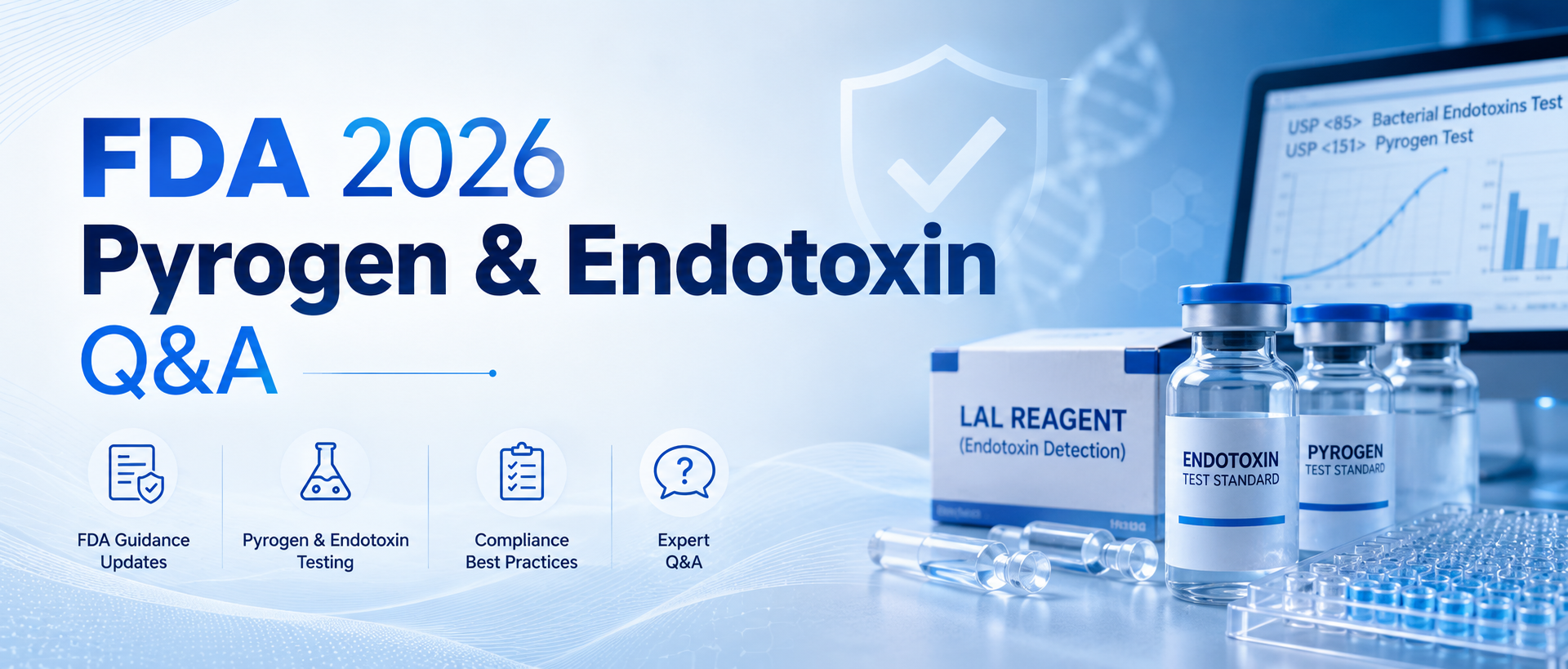
Introduction
Few quality control topics have evolved more rapidly over the past several years than pyrogen and endotoxin testing.
The introduction of USP <86>, continued regulatory acceptance of TAL/LAL Reagent-based methods, increasing attention to Low Endotoxin Recovery (LER), and the rapid expansion of cell and gene therapy manufacturing have created a more complex testing landscape than many laboratories have previously experienced.
For quality control (QC) laboratories, simply performing endotoxin testing is no longer enough.
Regulators increasingly expect manufacturers to demonstrate:
- Scientific justification for method selection
- Method suitability
- Risk-based contamination control
- Process understanding
- Robust data trending
While FDA's Guidance for Industry: Pyrogen and Endotoxins Testing – Questions and Answers remains one of the most frequently cited regulatory resources, many laboratories continue to face practical questions regarding compliance, method selection, and emerging technologies.
This article answers ten of the most important questions every QC laboratory should be asking in 2026.
Question 1
What Is the Difference Between Pyrogen Testing and Endotoxin Testing?
Although these terms are often used interchangeably, they are not synonymous.
Pyrogens
Pyrogens are substances capable of inducing fever.
Examples include:
- Gram-negative bacterial endotoxins
- Gram-positive bacterial components
- Fungal cell wall materials
- Certain process-related contaminants
Endotoxins
Endotoxins specifically refer to lipopolysaccharides (LPS) originating from Gram-negative bacteria.
Therefore:
All endotoxins are pyrogens.
Not all pyrogens are endotoxins.
Understanding this distinction is critical when evaluating regulatory requirements and selecting appropriate testing methods.
Question 2
How Does FDA Define the Bacterial Endotoxins Test (BET)?
The Bacterial Endotoxins Test (BET) is the compendial method used to detect and quantify Gram-negative bacterial endotoxins in pharmaceutical products, biologics, medical devices, and water systems.
BET remains one of the most widely performed quality control assays in the pharmaceutical industry.
According to FDA guidance and USP <85>, BET plays a critical role in ensuring product safety for injectable and implantable products.
Common applications include:
- Raw material testing
- Water system monitoring
- In-process controls
- Finished product release testing
- Investigation support
Despite ongoing technological developments, BET remains the global standard for endotoxin monitoring.
Question 3
Does FDA Still Accept TAL/LAL Reagent-Based Endotoxin Testing?
Yes.
Despite increasing discussion surrounding recombinant technologies, FDA continues to accept validated TAL/LAL Reagent-based methods.
These include:
Gel Clot
Traditional qualitative method.
Kinetic Turbidimetric
Quantitative and automated.
Kinetic Chromogenic
Highly sensitive and widely adopted throughout the biopharmaceutical industry.
Today, TAL/LAL Reagent-based testing remains the dominant approach used by:
- Pharmaceutical manufacturers
- Biotechnology companies
- CDMOs
- Cell and gene therapy developers
- Medical device manufacturers
USP <86> has expanded available options, but it has not replaced TAL/LAL Reagent testing.
Question 4
Why Does USP <85> Remain the Global Standard for BET?
USP <85> continues to serve as the foundational compendial chapter governing bacterial endotoxins testing.
According to USP <85>, laboratories must establish scientifically justified testing procedures capable of accurately detecting endotoxins within specific product matrices.
USP <85> provides:
- Test principles
- Validation expectations
- Endotoxin limit calculations
- Method suitability requirements
- Acceptance criteria
Importantly, FDA, EMA, and other major regulatory authorities continue to recognize USP <85> as a primary reference for endotoxin testing programs.
For many QC laboratories, USP <85> remains the cornerstone of endotoxin compliance.
Question 5
What Changed With USP <86>?
USP <86> introduced a compendial framework for recombinant reagent-based endotoxin testing.
Historically:
USP <85>
↓
TAL/LAL Reagent Methods
Now:
USP <85>
+
USP <86>
↓
Multiple Validated Endotoxin Testing Options
USP <86> includes guidance related to:
- Recombinant Factor C (rFC)
- Recombinant Cascade Reagent (rCR)
- Future recombinant technologies
The most important takeaway is that USP <86> complements USP <85> rather than replacing it.
Question 6
Which Endotoxin Testing Method Should a QC Laboratory Choose?
Selection should be based on:
- Product type
- Regulatory strategy
- Throughput requirements
- Sensitivity requirements
- Laboratory capabilities
Method Comparison
| Method | Quantitative | Sensitivity | Automation |
|---|---|---|---|
| Gel Clot | No | Moderate | No |
| Kinetic Turbidimetric | Yes | High | Yes |
| Kinetic Chromogenic | Yes | Very High | Yes |
| Recombinant Methods | Yes | High | Yes |
For many modern biologics and advanced therapies, kinetic chromogenic assays remain the preferred option due to their sensitivity and operational efficiency.
Question 7
Why Does FDA Place So Much Emphasis on Method Suitability?
A validated assay is not automatically suitable for every product.
Product matrices may:
- Inhibit reactions
- Enhance reactions
- Alter signal intensity
- Mask endotoxins
FDA guidance repeatedly emphasizes the importance of demonstrating that the chosen method can accurately detect endotoxins within the specific sample being tested.
Method Suitability Workflow
Validated Method
        ↓
Product-Specific Evaluation
        ↓
Spike Recovery Assessment
        ↓
Method Suitability
        ↓
Reliable BET Results
Method suitability failures remain among the most common root causes of inaccurate endotoxin results.
Question 8
What Is Low Endotoxin Recovery (LER)?
Low Endotoxin Recovery (LER) refers to a reduction in measurable endotoxin recovery despite the continued presence of endotoxin.
This phenomenon has been observed in formulations containing:
- Surfactants
- Chelating agents
- Lipid nanoparticles
- Complex biologics
Simplified LER Mechanism
Free Endotoxin
       ↓
Interaction With Formulation Components
       ↓
Complex Formation
       ↓
Masked Endotoxin
       ↓
Reduced Recovery
PDA technical reports identify endotoxin masking as one of the most important analytical challenges facing modern endotoxin testing programs.
Question 9
Can Sterile Products Still Contain Endotoxins?
Yes.
One of the most misunderstood concepts in quality control is:
Sterility does not equal endotoxin-free.
Sterility testing evaluates viable microorganisms.
Endotoxin testing evaluates bacterial lipopolysaccharides.
Therefore:
Sterile Product
        ≠
Endotoxin-Free Product
Products may successfully pass sterility testing while still failing endotoxin specifications.
This is why BET remains essential even when sterility testing is performed.
Question 10
What Does a Modern Endotoxin Control Strategy Look Like in 2026?
Leading organizations no longer treat endotoxin testing as a standalone release activity.
Instead, they implement comprehensive contamination control strategies.
Modern Endotoxin Control Model
Supplier Qualification
          ↓
Raw Material Testing
          ↓
Water System Monitoring
          ↓
Manufacturing Risk Assessment
          ↓
Method Suitability
          ↓
TAL/LAL Reagent Testing
          ↓
Product Release
          ↓
Trending & CAPA
          ↓
Continuous Improvement
Testing identifies contamination.
Control prevents contamination.
The most mature quality systems focus on both.
Real-World Industry Example: When Sterility Testing Was Not Enough
Consider a common scenario observed throughout the pharmaceutical industry.
A manufacturer successfully completed:
- Environmental monitoring
- Sterility testing
- Microbial controls
However, final product BET testing failed.
Subsequent investigation identified elevated endotoxin levels originating from a process water hold tank.
No viable microorganisms were detected.
The root cause was endotoxin accumulation associated with biofilm development within the water distribution system.
This example highlights a critical lesson:
Endotoxin control requires more than microbial control.
It requires dedicated endotoxin monitoring strategies.
Key Takeaways for QC Laboratories
As endotoxin testing continues to evolve, several principles remain clear:
- FDA continues to accept validated TAL/LAL Reagent-based methods.
- USP <85> remains the primary compendial standard for BET.
- USP <86> expands available testing options.
- Method suitability remains essential.
- Low Endotoxin Recovery must be considered during assay development.
- Cell and gene therapy manufacturing presents unique endotoxin challenges.
- Effective contamination control extends beyond release testing.
Organizations that combine endotoxin testing with risk-based quality management are best positioned to maintain compliance and protect patient safety.
Frequently Asked Questions
Is FDA requiring recombinant endotoxin testing?
No. FDA does not currently require recombinant methods and continues to accept validated TAL/LAL Reagent-based assays.
Is TAL/LAL Reagent being phased out?
No. TAL/LAL Reagent testing remains widely used throughout the pharmaceutical and biotechnology industries.
Does USP <86> replace USP <85>?
No. Both chapters currently coexist.
What is BET?
BET stands for Bacterial Endotoxins Test, the compendial assay used to detect Gram-negative bacterial endotoxins.
What causes Low Endotoxin Recovery?
Interactions between endotoxins and formulation components can reduce measurable recovery.
Can endotoxins survive sterilization?
Yes. Endotoxins are significantly more resistant than live microorganisms.
Can sterile filtration remove endotoxins?
Not necessarily. Sterile filtration removes microorganisms but may not effectively remove endotoxins.
Why is method suitability important?
It demonstrates that the assay can accurately detect endotoxins within a specific product matrix.
What endotoxin limits apply to injectable products?
Limits depend on route of administration, dosage, and applicable pharmacopeial requirements.
How often should BET be performed?
Testing frequency should be determined through product-specific risk assessments and regulatory requirements.
Why is endotoxin testing critical for cell and gene therapy products?
These products often involve complex matrices, small batch sizes, and rapid release timelines.
Which BET method is most commonly used today?
Kinetic chromogenic assays remain among the most widely adopted quantitative endotoxin testing methods.
Recommended Resources
Technical Guides
- USP <86> and FDA 2026 Guidance: Navigating the New Dual-Track Era of Endotoxin Testing
- Hidden Sources of Endotoxin Contamination in Cell and Gene Therapy Manufacturing: What QC Teams Are Missing in 2026
- Why Kinetic Chromogenic Endotoxin Testing Is Becoming Essential for Cell and Gene Therapy Manufacturing in 2026
- Low Endotoxin Recovery (LER): Causes, Endotoxin Masking Mechanisms, Regulatory Expectations, and Practical Solutions
Product Solutions
- Kinetic Chromogenic TAL/LAL Reagent
- Gel Clot TAL/LAL Reagent
- Endotoxin Detection Kits
- Endotoxin Standard Controls
References
FDA
FDA. Guidance for Industry: Pyrogen and Endotoxins Testing – Questions and Answers.
United States Pharmacopeia
USP <85> Bacterial Endotoxins Test.
USP <86> Bacterial Endotoxins Test Using Recombinant Reagents.
ICH
ICH Q9 Quality Risk Management.
PDA
PDA Technical Report No. 82: Low Endotoxin Recovery and Endotoxin Masking.
European Medicines Agency (EMA)
Guidelines Related to Biological and Advanced Therapy Medicinal Products.
Williams KL
Endotoxins: Pyrogens, LAL Testing and Depyrogenation.
FireGene Endotoxin Testing
Ready to run your endotoxin assay?
FireGene offers a complete endotoxin testing toolkit — from TAL reagents and CSE standards to pyrogen-free consumables and LAL reagent water. All products are aligned with USP <85>, EP 2.6.14, and JP 4.01.


