
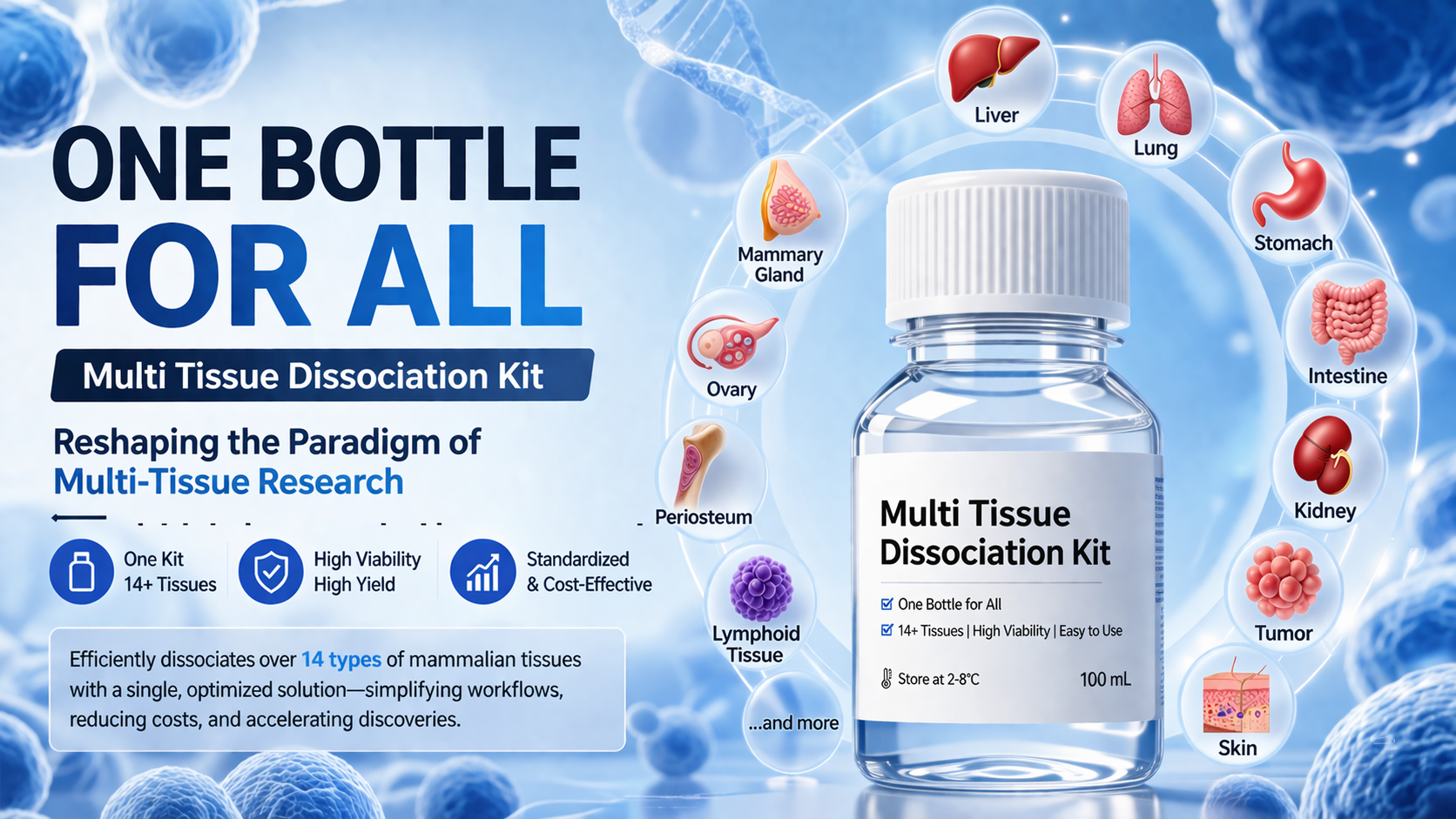
Are you still struggling to manage a diverse array of tissue samples? Liver, lung, stomach, tumor, skin... it seems as though every tissue type requires its own specialized dissociation protocol. The complexities of procurement, inconsistent workflows, and skyrocketing costs can severely compromise experimental efficiency right from the starting line. It is time to bid farewell to this inefficient, fragmented research paradigm and embrace a smarter, more unified solution for multi-tissue dissociation!
Today, we proudly introduce the FireGene Multi Tissue Dissociation Kit. With just a single bottle of dissociation reagent, you can efficiently tackle the challenges of dissociating over 14 types of mammalian tissues—including liver, lung, stomach, intestine, kidney, tumor, mammary gland, ovary, periosteum, skin, and lymphoid tissue. This kit ushers in a new era of efficient, cost-effective, and standardized single-cell research for the scientific community, liberating you entirely from the burden of repetitive protocol optimization so you can focus your full attention on the core scientific discoveries themselves.
I. Simplifying Complexity: The Epoch-Making Value of Universal Dissociation
On the path of multi-tissue research, traditional dissociation methods have left researchers mired in a host of dilemmas, severely hindering research progress:
Piles of Kits: Conducting research across multiple tissue types requires the procurement, management, and optimization of various specialized kits—a process that consumes vast amounts of time and research funding.
Confusing Protocols: Dissociation steps, digestion times, and enzyme concentrations vary significantly across different tissues; this makes experimental errors highly probable for lab personnel, resulting in poor experimental reproducibility.
Soaring Research Costs: Specialized kits carry high unit prices, causing reagent costs for multi-tissue research to rise exponentially and leading to inefficient utilization of research budgets.
No Solutions for Special Samples: When faced with rare tissues (such as periosteum or embryos) or complex composite samples, research often grinds to a halt due to the lack of specialized kits.
The advent of FG-BA3303 precisely resolves all the pain points associated with multi-tissue dissociation, achieving a comprehensive enhancement of research efficiency:
One Kit Fits All: Universal Coverage: A single bottle of meticulously optimized dissociation solution efficiently processes over a dozen common and specialized tissue types, achieving the ultimate in experimental protocol standardization and simplification.
Standardized Protocols, Stable Results: Standardized operating procedures drastically reduce human-induced variability, ensuring high reproducibility and comparability of experimental data across different tissue types and production batches.
Significant Cost Reduction, Maximum Efficiency: There is no longer a need to stockpile multiple reagents; a single bottle meets the dissociation needs of diverse samples, resulting in substantial savings on procurement and inventory management costs.
Flexible Expansion, Boundless Research: It provides reliable dissociation solutions for both common organ tissues and specialized niche samples, effectively expanding the frontiers of multi-tissue research.
II. Core Insights: How Does FG-BA3303 Achieve "One Bottle Fits All"?
1. A Gentle, Universally Optimized Enzyme Cocktail: FG-BA3303 utilizes a proprietary enzyme system—validated through extensive iterative formulation—to gently yet efficiently dissociate the extracellular matrix (ECM) of various tissues, regardless of their structural diversity. While efficiently releasing a high yield of single cells, it simultaneously maximizes the preservation of cell membrane integrity and cellular viability, thereby laying a solid foundation for the success of downstream high-precision experiments such as single-cell RNA sequencing, flow cytometry analysis, and primary cell culture.
2. A Flexible and Intelligent Digestion Control Strategy: The kit features a flexible digestion time window ranging from 0.5 to 2 hours. Researchers can monitor cell release in real-time by taking samples for microscopic examination during the digestion process—adjusting their approach based on tissue type (e.g., loose lung tissue vs. dense tumor tissue) and tissue condition (e.g., degree of fibrosis). This allows for the precise determination of the optimal time to terminate dissociation, fundamentally preventing common industry pitfalls such as "incomplete dissociation leading to cell clumping" or "over-digestion causing cellular damage."
3. Comprehensive and Thoughtful Experimental Support:
• Dual-Mode Compatibility: Widely compatible with two common laboratory devices—37°C water baths (requiring periodic manual shaking) and 37°C hybridization ovens (operating at 20–30 rpm). This eliminates the need for expensive, specialized tissue dissociators and ensures adaptability across a wide range of laboratory equipment configurations.
• Flexible Media Selection: The dissociation solution can be diluted and prepared using standard RPMI 1640 or DMEM media, integrating seamlessly with the vast majority of existing laboratory culture systems and eliminating the need to purchase specialized media.
• User-Friendly Workflow Design: For tissues with high erythrocyte content post-dissociation (such as the spleen), the kit can be optionally paired with FG-BA3311 Erythrocyte Lysis Solution for processing. This flexible, optional step for removing erythrocytes ensures the protocol remains adaptable to the specific dissociation requirements of different tissue types.
III. Three Simple Steps for Easily Obtaining High-Viability Single-Cell Suspensions
Step 1: Sample Pre-processing. Take approximately 200 mg (about the size of a soybean) of fresh tissue sample. Wash it thoroughly with pre-cooled PBS buffer. Using ophthalmic scissors or a scalpel blade, mince the tissue completely into a slurry-like consistency to increase the surface area for the subsequent enzymatic digestion reaction.
Step 2: Dissociation and Digestion. 1. In a sterile 5 mL centrifuge tube, add 240 μL of BA3303 Dissociation Solution and 2760 μL of RPMI 1640 medium; gently pipette to mix. 2. Transfer all of the minced tissue fragments into the working dissociation solution, ensuring that the tissue fragments are in full contact with the liquid. 3. Incubate in a 37°C water bath or hybridization oven for 0.5 to 2 hours to allow for digestion. If using a water bath, gently shake or invert the centrifuge tube every 3–5 minutes to ensure the tissue remains thoroughly mixed with the dissociation solution.
Step 3: Purification and Resuspension. 1. Once digestion is complete, filter the entire digestion mixture through a sterile 70 μm cell strainer to remove undissociated tissue clumps and large debris, thereby collecting the single-cell suspension. 2. Rinse the original digestion tube with a small volume of fresh medium and pass the rinse through the strainer; repeat this process 3 times to maximize cell recovery, then pool all the filtrates. 3. Centrifuge the pooled filtrate at 300 × g for 5 minutes at 4°C, then carefully discard the supernatant. 4. Resuspend the cell pellet in PBS buffer containing 5% Fetal Bovine Serum (FBS); centrifuge and wash again to remove residual enzyme solution and cellular debris. 5. Depending on the requirements of downstream experiments, resuspend the cell pellet in 50 μL to 2 mL of PBS buffer containing 5% FBS. After performing cell counting and viability assessment, the suspension is ready for direct use in subsequent experiments.
The FireGene Multi Tissue Dissociation Kit represents not merely an upgrade to a laboratory product, but a true innovation in the conceptual framework of multi-tissue research. It liberates researchers from the burden of tedious, repetitive protocol development and optimization, allowing them to channel their invaluable time and creativity into the core aspects of research—formulating scientific questions, interpreting data, and unraveling biological mechanisms—thereby truly realizing the scientific philosophy that "technology serves discovery."
FireGene, light your research with passion, innovation, and profession.
FireGene Single-Cell Sample Prep
Looking for validated dissociation kits?
FireGene's tissue dissociation kits are optimized for specific organ types — brain, tumor, liver, GI, reproductive, and more. Validated for 10x Genomics Chromium and BD Rhapsody workflows.


