
Introduction
Monoclonal antibodies have become essential tools in modern biotechnology, pharmaceutical development, diagnostics, and biomedical research. From therapeutic antibody development to immunoassay production, the demand for high-quality antibody-producing cell lines continues to grow. However, generating and selecting high-performing hybridoma clones remains a time-consuming and labor-intensive process.
Traditional hybridoma screening methods often rely on limiting dilution cloning, ELISA screening, and repeated subcloning, which require significant time and resources. Researchers must analyze hundreds or even thousands of individual clones to identify cells producing antibodies with desirable characteristics.
FireGene™ Hybridoma Rapid Fluorescence Screening Semi-Solid Medium provides an innovative solution by combining semi-solid hybridoma culture technology with fluorescence-based screening. This advanced platform enables rapid identification of antibody-producing hybridoma colonies, improves screening efficiency, and accelerates monoclonal antibody discovery workflows.
What Is Hybridoma Rapid Fluorescence Screening?
Hybridoma technology is a well-established method for producing monoclonal antibodies. It involves the fusion of antibody-producing B cells with immortal myeloma cells, creating hybridoma cells that combine antibody secretion ability with unlimited growth potential.
After fusion, thousands of hybridoma cells may be generated, but only a small percentage produce antibodies with the desired specificity and affinity. Therefore, efficient screening methods are critical for identifying valuable antibody-producing clones.
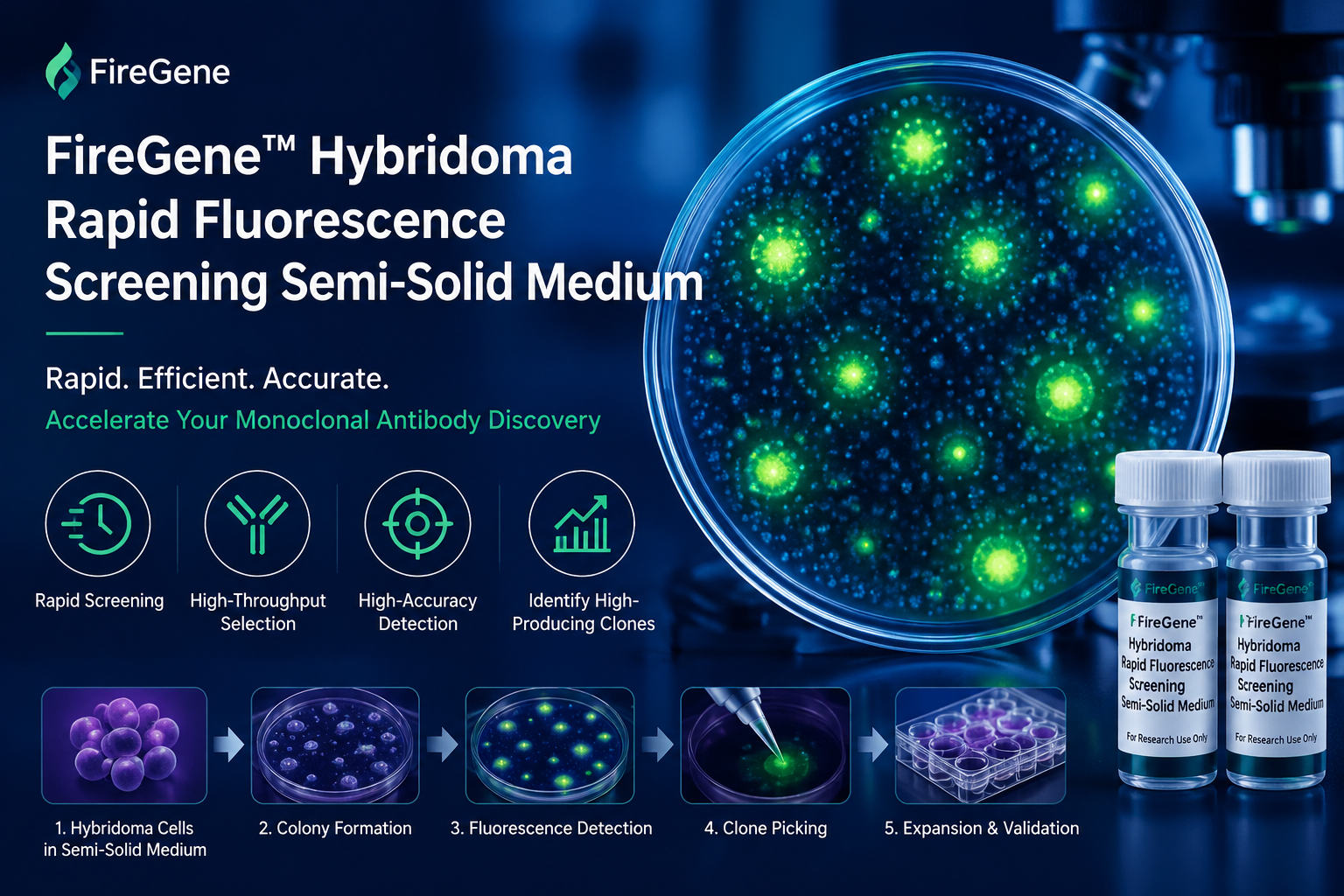
FireGene™ Hybridoma Rapid Fluorescence Screening Semi-Solid Medium is designed to simplify this process. Instead of analyzing individual wells separately, hybridoma cells are cultured in a semi-solid environment where each cell develops into an isolated colony. Antibody secretion can then be detected through fluorescence signals surrounding productive colonies.
This allows researchers to quickly locate and select high-performing antibody-producing clones.
How Does FireGene™ Hybridoma Fluorescence Screening Medium Work?
The technology is based on the combination of semi-solid cell culture and fluorescence detection principles.
Step 1: Hybridoma Cell Encapsulation
Hybridoma cells are mixed with FireGene™ semi-solid medium and distributed evenly throughout the culture system.
The semi-solid environment restricts cell movement, allowing individual hybridoma cells to remain separated.
Step 2: Colony Formation
Each hybridoma cell grows into a localized colony.
Because colonies remain physically separated:
· Individual clones can be evaluated independently
· Cross-contamination between colonies is minimized
· Rare high-producing clones can be identified more easily
Step 3: Fluorescence-Based Antibody Detection
As hybridoma colonies produce antibodies, secreted antibodies accumulate around the colonies.
A fluorescence detection system recognizes antibody production and generates visible fluorescent signals.
The intensity of fluorescence can indicate relative antibody secretion levels, allowing researchers to prioritize stronger antibody-producing clones.
Step 4: Clone Recovery and Expansion
High-fluorescence colonies can be selected, recovered, expanded, and further validated using downstream assays such as:
· ELISA
· Western blot
· Flow cytometry
· Immunohistochemistry
This streamlined workflow reduces unnecessary screening steps and improves overall efficiency.
Advantages of FireGene™ Hybridoma Rapid Fluorescence Screening Semi-Solid Medium
1. Accelerated Hybridoma Screening
Traditional hybridoma screening can require multiple rounds of culture and testing. FireGene™ fluorescence screening technology enables researchers to identify promising clones earlier.
By directly visualizing antibody-producing colonies, scientists can reduce screening time and focus resources on the most valuable candidates.
2. High-Throughput Antibody Discovery
Modern antibody discovery projects often require screening large numbers of hybridoma clones.
The semi-solid fluorescence platform supports:
· Large-scale hybridoma screening
· Efficient clone comparison
· Rapid identification of rare antibody-producing cells
This makes it particularly valuable for pharmaceutical research and antibody engineering programs.
3. Improved Selection of High-Producing Clones
Not all antibody-producing hybridomas have the same performance.
Some clones may produce:
· Higher antibody concentrations
· Better antibody stability
· Improved antigen specificity
Fluorescence-based screening enables researchers to prioritize colonies with stronger antibody secretion signals, increasing the chance of selecting superior clones.
4. Reduced Labor and Resource Requirements
Conventional screening approaches often require:
· Large numbers of culture plates
· Multiple ELISA assays
· Extensive manual analysis
FireGene™ semi-solid screening reduces dependence on repetitive screening steps by providing a visual method for identifying productive colonies.
This helps laboratories improve workflow efficiency and reduce operational costs.
Applications of Hybridoma Rapid Fluorescence Screening Technology

1. Monoclonal Antibody Development
The primary application of FireGene™ Hybridoma Rapid Fluorescence Screening Semi-Solid Medium is monoclonal antibody discovery.
It supports researchers working on:
· Therapeutic antibody development
· Research antibodies
· Target-specific antibody generation
· Immune response studies
By improving clone selection efficiency, this technology helps accelerate antibody development pipelines.
2. Diagnostic Antibody Production
High-quality monoclonal antibodies are widely used in diagnostic applications, including:
· ELISA kits
· Immunoassays
· Rapid diagnostic tests
· Biomarker detection systems
Efficient screening of antibody-producing hybridomas helps manufacturers develop reliable diagnostic reagents faster.
3. Immunology Research
Hybridoma-derived antibodies are essential tools for studying biological processes.
Applications include:
· Immune cell identification
· Protein expression analysis
· Cell signaling research
· Disease mechanism studies
Rapid screening technology allows researchers to obtain suitable antibodies more efficiently.
4. Biotechnology and Pharmaceutical Research
The pharmaceutical industry increasingly relies on monoclonal antibodies for drug discovery and therapeutic development.
FireGene™ screening technology can support:
· Early-stage antibody discovery
· Lead antibody identification
· Clone optimization
· Research antibody production
FireGene™ Semi-Solid Screening vs Traditional Hybridoma Screening
|
Feature |
Traditional Screening |
FireGene™ Fluorescence Screening |
|
Screening approach |
Individual well testing |
Colony-based fluorescence identification |
|
Detection method |
Secondary assays required |
Direct fluorescence visualization |
|
Screening speed |
Time-consuming |
Rapid identification |
|
Throughput |
Limited |
High-throughput compatible |
|
Clone selection |
Based on sequential testing |
Based on fluorescence intensity |
|
Labor requirement |
High |
Reduced |
The major advantage of FireGene™ technology is the ability to combine clone isolation and antibody production analysis into a single screening platform.
Why Choose FireGene™ Hybridoma Rapid Fluorescence Screening Semi-Solid Medium?
The success of monoclonal antibody development depends heavily on the ability to identify the best-producing clones efficiently.
FireGene™ provides researchers with:
Faster Discovery
Rapid identification of antibody-producing colonies accelerates research timelines.
Better Screening Accuracy
Fluorescence signals provide an effective method for comparing antibody production levels.
Higher Efficiency
Reduced screening workload allows researchers to focus on promising candidates.
Flexible Applications
Suitable for research antibody development, diagnostics, and biotechnology applications.
Future Perspectives of Hybridoma Screening Technology
As demand for monoclonal antibodies continues to expand, researchers require faster and more reliable screening platforms.
Future antibody discovery workflows are expected to integrate:
· Automated fluorescence imaging
· Artificial intelligence-based colony analysis
· High-throughput screening platforms
· Advanced antibody engineering technologies
Semi-solid fluorescence screening represents an important step toward more efficient antibody discovery by reducing bottlenecks in traditional hybridoma workflows.
Conclusion
FireGene™ Hybridoma Rapid Fluorescence Screening Semi-Solid Medium offers an innovative approach for improving hybridoma clone identification and monoclonal antibody development. By combining semi-solid culture technology with fluorescence-based detection, it enables rapid visualization of antibody-producing colonies and simplifies the selection of high-performing clones.
For researchers involved in monoclonal antibody discovery, diagnostic development, and biotechnology applications, this advanced screening platform provides a powerful tool to increase efficiency, reduce screening time, and accelerate the development of valuable antibody products.


