
Introduction
Bacterial endotoxin testing has long been a cornerstone of pharmaceutical quality control, providing manufacturers with a reliable means of detecting pyrogenic contamination before products reach patients. For decades, compendial TAL/LAL assays have demonstrated excellent sensitivity and reproducibility across a wide range of injectable drugs, medical devices, and biological products.
However, as pharmaceutical formulations have become increasingly sophisticated, a new analytical challenge has emerged—Low Endotoxin Recovery (LER).
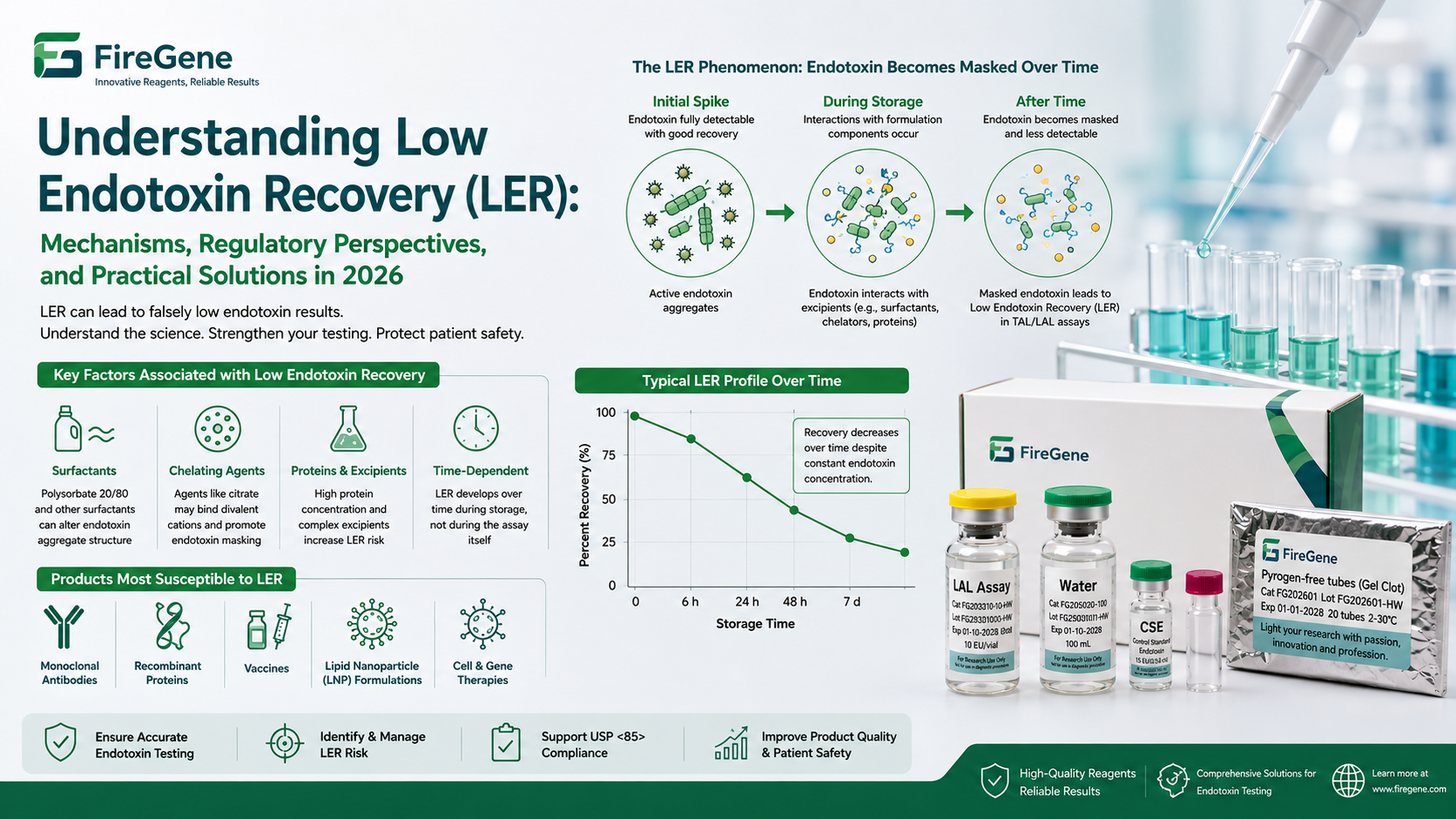
LER refers to the unexpected reduction in detectable endotoxin over time, even when the actual amount of endotoxin present in a sample has not changed. During routine testing, laboratories may observe that a product spiked with a known concentration of endotoxin initially produces acceptable recovery, only for the measured endotoxin level to decline significantly after storage. This apparent loss of endotoxin activity is not necessarily caused by degradation of the endotoxin molecule itself. Instead, it is often the result of interactions between endotoxins and specific formulation components that reduce their ability to activate the TAL/LAL enzymatic cascade.
Because LER may lead to falsely low endotoxin results, it has become one of the most widely discussed topics in pharmaceutical microbiology, particularly in the development of biologics, monoclonal antibodies, vaccines, recombinant proteins, and advanced cell and gene therapies.
Over the past decade, regulators, pharmacopeias, industry organizations, and manufacturers have devoted considerable attention to understanding the mechanisms behind endotoxin masking and evaluating how laboratories should address this phenomenon during method development and product lifecycle management.
Although scientific understanding continues to evolve, one principle remains clear: laboratories must understand the factors contributing to Low Endotoxin Recovery if they are to generate reliable, scientifically defensible endotoxin testing results.
In this guide, we explain the mechanisms behind LER, review current regulatory perspectives, discuss products most susceptible to endotoxin masking, and present practical strategies for minimizing analytical risk while maintaining compliance with USP <85> and global pharmacopeial expectations.
What Is Low Endotoxin Recovery (LER)?
Low Endotoxin Recovery describes a phenomenon in which the measurable endotoxin concentration decreases over time despite the endotoxin still being physically present within the sample.
Unlike traditional analytical interference, where inhibition occurs only during the assay itself, LER develops during sample storage or incubation. A freshly prepared endotoxin spike may initially demonstrate acceptable recovery, yet subsequent testing after hours or days reveals substantially lower detectable endotoxin levels.
This reduction does not necessarily indicate that the endotoxin has degraded or disappeared. Instead, the endotoxin may become masked by interactions with components in the pharmaceutical formulation, preventing it from effectively activating the Factor C-mediated enzymatic cascade used in TAL/LAL assays.
Because endotoxin masking can produce artificially low analytical results, laboratories may incorrectly conclude that a product contains little or no endotoxin when contamination is actually present.
For this reason, LER has become an important consideration during method development, validation, and ongoing quality control for complex pharmaceutical products.
Why LER Matters in Modern Pharmaceutical Manufacturing
Historically, most injectable formulations contained relatively simple combinations of active pharmaceutical ingredients, buffers, and stabilizers. Under these conditions, endotoxin recovery was generally predictable, and traditional bacterial endotoxin testing methods performed reliably.
Today's pharmaceutical products are very different.
Modern biologics frequently include complex mixtures of proteins, surfactants, chelating agents, sugars, lipids, polymers, and proprietary stabilizing excipients. These ingredients are carefully selected to improve product stability and therapeutic performance—but they may also create conditions that promote endotoxin masking.
If LER is not recognized during method development, manufacturers may face several risks:
- False-negative endotoxin results
- Delayed method validation
- Failed recovery studies
- Repeated laboratory investigations
- Increased regulatory scrutiny
- Potential patient safety concerns
- Higher quality control costs
As biologics and advanced therapies continue to expand, understanding LER is becoming increasingly important for pharmaceutical quality systems.
The Science Behind Endotoxin Masking
Although the exact molecular mechanisms remain an active area of research, most scientists agree that LER is driven by changes in how endotoxin molecules interact with the surrounding formulation.
Endotoxins naturally exist as large aggregates in aqueous environments. These aggregates are highly effective at activating the TAL/LAL enzymatic cascade.
However, certain formulation components can disrupt these structures.
The most frequently implicated factors include:
Surfactants
Nonionic surfactants such as Polysorbate 20 and Polysorbate 80 can alter endotoxin aggregate structure, increasing the likelihood of masking over time.
Chelating Agents
Chelators such as citrate may bind divalent cations that help stabilize endotoxin aggregates, contributing to structural changes that reduce analytical detectability.
Combined Effects
Many studies suggest that surfactants and chelating agents act synergistically, making their combined presence more likely to induce LER than either component alone.
Time-Dependent Changes
Unlike immediate assay inhibition, LER often develops gradually.
Endotoxin recovery may appear normal immediately after spiking but decrease after hours, days, or longer storage periods.
This time-dependent behavior distinguishes LER from conventional matrix interference.
Which Pharmaceutical Products Are Most Susceptible to Low Endotoxin Recovery?
Although LER can theoretically occur in many pharmaceutical formulations, experience has shown that it is most frequently associated with complex biological products containing surfactants, chelating agents, or other formulation components capable of altering endotoxin behavior.
As biologics become increasingly sophisticated, understanding product-specific LER risk has become an essential part of endotoxin method development.
Monoclonal Antibodies (mAbs)
Monoclonal antibodies are among the products most commonly discussed in relation to Low Endotoxin Recovery.
Many antibody formulations contain:
- Polysorbate 20 or Polysorbate 80
- Citrate buffers
- Histidine buffers
- Stabilizing sugars
- High protein concentrations
These excipients help maintain protein stability during storage but may also contribute to endotoxin masking over time. As a result, manufacturers should carefully evaluate recovery during method validation and throughout the product lifecycle.
Recombinant Proteins
Recombinant enzymes, hormones, growth factors, and fusion proteins often require formulation strategies similar to monoclonal antibodies.
The combination of proteins, surfactants, and stabilizers may create conditions favorable for reduced endotoxin recovery, particularly after prolonged storage.
Vaccines
Modern vaccines include increasingly diverse formulations, such as recombinant protein vaccines, viral vector vaccines, and nucleic acid-based vaccines.
Many vaccine formulations contain adjuvants, stabilizers, preservatives, or emulsifying agents that may influence endotoxin behavior. Although not every vaccine exhibits LER, manufacturers should evaluate recovery during analytical method development rather than assuming traditional endotoxin testing conditions remain appropriate.
Cell and Gene Therapies
Cell and gene therapy products represent one of the fastest-growing areas of pharmaceutical development.
Products such as:
- CAR-T cell therapies
- AAV-based gene therapies
- Lentiviral vector products
- Gene-editing therapies
- Stem cell products
often contain highly complex biological matrices, cryoprotectants, proteins, nucleic acids, and specialized formulation buffers.
While these products are more commonly associated with matrix interference, manufacturers should also consider the potential for Low Endotoxin Recovery when designing validation studies.
Lipid Nanoparticle (LNP) Formulations
Lipid nanoparticles have become an important delivery platform for mRNA therapeutics, siRNA products, and other nucleic acid-based medicines.
Because LNP formulations contain complex lipid structures and surfactants, laboratories should evaluate whether formulation characteristics influence endotoxin recovery during storage.
Low Endotoxin Recovery vs. Matrix Interference: Understanding the Difference
One of the most common misconceptions is that Low Endotoxin Recovery and matrix interference are interchangeable concepts.
Although both can affect endotoxin testing results, they occur through different mechanisms and should be investigated differently.
Matrix Interference
Matrix interference occurs during the endotoxin assay itself.
Components within the sample directly inhibit or enhance the TAL/LAL enzymatic reaction, leading to inaccurate measurements.
Typical characteristics include:
- Immediate effect during analysis
- Often resolved through optimized dilution
- Evaluated through method suitability testing
- Monitored using Positive Product Controls (PPCs)
Low Endotoxin Recovery (LER)
LER develops before the assay begins.
The endotoxin gradually becomes less detectable while stored in the product formulation, even though the endotoxin molecules remain present.
Typical characteristics include:
- Time-dependent phenomenon
- Often associated with endotoxin masking
- Cannot always be corrected by simple dilution
- Requires carefully designed recovery studies
Understanding this distinction helps laboratories select the appropriate investigation strategy rather than applying the same troubleshooting approach to fundamentally different analytical problems.
Current Regulatory Perspectives on LER
As scientific understanding of Low Endotoxin Recovery has evolved, regulatory agencies and pharmacopeial organizations have acknowledged the importance of evaluating endotoxin recovery in complex pharmaceutical products.
Rather than prescribing a single universal solution, regulators generally encourage manufacturers to adopt a science- and risk-based approach when designing endotoxin testing strategies.
Current expectations typically include:
- Demonstrating method suitability for the specific product.
- Evaluating endotoxin recovery during method validation.
- Investigating unexpected recovery failures using scientifically justified procedures.
- Maintaining comprehensive documentation of validation studies and investigations.
- Applying quality risk management principles throughout product development and commercial manufacturing.
This approach aligns with the broader pharmaceutical emphasis on lifecycle management, process understanding, and evidence-based quality systems.
Designing Studies to Evaluate Low Endotoxin Recovery
Because LER develops over time, study design differs from conventional spike recovery experiments.
Several best practices can improve the quality and interpretability of LER investigations.
Perform Time-Course Recovery Studies
Instead of measuring recovery immediately after spiking, evaluate endotoxin recovery at multiple predefined time points—for example, immediately after preparation and again after controlled storage intervals.
Monitoring recovery over time helps determine whether the formulation exhibits progressive endotoxin masking.
Evaluate Representative Manufacturing Formulations
LER studies should use the actual commercial or clinical formulation whenever possible.
Testing simplified laboratory formulations may fail to capture interactions that occur in the final pharmaceutical product.
Investigate Formulation Variables
Potential variables include:
- Surfactant concentration
- Buffer composition
- Chelating agents
- Storage temperature
- Storage duration
- Protein concentration
- Container materials
Understanding these variables supports more effective root cause analysis if recovery decreases during storage.
Integrate LER Assessment into Method Validation
Rather than treating LER as a separate investigation, manufacturers should incorporate appropriate recovery evaluations into their broader endotoxin method validation strategy whenever product characteristics indicate elevated risk.
This proactive approach reduces the likelihood of unexpected analytical issues during commercial manufacturing.
Practical Strategies for Reducing LER Risk
Although no universal solution eliminates Low Endotoxin Recovery in every formulation, several practical approaches can reduce analytical uncertainty and improve confidence in endotoxin testing.
Understand Product Formulation Early
Close collaboration between formulation scientists, analytical development teams, and quality control laboratories helps identify potential LER risks before method validation begins.
Perform Comprehensive Recovery Studies
Recovery studies remain one of the most effective tools for evaluating endotoxin behavior within a specific formulation.
Well-designed studies provide valuable evidence supporting analytical reliability.
Standardize Sample Handling
Consistent sample preparation, storage conditions, mixing procedures, and timing reduce unnecessary analytical variability.
Use High-Quality Endotoxin Testing Reagents
Reliable TAL/LAL reagents, validated Control Standard Endotoxin (CSE), endotoxin-free water, and certified pyrogen-free consumables improve overall assay consistency and reduce uncertainty during recovery studies.
Continuously Review Analytical Performance
Routine trending of recovery data across validation studies, manufacturing campaigns, and product lots helps identify emerging patterns before they develop into significant quality issues.
A proactive review process strengthens both analytical confidence and regulatory readiness.
FireGene Solutions for Addressing Low Endotoxin Recovery
Successfully managing Low Endotoxin Recovery requires more than understanding the science behind endotoxin masking. Laboratories also need robust analytical methods, high-quality reagents, and standardized procedures that deliver consistent performance throughout method development, validation, and routine quality control.
FireGene offers a comprehensive portfolio of endotoxin testing solutions designed to support pharmaceutical manufacturers in evaluating endotoxin recovery, investigating potential masking phenomena, and maintaining compliance with USP <85> and other international pharmacopeial requirements.
Our endotoxin testing portfolio includes:
- Gel-Clot TAL/LAL Reagents for qualitative bacterial endotoxin testing
- Kinetic Chromogenic Endotoxin Test Kits for sensitive quantitative analysis
- Control Standard Endotoxin (CSE) for recovery studies and Positive Product Controls (PPCs)
- Endotoxin-Free Water for reagent preparation and sample dilution
- Pyrogen-Free Tubes and Consumables to minimize laboratory contamination
When combined with scientifically designed recovery studies and validated method suitability testing, these products help laboratories generate reliable, reproducible endotoxin results while supporting efficient GMP quality control operations.
Case Study: Investigating Low Endotoxin Recovery During Monoclonal Antibody Development
A pharmaceutical company developing a monoclonal antibody (mAb) observed inconsistent endotoxin recovery during late-stage analytical validation. Initial spike recovery experiments produced acceptable results immediately after sample preparation. However, when the same spiked samples were stored under defined conditions and reanalyzed 24 hours later, measured endotoxin concentrations declined substantially.
The laboratory first evaluated common analytical variables, including reagent preparation, pipetting accuracy, instrument calibration, and Control Standard Endotoxin (CSE) preparation. All quality controls met predefined acceptance criteria, suggesting that the assay itself was functioning correctly.
Attention then shifted to the formulation.
The antibody product contained Polysorbate 80, a citrate buffer, and stabilizing excipients commonly used to maintain protein integrity. Based on the formulation profile and the time-dependent nature of the recovery loss, the investigation focused on the possibility of endotoxin masking.
To better understand the phenomenon, the analytical development team designed a structured study that included:
- Recovery measurements at multiple storage time points
- Evaluation of different sample dilution factors within the Maximum Valid Dilution (MVD)
- Comparison of freshly prepared and stored spiked samples
- Assessment of Positive Product Control (PPC) performance
- Review of formulation composition and storage conditions
The investigation confirmed that the observed decrease in measurable endotoxin was consistent with Low Endotoxin Recovery (LER) rather than conventional assay inhibition.
The laboratory updated its validation strategy to include time-course recovery studies and additional monitoring during method development. This proactive approach improved process understanding, strengthened analytical confidence, and supported successful regulatory documentation.
This example illustrates an important lesson: not every low endotoxin result reflects a low endotoxin concentration. Understanding formulation-specific behavior is essential for generating scientifically defensible data.
Frequently Asked Questions (FAQ)
1. What is Low Endotoxin Recovery (LER)?
Low Endotoxin Recovery (LER) is a phenomenon in which detectable endotoxin levels decrease over time after being introduced into certain pharmaceutical formulations, even though the endotoxin itself has not necessarily been destroyed or removed.
2. Is LER the same as endotoxin masking?
The terms are closely related but not identical. LER describes the observed analytical phenomenon of reduced measurable endotoxin, while endotoxin masking refers to one of the proposed mechanisms responsible for that reduction.
3. Which pharmaceutical products are most at risk for LER?
LER is most frequently discussed in relation to:
- Monoclonal antibodies
- Recombinant proteins
- Vaccines
- Cell and gene therapies
- Lipid nanoparticle (LNP) formulations
- Other biologics containing surfactants and chelating agents
4. What causes Low Endotoxin Recovery?
Although the exact molecular mechanisms remain under investigation, LER is commonly associated with interactions between endotoxins and formulation components such as surfactants, chelating agents, proteins, and specialized excipients that alter endotoxin aggregation and reduce detectability.
5. How is LER different from matrix interference?
Matrix interference affects the TAL/LAL reaction during the assay, whereas LER develops before testing, typically during sample storage. The two phenomena require different investigation strategies and should not be considered interchangeable.
6. Can sample dilution eliminate LER?
Not necessarily. Appropriate dilution may reduce conventional matrix interference, but it does not always reverse endotoxin masking. Product-specific studies are needed to determine the most suitable analytical approach.
7. How can manufacturers investigate suspected LER?
A comprehensive investigation typically includes:
- Time-course recovery studies
- Spike recovery experiments
- Method suitability testing
- Positive Product Controls (PPCs)
- Review of formulation composition
- Evaluation of storage conditions
- Risk assessment and trend analysis
8. Do regulatory agencies recognize LER?
Yes. Regulatory agencies and pharmacopeial organizations recognize that complex pharmaceutical formulations may influence endotoxin recovery. Manufacturers are expected to apply scientifically justified, risk-based approaches when validating endotoxin testing methods.
9. How can laboratories reduce the risk of LER?
While no universal solution exists, laboratories can reduce analytical risk by understanding formulation characteristics, performing comprehensive recovery studies, validating analytical methods, standardizing sample handling procedures, and using high-quality endotoxin testing reagents.
10. How does FireGene support LER investigations?
FireGene provides a complete portfolio of endotoxin testing solutions—including Gel-Clot TAL/LAL Reagents, Kinetic Chromogenic Endotoxin Test Kits, Control Standard Endotoxin (CSE), Endotoxin-Free Water, and Pyrogen-Free Consumables—to support recovery studies, method validation, routine quality control, and investigations involving complex pharmaceutical formulations.
Key Takeaways
Low Endotoxin Recovery has become one of the most important analytical considerations in modern bacterial endotoxin testing, particularly as biologics and advanced therapies continue to increase in complexity.
The most important lessons include:
- LER is a time-dependent phenomenon that can reduce detectable endotoxin without necessarily reducing the actual endotoxin present.
- Surfactants, chelating agents, proteins, and complex formulation excipients are commonly associated with endotoxin masking.
- LER differs fundamentally from traditional matrix interference and should be investigated using appropriate recovery studies and time-course experiments.
- Product-specific method validation and method suitability testing are essential for generating reliable endotoxin results.
- Comprehensive risk assessments, standardized laboratory practices, and high-quality TAL/LAL reagents strengthen analytical confidence and support regulatory compliance.
- A proactive approach to LER helps pharmaceutical manufacturers minimize false-negative results, improve quality control efficiency, and protect patient safety.
Conclusion
Low Endotoxin Recovery has fundamentally changed how pharmaceutical laboratories approach bacterial endotoxin testing for complex biologics and advanced therapeutic products. As formulations increasingly incorporate surfactants, chelating agents, lipid-based delivery systems, and other specialized excipients, traditional assumptions about endotoxin behavior are no longer sufficient.
Rather than viewing LER as an isolated laboratory issue, manufacturers should incorporate endotoxin recovery assessments into a broader quality strategy that spans formulation development, analytical method validation, routine quality control, and lifecycle management. By combining robust recovery studies, method suitability testing, comprehensive risk assessments, and continuous data trending, laboratories can better understand product-specific behavior and generate reliable, reproducible endotoxin results.
Ultimately, the goal is not simply to meet the requirements of USP <85> or other pharmacopeial standards—it is to ensure that every endotoxin result accurately reflects product quality. As scientific knowledge and regulatory expectations continue to evolve, organizations that invest in proactive, science-based endotoxin control strategies will be better positioned to improve manufacturing efficiency, accelerate product release, maintain regulatory compliance, and, most importantly, safeguard patient health.
FireGene Endotoxin Testing
Ready to run your endotoxin assay?
FireGene offers a complete endotoxin testing toolkit — from TAL reagents and CSE standards to pyrogen-free consumables and LAL reagent water. All products are aligned with USP <85>, EP 2.6.14, and JP 4.01.


