Introduction
Brain tissue is one of the most challenging sample types for single-cell analysis. Unlike blood or cultured cells, brain tissue contains a dense network of neurons, glial cells, lipid-rich myelin, and extracellular debris. When researchers perform dissociation, the resulting suspension is often contaminated with cellular fragments and myelin debris that significantly interfere with downstream applications such as single-cell RNA sequencing (scRNA-seq), flow cytometry, and cell sorting.
To address this issue, specialized cleanup solutions are required. The FireGene Brain Tissue Cell Debris Removal Kit for Single-Cell Cleanup is designed specifically to improve sample quality by efficiently removing debris while preserving viable single cells. This blog explores how the kit works, why it matters, and how it fits into modern single-cell workflows.
Why Brain Tissue Requires Specialized Debris Removal
Brain tissue is structurally and chemically unique. Its high lipid content—especially from myelin sheaths surrounding axons—creates major challenges during dissociation. When tissue is mechanically or enzymatically broken down, the following contaminants are commonly produced:
· Myelin fragments that float and interfere with cell separation
· Dead cells and apoptotic bodies
· Neuronal debris from fragile dendritic and axonal structures
· Lipid-rich particles that affect downstream optical and sorting systems
These contaminants can significantly reduce the quality of single-cell data by:
· Increasing background noise in RNA sequencing libraries
· Reducing cell viability estimates
· Distorting flow cytometry scatter plots (FSC/SSC)
· Causing clogging in microfluidic systems
· Increasing doublet rates during cell capture
Without proper cleanup, even a well-executed dissociation protocol may result in poor sequencing depth and unreliable biological interpretation.
What Is the FireGene Brain Tissue Cell Debris Removal Kit?
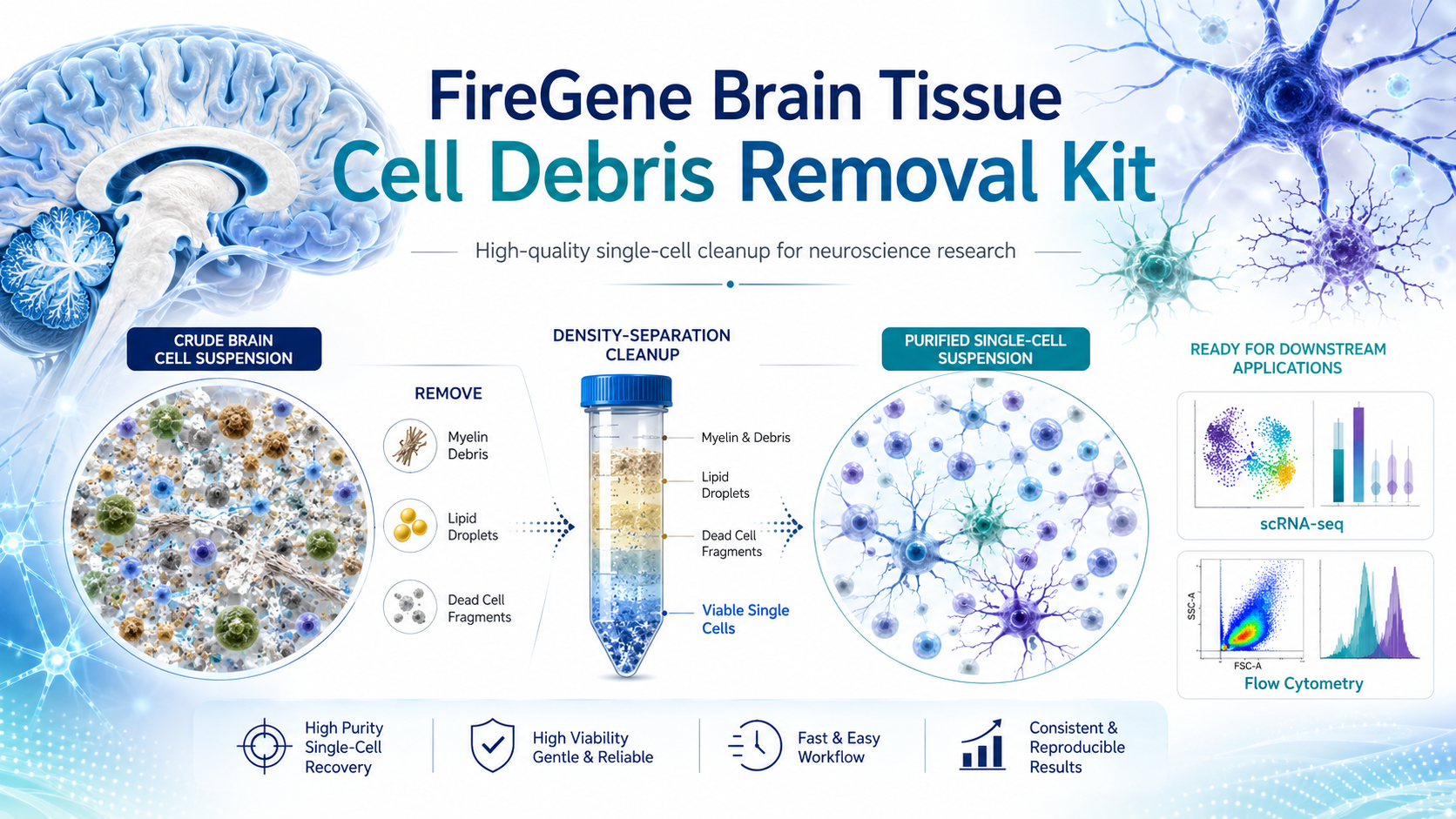
The FireGene Brain Tissue Cell Debris Removal Kit is a reagent system designed to purify single-cell suspensions derived from brain tissue. Its primary goal is to separate intact viable cells from unwanted debris using a density-based separation strategy.
The kit is typically used after tissue dissociation and filtration, acting as a crucial intermediate cleanup step before downstream processing.
Unlike generic debris removal solutions, this kit is optimized specifically for brain-derived samples, where myelin content is particularly high and requires more effective separation.
How the Kit Works: Density-Based Separation Principle
The core mechanism behind the FireGene debris removal system is density gradient separation. This method exploits differences in buoyant density between intact cells and debris particles.
During centrifugation:
· Viable cells, which are denser and structurally intact, migrate to a defined layer
· Myelin and lipid-rich debris remain in upper layers due to low density
· Cell fragments and apoptotic bodies separate into intermediate fractions
After centrifugation, the clean cell layer is carefully collected, leaving debris behind.
This approach offers several advantages:
· No harsh chemical disruption of cells
· High recovery of viable single cells
· Compatibility with downstream molecular assays
· Minimal impact on gene expression profiles
Because RNA integrity is critical for scRNA-seq, the gentle nature of this method is particularly important.
Key Benefits of Using FireGene Debris Removal Kit

1. Improved Single-Cell RNA Sequencing Quality
One of the most significant benefits is improved scRNA-seq data quality. Removing debris reduces ambient RNA contamination, which can otherwise blur true gene expression profiles. Cleaner suspensions result in:
· Higher unique molecular identifier (UMI) counts
· Reduced background RNA noise
· Better cell type clustering resolution
· More accurate differential expression analysis
2. Enhanced Flow Cytometry Performance
Debris in brain samples often overlaps with cell populations in scatter plots, making gating difficult. After cleanup:
· Forward and side scatter resolution improves
· Cell populations become more distinct
· Sorting accuracy increases
· Instrument clogging risk decreases
This is especially important when isolating rare neuronal or immune populations from brain tissue.
3. Higher Viability and Yield
Because the kit is designed to preserve intact cells rather than destroy debris chemically, it maintains:
· High cell viability rates
· Improved recovery of fragile neuronal populations
· Reduced mechanical stress during processing
This leads to more reliable downstream culture or sequencing inputs.
4. Reduced Doublets and Technical Artifacts
In single-cell sequencing platforms, debris and clumps can lead to doublets—where two cells are captured as one. This can distort downstream analysis. By removing debris and aggregates, the kit helps:
· Reduce multiplet formation
· Improve single-cell capture accuracy
· Enhance overall data interpretability
Workflow Integration: Where the Kit Fits
The FireGene Brain Tissue Cell Debris Removal Kit is typically integrated into a multi-step workflow:
Step 1: Tissue Dissociation
Brain tissue is mechanically and enzymatically dissociated into a crude cell suspension.
Step 2: Filtration
The suspension is passed through a mesh filter (often 40 μm or 70 μm) to remove large clumps.
Step 3: Debris Removal (FireGene Kit Step)
The filtered suspension undergoes density-based centrifugation using the FireGene system to separate debris from viable cells.
Step 4: Optional Red Blood Cell Lysis
If vascular contamination is present, RBC lysis may be performed.
Step 5: Cell Counting and Quality Control
Viable cells are counted using trypan blue or automated counters.
Step 6: Downstream Applications
Cells are used for:
· scRNA-seq library preparation
· Flow cytometry sorting
· Cell culture or functional assays
Comparison With Alternative Methods
Researchers often compare FireGene’s debris removal system with other commonly used approaches:
Percoll Gradient Centrifugation
Percoll gradients are widely used but require manual optimization and preparation. They can be time-consuming and less standardized.
Miltenyi Myelin Removal Kits
Magnetic bead-based systems can effectively reduce myelin, but may add cost and require antibody-based binding steps.
Simple Filtration Only
Filtration alone is insufficient for brain tissue, as myelin and fine debris pass through filters easily.
Advantage of FireGene Kit
The FireGene system combines ease of use with efficient separation, making it a balanced solution between performance and workflow simplicity.
Best Practices for Optimal Results
To maximize the performance of the FireGene Brain Tissue Cell Debris Removal Kit, researchers should consider the following best practices:
· Always process fresh tissue when possible
· Avoid excessive mechanical dissociation that increases debris load
· Maintain proper centrifugation speed and timing as recommended
· Use cold buffers to preserve RNA integrity
· Minimize delay between dissociation and cleanup
· Handle gradients gently to avoid disturbing separated layers
Following these practices ensures higher cell yield and better downstream data quality.
Applications in Modern Neuroscience Research
This kit is widely applicable across neuroscience and biomedical research fields, including:

· Single-cell transcriptomics of brain development
· Neurodegenerative disease research (e.g., Alzheimer’s, Parkinson’s)
· Brain tumor microenvironment studies
· Immune cell infiltration analysis in CNS disorders
· Drug response profiling in neural tissue
As single-cell technologies continue to advance, the demand for high-quality, debris-free brain cell suspensions is increasing rapidly.
Conclusion
The FireGene Brain Tissue Cell Debris Removal Kit for Single-Cell Cleanup plays an essential role in modern neuroscience workflows. By efficiently separating viable cells from myelin and tissue debris, it significantly improves the quality and reliability of downstream applications such as single-cell RNA sequencing and flow cytometry.
For researchers working with brain tissue, incorporating a dedicated debris removal step is no longer optional—it is a critical requirement for generating reproducible, high-resolution biological data. With its density-based separation approach and brain-specific optimization, the FireGene kit offers a practical and effective solution for overcoming one of neuroscience research’s most persistent technical challenges.
FireGene, light your research with passion, innovation, and profession.


