
1. Why Is Cell Debris Removal Important for Brain Tissue Single-Cell Analysis?
Single-cell analysis requires a high-quality cell suspension containing intact, viable, and well-separated cells. However, obtaining such a suspension from brain tissue can be challenging.
Brain tissue is structurally complex and contains not only neurons and glial cells but also substantial amounts of myelin, extracellular material, dead cells, membrane fragments, and cellular debris. During tissue dissociation, mechanical disruption and enzymatic digestion can further increase the amount of debris in the resulting suspension.
If these unwanted components are not adequately removed, they can negatively affect downstream experiments.
For example, excessive debris may:
· Reduce the proportion of usable cells
· Interfere with cell counting
· Increase sample background
· Complicate flow cytometry analysis
· Affect microfluidic systems used for single-cell analysis
· Reduce the efficiency of single-cell library preparation
· Contribute to poor-quality sequencing data
This is particularly important for single-cell RNA sequencing (scRNA-seq). In droplet-based workflows, excessive debris and free RNA can contribute to background signals and interfere with accurate cell-associated transcriptomic measurements.
Therefore, cell debris removal is an important quality-control step in brain tissue single-cell sample preparation.
2. What Makes Brain Tissue Challenging for Single-Cell Preparation?
Unlike relatively simple cell cultures, brain tissue contains multiple cell populations embedded within a highly organized tissue structure.


During tissue processing, researchers typically need to disrupt the tissue structure and release individual cells. This process can produce a mixture containing:
Intact cells + dead cells + myelin + membrane fragments + extracellular debris + free nucleic acids
The presence of myelin is especially relevant when processing nervous-system tissues. Myelin fragments can remain suspended after dissociation and may be difficult to separate from desired cells using simple centrifugation or filtration alone.
At the same time, aggressive tissue dissociation can damage fragile cells and increase cell death, creating even more debris.
This creates a fundamental challenge:
The goal is not simply to dissociate the tissue, but to obtain a clean and biologically representative single-cell suspension.
A dedicated debris-removal step can therefore improve the quality of the material entering downstream single-cell workflows.
3. How Does the FireGene Brain Tissue Cell Debris Removal Kit Help?
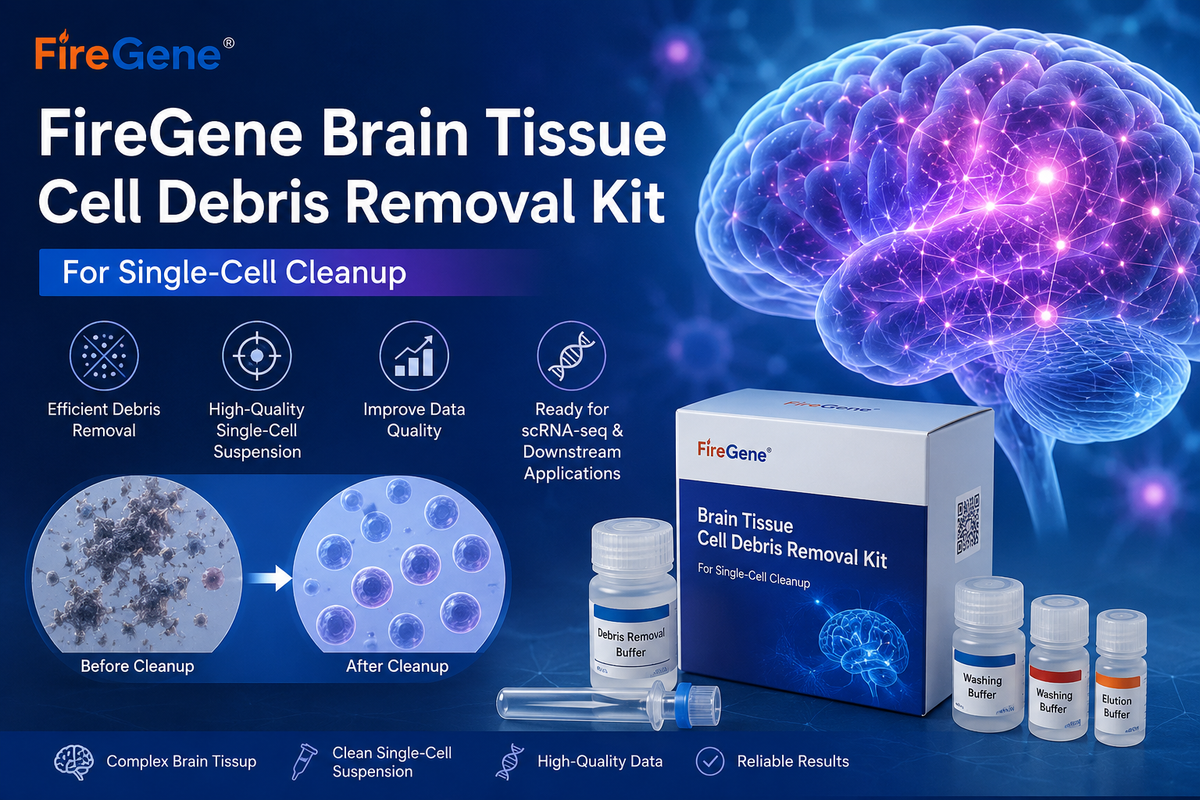
The FireGene Brain Tissue Cell Debris Removal Kit is designed for cleanup of brain-derived cell suspensions following tissue dissociation.
The general workflow can be viewed as:
Brain tissue → Tissue dissociation → Cell suspension → Debris removal → Clean cell suspension → Downstream analysis
The cleanup step helps separate unwanted debris from the cell population, allowing researchers to obtain a suspension more suitable for subsequent experiments.
A typical workflow involves:
Step 1: Brain tissue dissociation
Brain tissue is first processed using an appropriate mechanical and/or enzymatic dissociation procedure to release individual cells.
Step 2: Generate a cell suspension
The dissociated material is collected and prepared as a suspension under appropriate experimental conditions.
Step 3: Debris removal
The cell suspension is processed using the FireGene debris removal system. Unwanted debris and other interfering components are separated from the desired cellular fraction.
Step 4: Cell recovery
The cleaned cell fraction is collected and prepared for downstream applications.
Step 5: Quality assessment
Researchers can evaluate parameters such as:
· Cell concentration
· Cell viability
· Cell morphology
· Cell aggregation
· Debris level
The cleaned suspension can then be used for downstream single-cell applications.
4. Applications in Single-Cell Research
The FireGene Brain Tissue Cell Debris Removal Kit can be particularly useful when preparing brain-derived samples for applications requiring relatively clean cell suspensions.
scRNA-seq
Single-cell RNA sequencing is one of the most important applications.
High-quality input material is essential for generating reliable single-cell transcriptomic datasets. Removing excessive debris before library preparation can help improve the quality of the starting sample.
This can be especially valuable for studies investigating:
· Neuronal heterogeneity
· Astrocyte populations
· Microglia
· Oligodendrocytes
· Brain development
· Neuroinflammation
· Neurodegenerative disease
· Brain tumors
· Neural regeneration
Flow Cytometry
Brain tissue contains substantial background material that can complicate flow cytometry analysis.
Debris removal can help researchers obtain cleaner samples for identifying and characterizing specific cell populations using surface or intracellular markers.
Cell Sorting
For experiments requiring FACS or other cell-sorting approaches, cleaner cell suspensions can facilitate more reliable discrimination between target cells and unwanted particles.
Other Single-Cell Applications
A cleaned brain-derived cell suspension may also be useful for other applications involving individual-cell analysis, depending on the experimental design.
5. Key Advantages of Effective Brain Tissue Debris Removal
Improved Sample Cleanliness
One of the primary benefits is reducing unwanted particles and debris in the cell suspension.
A cleaner sample can make subsequent cell counting, visualization, and analytical workflows easier.
Better Suitability for Single-Cell Workflows
Single-cell technologies generally perform best when the input consists of intact, well-separated cells rather than a mixture containing large amounts of debris.
Therefore, sample cleanup is an important component of successful single-cell preparation.
Reduced Background
Free cellular material and debris can contribute to background signals in downstream assays.
Removing these components can help researchers obtain cleaner experimental data.
Improved Handling of Complex Brain Samples
Brain tissue presents unique sample-preparation challenges because of its cellular composition and myelin-rich environment. A dedicated cleanup approach provides an additional step specifically designed to address these challenges.
Compatibility with Multi-Step Workflows
Cell debris removal can be incorporated between tissue dissociation and downstream analysis:
Dissociation → Cleanup → Cell counting → Quality control → Single-cell analysis
This makes debris removal a practical intermediate step in many brain tissue workflows.
6. Recommended Workflow for High-Quality Brain Single-Cell Samples
For optimal results, debris removal should not be considered as an isolated step. Overall sample quality depends on the entire workflow.
A useful strategy is:
1. Tissue collection
↓
2. Appropriate tissue dissociation
↓
3. Gentle handling of the cell suspension
↓
4. Cell debris removal
↓
5. Cell concentration and viability assessment
↓
6. Removal of aggregates if necessary
↓
7. Single-cell analysis or library preparation
Several factors can influence the final quality of the sample.
Avoid Excessive Mechanical Stress
Overly aggressive dissociation can increase cell damage and generate additional debris.
Minimize Processing Time
Extended processing can reduce cell viability, particularly for sensitive primary cells.
Monitor Cell Viability
A high debris level may be associated with increased cell death. Measuring cell concentration and viability after cleanup can help determine whether the sample is suitable for downstream analysis.
Prevent Cell Aggregation
Even after debris removal, cell clumps can negatively affect some single-cell platforms. Appropriate handling and, where appropriate, an anti-clumping strategy can help maintain a more uniform suspension.
7. FireGene Brain Tissue Cell Debris Removal Kit vs. Simple Filtration
Researchers may ask why a dedicated debris-removal step is necessary when filtration is already part of their tissue-dissociation workflow.
Filtration and debris removal serve different purposes.
Filtration primarily removes particles based on physical size. It is useful for eliminating larger tissue fragments and aggregates.
Debris removal, by contrast, is intended to reduce smaller unwanted components that may remain in the suspension after dissociation.
Therefore, these approaches can be complementary:
Tissue dissociation → Filtration → Debris removal → Cell recovery
Using both steps may provide a cleaner starting material than relying on filtration alone, depending on the tissue and experimental workflow.
8. Why Choose FireGene for Brain Tissue Single-Cell Preparation?
The success of single-cell experiments depends heavily on sample preparation. Even sophisticated sequencing platforms cannot compensate for poor-quality input material.
The FireGene Brain Tissue Cell Debris Removal Kit provides researchers with a dedicated solution for cleaning up brain-derived cell suspensions before downstream analysis.
It can be integrated into workflows involving:
· Brain tissue dissociation
· Primary brain cell preparation
· Single-cell RNA sequencing
· Flow cytometry
· Cell sorting
· Other single-cell research applications
For researchers working with challenging brain samples, incorporating an appropriate cell debris removal step can help establish a more consistent and reproducible sample-preparation workflow.
9. Conclusion
Brain tissue is one of the more challenging sample types for single-cell research because tissue dissociation can generate substantial amounts of myelin, dead cells, membrane fragments, and cellular debris.
Effective sample cleanup is therefore an important step between tissue dissociation and downstream single-cell analysis.
The FireGene Brain Tissue Cell Debris Removal Kit is designed to help researchers obtain cleaner brain-derived cell suspensions by reducing unwanted debris before applications such as scRNA-seq, flow cytometry, and cell sorting.
By combining appropriate tissue dissociation, debris removal, cell viability assessment, and careful sample handling, researchers can build a more reliable workflow for generating high-quality brain single-cell samples.


