
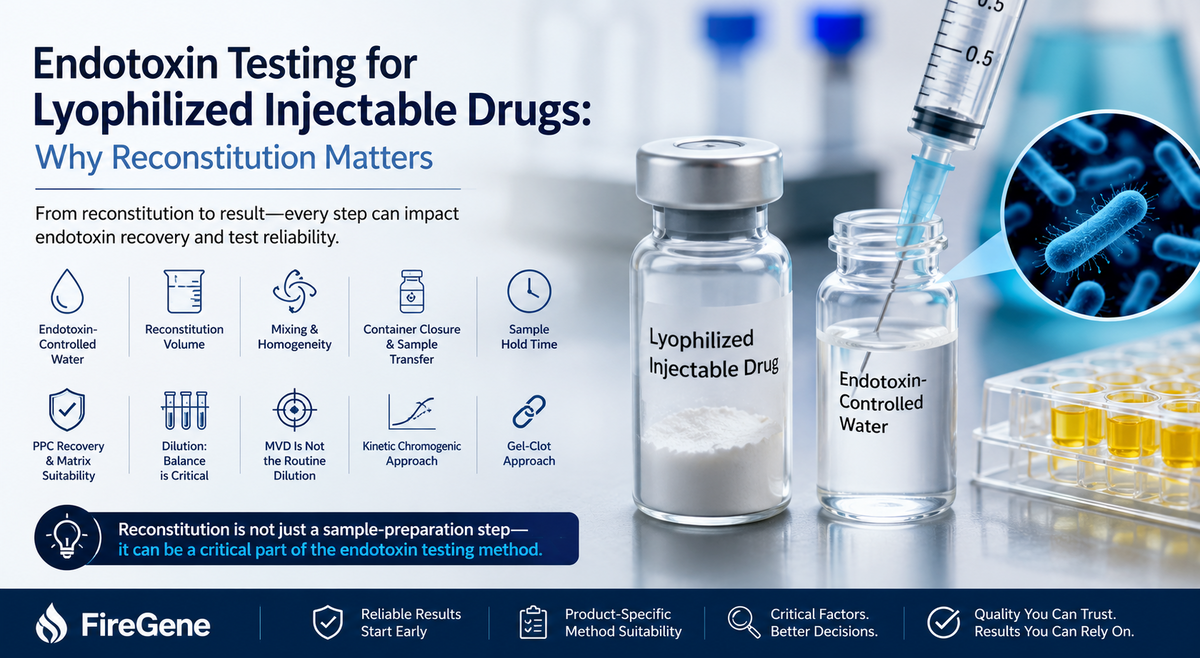
Introduction
Lyophilization, or freeze-drying, is widely used to improve the stability and shelf life of pharmaceutical products.
Biologics, vaccines, peptides, proteins, enzymes, and other injectable products may be formulated as lyophilized powders that are reconstituted immediately before administration.
From a manufacturing perspective, lyophilization provides important advantages.
But from an endotoxin testing perspective, it introduces an additional layer of complexity.
A conventional liquid injectable can often be sampled directly from its final formulation.
A lyophilized injectable requires another step:
Lyophilized product
→
Reconstitution
→
Homogeneous solution
→
Sample preparation
→
Endotoxin testing
This means the final endotoxin result can be influenced not only by the product itself, but also by how the product is reconstituted, what water is used, what container is used, how long the sample is held, and how the sample is subsequently diluted.
This is why endotoxin testing for lyophilized drugs should be considered a sample-preparation and method-suitability problem, rather than simply a reagent-selection problem.
FDA's current guidance on pyrogen and endotoxin testing emphasizes appropriate testing of drug products and the suitability of the selected test method, while USP <1085> provides additional guidance on preparation, PPCs, interference, routine testing, and other practical aspects of endotoxin testing.
For pharmaceutical QC laboratories, the central question is therefore:
Can the laboratory reliably measure endotoxin after the lyophilized product has been reconstituted under controlled and representative conditions?
1. Why Lyophilized Drugs Create Unique Endotoxin Testing Challenges
Lyophilized drugs are fundamentally different from ready-to-use liquid formulations.
The final marketed dosage form may contain a dry cake or powder, while the patient receives a liquid preparation.
This creates two different analytical states:
Before reconstitution
- Dry powder
- Low water activity
- Concentrated formulation components
- Solid-state matrix
After reconstitution
- Aqueous formulation
- Defined final concentration
- New pH and ionic environment
- Potentially different endotoxin accessibility
For endotoxin testing, the relevant sample is usually the reconstituted product or an appropriately prepared extract, depending on the product and applicable test requirements.
The reconstitution process therefore becomes part of the analytical workflow.
A poorly controlled reconstitution procedure can introduce variability that has nothing to do with the actual endotoxin concentration of the manufactured product.
2. The Reconstitution Step Is Part of the Endotoxin Testing Strategy
When a lyophilized drug is reconstituted, several variables can change simultaneously.
These include:
- Reconstitution volume
- Reconstitution solvent
- Water quality
- Mixing procedure
- Reconstitution time
- Container material
- Temperature
- Final product concentration
- pH
- Hold time
Each variable can potentially influence endotoxin recovery.
For example, if the reconstitution volume is incorrect, the calculated endotoxin concentration may be incorrect even when the analytical assay itself performs perfectly.
Similarly, if the reconstitution water introduces endotoxin, the laboratory may measure contamination originating from the sample preparation process rather than the drug product.
This is why the reconstitution procedure should be standardized and documented as part of the endotoxin test method.
3. Reconstitution Water Can Become a Hidden Source of Endotoxin
One of the most overlooked variables in lyophilized-product testing is the water used during reconstitution.
Water may be introduced directly into the product immediately before testing.
If that water contains endotoxin, the laboratory can unintentionally add endotoxin to an otherwise acceptable sample.
This is especially important when the product has a low endotoxin specification.
FireGene's Endotoxin Assay Water is specified at less than 0.005 EU/mL and is intended for applications including sample dilution, standard preparation, CSE reconstitution, and negative controls.
The broader principle is more important than any particular product:
Water used during endotoxin testing should be appropriately controlled and qualified for endotoxin analysis.
USP <85> and related endotoxin-testing practices place significant emphasis on the quality of water and controls used in the assay.
4. Reconstitution Volume Directly Affects the Reported Endotoxin Result
Consider a simplified example.
Suppose a lyophilized vial is reconstituted with:
2 mL
and the assay measures:
0.10 EU/mL
The total endotoxin content represented by the reconstituted vial would be:
0.10 EU/mL × 2 mL = 0.20 EU/vial
Now imagine that the same vial is accidentally reconstituted with:
4 mL
The measured concentration could appear different even though the total endotoxin burden has not changed.
This demonstrates why laboratories should distinguish between:
- EU/mL
- EU/vial
- EU/dose
- EU/device
depending on the applicable specification.
The calculation of an endotoxin limit ultimately needs to be connected to the product's dose and route of administration.
FDA has reiterated that the finished-drug endotoxin acceptance criterion should be established based on the maximum dose that can be delivered within the relevant one-hour period, with additional considerations for products involving repeat or maintenance dosing.
5. Why Mixing Matters After Reconstitution
A lyophilized cake does not instantly become a perfectly homogeneous solution.
Depending on the formulation, reconstitution may involve:
- Wetting
- Dissolution
- Swelling
- Gentle mixing
- Standing time
If the sample is not sufficiently homogeneous, different aliquots may contain different concentrations of formulation components—and potentially different amounts of accessible endotoxin.
This can result in:
- High replicate variability
- Poor PPC recovery
- Unexpected dilution behavior
- Inconsistent results between analysts
However, aggressive shaking is not automatically the solution.
Some biologics are sensitive to:
- Shear stress
- Foaming
- Aggregation
- Protein denaturation
Therefore, the reconstitution procedure should be based on the product's characteristics and the validated manufacturing/QC procedure.
6. Container Closure Can Affect Endotoxin Testing
The vial, stopper, seal, and other container-closure components are not merely packaging.
They can become part of the sample environment.
Potential concerns include:
- Endotoxin contamination on surfaces
- Adsorption of endotoxin
- Interaction between sample and container material
- Extractables or leachables
- Sample hold-time effects
For example, endotoxin may interact with surfaces differently depending on:
- Material composition
- Surface characteristics
- Ionic strength
- pH
- Protein concentration
This means that transferring a reconstituted sample from its original vial into another container can potentially change the analytical environment.
Whenever practical, the sample-handling procedure should therefore be standardized.
7. Why Sample Hold Time Deserves More Attention
One of the most important questions in endotoxin testing is often overlooked:
How long can the reconstituted sample sit before testing?
The answer should not simply be based on convenience.
Sample hold time can potentially affect endotoxin detectability.
Possible mechanisms include:
- Endotoxin adsorption
- Aggregation
- Interaction with proteins
- Interaction with surfactants
- Matrix changes
- pH changes
- Temperature effects
For some complex pharmaceutical products, endotoxin may become less readily detectable over time.
This is particularly important when investigating Low Endotoxin Recovery (LER) or other masking phenomena.
FDA regulatory documentation has specifically requested studies evaluating the effect of hold time on recoverable endotoxin for formulations where endotoxin masking may occur.
Therefore:
Sample preparation time
Sample storage condition
Time before testing
should be considered part of method suitability for complex products.
8. Reconstitution Can Change Matrix Interference
A lyophilized product may contain:
- Proteins
- Peptides
- Sugars
- Amino acids
- Buffers
- Surfactants
- Salts
- Stabilizers
After reconstitution, these components interact in an aqueous environment.
The resulting matrix may inhibit or enhance the endotoxin reaction.
This can affect:
- Reaction kinetics
- Endotoxin accessibility
- Enzyme activity
- Optical detection
- PPC recovery
Therefore, a method that works with a simple laboratory solution cannot automatically be assumed to work with a reconstituted biologic.
FireGene's Endotoxin Testing Sample Preparation Guide discusses the broader relationship between dilution, matrix interference, storage, pH, sample handling, and endotoxin recovery.
9. PPC Recovery Is Particularly Important After Reconstitution
Positive Product Control, or PPC, is one of the most useful tools for demonstrating matrix suitability.
The basic approach is:
Reconstituted product
Known endotoxin spike
↓
Endotoxin assay
↓
Measured recovery
The purpose is not simply to prove that the reagent works.
It is to demonstrate that the reconstituted pharmaceutical matrix allows endotoxin to be detected appropriately.
If PPC recovery is poor, potential causes include:
- Product inhibition
- Enhancement
- Incorrect dilution
- pH effects
- Protein-endotoxin interaction
- Endotoxin adsorption
- Incorrect sample preparation
- Hold-time effects
USP's current guidance framework specifically addresses PPC criteria and interference as important elements of endotoxin testing.
FireGene's Control Standard Endotoxin (CSE) is designed for sensitivity checks, interference testing, and positive-control applications for Gel-Clot and colorimetric endotoxin assays.
10. Why a Passing Standard Curve Does Not Prove Product Suitability
This is one of the most important concepts in pharmaceutical endotoxin testing.
A standard curve demonstrates that the assay can respond appropriately to known endotoxin standards.
It does not automatically demonstrate that the reconstituted drug product behaves the same way.
Consider two situations.
Standard
Endotoxin standard
→
Expected assay response
→
Acceptable standard curve
Product
Reconstituted drug
→
Matrix interaction
→
Endotoxin masking
→
Lower-than-expected signal
Both tests may be performed in the same assay run.
The standard curve can pass while the product matrix remains unsuitable.
This is why PPC recovery and product-specific method suitability are essential.
FireGene's Endotoxin Recovery Studies Explained provides a more detailed explanation of how recovery studies demonstrate whether a pharmaceutical matrix allows reliable endotoxin detection.
11. Dilution Can Help—but It Is Not a Universal Solution
If the reconstituted product interferes with endotoxin detection, dilution may reduce the concentration of interfering components.
For example:
1:1
↓
1:2
↓
1:4
↓
1:8
As dilution increases, matrix interference may decrease.
But the endotoxin concentration decreases at the same time.
This creates a fundamental trade-off:
Too little dilution
→ excessive matrix interference
Too much dilution
→ reduced endotoxin detectability
The goal is therefore to identify a dilution that provides acceptable recovery while remaining within the applicable Maximum Valid Dilution.
FireGene's recent guide on Choosing the Right Sensitivity and Dilution for Kinetic Chromogenic Endotoxin Testing discusses this balance in detail.
12. MVD Should Not Automatically Become the Routine Dilution
A common misconception is:
“If the MVD is 1:100, we should test at 1:100.”
That is not necessarily correct.
MVD represents the maximum dilution allowed under the applicable endotoxin-testing calculation.
It does not automatically identify the optimal routine dilution.
For a reconstituted lyophilized drug, the laboratory may find that:
1:5
provides acceptable recovery,
while:
1:20
provides no additional analytical benefit.
In that situation, the lower dilution may be preferable because it preserves more analytical sensitivity.
USP's endotoxin-testing framework explicitly describes using dilutions that address interference while remaining within the MVD.
13. The Reconstituted Concentration Matters
Lyophilized drugs can be reconstituted to different final concentrations depending on their intended clinical use.
For example, a product may be supplied as:
10 mg/vial
but reconstituted to:
- 1 mg/mL
- 2 mg/mL
- 5 mg/mL
depending on the labeled procedure.
This can dramatically change matrix effects.
A higher concentration may result in:
- Greater viscosity
- Higher protein concentration
- More pronounced inhibition
- Stronger endotoxin binding
Therefore, endotoxin method suitability should reflect the actual concentration relevant to the intended product-use conditions.
14. Why Concentration Changes Can Produce Unexpected Endotoxin Results
Imagine a product tested at three concentrations:
1 mg/mL
→ acceptable recovery
5 mg/mL
→ borderline recovery
10 mg/mL
→ poor recovery
This does not necessarily mean that the product suddenly contains more endotoxin at 10 mg/mL.
Instead, the concentrated matrix may interfere more strongly with endotoxin detection.
This is why laboratories should not interpret concentration-dependent endotoxin results without considering:
- PPC recovery
- Dilution-adjusted results
- Matrix behavior
- MVD
- Sample preparation
15. Kinetic Chromogenic Testing Can Help Characterize Reconstituted Products
A quantitative kinetic chromogenic assay can be particularly useful during method development because it provides numerical information across multiple concentrations and dilutions.
The workflow can be used to compare:
Undiluted sample
vs.
1:2 dilution
vs.
1:4 dilution
vs.
1:8 dilution
The laboratory can then evaluate:
- Endotoxin concentration
- PPC recovery
- Dilution consistency
- Standard-curve performance
- Replicate variability
FireGene's Kinetic Chromogenic Endotoxin Test Kit uses a 96-well format and 405 nm kinetic absorbance detection, providing quantitative EU/mL measurements.
Important: FireGene's current product page identifies this kit as Research Use Only and states that it is not licensed by FDA for end-product release of FDA-regulated pharmaceutical drugs, devices, or biologics. It should therefore not be represented as an FDA-approved release-testing solution.
For laboratories evaluating an endotoxin-testing platform, however, its quantitative format can be useful for research, method development, and analytical investigations where appropriate.
16. Gel-Clot TAL/LAL Testing Remains Useful for Limit Testing
Not every laboratory requires quantitative kinetic data.
For routine limit testing, Gel-Clot TAL/LAL Reagent can provide a straightforward endpoint.
The basic concept is:
Endotoxin present above assay sensitivity
→
Enzymatic cascade activated
→
Gel formation
→
Positive result
FireGene offers Gel-Clot TAL/LAL Reagent in several sensitivity levels, including 0.03, 0.06, 0.125, 0.25, and 0.5 EU/mL.
The appropriate sensitivity should be selected according to the applicable endotoxin limit, sample concentration, dilution strategy, and validated method.
The choice between gel-clot and kinetic testing should therefore be driven by the analytical objective rather than by the assumption that one technology is universally superior.
17. What Happens If Endotoxin Recovery Changes With Hold Time?
Consider a hypothetical study:
Immediately after reconstitution:
PPC recovery = acceptable
After 2 hours:
PPC recovery = acceptable
After 8 hours:
PPC recovery = significantly lower
This could suggest that the sample's matrix or storage conditions are affecting endotoxin detectability.
Potential mechanisms include:
- Endotoxin adsorption
- Protein interaction
- Aggregation
- Surface binding
- Temperature-related changes
This is why hold-time studies can be valuable for complex products.
The goal is not to create an unnecessarily complicated QC procedure.
It is to determine whether the time between reconstitution and endotoxin testing could change the analytical result.
18. Sample Storage Conditions Should Be Controlled
Once a lyophilized product is reconstituted, the sample should be handled under defined conditions.
Important variables include:
- Temperature
- Light exposure
- Container type
- Sample concentration
- Time before testing
- Number of transfers
- Mixing
For biologics, temperature can be particularly important because changes in protein structure or aggregation can indirectly affect endotoxin recovery.
The best practice is to define a controlled sample-handling window during method development rather than allowing analysts to make ad hoc decisions during routine testing.
19. Container Transfer Can Introduce Another Variable
Consider this workflow:
Reconstituted vial
→
Transfer to tube
→
Dilution
→
Transfer to assay plate
Every transfer introduces another opportunity for:
- Contamination
- Adsorption
- Pipetting variability
- Sample loss
For low-level endotoxin testing, minimizing unnecessary transfers can improve consistency.
Where transfers are necessary, the laboratory should use appropriately qualified consumables and standardized handling procedures.
This is particularly important because endotoxin can interact with surfaces in ways that depend on the chemical environment.
20. Why Pyrogen-Free Consumables Matter
When the endotoxin limit is low, even small amounts of contamination from laboratory consumables can become analytically significant.
Potential sources include:
- Tubes
- Vials
- Pipette tips
- Microplates
- Reservoirs
- Water
- Glassware
The laboratory should therefore establish appropriate controls for materials that contact the sample.
FireGene's Endotoxin Assay Water is designed for use in endotoxin testing workflows, while pyrogen-free consumables can help reduce background contamination.
The broader lesson is:
The assay does not exist in isolation. Every material that touches the sample becomes part of the analytical system.
21. What If the Reconstituted Product Is Highly Concentrated?
Highly concentrated products are among the most difficult endotoxin-testing matrices.
Potential problems include:
- Protein concentration
- Viscosity
- Endotoxin binding
- Optical interference
- Inhibition
- Enhancement
The first strategy is generally to understand the matrix rather than immediately applying extreme dilution.
A structured study might compare:
1:2
1:5
1:10
1:20
while monitoring:
- PPC recovery
- Dilution-adjusted endotoxin
- Replicate precision
- Standard curve
- MVD
This provides a scientific basis for selecting the routine dilution.
22. Reconstitution Can Also Affect Endotoxin Accessibility
Endotoxin is not always freely available in solution.
It may interact with:
- Proteins
- Lipids
- Surfactants
- Polymers
- Aggregates
Lyophilization and subsequent reconstitution can alter these interactions.
This is one reason why endotoxin testing should not simply assume:
Endotoxin concentration before freeze-drying
=
Endotoxin detectability after reconstitution
The physical state and chemical environment have changed.
For complex formulations, the analytical method should demonstrate that endotoxin remains detectable under the actual testing conditions.
23. How to Build a Robust Endotoxin Testing Strategy for Lyophilized Drugs
A practical workflow can be structured around eight questions.
1. What is the applicable endotoxin limit?
Define the acceptance criterion based on the product, route, dose, and applicable regulatory requirements.
2. How is the product reconstituted?
Define:
- Water
- Volume
- Mixing
- Temperature
- Time
3. What is the final concentration?
The reconstituted concentration should be known before establishing dilution.
4. Does the matrix interfere?
Evaluate inhibition and enhancement.
5. What dilution provides acceptable recovery?
Select the lowest scientifically justified dilution that provides acceptable method performance.
6. What is the maximum valid dilution?
Calculate MVD and ensure the selected dilution remains within the applicable limit.
7. How long can the sample be held?
Evaluate whether hold time affects endotoxin recovery.
8. Are the containers and consumables appropriate?
Control water, tubes, vials, pipette tips, plates, and other sample-contact materials.
24. A Step-by-Step Endotoxin Testing Workflow
The complete process can be visualized as:
Lyophilized Drug Product
↓
Controlled Reconstitution
↓
Verify Final Volume
↓
Homogenize Sample
↓
Define Sample Hold Time
↓
Select Dilution
↓
Perform PPC Recovery
↓
Run TAL/LAL Endotoxin Assay
↓
Evaluate Controls
↓
Calculate Endotoxin Concentration
↓
Compare With Applicable Limit
↓
Review Trend and Investigate Abnormal Results
This approach integrates the sample-preparation stage with the endotoxin assay rather than treating them as independent processes.
25. Common Mistakes When Testing Lyophilized Products
Mistake 1: Using Unqualified Reconstitution Water
Water can become a direct source of endotoxin contamination.
Mistake 2: Ignoring Reconstitution Volume
Incorrect volume changes the calculated concentration.
Mistake 3: Testing Immediately Without Confirming Homogeneity
Incomplete dissolution can produce variable aliquots.
Mistake 4: Ignoring Sample Hold Time
Endotoxin recovery can potentially change during storage.
Mistake 5: Using the Same Dilution for Every Product
Different formulations can have very different matrix effects.
Mistake 6: Assuming MVD Is the Best Routine Dilution
MVD is a maximum, not automatically the optimal dilution.
Mistake 7: Looking Only at the Standard Curve
The product matrix still needs to demonstrate suitability.
Mistake 8: Ignoring Container Effects
Endotoxin can interact with sample-contact surfaces.
Mistake 9: Adding Too Many Transfer Steps
Every transfer can introduce variability or contamination.
Mistake 10: Treating Reconstitution as a Simple Preparation Step
For lyophilized drugs, reconstitution is effectively part of the analytical method.
26. How FireGene Can Support Lyophilized-Drug Endotoxin Testing
FireGene provides several components that can support endotoxin method development and laboratory workflows.
Kinetic Chromogenic Endotoxin Testing
The FireGene Kinetic Chromogenic Endotoxin Test Kit provides a 96-well quantitative format with kinetic 405 nm absorbance detection and a stated detection range of 0.005–10 EU/mL.
It can be useful for research and method-development activities such as:
- Comparing reconstitution conditions
- Screening sample dilutions
- Evaluating PPC recovery
- Investigating matrix interference
- Comparing hold times
Again, the current product labeling identifies this kit as Research Use Only, so it should not be presented as an FDA-approved finished-product release assay.
Gel-Clot TAL/LAL Reagent
FireGene Gel-Clot TAL/LAL Reagent provides multiple sensitivity levels, allowing laboratories to select a sensitivity appropriate for the validated endotoxin-testing strategy.
Control Standard Endotoxin
FireGene Control Standard Endotoxin (CSE) is an E. coli O111:B4-derived, freeze-dried endotoxin standard calibrated against the national standard and intended for sensitivity checks, interference studies, and positive-control applications.
Endotoxin Assay Water
FireGene Endotoxin Assay Water can support:
- Sample dilution
- Standard preparation
- CSE reconstitution
- Negative controls
- Endotoxin testing workflows
The current product specification is less than 0.005 EU/mL.
27. Regulatory Perspective in 2026
The regulatory environment for bacterial endotoxin testing continues to evolve.
FDA's March 2026 Pyrogen and Endotoxins Testing: Questions and Answers provides current recommendations related to USP <85>, USP <161>, and AAMI ST72, covering gel-clot, photometric, and kinetic test methods.
At the same time, USP <86> provides additional bacterial endotoxin testing techniques using recombinant reagents. USP emphasizes that users must verify suitability for the specific material, drug substance, or drug product being tested.
USP's newer <1085> guidance is also particularly relevant because it provides additional practical information on:
- Preparatory requirements
- RSE/CSE calibration
- Labware qualification
- Endotoxin limits
- PPC criteria
- Interference
- Routine testing
- OOS investigations
- Recombinant reagents
For lyophilized injectable products, this reinforces a key concept:
The testing method should be scientifically appropriate for the actual reconstituted product and the conditions under which it is tested.
28. Frequently Asked Questions
Does a lyophilized drug need to be reconstituted before endotoxin testing?
The appropriate sample preparation depends on the product and applicable test procedure. For products intended for reconstitution before administration, the reconstituted matrix can be highly relevant to method suitability.
Can I use the same water used for routine laboratory work?
Not automatically. Water used in endotoxin testing should be appropriately controlled for endotoxin. FireGene Endotoxin Assay Water is specified at less than 0.005 EU/mL.
Does reconstitution volume affect the endotoxin result?
Yes. Reconstitution volume directly affects the concentration expressed in EU/mL and can influence the final interpretation of endotoxin content.
Why should hold time be evaluated?
Because endotoxin detectability can potentially change over time due to adsorption, matrix interactions, temperature, or other factors.
Can dilution solve endotoxin interference?
Appropriate dilution can reduce some matrix effects, but excessive dilution can compromise analytical sensitivity.
Is MVD the recommended routine dilution?
No. MVD is the maximum valid dilution. The routine dilution should be selected based on method suitability and recovery.
Why do I need PPC recovery?
PPC demonstrates whether the reconstituted product matrix allows known endotoxin to be detected appropriately.
Can a passing standard curve prove that my lyophilized product method is valid?
No. Standard-curve performance does not eliminate the need for product-specific suitability evaluation.
Can kinetic chromogenic testing be used for lyophilized drugs?
A kinetic chromogenic method can be useful for quantitative endotoxin testing and method development when appropriately validated for the specific product. The regulatory status and intended use of the particular commercial kit must also be considered.
Can endotoxin testing be performed after transferring the reconstituted product into another tube?
Potentially, but the transfer procedure should be controlled because additional handling can introduce contamination, adsorption, or variability.
Conclusion
For lyophilized injectable drugs, endotoxin testing does not begin when the sample reaches the TAL/LAL Reagent.
It begins much earlier.
It begins with:
How the product is reconstituted
→
What water is used
→
How much water is added
→
How the product is mixed
→
What container holds the sample
→
How long the sample is held
→
How the sample is diluted
→
Whether endotoxin can be recovered
Only after these factors are controlled does the actual endotoxin assay provide meaningful information.
This is especially important for biologics and other complex injectable formulations, where proteins, surfactants, buffers, and other excipients can influence endotoxin availability and assay performance.
A reliable strategy should therefore combine:
- Controlled reconstitution
- Endotoxin-controlled water
- Appropriate sample-contact materials
- Defined hold times
- Scientifically justified dilution
- MVD assessment
- PPC recovery
- Matrix interference evaluation
- Appropriate TAL/LAL Reagent
- Documented method suitability
The broader regulatory direction in 2026 also supports this product-specific approach. FDA continues to emphasize appropriate endotoxin-testing methods and acceptance criteria, while USP <1085> provides expanded practical guidance for interference, PPCs, labware, routine testing, and OOS investigations.
For pharmaceutical QC laboratories, the key takeaway is simple:
For a lyophilized injectable, reconstitution is not just a preparation step—it can be a critical part of the endotoxin testing method.
And when the goal is a reliable endotoxin result, every variable between the vial and the reaction well matters.
FireGene Endotoxin Assay Water
FireGene Control Standard Endotoxin (CSE)
FireGene Kinetic Chromogenic Endotoxin Test Kit
FireGene Endotoxin Testing Sample Preparation Guide
FireGene Endotoxin Recovery Studies Guide
FireGene Endotoxin Testing
Ready to run your endotoxin assay?
FireGene offers a complete endotoxin testing toolkit — from TAL reagents and CSE standards to pyrogen-free consumables and LAL reagent water. All products are aligned with USP <85>, EP 2.6.14, and JP 4.01.


