
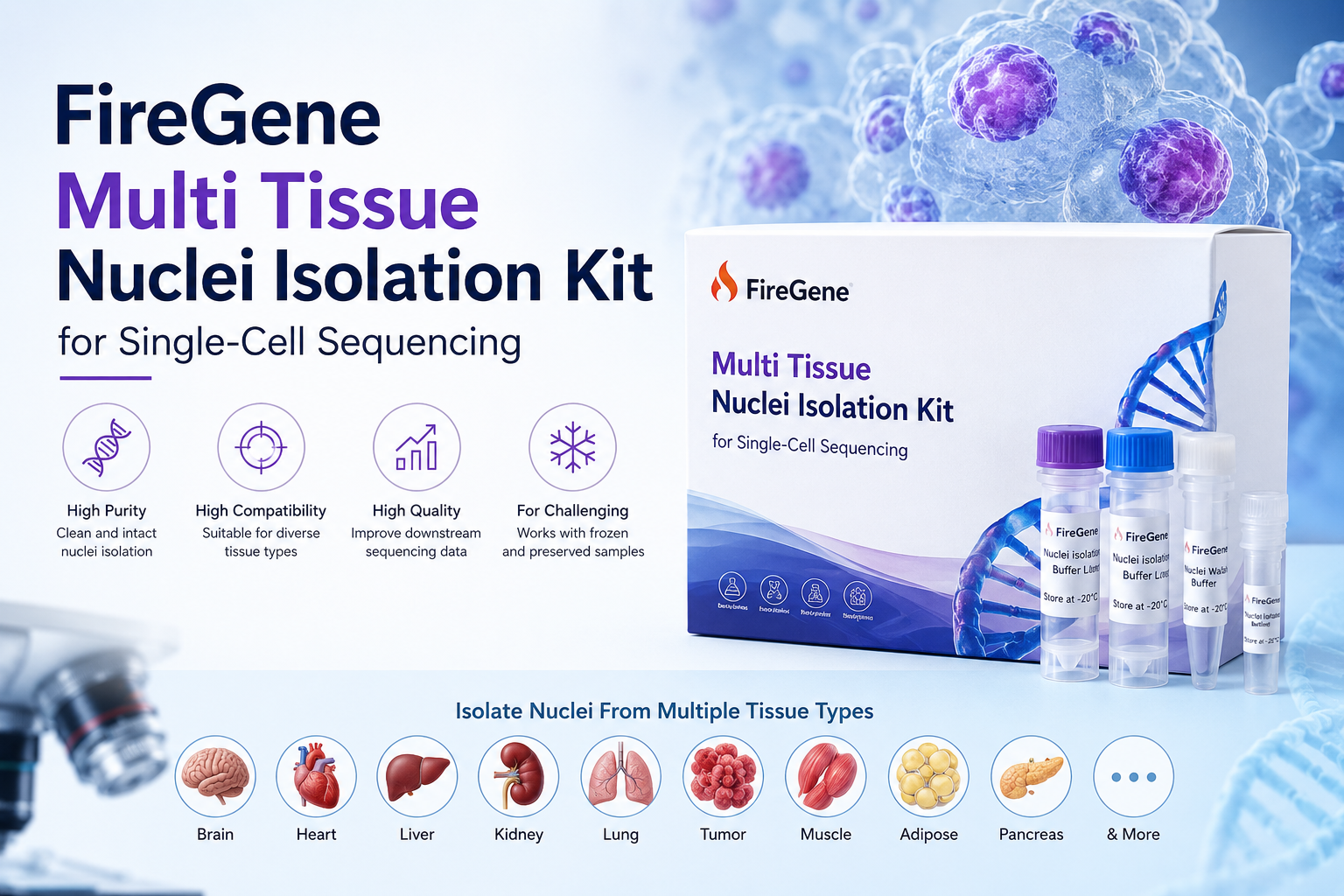
Single-cell sequencing has become one of the most powerful technologies for understanding tissue complexity, disease mechanisms, and cellular heterogeneity. By analyzing genetic or transcriptomic information at the level of individual cells, researchers can identify rare cell populations, map developmental trajectories, compare disease and healthy tissues, and discover biomarkers that may be hidden in bulk sequencing data. However, successful single-cell sequencing depends heavily on the quality of the starting material. For many tissue types, preparing a clean, intact, and sequencing-compatible cell suspension remains one of the most difficult steps in the workflow.
The FireGene Multi Tissue Nuclei Isolation Kit for Single-Cell Sequencing is designed to support the preparation of nuclei from multiple tissue types for downstream single-cell and single-nucleus sequencing applications. Instead of relying only on intact living cells, researchers can isolate nuclei and use them for workflows such as single-nucleus RNA sequencing, single-nucleus ATAC sequencing, and other genomic or epigenomic assays. This approach is especially valuable for complex tissues, frozen samples, and specimens that are difficult to dissociate into viable single cells.
Why Nuclei Isolation Matters in Single-Cell Sequencing
Traditional single-cell RNA sequencing usually requires fresh, viable cells. This creates challenges for tissues that are fragile, fibrotic, lipid-rich, frozen, archived, or difficult to enzymatically digest. During dissociation, some cell types may be lost, damaged, or artificially activated. Stress-response genes can be induced, fragile cells may rupture, and certain populations may be underrepresented. These effects can introduce technical bias and reduce the biological accuracy of sequencing data.
Single-nucleus sequencing provides an alternative by analyzing isolated nuclei rather than whole cells. This strategy allows researchers to access nuclear RNA, chromatin accessibility, and other nuclear information even when intact cell recovery is poor. Single-nucleus RNA sequencing is widely used for difficult tissues because it can help overcome limitations associated with fresh-tissue dissociation and can be applied to frozen samples in many experimental settings. Studies and protocols have emphasized that nuclei-based workflows can be particularly useful when tissues are difficult to process into high-quality single-cell suspensions.
A Practical Tool for Multi-Tissue Research
The FireGene Multi Tissue Nuclei Isolation Kit is positioned for laboratories working with a broad range of biological specimens. Multi-tissue compatibility is important because each tissue type presents unique preparation challenges. Brain tissue contains diverse neuronal and glial populations that require gentle handling. Heart and skeletal muscle contain dense contractile proteins. Adipose tissue can introduce lipid contamination. Tumor samples may be necrotic, heterogeneous, or fibrotic. Kidney, pancreas, liver, spleen, and placental tissues may require careful optimization to preserve nuclear integrity while reducing debris.
A standardized nuclei isolation kit helps researchers establish a more reproducible upstream workflow. While individual tissue types may still require optimization of input amount, homogenization intensity, filtration, and centrifugation conditions, a dedicated kit provides a practical foundation for generating nuclei suspensions suitable for downstream sequencing. This can save time during protocol development and reduce variation between samples, users, and experimental batches.
Key Requirements for High-Quality Nuclei Preparation
For single-cell sequencing, the quality of the input suspension directly affects the quality of the final dataset. A successful nuclei isolation workflow should produce intact, individual nuclei with minimal clumping, low debris, limited cytoplasmic contamination, and preserved nucleic acid quality. Official single-cell sequencing sample-preparation guidance emphasizes steps such as controlled lysis, washing, debris removal, counting, and concentration of nuclei before sequencing library preparation.
Poor nuclei preparations can lead to low capture efficiency, high background RNA, poor barcode assignment, increased doublets, and reduced gene or peak detection. In contrast, clean nuclei suspensions can improve data reliability, support better clustering, and help researchers detect biologically meaningful differences between cell types or disease states. For high-cost single-cell sequencing experiments, careful nuclei preparation is not a minor technical detail—it is a critical determinant of experimental success.
Supporting Research with Frozen and Difficult Samples
One of the strongest advantages of single-nucleus sequencing is its compatibility with frozen tissue. Many research laboratories, hospitals, and biobanks store specimens at low temperatures, and these materials may not be suitable for conventional live-cell dissociation. Nuclei isolation allows researchers to use valuable stored samples that might otherwise be excluded from single-cell studies.
Research on frozen and preserved clinical biopsy samples has shown that optimized nuclei isolation can generate intact nuclei suitable for downstream analysis. For example, work with human kidney biopsies demonstrated that nuclei could be isolated from frozen and RNAlater-preserved samples using a time-efficient protocol, supporting the feasibility of nuclei-based analysis for clinical materials. This is important for translational research, where sample access may be limited and fresh tissue is not always available.
Applications in Disease and Tissue Biology
The FireGene Multi Tissue Nuclei Isolation Kit can support research across many fields, including cancer biology, neuroscience, immunology, developmental biology, cardiovascular research, metabolic disease, and tissue atlas projects.
In cancer research, nuclei isolation can help scientists examine heterogeneous tumor tissues, including malignant cells, immune infiltrates, stromal cells, endothelial cells, and rare subpopulations. Tumor dissociation can be difficult because of necrosis, extracellular matrix, variable tissue density, and fragile cell states. Nuclei-based sequencing may help preserve information from complex tumor microenvironments.
In neuroscience, single-nucleus sequencing has become especially important because brain tissues are complex and many samples are archived or frozen. Nuclei isolation enables researchers to profile neurons, astrocytes, oligodendrocytes, microglia, and other neural cell types from tissues that may not be suitable for viable single-cell dissociation.
In metabolic and endocrine research, tissues such as liver, pancreas, adipose tissue, and muscle can present major processing challenges. Nuclei isolation can help researchers investigate cellular heterogeneity in obesity, diabetes, fatty liver disease, endocrine dysfunction, and metabolic inflammation.
In developmental and regenerative biology, nuclei-based workflows can support the analysis of complex tissues where timing, sample preservation, and cell fragility are major considerations.
Improving Reproducibility in Single-Cell Workflows
Reproducibility is a major concern in single-cell sequencing. Differences in tissue handling, dissociation time, temperature, lysis conditions, and filtration can all affect downstream results. A multi-tissue nuclei isolation kit can help reduce variability by providing a more consistent workflow for sample preparation.
Researchers still need to evaluate nuclei quality before sequencing. Common quality checks include microscopy-based assessment of nuclear morphology, counting accuracy, concentration measurement, and evaluation of debris or aggregation. 10x Genomics sample-preparation guidance notes that visualization of nuclei suspensions is important for determining nuclei concentration, suspension quality, and nuclei size before single-cell workflows. These checks help ensure that only suitable preparations proceed to expensive library construction and sequencing.
Expanding the Potential of Single-Nucleus Sequencing
The field of single-nucleus sequencing continues to evolve rapidly. Recent research has explored nuclei extraction from challenging preserved materials, including formalin-fixed paraffin-embedded tissues. Although FFPE samples remain technically demanding because of fixation-related crosslinking and RNA degradation, newer approaches are expanding the possibilities for archived specimen analysis. This trend highlights the growing importance of robust nuclei isolation strategies in both basic and translational research.
As sequencing platforms become more sensitive and bioinformatics pipelines become more sophisticated, the demand for reliable upstream sample preparation will continue to grow. High-quality nuclei isolation enables researchers to ask deeper questions about cell identity, regulatory mechanisms, disease progression, and treatment response.
Conclusion
The FireGene Multi Tissue Nuclei Isolation Kit for Single-Cell Sequencing offers a practical solution for researchers preparing nuclei from diverse tissue types for advanced single-cell and single-nucleus sequencing workflows. By supporting nuclei isolation from complex, difficult, or preserved samples, the kit helps overcome common limitations of traditional single-cell dissociation. It is especially valuable for studies involving frozen tissues, heterogeneous specimens, fragile cell populations, and multi-tissue research projects.
For laboratories focused on transcriptomics, epigenomics, tissue mapping, disease modeling, or biomarker discovery, reliable nuclei preparation is essential. A clean and intact nuclei suspension can improve sequencing performance, reduce technical artifacts, and support more accurate biological interpretation. As single-nucleus sequencing becomes increasingly central to modern biomedical research, tools such as the FireGene Multi Tissue Nuclei Isolation Kit will play an important role in helping scientists generate high-quality data from challenging biological samples.
FireGene, light your research with passion, innovation, and profession.


