
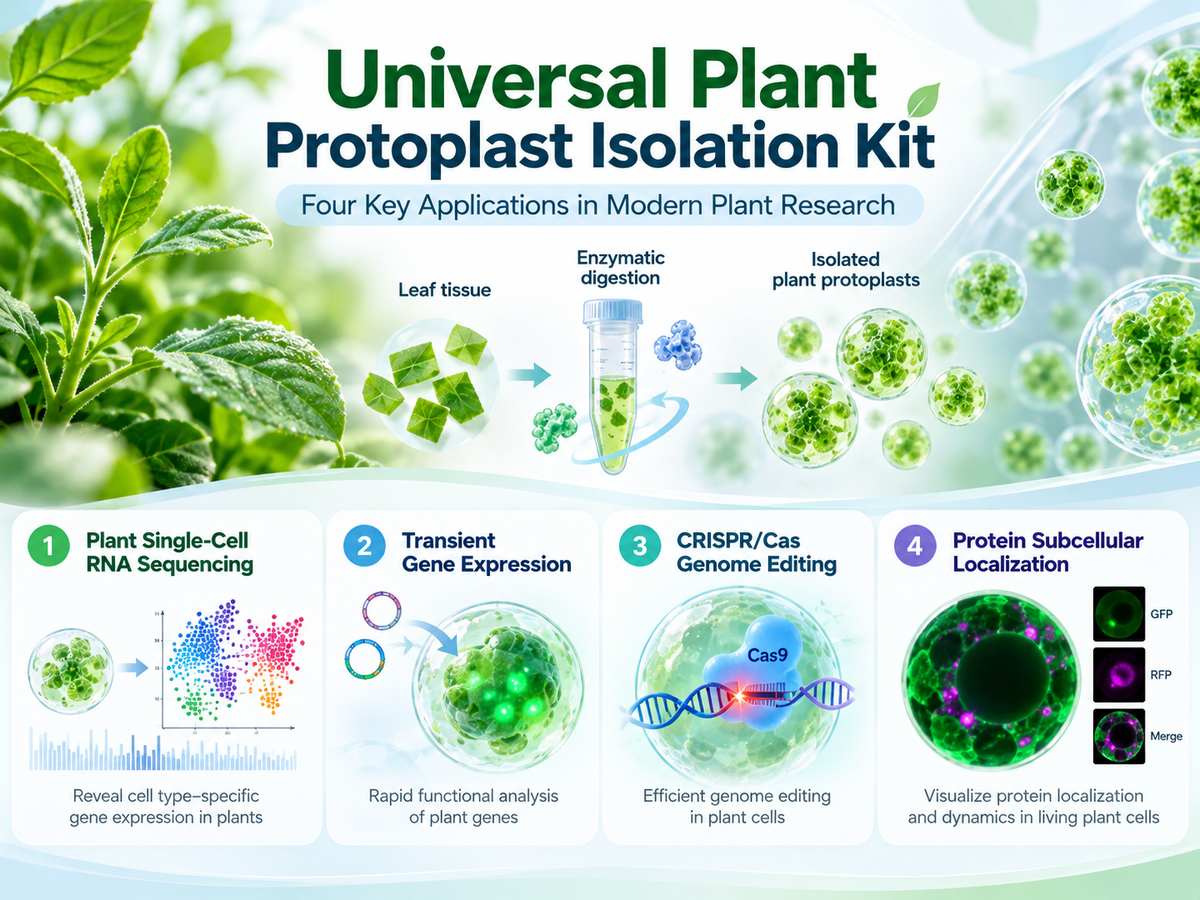
Plant protoplast isolation has become an essential technique in plant molecular biology, functional genomics, and biotechnology. By removing the cell wall while maintaining plasma membrane integrity, researchers can obtain individual plant cells suitable for diverse experimental applications. The Universal Plant Protoplast Isolation Kit provides an enzyme-based approach to preparing protoplasts from compatible plant tissues, supporting downstream molecular and cellular investigations. This article explores four major applications: plant single-cell RNA sequencing, transient gene expression, CRISPR/Cas genome editing, and protein subcellular localization. Particular attention is given to experimental principles, research significance, sample quality requirements, and the advantages of reliable protoplast preparation for advanced plant research.
1. Introduction: Why Plant Protoplast Isolation Matters
Plant molecular biology increasingly relies on experimental techniques capable of investigating cellular functions at high resolution.
Unlike animal cells, plant cells are surrounded by rigid cell walls containing cellulose, hemicellulose, pectin, and other structural polymers. Although essential for plant growth and structural stability, these walls present barriers to cell isolation, nucleic acid delivery, and certain imaging techniques.
Plant protoplast isolation addresses these challenges through enzymatic cell wall digestion.
The resulting protoplasts retain their plasma membranes and, under suitable isolation conditions, remain metabolically active and suitable for downstream experiments.
The Universal Plant Protoplast Isolation Kit provides a convenient approach to generating plant protoplast suspensions through enzymatic digestion and purification.
Its applications extend beyond simple cell isolation. High-quality protoplasts can serve as experimental starting materials for four important areas of plant research.
2. Application One: Plant Single-Cell RNA Sequencing
Understanding Cellular Diversity in Plant Tissues
Single-cell RNA sequencing (scRNA-seq) enables researchers to examine gene expression at the individual-cell level.
Traditional bulk RNA sequencing measures average gene expression across many cells. While valuable for identifying tissue-level responses, it may obscure transcriptional differences between distinct cell populations.
Plant tissues contain specialized cell types with different physiological and developmental functions.
For example, plant roots include epidermal cells, cortical cells, endodermal cells, vascular cells, and meristematic populations, each contributing to tissue organization and function.
Single-cell transcriptomics allows researchers to investigate these populations independently.
How Protoplast Isolation Supports scRNA-seq
A major challenge in plant single-cell sequencing is obtaining individual cells from tissues containing interconnected cell walls.
Protoplast isolation addresses this problem by enzymatically separating plant cells.
After isolation, suitable protoplast suspensions may be processed using compatible single-cell capture and sequencing workflows.
Researchers can then investigate cellular heterogeneity, cell-type-specific gene expression, developmental trajectories, and transcriptional responses to experimental conditions.
A landmark study by Denyer et al. (2019) demonstrated the value of single-cell RNA sequencing for examining developmental trajectories in Arabidopsis roots.
Importance of Protoplast Quality
Single-cell sequencing places particular demands on sample preparation.
Cell viability, aggregation, cellular debris, and the representation of different cell populations can influence sequencing results.
Furthermore, enzymatic digestion may induce stress-responsive transcriptional changes, potentially affecting biological interpretation.
For these reasons, researchers should optimize isolation conditions and consider appropriate quality controls.
Research significance: Reliable plant protoplast isolation supports high-resolution investigations of cellular identity, development, and gene regulation.
3. Application Two: Transient Gene Expression
A Flexible Platform for Plant Gene Function Studies
Transient gene expression is one of the most established applications of plant protoplasts.
Unlike stable transformation, which generally requires integration or maintenance of genetic material over longer periods, transient expression enables researchers to investigate introduced gene constructs over relatively short experimental periods.
Plant protoplasts are suitable for these experiments because the absence of a cell wall facilitates the introduction of nucleic acids.
How Protoplast-Based Transfection Works
Following isolation, protoplasts can be transfected using techniques such as polyethylene glycol-mediated DNA delivery.
Under suitable conditions, introduced plasmid DNA directs temporary expression of selected genes or reporter proteins.
Researchers can evaluate gene expression, promoter activity, transcription factor function, protein interactions, and cellular signaling responses.
For example, a promoter-reporter construct containing luciferase can be used to investigate transcriptional regulation under specific experimental conditions.
Similarly, transcription factors can be introduced alongside reporter constructs to assess their effects on gene expression.
Yoo et al. (2007) established a widely adopted Arabidopsis mesophyll protoplast system for transient expression and cellular signaling studies.
Advantages for Functional Genomics
Transient expression offers several practical advantages.
It allows researchers to screen gene constructs without first producing stable transgenic plants.
Multiple experimental conditions can be evaluated, and results can often be obtained within relatively short timeframes.
However, transfection efficiency depends on protoplast condition, plant species, construct properties, and delivery conditions.
Research significance: Protoplast-based transient expression provides a versatile approach to studying gene regulation and validating molecular hypotheses in plant cells.
4. Application Three: CRISPR/Cas Genome Editing

Accelerating Plant Genome Editing Research
CRISPR/Cas genome editing has transformed plant genetic research by enabling targeted modifications of genomic sequences.
However, evaluating editing constructs directly in whole plants can be time-consuming, especially when stable transformation and regeneration protocols are required.
Plant protoplasts provide an alternative experimental system for preliminary genome-editing validation.
Evaluating Genome-Editing Efficiency
Following isolation, researchers can introduce CRISPR/Cas components into protoplasts using compatible transfection methods.
These may include plasmid-based expression systems or ribonucleoprotein complexes containing Cas proteins and guide RNAs.
After an appropriate incubation period, researchers can extract genomic DNA and evaluate editing outcomes through PCR-based analysis or DNA sequencing.
This approach supports the evaluation of guide RNA performance, target-site accessibility, editing efficiency, and different CRISPR/Cas configurations.
Yue et al. (2021) highlighted the value of protoplast systems for genome-editing validation and DNA-free editing strategies.
Applications in Plant Biotechnology
Protoplast-based CRISPR experiments can help researchers identify promising editing constructs before advancing to more resource-intensive plant transformation experiments.
Nevertheless, efficient editing in isolated protoplasts does not necessarily translate into successful regeneration of edited plants.
Species-specific regeneration requirements remain an important limitation.
Research significance: Protoplast-based CRISPR/Cas testing provides an efficient preliminary platform for evaluating genome-editing strategies in plant biotechnology.
5. Application Four: Protein Subcellular Localization
Understanding Where Plant Proteins Function
The biological function of a protein is often closely associated with its intracellular location.
Plant proteins may function in the nucleus, cytoplasm, chloroplasts, mitochondria, endoplasmic reticulum, Golgi apparatus, vacuoles, or plasma membrane.
Determining protein localization therefore provides important information about cellular organization, trafficking, and molecular function.
Fluorescence-Based Protein Localization
Plant protoplasts are widely used for investigating protein localization through fluorescent reporter systems.
Researchers can construct fusion proteins by linking a target protein to fluorescent markers such as green fluorescent protein (GFP).
Following transfection, fluorescence microscopy can be used to visualize the distribution of the expressed fusion protein.
For example, a transcription factor fused to GFP may show nuclear localization, while a membrane-associated protein may display fluorescence near the cell periphery.
Co-expression with established organelle markers can improve localization accuracy.
Miao and Jiang (2007) described a protoplast-based approach for investigating protein localization and intracellular dynamics using fluorescent fusion proteins.
Investigating Protein Trafficking and Interactions
Beyond static localization, protoplast systems can support investigations of intracellular protein movement and interactions.
Fluorescence-based approaches may help researchers examine protein redistribution, organelle-associated trafficking, and responses to experimental treatments.
However, fluorescent fusion tags and protein overexpression may affect localization. Appropriate controls are therefore essential.
Research significance: Plant protoplasts provide accessible cellular systems for investigating protein distribution, trafficking, and intracellular organization.
6. Why Protoplast Isolation Quality Matters
The reliability of all four applications depends strongly on the quality of the starting protoplast preparation.
Important considerations include:
Cell viability: Maintaining intact plasma membranes and functional cellular processes.
Protoplast yield: Obtaining sufficient cells for downstream experiments.
Sample purity: Minimizing undigested tissue, cellular debris, and aggregates.
Osmotic stability: Protecting wall-free cells against inappropriate osmotic conditions.
Experimental reproducibility: Maintaining consistent isolation conditions across biological replicates.
The Universal Plant Protoplast Isolation Kit provides a structured starting point for these workflows by supporting enzymatic cell wall removal and subsequent protoplast preparation.
Nevertheless, isolation conditions should be optimized for the selected plant species, tissue type, and downstream application.
7. Conclusion
The Universal Plant Protoplast Isolation Kit supports four important areas of modern plant research: single-cell RNA sequencing, transient gene expression, CRISPR/Cas genome editing, and protein subcellular localization.
Each application relies on access to individual plant cells with sufficient structural integrity and biological activity.
By facilitating plant protoplast preparation, the kit provides valuable starting material for studying cellular diversity, evaluating gene function, investigating genome-editing technologies, and visualizing protein behavior.
As plant genomics and biotechnology continue to develop, reliable protoplast isolation remains an important foundation for advanced cellular and molecular investigations.


