
Introduction
Intrathecal drug delivery is one of the most specialized routes of pharmaceutical administration.
Instead of being administered into the bloodstream, an intrathecal product is introduced directly into the cerebrospinal fluid (CSF) surrounding the brain and spinal cord. This route is used for selected therapies where direct access to the central nervous system is necessary, including certain treatments for neurological disorders, spinal conditions, infections, and other specialized indications.
The same characteristic that makes intrathecal administration therapeutically valuable also creates a particularly demanding quality-control environment.
Endotoxin control becomes extremely important.
Bacterial endotoxins are lipopolysaccharide-associated components derived primarily from the outer membrane of Gram-negative bacteria. Even relatively small quantities can produce pyrogenic and inflammatory responses.
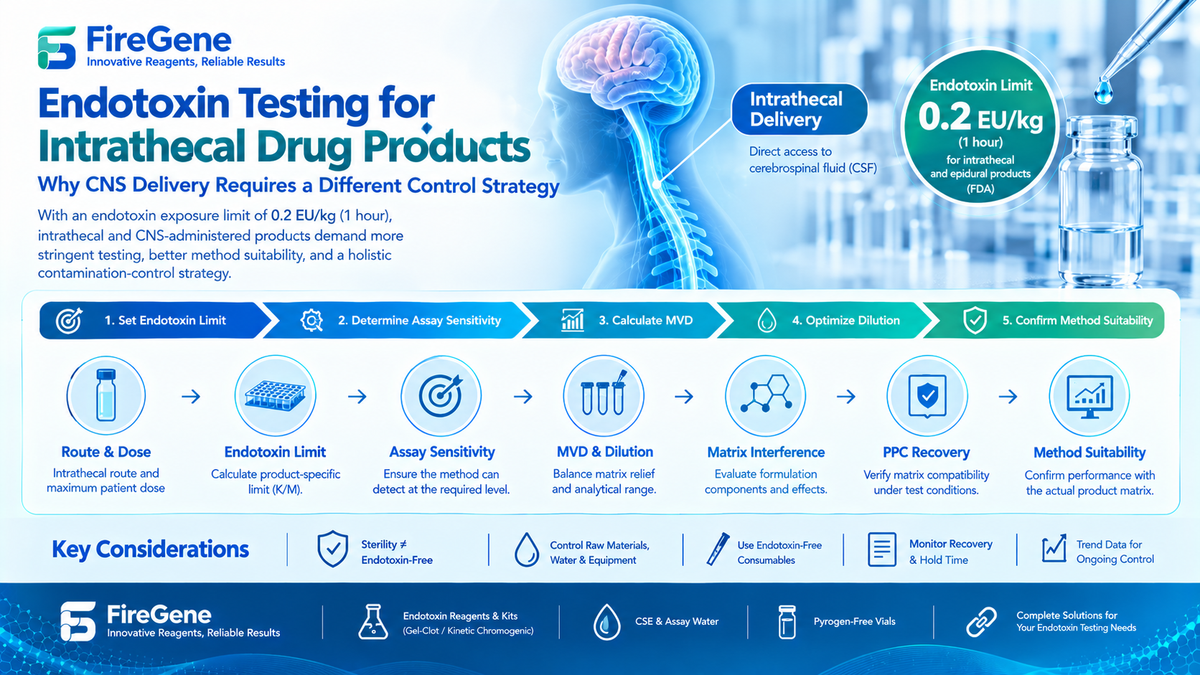
For intrathecal products, the applicable endotoxin exposure threshold is substantially more restrictive than the commonly referenced value for many other parenteral products. FDA's current quality-related materials identify a maximum recommended exposure of 0.2 EU/kg within one hour for drug products administered intrathecally, as well as epidural products because of the risk of inadvertent intrathecal administration.
FDA: Questions and Answers on Quality-Related Controlled Correspondence
This difference has major analytical consequences.
A laboratory cannot simply take an endotoxin test method developed for a conventional injectable product and assume that it will automatically provide an appropriate strategy for an intrathecal drug.
The laboratory must consider:
-
Route of administration
-
Maximum patient dose
-
Endotoxin limit
-
Assay sensitivity
-
Maximum Valid Dilution (MVD)
-
Matrix interference
-
Positive Product Control (PPC) recovery
-
Sample preparation
-
Testing materials
-
Method suitability
-
Data interpretation
In other words:
For intrathecal products, endotoxin limit calculation and endotoxin method development must be treated as one connected analytical strategy.
This article explains the key challenges and provides a practical framework for developing reliable endotoxin testing workflows for intrathecal and other CNS-administered drug products.
For a broader explanation of how dose, route, K/M, and MVD are connected, see FireGene's How to Set Endotoxin Limits for Pharmaceutical Products: A Practical Guide to K/M, Dose, MVD, and Method Selection.
1. Why Intrathecal Drug Products Require Special Endotoxin Control
The central nervous system has a highly specialized biological environment.
The brain and spinal cord are protected by structures such as the blood-brain barrier, which limits the movement of many substances from systemic circulation into the CNS.
Intrathecal administration intentionally bypasses many of these barriers.
That creates a direct therapeutic pathway—but also means that contaminants introduced into the CSF may have a different biological impact than contaminants introduced through other routes.
For endotoxin testing, this distinction is critical.
The general principle behind pharmaceutical endotoxin limits is that acceptable endotoxin exposure depends on the amount of product administered to the patient.
For many non-intrathecal parenteral products, the commonly referenced K value is 5 EU/kg.
For intrathecal administration, the value is substantially lower:
K = 0.2 EU/kg
FDA's current materials specifically identify 0.2 EU/kg in one hour as the maximum recommended exposure for intrathecal and epidural drug products.
The historical FDA bacterial endotoxin technical guidance also explains that when a product is labeled for intrathecal injection, K is 0.2 EU/kg rather than 5 EU/kg.
FDA: Bacterial Endotoxins/Pyrogens
This lower threshold means that the analytical method may need to detect much lower endotoxin concentrations relative to the product concentration.
That immediately creates a connection between:
Clinical Dose → Endotoxin Limit → Assay Sensitivity → MVD → Dilution Strategy → Method Suitability
A weakness in any one of these elements can compromise the overall testing strategy.
2. Sterility Does Not Mean Endotoxin-Free
One of the most important concepts in intrathecal pharmaceutical quality control is the distinction between sterility and endotoxin control.
Sterility testing addresses the presence of viable microorganisms under the conditions of the test.
Endotoxin testing addresses bacterial endotoxin contamination.
These are not interchangeable.
A product can successfully pass sterility testing and still contain endotoxin.
Why?
Because endotoxins can remain biologically active after bacteria have been removed or destroyed.
For example, a manufacturing process may successfully eliminate viable Gram-negative bacteria through sterilization or filtration, while endotoxin that was already introduced into the process remains in the product or manufacturing system.
This is particularly important for intrathecal products because the applicable endotoxin exposure threshold is so restrictive.
Therefore:
Sterility Testing ≠ Endotoxin Testing
A comprehensive quality strategy should consider both.
FireGene's article Sterility Test Passed, Endotoxin Test Failed: Why Sterility Does Not Guarantee Endotoxin-Free Pharmaceutical Products provides a more detailed comparison of these two quality attributes.
FireGene: Sterility Test Passed, Endotoxin Test Failed
3. Where Can Endotoxin Enter an Intrathecal Manufacturing Process?
Endotoxin contamination can occur long before final-product testing.
Potential sources include raw materials, process water, buffers, equipment, single-use components, filtration systems, containers, and manufacturing operations.
Raw Materials
Raw materials can introduce endotoxin into the manufacturing process even when they meet chemical purity specifications.
Potential examples include:
-
Active pharmaceutical ingredients
-
Excipients
-
Salts
-
Sugars
-
Amino acids
-
Surfactants
-
Biological materials
-
Process reagents
Supplier qualification and appropriate incoming controls can therefore play an important role in endotoxin risk management.
FireGene's Endotoxin Testing for Raw Materials and Excipients: How to Control Endotoxin Risk Before Manufacturing examines how raw materials, excipients, concentrated solutions, proteins, surfactants, and lipid-containing materials can contribute to endotoxin risk.
FireGene: Endotoxin Testing for Raw Materials and Excipients
Process Water
Water is often one of the largest components of pharmaceutical formulations and manufacturing processes.
Potential endotoxin sources within water systems include:
-
Biofilm formation
-
Poor sanitization
-
Dead legs
-
Distribution-system contamination
-
Maintenance activities
-
Improper storage
Water used for preparation, rinsing, formulation, and analytical testing should therefore be considered separately within the overall endotoxin-control strategy.
FireGene's Why Water System Monitoring Is the Foundation of Reliable Endotoxin Testing provides a more detailed discussion of pharmaceutical water systems, endotoxin monitoring, and contamination control.
FireGene: Why Water System Monitoring Is the Foundation of Reliable Endotoxin Testing
Equipment and Manufacturing Surfaces
Endotoxin can adsorb to surfaces and remain in manufacturing equipment.
This makes cleaning and depyrogenation important elements of the overall control strategy.
Potential risk areas include:
-
Mixing vessels
-
Transfer lines
-
Filling equipment
-
Stainless-steel surfaces
-
Holding containers
-
Sampling equipment
Single-Use Components
Single-use technologies can reduce certain manufacturing risks, but sterile does not automatically mean endotoxin-free.
Potential components include:
-
Bags
-
Tubing
-
Connectors
-
Filters
-
Sampling assemblies
Supplier qualification and appropriate endotoxin specifications should therefore be considered for critical single-use components.
FireGene's Endotoxin Testing for Single-Use Systems provides additional guidance on endotoxin risk associated with single-use manufacturing systems.
4. Endotoxin Limits Should Be Established Before Method Selection
One of the most common analytical mistakes is selecting the endotoxin reagent first and determining the endotoxin limit later.
For an intrathecal product, this sequence can create problems.
The better workflow is:
Product Dose
↓
Route of Administration
↓
Applicable Endotoxin Exposure
↓
Product Endotoxin Limit
↓
Required Assay Sensitivity
↓
MVD
↓
Sample Dilution
↓
Method Suitability
The endotoxin limit should be scientifically established using the applicable product dose, route, labeling, compendial requirements, and regulatory framework.
FDA's current materials emphasize that the endotoxin limit should be connected to maximum relevant dosing and route-specific exposure.
FireGene's How to Set Endotoxin Limits for Pharmaceutical Products provides a more detailed explanation of K/M calculations, dose selection, route-specific limits, and MVD.
This can result in a substantially lower allowable endotoxin concentration than would be obtained using a generic assumption for an injectable product.
That difference can directly affect the feasibility of the analytical method.
5. Why MVD Becomes Especially Important for Intrathecal Products
Maximum Valid Dilution (MVD) connects the product endotoxin limit with the sensitivity of the selected assay.
For a gel-clot-type calculation, MVD is commonly related to the endotoxin limit and the labeled sensitivity of the reagent.
For products expressed on a concentration basis, the broader relationship may be represented as:
MVD = Endotoxin Limit × Sample Concentration / λ
where λ represents the labeled sensitivity of the endotoxin reagent under the applicable method.
The exact calculation should follow the applicable compendial procedure and the product's units and testing strategy.
The important concept is the relationship between dilution and sensitivity.
Suppose a product has significant matrix interference.
The laboratory may want to dilute the sample to reduce inhibition.
However:
More Dilution → Less Matrix Interference
but also:
More Dilution → Lower Detectable Endotoxin Concentration
For an intrathecal product with a restrictive endotoxin limit, excessive dilution may quickly become analytically problematic.
Therefore, the laboratory must balance:
-
Matrix relief
-
Assay sensitivity
-
Product concentration
-
Endotoxin limit
-
MVD
-
Recovery
FireGene's Endotoxin Testing: Sensitivity, LOD, LOQ, and MVD Explained provides a detailed explanation of how assay sensitivity and MVD interact during endotoxin method development.
FireGene: Sensitivity, LOD, LOQ, and MVD Explained
MVD should therefore not be treated as a calculation performed after method development.
It should be part of the method-development strategy from the beginning.
6. Matrix Interference Can Make Low-Level Endotoxin Testing Difficult
Intrathecal drug products can have relatively simple or highly complex formulations depending on the therapeutic platform.
Potential formulation components include:
-
Proteins
-
Peptides
-
Buffers
-
Sugars
-
Amino acids
-
Surfactants
-
Preservatives
-
Chelating agents
-
Lipids
-
Nanoparticles
-
Other excipients
These components may influence endotoxin detection.
Two major forms of analytical interference are:
Inhibition
The product matrix suppresses the response generated by endotoxin.
The apparent endotoxin concentration may therefore be lower than the actual amount present.
Enhancement
The matrix increases the assay response.
The measured endotoxin concentration may therefore appear higher than expected.
Both conditions can create analytical uncertainty.
This is particularly important when the product has a very low endotoxin limit.
A small analytical bias that might be insignificant for a higher-limit product could become highly consequential when testing an intrathecal formulation.
FireGene's Endotoxin Testing Sample Preparation: A Practical Guide to Dilution, Interference, Recovery, and Reliable Results discusses how pH, ionic strength, proteins, surfactants, preservatives, sample concentration, storage, and dilution can affect endotoxin testing.
FireGene: Endotoxin Testing Sample Preparation Guide
7. Why Positive Product Control Recovery Matters
The Positive Product Control (PPC) provides a way to evaluate whether the product matrix is interfering with endotoxin detection under the selected testing conditions.
The basic concept is:
Known Endotoxin Spike + Product Matrix → Measured Recovery
The laboratory compares the observed recovery with the applicable acceptance criteria.
If recovery is acceptable, the result supports the suitability of the selected sample condition.
If recovery is unacceptable, potential causes may include:
-
Insufficient dilution
-
Excessive matrix interference
-
pH effects
-
Surfactant effects
-
Chelating-agent effects
-
Sample preparation problems
-
Reagent issues
-
Endotoxin masking
-
Sample storage effects
For intrathecal products, this assessment is especially important because the analytical target may be very low.
A passing standard curve does not automatically demonstrate that the product itself is compatible with the method.
The laboratory must evaluate the actual product matrix.
FireGene's Endotoxin Recovery Studies Explained: How to Design, Perform, and Interpret Recovery Experiments explains the distinction between recovery studies and routine PPC testing and describes their role in method suitability.
FireGene: Endotoxin Recovery Studies Explained
8. Low Endotoxin Recovery Can Complicate CNS Product Testing
Some formulations can produce time-dependent changes in endotoxin recovery.
This phenomenon is commonly discussed as Low Endotoxin Recovery (LER).
A sample may initially demonstrate acceptable spike recovery but show reduced recovery after storage or incubation.
For a complex CNS formulation, this creates an important question:
Is the endotoxin actually absent, or has it become less available to the assay?
Potential contributors to endotoxin masking may include:
-
Surfactants
-
Chelating agents
-
Lipids
-
Protein interactions
-
Other formulation components
This is why laboratories developing methods for complex products may need to evaluate recovery at more than one time point.
A study could compare scientifically justified intervals such as:
Initial Testing → Short Hold → Extended Hold
The exact time points should be based on the intended sample handling and storage conditions.
LER should not simply be treated as an assay failure.
It should trigger investigation into the relationship between the product matrix, endotoxin availability, sample storage, and assay performance.
FireGene's Understanding Low Endotoxin Recovery (LER): Mechanisms, Regulatory Perspectives, and Practical Solutions in 2026 provides a dedicated discussion of endotoxin masking and time-dependent recovery.
FireGene: Understanding Low Endotoxin Recovery (LER)
9. Choosing Between Gel-Clot and Kinetic Chromogenic Testing
Intrathecal products may require particularly sensitive and well-controlled endotoxin testing strategies.
The choice of assay should be based on the product, intended use, applicable requirements, sensitivity, matrix characteristics, and demonstrated suitability.
FDA's March 2026 guidance discusses the fundamental principles of gel-clot, photometric, and kinetic endotoxin test methods and recommends testing appropriate components and finished products for pyrogens and endotoxins.
FDA: Pyrogen and Endotoxins Testing — Questions and Answers, March 2026
Gel-Clot Testing
Gel-clot testing provides a defined qualitative or semi-quantitative endpoint.
It can be useful when:
-
The sample is relatively straightforward
-
A qualitative endpoint is appropriate
-
The method is already demonstrated to be suitable
-
Routine testing requirements can be met with the selected sensitivity
FireGene's Gel-Clot LAL/TAL Endotoxin Test Kit provides multiple sensitivity options for endotoxin testing. The current product information lists sensitivity options ranging from 0.03 to 0.5 EU/mL.
FireGene Gel-Clot LAL/TAL Endotoxin Test Kit
Kinetic Chromogenic Testing
Kinetic chromogenic testing provides quantitative endotoxin results using kinetic optical measurement.
This approach can be useful during method development because laboratories can compare:
-
Multiple dilution levels
-
PPC recovery
-
Standard curve performance
-
Different formulation conditions
-
Different sample preparation conditions
-
Different sample hold times
FireGene's Kinetic Chromogenic Endotoxin Test Kit is a 96-well quantitative TAL/LAL assay with 405 nm absorbance detection and a listed analytical range of 0.005–10 EU/mL. FireGene identifies the current product as Research Use Only and states that it is not licensed by FDA for end-product release of FDA-regulated pharmaceutical drugs, devices, or biologics.
For additional technical background, see FireGene's The Ultimate Guide to Kinetic Chromogenic Endotoxin Assays.
FireGene: The Ultimate Guide to Kinetic Chromogenic Endotoxin Assays
10. Sample Preparation Is Critical at Very Low Endotoxin Levels
When testing at low endotoxin concentrations, sample preparation becomes part of the analytical method.
Potential variables include:
Sample Mixing
The sample should be sufficiently homogeneous before testing.
Dilution Accuracy
Small pipetting errors can become significant when multiple serial dilutions are used.
Containers
The tubes, plates, vials, and other materials that contact the sample should be appropriate for endotoxin testing.
Water Quality
Water used for dilution should not introduce additional endotoxin.
FireGene's Endotoxin Assay Water is designed for negative controls, CSE/ECV dissolution and dilution, and sample preparation for bacterial endotoxin testing. The product is available in multiple package sizes and is designed for gel-clot, turbidimetric, and chromogenic LAL workflows.
FireGene Endotoxin Assay Water
Sample Hold Time
The time between sample preparation and analysis should be controlled and scientifically justified, particularly when the formulation may influence endotoxin recovery.
FireGene's Endotoxin Sample Hold Time: How Storage Conditions, Temperature, and Delayed Testing Can Affect Endotoxin Recovery provides additional discussion of sample storage and delayed testing.
11. A Practical Method Development Workflow for Intrathecal Products
A structured workflow can reduce analytical uncertainty.
Step 1: Define the Product
Document:
-
Drug substance or drug product
-
Concentration
-
Dosage form
-
Formulation
-
Route of administration
-
Intended dose
Step 2: Establish the Endotoxin Limit
Determine the applicable endotoxin exposure threshold and calculate the product-specific limit.
For intrathecal products, the applicable threshold is substantially lower than the commonly used non-intrathecal value. FDA's current materials identify 0.2 EU/kg in one hour for intrathecal and epidural drug products.
Step 3: Determine Required Assay Sensitivity
Select an assay sensitivity that can adequately demonstrate compliance with the product limit.
Step 4: Calculate MVD
Determine the maximum valid dilution based on the product endotoxin limit, concentration, and assay sensitivity.
Step 5: Identify Potential Matrix Interference
Review:
-
pH
-
Protein concentration
-
Surfactants
-
Chelating agents
-
Salts
-
Sugars
-
Preservatives
-
Lipids
-
Other formulation components
Step 6: Develop a Dilution Series
Evaluate appropriate dilution levels while remaining within the applicable MVD.
Step 7: Evaluate PPC Recovery
Determine whether the product matrix interferes with endotoxin detection.
Step 8: Evaluate Time-Dependent Recovery
If scientifically justified, investigate whether recovery changes during the intended sample handling period.
Step 9: Confirm the Testing Method
Demonstrate that the selected method performs consistently under the intended conditions.
Step 10: Establish Routine Controls
Define:
-
Standard preparation
-
Negative controls
-
PPC requirements
-
Sample dilution
-
Instrument requirements
-
Acceptance criteria
-
Data review
-
Documentation
For a detailed validation framework, FireGene's How to Validate an Endotoxin Test Method: A Step-by-Step Guide for USP <85> Compliance explains endotoxin limit calculation, MVD, PPC recovery, inhibition/enhancement, and method suitability.
FireGene: How to Validate an Endotoxin Test Method
12. Common Mistakes in Intrathecal Endotoxin Testing
Mistake 1: Using the Same Endotoxin Limit as an IV Product
The route of administration matters.
Intrathecal administration has a substantially lower applicable exposure threshold.
Mistake 2: Selecting the Assay Before Calculating the Limit
The required analytical sensitivity should be driven by the product requirement.
Mistake 3: Assuming a Very Sensitive Reagent Solves Everything
High sensitivity does not eliminate matrix interference.
The method must still demonstrate suitability.
Mistake 4: Diluting Beyond the MVD
Dilution may reduce interference but can also make the assay unable to demonstrate compliance at the required limit.
Mistake 5: Ignoring PPC Recovery
A passing standard curve does not prove that the product matrix is compatible with the assay.
Mistake 6: Testing Only the Final Product
Testing selected raw materials, process inputs, buffers, and intermediates can help identify contamination risks earlier.
Mistake 7: Ignoring Sample Hold Time
Complex formulations may alter endotoxin recovery over time.
Mistake 8: Using Ordinary Laboratory Water
At very low endotoxin levels, the analytical water itself can become a contamination source.
Mistake 9: Treating Sterility as Proof of Endotoxin Control
Sterility and endotoxin testing address different quality attributes.
Mistake 10: Failing to Document the Scientific Basis
For specialized products, the rationale connecting dose, route, limit, sensitivity, dilution, and method suitability should be clearly documented.
13. Building an Endotoxin Control Strategy Beyond Final-Product Testing
A strong intrathecal endotoxin strategy should not begin when the final drug product reaches the QC laboratory.
It should begin during process development.
A practical control strategy can be visualized as:
Supplier Qualification
↓
Raw Material Control
↓
Water System Control
↓
Equipment Cleaning & Depyrogenation
↓
Process Monitoring
↓
Intermediate Testing
↓
Formulation Control
↓
Sterile Filtration
↓
Fill-Finish Control
↓
Final Endotoxin Testing
↓
Trend Analysis
This lifecycle approach provides more information than relying exclusively on the final batch result.
For example, if an endotoxin result gradually increases over multiple batches, trend analysis may identify a developing process issue before it becomes a specification failure.
FireGene's Endotoxin Testing Data Trending: How to Detect Process Drift Before a Batch Fails discusses how quantitative endotoxin data can be evaluated over time to identify potential process drift.
FireGene: Endotoxin Testing Data Trending
For laboratories developing a broader sampling strategy, FireGene also provides How to Build an Endotoxin Testing Sampling Plan: Where, When, and How Often Should You Test?.
14. The Role of Endotoxin-Free Materials in the Analytical Workflow
When the product endotoxin limit is very low, every material that enters the assay becomes important.
The analytical system can be summarized as:
- TAL/LAL Reagent
- Control Standard Endotoxin
- Endotoxin Assay Water
- Pyrogen-Free Consumables
- Sample Preparation
- Dilution
- Instrument
- Data Analysis
A problem in any one of these components can affect the final result.
For example, contaminated water can elevate the background signal.
Non-qualified tubes or pipette tips can introduce endotoxin.
Poor standard preparation can affect the calibration curve.
Inconsistent pipetting can affect both standards and samples.
FireGene's Pyrogen-Free Vials are designed for CSE reconstitution, serial dilution, and ECV preparation and are compatible with Gel-Clot, Kinetic Chromogenic, and End-Point Chromogenic LAL/TAL workflows.
This is why endotoxin testing should be considered a complete analytical system rather than simply a reagent-based assay.
15. Regulatory Considerations: USP <85>, USP <86>, and FDA Expectations
The regulatory landscape surrounding bacterial endotoxin testing continues to evolve.
FDA's March 2026 Pyrogen and Endotoxins Testing: Questions and Answers provides current FDA thinking concerning USP <85>, USP <161>, AAMI ST72, and gel-clot, photometric, and kinetic endotoxin testing approaches.
USP <86> provides additional techniques for bacterial endotoxin testing using recombinant reagents. USP describes the chapter as using recombinant Factor C or recombinant cascade reagents to detect or quantify endotoxins from Gram-negative bacteria.
USP <86>: Bacterial Endotoxins Test Using Recombinant Reagents
For laboratories considering recombinant-reagent approaches, USP also emphasizes that suitability for the specific material and intended use needs to be verified.
USP: <86> Bacterial Endotoxins Test Using Recombinant Reagents — Verification Considerations
These developments reinforce an important principle:
The analytical method, endotoxin limit, and product-specific suitability assessment should be considered as one connected system.
A laboratory should not select a test method independently of the product's actual endotoxin requirement.
16. How FireGene Endotoxin Testing Solutions Can Support Method Development
For laboratories developing research and analytical workflows for intrathecal or other low-endotoxin products, FireGene provides a range of endotoxin-testing components.
The Kinetic Chromogenic Endotoxin Test Kit provides quantitative 96-well analysis with 405 nm detection and a listed range of 0.005–10 EU/mL. It can be used in research and method-development workflows where quantitative comparison of dilution, recovery, and matrix effects is important.
For qualitative or semi-quantitative applications, the Gel-Clot LAL/TAL Endotoxin Test Kit provides multiple sensitivity options.
Supporting materials include:
-
Other endotoxin-testing consumables
For laboratories looking for a broader portfolio, FireGene's Endotoxin Assay Reagents and Kits collection brings together endotoxin reagents, standards, assay water, and related consumables.
The key is not simply to select the most sensitive reagent.
The goal is to establish a complete analytical workflow in which:
Endotoxin Limit → Assay Sensitivity → MVD → Sample Preparation → PPC Recovery → Method Suitability → Routine Testing
are scientifically connected.
Conclusion
Endotoxin testing for intrathecal drug products requires a more specialized approach than routine endotoxin testing for many conventional pharmaceutical products.
The reason is straightforward:
The route of administration changes the acceptable endotoxin exposure.
FDA's current materials identify 0.2 EU/kg within one hour as the maximum recommended endotoxin exposure for intrathecal and epidural drug products.
That difference affects the entire analytical strategy.
A reliable approach should connect:
-
Route of administration
-
Maximum patient dose
-
Endotoxin limit
-
Assay sensitivity
-
MVD
-
Sample dilution
-
Matrix interference
-
PPC recovery
-
Sample hold time
-
Testing materials
-
Method suitability
-
Routine monitoring
The most important principle is therefore:
Do not design the endotoxin test independently from the product's clinical and analytical requirements.
For intrathecal and CNS-administered products, endotoxin control should be built into the manufacturing and analytical lifecycle—from raw material qualification and water-system control to formulation, fill-finish, final testing, and trend analysis.
As pharmaceutical development increasingly expands into specialized CNS therapies, laboratories will need endotoxin testing strategies that are not only sensitive, but also product-specific, reproducible, and scientifically justified.
Ultimately, successful endotoxin testing is not simply about obtaining a number below a specification.
It is about demonstrating that the analytical system can reliably measure endotoxin at the level that matters for the actual product, route, dose, and patient exposure.
FireGene Endotoxin Testing
Ready to run your endotoxin assay?
FireGene offers a complete endotoxin testing toolkit — from TAL reagents and CSE standards to pyrogen-free consumables and LAL reagent water. All products are aligned with USP <85>, EP 2.6.14, and JP 4.01.


