
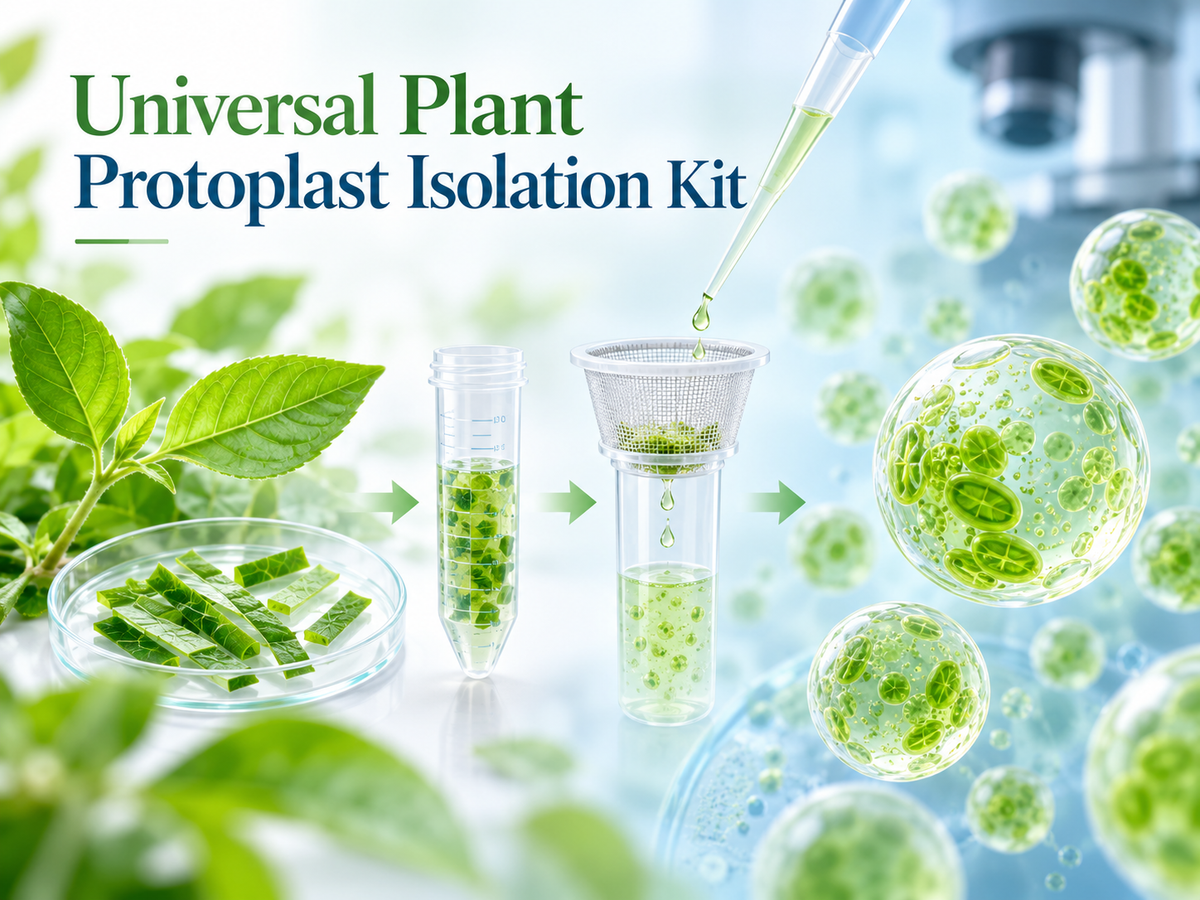
Plant protoplast isolation is an essential technique in plant cell biology, functional genomics, and biotechnology. By enzymatically removing plant cell walls, researchers can obtain individual cells suitable for molecular analysis, transient gene expression, cell fusion, and single-cell sequencing. However, variations in plant cell wall composition, tissue maturity, and physiological conditions make protoplast preparation challenging. The Universal Plant Protoplast Isolation Kit provides a standardized, enzyme-based workflow for releasing and purifying plant protoplasts from suitable tissues. This article examines the principles of protoplast isolation, key workflow considerations, quality control, and major research applications, highlighting the importance of maintaining cell viability and sample quality.
1. Introduction to Plant Protoplast Isolation
Plant protoplasts are plant cells whose cell walls have been removed while their plasma membranes and intracellular components remain intact.
Unlike animal cells, plant cells are surrounded by rigid cell walls composed primarily of cellulose, hemicellulose, pectin, and other structural polymers. These walls provide mechanical support and protection but create technical barriers when researchers need to isolate individual plant cells.
Protoplast isolation overcomes this limitation by selectively degrading cell wall components, allowing individual cells to be released from plant tissues.
Isolated protoplasts are valuable experimental systems because they provide direct access to the plasma membrane and facilitate cellular manipulation without the physical barrier of the cell wall.
The Universal Plant Protoplast Isolation Kit is designed to simplify this procedure through coordinated enzymatic digestion, filtration, purification, and resuspension steps.
Such workflows support research in plant physiology, developmental biology, molecular genetics, and crop biotechnology.
2. Why Is Plant Protoplast Isolation Important?
Plant tissues contain diverse cell populations embedded within complex extracellular structures.
Traditional tissue-level analyses often measure the combined biological responses of numerous cell types, potentially obscuring important differences between individual cells.
Protoplast isolation enables researchers to examine cellular processes at higher resolution.
Direct Access to Individual Plant Cells
Removing the cell wall facilitates experimental access to individual plant cells and makes them suitable for selected transfection, imaging, and cell-based assays.
Supporting Molecular Biology Experiments
Protoplast-based systems allow researchers to investigate gene expression, protein localization, signal transduction, and cellular responses under controlled laboratory conditions.
Enabling Single-Cell Analysis
Single-cell technologies require the isolation of individual biological units.
High-quality plant protoplast suspensions can provide starting material for single-cell RNA sequencing, helping researchers characterize cellular diversity and gene regulatory programs.
However, successful isolation must preserve sufficient viability and minimize artifacts introduced during enzymatic digestion.
3. How Does the Universal Plant Protoplast Isolation Kit Work?
The fundamental principle of plant protoplast isolation is the enzymatic breakdown of structural components surrounding plant cells.
Most conventional protoplast isolation systems rely on combinations of cell wall-degrading enzymes.
Enzymatic Degradation of Plant Cell Walls
Cellulase contributes to cellulose degradation, while pectin-degrading enzymes help disrupt pectin-rich regions involved in cell adhesion.
Depending on the enzyme formulation and plant tissue, additional activities may help release individual cells.
The objective is to disrupt the cell wall sufficiently without causing extensive damage to the plasma membrane.
Osmotic Protection During Isolation
Once the cell wall is removed, protoplasts become particularly sensitive to changes in surrounding osmotic pressure.
Osmotic stabilizers, commonly including mannitol, help maintain an appropriate extracellular environment during isolation.
Insufficient osmotic protection may cause swelling and rupture, while unsuitable hyperosmotic conditions can lead to cellular shrinkage and physiological stress.
Protoplast Separation and Purification
After digestion, the suspension generally contains released protoplasts, undigested tissue fragments, cellular debris, and other impurities.
Filtration and carefully controlled centrifugation help separate intact protoplasts from unwanted material.
Optional purification steps may further improve sample cleanliness, depending on the application.
The objective is to obtain a suspension containing intact, viable protoplasts with minimal debris and aggregation.
4. General Workflow for Plant Protoplast Isolation
A standardized workflow can improve consistency between experiments. The following overview reflects the general process and the manufacturer's published approach for the FireGene Universal Plant Protoplast Isolation Kit, rather than a substitute for its detailed operating protocol.
FireGene
Step 1: Plant Tissue Selection
Fresh, physiologically healthy, and relatively tender plant tissues are generally preferred.
Young leaves are frequently used because their primary cell walls are often more accessible to enzymatic digestion than highly lignified tissues.
Sample condition, developmental stage, and plant species should be considered before beginning isolation.
Step 2: Tissue Preparation and Pretreatment
Plant tissues are cut into suitable fragments to increase the surface area available for enzymatic digestion.
Depending on the protocol, pretreatment with an osmotic stabilization solution may help prepare the tissue for protoplast release.
Excessively aggressive mechanical handling should be avoided because it can damage cellular membranes.
Step 3: Enzymatic Digestion
Prepared tissue is incubated in an enzyme-containing solution under controlled conditions.
For the FireGene kit, the published protocol describes a digestion period of approximately 3–5 hours at around 25°C, with microscopic monitoring. The appropriate endpoint depends on the tissue being processed.
FireGene
Step 4: Filtration and Collection
The digested suspension is filtered to remove large tissue fragments.
Gentle centrifugation and collection procedures are then used to concentrate the released protoplasts while minimizing mechanical injury.
Step 5: Purification and Resuspension
When required, purification is performed to reduce residual debris and enrich the protoplast fraction.
The resulting cells are resuspended in an appropriate buffer compatible with the intended downstream experiment.
Step 6: Quality Assessment
Researchers should examine the final suspension using microscopy and suitable viability assays.
Important quality parameters include cell integrity, viability, yield, aggregation, and sample cleanliness.
A successful preparation should contain sufficient intact protoplasts for the planned experimental application.
5. Major Applications of Plant Protoplast Isolation
5.1 Plant Single-Cell RNA Sequencing
Single-cell RNA sequencing (scRNA-seq) allows researchers to investigate gene expression patterns in individual plant cells.
Protoplast isolation can provide single-cell suspensions for examining cellular heterogeneity, developmental transitions, and tissue-specific gene expression.
For example, single-cell transcriptomic studies of Arabidopsis roots have demonstrated how individual cellular profiles can reveal developmental trajectories and regulatory patterns that may be obscured in bulk tissue analysis.
However, researchers must consider cell-type recovery bias, protoplasting-induced transcriptional changes, and compatibility with the selected sequencing platform.
5.2 Transient Gene Expression and Protein Localization
Plant protoplasts provide a flexible experimental platform for transient gene expression.
Following isolation, researchers can introduce suitable expression constructs through methods such as polyethylene glycol-mediated transfection or electroporation.
These approaches enable investigations into promoter activity, protein localization, transcriptional regulation, and intracellular signaling.
Fluorescent reporter proteins can also be used to visualize protein distribution within cellular compartments.
Protoplast-based expression systems have become established tools for studying plant molecular and cellular processes.
5.3 Plant Genetic Engineering and Genome Editing
Protoplasts are useful for evaluating plant genome-editing technologies, including CRISPR/Cas systems.
Because the cell wall has been removed, nucleic acids and certain gene-editing components can be introduced using compatible delivery methods.
Researchers can subsequently evaluate editing efficiency, guide RNA activity, and cellular responses.
However, obtaining edited protoplasts does not automatically guarantee successful regeneration of whole plants. Regeneration capacity remains highly dependent on plant species, genotype, and culture conditions.
5.4 Protoplast Fusion and Plant Biotechnology
Protoplast fusion enables researchers to investigate interactions between cells originating from different plant lines or species.
Under appropriate experimental conditions, isolated protoplasts may be induced to fuse, creating hybrid or cybrid cellular systems.
These approaches have applications in somatic hybridization, organelle inheritance research, and selected plant breeding studies.
Reliable protoplast preparation is an important preliminary step, although successful fusion and regeneration require additional optimization.
5.5 Plant Stress Response and Signal Transduction
Plant protoplasts can support studies of cellular responses to environmental and biochemical stimuli.
Potential research areas include osmotic stress, hormone signaling, oxidative stress, membrane transport, and cellular signaling pathways.
For example, fluorescence-based assays and electrophysiological methods can be used to investigate selected changes in membrane properties or intracellular signaling.
Researchers should include appropriate controls because the isolation procedure itself can induce cellular stress responses.
6. Advantages of a Standardized Protoplast Isolation Kit
A standardized kit can reduce the need to prepare and coordinate multiple reagents independently.
The Universal Plant Protoplast Isolation Kit combines key workflow stages, including cell wall digestion and protoplast purification, into a defined experimental procedure.
Potential advantages include more convenient experimental preparation, simplified reagent handling, improved procedural consistency, and a practical starting point for laboratory optimization.
Nevertheless, the term universal should not be interpreted as a guarantee of equivalent isolation efficiency across every plant species or tissue.
Protoplast yield, viability, purity, and experimental suitability must be verified for each application.
7. Key Factors Affecting Protoplast Quality
High-quality preparations depend on several interconnected experimental variables.
Plant tissue characteristics: Tissue age, physiological condition, cell wall composition, and lignification influence enzyme accessibility and cell release.
Digestion conditions: Insufficient digestion may reduce yield, while excessive digestion may compromise viability and alter cell physiology.
Osmotic balance: Suitable osmotic protection helps maintain plasma membrane integrity during cell wall removal.
Mechanical handling: Gentle filtration, pipetting, and centrifugation can reduce membrane damage and cellular loss.
Processing time: Prompt quality assessment and downstream processing can help minimize deterioration after isolation.
For transcriptomic experiments, consistency between biological replicates is particularly important because isolation-related stress may influence measured gene expression.
8. Conclusion
The Universal Plant Protoplast Isolation Kit provides a practical approach to obtaining individual plant cells for molecular, cellular, and biotechnology research.
By combining enzymatic cell wall digestion with controlled separation and purification, the kit supports the preparation of protoplast suspensions for diverse downstream applications.
Its relevance extends to plant single-cell sequencing, transient gene expression, genome-editing research, cellular imaging, and protoplast fusion.
Successful applications depend on appropriate tissue selection, optimized digestion, careful handling, and reliable quality assessment.
As plant single-cell technologies and functional genomics continue to advance, reproducible protoplast isolation will remain an important component of experimental plant biology.


