
Introduction: What Does “Kinetic” Really Mean in Kinetic Chromogenic Endotoxin Testing?
When laboratories first encounter kinetic chromogenic endotoxin testing, the word chromogenic is usually easy to understand.
The assay produces a color.
The color can be measured by a microplate reader.
But the more important word is actually kinetic.
A kinetic chromogenic endotoxin assay does not simply ask:
How much color is present at the end of the reaction?
Instead, it monitors how the color develops over time.
That difference is fundamental.
The reaction does not occur instantaneously. Endotoxin activates an enzymatic cascade, the chromogenic substrate is cleaved, and the optical signal progressively changes.
The instrument captures this change as a function of time.
The resulting kinetic information is then used to determine the endotoxin concentration of an unknown sample.
In simplified form:
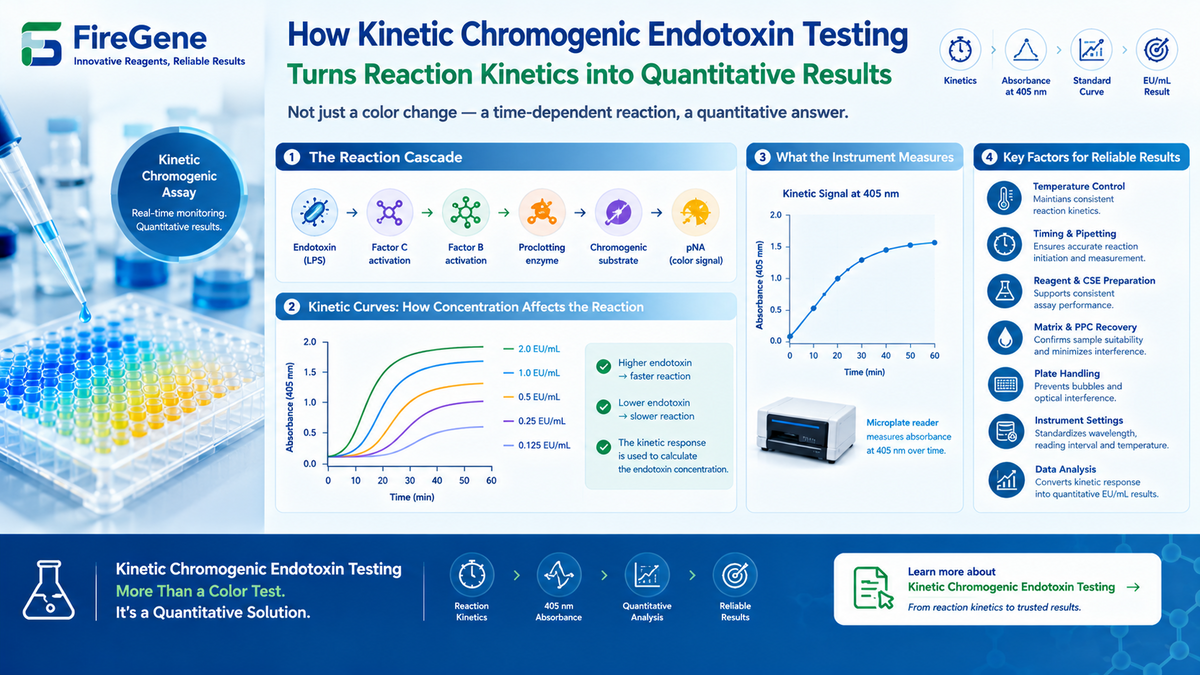
Endotoxin → Enzymatic Activation → Chromogenic Reaction → Absorbance Change Over Time → Kinetic Response → Quantitative Endotoxin Result
This is what makes kinetic chromogenic endotoxin testing fundamentally different from simply looking at a final color.
FireGene's current Kinetic Chromogenic Endotoxin Test Kit uses a 96-well format with kinetic absorbance detection at 405 nm and is designed for quantitative endotoxin measurement using compatible microplate-reader instrumentation.
But what exactly happens between the first contact with endotoxin and the final EU/mL result?
Let's take a closer look.
1. The Basic Principle of Kinetic Chromogenic Endotoxin Testing
Kinetic chromogenic endotoxin testing is based on the biological response of a TAL/LAL reagent system to bacterial endotoxin.
Endotoxin, primarily lipopolysaccharide (LPS) from the outer membrane of Gram-negative bacteria, activates an enzymatic cascade within the reagent.
In a conventional LAL/TAL-based pathway, the simplified sequence can be represented as:
Endotoxin → Factor C → Factor B → Proclotting Enzyme → Activated Enzyme
The downstream activated enzyme then interacts with a synthetic chromogenic substrate.
This produces a colored reaction product.
As the reaction progresses, absorbance increases.
A microplate reader monitors that optical change during incubation.
The important point is that the rate and timing of this reaction depend on the amount of endotoxin present.
In general:
Higher endotoxin concentration → faster reaction
Lower endotoxin concentration → slower reaction
Therefore, the assay transforms an invisible biological contaminant into a measurable kinetic signal.
2. Why Does Higher Endotoxin Produce a Faster Reaction?
This is one of the most important concepts for understanding kinetic chromogenic endotoxin testing.
Consider two samples:
Sample A
Contains a relatively high endotoxin concentration.
Sample B
Contains a relatively low endotoxin concentration.
When the same volume of each sample is introduced into the assay system, Sample A contains more endotoxin molecules capable of initiating the enzymatic cascade.
The result is stronger activation of the downstream reaction.
The chromogenic substrate is therefore cleaved more rapidly.
The absorbance signal rises sooner.
Sample B produces a slower response, so its absorbance increases more gradually.
Conceptually:
High endotoxin
→ stronger enzymatic activation
→ faster substrate cleavage
→ faster color development
→ earlier kinetic response
Low endotoxin
→ weaker activation
→ slower substrate cleavage
→ slower color development
→ later kinetic response
This relationship between endotoxin concentration and reaction kinetics is the foundation of quantitative kinetic chromogenic testing.
3. What Does the Microplate Reader Actually Measure?
The microplate reader does not directly measure “endotoxin.”
This is an important distinction.
The instrument measures an optical signal.
For a chromogenic assay, that signal is commonly expressed as absorbance at a specified wavelength, such as 405 nm.
The instrument repeatedly records absorbance during the reaction.
For example, a simplified kinetic dataset might look like:
| Time | Absorbance |
|---|---|
| 0 min | Low |
| 5 min | Low |
| 10 min | Increasing |
| 15 min | Increasing |
| 20 min | Higher |
| 25 min | Higher |
| 30 min | Approaching plateau |
The actual assay software then interprets the kinetic behavior according to the assay's analytical model.
Therefore:
The instrument measures absorbance.
The kinetic algorithm interprets the reaction.
The standard curve connects that response to endotoxin concentration.
This three-part relationship is essential for understanding the method.
4. From Color Development to Reaction Time
One common way of describing a kinetic chromogenic assay is through reaction time.
Instead of simply asking how much color exists at a particular endpoint, the analytical system can determine when the reaction reaches a predefined optical threshold.
Conceptually:
Absorbance threshold → reaction time
A sample with higher endotoxin concentration reaches the threshold earlier.
A sample with lower endotoxin concentration reaches it later.
This creates an inverse relationship:
More endotoxin → shorter reaction time
Less endotoxin → longer reaction time
This is why kinetic chromogenic endotoxin assays are sometimes described as time-based quantitative assays.
However, laboratories should always follow the calculation model and acceptance criteria specified for the particular reagent system and validated method rather than assuming that every kinetic assay uses exactly the same mathematical treatment.
5. What Does a Typical Kinetic Curve Look Like?
A kinetic chromogenic reaction can be visualized as absorbance plotted against time.
The curve generally contains several conceptual regions.
Region 1: Baseline
At the beginning of the reaction, absorbance is relatively low.
The chromogenic reaction has not yet generated a substantial optical signal.
Region 2: Reaction Initiation
The enzymatic cascade begins producing measurable changes.
The curve starts to rise.
Region 3: Rapid Signal Development
The chromogenic reaction becomes clearly measurable.
The slope of the curve increases.
Region 4: Later Reaction / Plateau
As the reaction progresses, the signal may begin approaching a plateau or otherwise leave the most useful kinetic region.
For quantitative purposes, the important information is often contained in the portion of the reaction where the kinetic response can be reliably distinguished.
This is why simply looking at the final color can lose important analytical information.
6. Why Endpoint Color Alone Is Not Enough
Imagine two samples that eventually produce almost the same final color.
If Sample A reaches that color in 15 minutes while Sample B requires 35 minutes, they clearly did not behave identically during the reaction.
A kinetic assay captures that difference.
This is one of the major strengths of kinetic chromogenic endotoxin testing.
Instead of reducing the entire reaction to:
Final color = result
the method preserves information about:
How quickly did the reaction develop?
That additional dimension makes quantitative analysis possible.
It also provides laboratories with a richer dataset for evaluating assay performance.
7. Reaction Time and Endotoxin Concentration
The relationship between reaction time and endotoxin concentration is not necessarily a simple linear relationship.
In many kinetic endotoxin methods, the calibration relationship is established using known endotoxin standards across a defined analytical range.
The laboratory therefore does not simply calculate:
“Half the reaction time means twice the endotoxin.”
That would be an oversimplification.
Instead, known endotoxin concentrations are measured under controlled conditions and their kinetic responses are used to establish the analytical relationship.
Unknown samples are then interpreted against that relationship.
This is why the standard curve remains essential even though the focus of this article is the kinetic reaction itself.
For a deeper explanation of calibration, see FireGene's guide to Understanding Standard Curves in Kinetic Chromogenic Endotoxin Testing.
8. The Kinetic Curve Contains More Information Than the Final Result
One of the biggest advantages of kinetic chromogenic endotoxin testing is that the raw reaction generates a time-dependent dataset.
That means laboratories can potentially evaluate more than just the final calculated endotoxin concentration.
For example, the kinetic data can help identify:
- Unusual reaction behavior
- Delayed reactions
- Abnormal background
- Irregular replicates
- Potential sample interference
- Standard curve abnormalities
- Unexpected plate behavior
- Instrument-related anomalies
This is particularly useful during method development and troubleshooting.
A final numerical result may tell you what happened.
The kinetic curve can sometimes provide clues about how it happened.
9. Why the 405 nm Measurement Matters
The chromogenic reaction produces an optical signal that can be monitored spectrophotometrically.
FireGene's current kinetic chromogenic endotoxin kit uses 405 nm absorbance detection.
The microplate reader therefore collects optical information at this wavelength during the reaction.
This is why instrument compatibility is an important part of kinetic chromogenic endotoxin testing.
A suitable reader should provide the necessary:
- Wavelength capability
- Kinetic reading capability
- Temperature control where required
- Plate compatibility
- Data acquisition
- Calculation functionality
The reader is not simply taking one photograph of the plate.
It is repeatedly measuring the optical signal as the reaction develops.
10. Why Kinetic Chromogenic Testing Is More Than a “Color Test”
The phrase “colorimetric endotoxin assay” can sometimes make the technique sound deceptively simple.
In reality, the assay combines several analytical layers:
Biological recognition
Endotoxin activates the TAL/LAL reagent system.
Enzymatic amplification
The activated cascade produces a measurable biochemical response.
Chromogenic detection
The reaction produces an optical signal.
Kinetic monitoring
The optical signal is measured as a function of time.
Quantitative calibration
The kinetic response is compared with known endotoxin standards.
Data interpretation
The analytical system calculates the endotoxin concentration.
So the complete process is:
Biological detection
→
Enzymatic amplification
→
Chromogenic signal
→
Kinetic measurement
→
Calibration
→
Quantitative result
This is the real architecture of kinetic chromogenic endotoxin testing.
11. Why Reaction Kinetics Improve Quantitative Information
Traditional qualitative endotoxin testing can answer an important question:
Is the sample above or below a defined detection threshold?
But quantitative kinetic chromogenic testing can provide a different level of information:
Approximately how much endotoxin is present within the validated analytical range?
That quantitative information can be useful for:
- Research
- Method development
- Process monitoring
- Raw-material characterization
- Formulation studies
- Laboratory investigations
- Trend analysis
FireGene's current kinetic chromogenic product is specifically positioned as a quantitative research-use assay rather than an FDA-licensed end-product release test.
Therefore, laboratories should distinguish between the analytical capability of kinetic chromogenic testing and the regulatory status of a specific product and intended application.
12. What Happens When Endotoxin Concentration Is Very Low?
At lower endotoxin concentrations, the enzymatic reaction generally takes longer to generate a measurable signal.
This creates an important analytical challenge.
The laboratory needs enough time for the reaction to develop while maintaining an appropriate signal-to-background relationship.
If the reaction is stopped too early, a low-end sample may not generate sufficient signal.
If the measurement continues indefinitely, other factors such as background changes or reaction plateau behavior may become increasingly relevant.
Therefore, the selected kinetic measurement window needs to be appropriate for the assay system.
This is one reason reagent sensitivity and analytical range need to be considered together.
FireGene's guide to kinetic chromogenic sensitivity and dilution explores how analytical sensitivity and sample dilution interact.
13. What Happens When Endotoxin Concentration Is Too High?
The opposite problem can occur with highly concentrated samples.
If the reaction develops extremely quickly, the kinetic response may occur outside the optimal analytical region.
The sample may therefore need appropriate dilution.
This is not simply about reducing the numerical endotoxin concentration.
Dilution can also:
- Move the sample into the validated analytical range
- Reduce matrix interference
- Improve quantitative interpretation
- Provide a more useful kinetic response
The laboratory therefore needs to consider both:
endotoxin concentration
and
sample matrix
when selecting test conditions.
14. Matrix Effects Can Change the Kinetic Response
The kinetic chromogenic assay does not operate in pure endotoxin solution when testing real products.
A pharmaceutical or biological sample may contain:
- Proteins
- Lipids
- Salts
- Surfactants
- Buffers
- Preservatives
- Nanoparticles
- Other formulation components
These substances can potentially interfere with the enzymatic reaction.
The result may be:
Inhibition
The reaction becomes slower than expected.
Enhancement
The reaction becomes faster than expected.
Optical interference
The sample itself affects the absorbance measurement.
This is why a sample's kinetic curve cannot be interpreted solely from its appearance.
A suitable method needs to demonstrate that the sample matrix does not compromise the assay under the selected conditions.
FireGene's recent mRNA-LNP endotoxin testing guide provides a useful example of why complex matrices require particular attention.
15. Why PPC Is Important for Interpreting Kinetic Results
The Positive Product Control (PPC) provides an important matrix-suitability check.
The basic concept is straightforward:
A known amount of endotoxin is added to the product matrix.
The laboratory then evaluates whether the endotoxin can be appropriately recovered.
If the kinetic response is substantially altered by the product matrix, the assay may not be suitable under those conditions.
This is important because a beautifully shaped standard curve does not automatically prove that every sample matrix behaves correctly.
The standard curve answers:
How does the assay respond to known endotoxin standards?
The PPC helps answer:
How does the assay respond to endotoxin in the presence of this product matrix?
These are related but different questions.
16. Kinetic Chromogenic Testing and Sample Dilution
Dilution is therefore an important part of kinetic endotoxin analysis.
Suppose a product contains a component that inhibits the reaction.
At a low dilution, the interfering substance remains highly concentrated.
The kinetic curve may therefore appear slower than expected.
After appropriate dilution, the interfering component becomes less concentrated.
The kinetic response may move closer to expected behavior.
However, excessive dilution can create a new problem:
The actual endotoxin concentration may become too low for reliable quantification.
The laboratory therefore needs to identify a useful balance between:
matrix compatibility
and
analytical sensitivity.
This is one of the reasons kinetic chromogenic endotoxin testing should be viewed as a method-development process rather than simply a reagent-and-reader combination.
17. Why Replicates Matter in Kinetic Chromogenic Testing
Replicate wells provide another important source of information.
Suppose two replicate wells contain the same sample.
If their kinetic curves are very similar, confidence in the measurement increases.
If one well reacts substantially earlier than the other, the laboratory should investigate the reason.
Potential causes may include:
- Pipetting variability
- Incomplete mixing
- Bubbles
- Contamination
- Uneven temperature
- Plate handling
- Sample heterogeneity
- Instrument-related effects
This is another advantage of kinetic data.
Instead of seeing only two final numbers, the laboratory can examine whether the entire reaction behavior is consistent.
18. What a Healthy Kinetic Chromogenic Assay Looks Like
A well-controlled assay generally produces predictable relationships among:
Standards
Increasing endotoxin concentration should produce correspondingly faster kinetic responses within the validated range.
Replicates
Replicate wells should show appropriate agreement.
Negative controls
Background should remain appropriately low.
PPC
The spiked product sample should demonstrate acceptable recovery according to the applicable method criteria.
Unknown samples
Samples should fall within the appropriate analytical range after considering dilution.
When these relationships behave consistently, the laboratory has greater confidence that the kinetic system is functioning correctly.
19. How to Read an Abnormal Kinetic Curve
A kinetic curve that looks unusual should not automatically be dismissed as a simple “bad result.”
The shape can sometimes provide a troubleshooting clue.
Curve begins too early
Possible considerations include:
- Elevated endotoxin concentration
- Contamination
- Incorrect dilution
- Standard preparation error
Curve begins too late
Possible considerations include:
- Low endotoxin concentration
- Matrix inhibition
- Reagent issues
- Incorrect assay conditions
Replicates diverge significantly
Possible considerations include:
- Pipetting inconsistency
- Bubbles
- Mixing problems
- Plate handling
- Sample heterogeneity
Negative control shows unexpected response
Possible considerations include:
- Environmental contamination
- Contaminated consumables
- Water contamination
- Reagent contamination
FireGene's Kinetic Chromogenic Endotoxin Testing Troubleshooting Guide provides a more detailed troubleshooting framework.
20. Why Reaction Timing Is Critical
Because the assay is kinetic, timing becomes part of the measurement itself.
Consider two wells containing identical samples.
If one well starts reacting three minutes earlier than the other, their raw absorbance values at a given clock time cannot necessarily be compared directly without accounting for that timing difference.
This is why laboratories should standardize:
- Sample addition
- Reagent addition
- Mixing
- Plate transfer
- Reader initiation
The goal is to make sure that each well experiences the reaction under comparable temporal conditions.
For high-throughput applications, this becomes especially important.
FireGene's guide on Kinetic Chromogenic Endotoxin Testing for High-Throughput QC discusses how plate design, automation, timing, and data handling affect larger kinetic workflows.
21. Why Temperature Changes Reaction Kinetics
Enzymatic reactions are sensitive to temperature.
Therefore, temperature control is a fundamental part of kinetic chromogenic endotoxin testing.
If the reaction temperature changes, the reaction rate can change.
That means the same endotoxin concentration may not necessarily generate exactly the same kinetic response under different temperature conditions.
This is why laboratories should pay attention to:
- Reader temperature control
- Incubation conditions
- Plate equilibration
- Laboratory temperature
- Timing between preparation and measurement
Temperature should therefore be treated as an analytical parameter rather than simply an equipment specification.
22. Kinetic Chromogenic Testing Generates More Than One Number
A final report may contain something as simple as:
Endotoxin: 0.12 EU/mL
But behind that number is a much richer analytical process.
The assay may have generated:
- Raw absorbance measurements
- Time points
- Standard responses
- Sample responses
- Replicate measurements
- PPC results
- Negative-control behavior
- Dilution information
- Calculated concentrations
This creates an opportunity for laboratories to use kinetic endotoxin testing not only for individual results but also for long-term analytical monitoring.
For example, a laboratory could observe whether:
- Standard performance is changing
- PPC recovery is drifting
- Certain matrices consistently require greater dilution
- One instrument behaves differently from another
- One analyst produces systematically different variability
That is one of the most powerful consequences of quantitative kinetic testing.
23. Kinetic Data Can Support Trend Analysis
Imagine a laboratory testing the same process material every week.
The individual endotoxin results might look like:
0.018 → 0.021 → 0.024 → 0.030 → 0.037 EU/mL
Every individual result may still be below the established limit.
But the trend could be worth investigating.
The value of quantitative kinetic chromogenic testing is that it preserves this information.
Instead of recording only:
Pass
the laboratory can retain:
How much endotoxin was detected?
That enables more sophisticated laboratory monitoring and investigation.
FireGene has separately discussed this concept in its Endotoxin Testing Data Trending content.
24. Kinetic Chromogenic vs. Endpoint Thinking
A useful way to understand the method is to compare two mindsets.
Endpoint mindset
Did the reaction reach the defined endpoint?
Kinetic mindset
How did the reaction develop over time?
The second question provides much more information.
Instead of reducing the assay to one observation, kinetic testing captures a trajectory.
That trajectory can then be translated into quantitative information.
This is why the word kinetic is not merely part of the product name.
It describes the fundamental analytical principle.
25. Why Kinetic Chromogenic Testing Fits Modern Quantitative QC
Modern laboratories increasingly work with:
- 96-well plates
- Automated pipetting
- Microplate readers
- Electronic records
- LIMS
- Historical datasets
- Quantitative trending
Kinetic chromogenic endotoxin testing naturally fits into this environment because the method already produces structured quantitative optical data.
This does not mean that every laboratory needs complete automation.
A manual workflow can still produce high-quality results when the procedure is appropriately controlled.
However, the quantitative structure of kinetic chromogenic testing creates opportunities for automation that are difficult to achieve with purely visual endpoint interpretation.
26. The Analytical Chain Behind a Kinetic Chromogenic Result
A useful way to visualize the complete method is:
Step 1 — Endotoxin enters the assay
The sample contains a measurable or potentially measurable amount of bacterial endotoxin.
↓
Step 2 — Endotoxin activates the reagent
The TAL/LAL enzymatic cascade is initiated.
↓
Step 3 — Enzymatic amplification occurs
The signal progresses through the relevant enzymatic pathway.
↓
Step 4 — Chromogenic substrate is cleaved
A measurable optical product is generated.
↓
Step 5 — Absorbance changes over time
The microplate reader records the kinetic response.
↓
Step 6 — Kinetic response is compared with standards
Known endotoxin standards establish the quantitative relationship.
↓
Step 7 — Sample concentration is calculated
The analytical system determines the endotoxin concentration within the validated range.
↓
Step 8 — Result is interpreted
The laboratory evaluates the result together with controls, PPC, dilution, method suitability, and applicable specifications.
This is the complete analytical logic behind kinetic chromogenic endotoxin testing.
27. Common Misunderstandings About Kinetic Chromogenic Endotoxin Testing
Misunderstanding 1: “The reader directly measures endotoxin.”
It does not.
The reader measures an optical response generated by the biochemical reaction.
Misunderstanding 2: “More color automatically means more endotoxin.”
Not necessarily at an arbitrary time point.
Quantification depends on the validated kinetic relationship between endotoxin concentration and analytical response.
Misunderstanding 3: “A good standard curve means every sample is valid.”
Not necessarily.
Sample-specific matrix suitability still needs to be demonstrated.
Misunderstanding 4: “Dilution is only for bringing samples into range.”
Dilution can also reduce matrix interference.
Misunderstanding 5: “The final endotoxin number is all that matters.”
The kinetic data behind that number can provide valuable information about assay performance and sample behavior.
Misunderstanding 6: “Any 405 nm reader will produce identical results.”
Wavelength compatibility alone does not guarantee equivalent assay performance.
Temperature control, kinetic acquisition, plate handling, software, and other instrument characteristics can also matter.
28. How to Build a Reliable Kinetic Chromogenic Workflow
A reliable workflow should control the entire analytical chain.
Before the assay
Verify:
- Reagent condition
- CSE status
- Endotoxin-free water
- Consumables
- Instrument readiness
- Sample dilution plan
During preparation
Control:
- Pipetting
- Standard dilution
- Sample dilution
- Reconstitution
- Timing
During measurement
Control:
- Temperature
- Wavelength
- Reading interval
- Plate handling
- Bubbles
- Reaction timing
During analysis
Review:
- Standard curve
- Negative control
- PPC
- Replicate agreement
- Sample dilution
- Kinetic response
After the assay
Retain:
- Raw data
- Calculated results
- Plate map
- Reagent lot information
- Instrument information
- Analyst information
- Relevant trend data
This creates a traceable kinetic chromogenic endotoxin testing workflow rather than simply generating a number from a microplate reader.
29. FireGene Kinetic Chromogenic Endotoxin Test Kit
FireGene's Kinetic Chromogenic Endotoxin Test Kit is designed for quantitative endotoxin testing in a 96-well microplate format.
The current product information specifies:
- Kinetic chromogenic TAL/LAL assay
- 405 nm absorbance detection
- 96-well format
- Quantitative endotoxin measurement
- Compatibility with appropriate microplate-reader workflows
- Research Use Only status
FireGene lists a detection range of 0.005–10 EU/mL for the current product configuration.
For laboratories developing or evaluating a kinetic chromogenic workflow, the FireGene Kinetic Chromogenic Endotoxin Test Kit can serve as a research and method-development platform.
FireGene also provides supporting components such as Control Standard Endotoxin (CSE) and Endotoxin Assay Water for controlled endotoxin-testing workflows.
Important: The current FireGene kinetic chromogenic product is identified as Research Use Only and is not licensed by FDA for end-product release of FDA-regulated pharmaceutical drugs, devices, or biologics. Laboratories should evaluate the specific product, method, intended use, and applicable regulatory requirements before implementation.
30. The Future of Kinetic Chromogenic Endotoxin Testing
The biggest opportunity for kinetic chromogenic endotoxin testing may not simply be faster testing.
It is the ability to convert a biological reaction into structured quantitative information.
The workflow begins with something invisible:
Bacterial endotoxin
It then becomes:
Enzymatic activity
→
Chromogenic signal
→
Absorbance
→
Kinetic response
→
Quantitative endotoxin concentration
→
Trendable analytical data
This transformation is what makes kinetic chromogenic testing particularly valuable for modern laboratories.
The technology provides a bridge between classical biological endotoxin detection and modern quantitative laboratory analytics.
Conclusion: The Real Power of Kinetic Chromogenic Endotoxin Testing Is in the Kinetics
Kinetic chromogenic endotoxin testing is sometimes described simply as a colorimetric endotoxin assay.
That description is technically incomplete.
The true strength of the method comes from combining:
Endotoxin recognition
Enzymatic amplification
Chromogenic detection
Time-dependent measurement
Quantitative calibration
The result is an analytical method capable of translating the speed of an enzymatic reaction into quantitative endotoxin information.
Understanding this principle makes it easier to understand everything else about the assay:
Why standards are necessary.
Why reaction timing matters.
Why temperature matters.
Why dilution matters.
Why PPC recovery matters.
Why matrix interference matters.
Why the shape of a kinetic curve can be informative.
And why the final EU/mL value should never be viewed completely independently from the reaction that generated it.
For laboratories using or evaluating kinetic chromogenic endotoxin testing, the most important question is therefore not simply:
“Can this assay detect endotoxin?”
It is:
“Can this assay consistently translate endotoxin concentration into a reliable kinetic signal and a scientifically defensible quantitative result?”
That is the fundamental principle behind modern kinetic chromogenic endotoxin testing.
Frequently Asked Questions
1. What is the “kinetic” part of a kinetic chromogenic endotoxin assay?
The assay continuously or periodically monitors the development of the chromogenic reaction over time. The resulting time-dependent response is used to quantify endotoxin.
2. What does the microplate reader measure?
The reader measures optical absorbance generated by the chromogenic reaction, commonly at 405 nm for this type of assay.
3. Does the reader directly measure endotoxin?
No. The reader measures the optical consequence of the endotoxin-triggered enzymatic reaction. The analytical system then uses calibration information to determine endotoxin concentration.
4. Why does higher endotoxin generally produce a faster reaction?
Higher endotoxin concentration produces stronger activation of the enzymatic cascade, resulting in faster development of the chromogenic signal under the assay conditions.
5. Why is reaction time important?
Because the assay is kinetic. Differences in reaction initiation or measurement timing can influence the observed kinetic response.
6. Why is 405 nm commonly used?
The chromogenic reaction generates an optical signal that can be monitored around 405 nm. FireGene's current kinetic chromogenic kit specifies 405 nm detection.
7. Can matrix interference affect kinetic results?
Yes. Product components can potentially inhibit, enhance, or otherwise interfere with the assay response. Method suitability and PPC evaluation are therefore important.
8. Why is dilution important?
Dilution can help bring samples into the useful analytical range and may reduce matrix interference. However, excessive dilution can make low endotoxin concentrations difficult to quantify.
9. Is kinetic chromogenic testing only useful for pharmaceutical release testing?
No. Quantitative kinetic chromogenic testing can support research, method development, process studies, raw-material evaluation, and other appropriate applications. The regulatory suitability of a particular product depends on its intended use and applicable requirements.
10. What is the biggest difference between kinetic chromogenic and a simple endpoint color test?
A kinetic assay evaluates how the reaction develops over time, rather than relying only on a final endpoint observation. That time-dependent information is the basis for quantitative analysis.
FireGene Endotoxin Testing
Ready to run your endotoxin assay?
FireGene offers a complete endotoxin testing toolkit — from TAL reagents and CSE standards to pyrogen-free consumables and LAL reagent water. All products are aligned with USP <85>, EP 2.6.14, and JP 4.01.


