
Introduction
Bacterial endotoxin testing is a critical quality control step in pharmaceutical manufacturing, biotechnology research, medical device production, and biological product development. Among various endotoxin detection methods, the Kinetic Chromogenic LAL/TAL Assay is widely used because of its high sensitivity, quantitative capability, and compatibility with automated microplate readers.
A common question among new users is:
“Why do we need to prepare a standard curve every time we perform a kinetic chromogenic endotoxin test?”
Unlike simple chemical assays, the LAL/TAL assay is based on a highly sensitive biological enzyme cascade. The relationship between endotoxin concentration and chromogenic signal can vary depending on reagent activity, experimental conditions, and instrument performance.
Therefore, generating a fresh endotoxin standard curve for every assay run is essential to ensure accurate, reliable, and regulatory-compliant results.
1. Principle of Kinetic Chromogenic LAL/TAL Endotoxin Detection
The kinetic chromogenic endotoxin assay is based on the natural response of horseshoe crab-derived enzymes (LAL/TAL reagents) to bacterial endotoxin.
The general reaction pathway is:
Endotoxin → Factor C activation → Enzyme cascade activation → Chromogenic substrate cleavage → Yellow color formation
The generated yellow color is proportional to the amount of endotoxin present in the sample.
During kinetic testing, the instrument monitors:
· Optical density (OD) increase over time
· Reaction onset time
· Color development rate
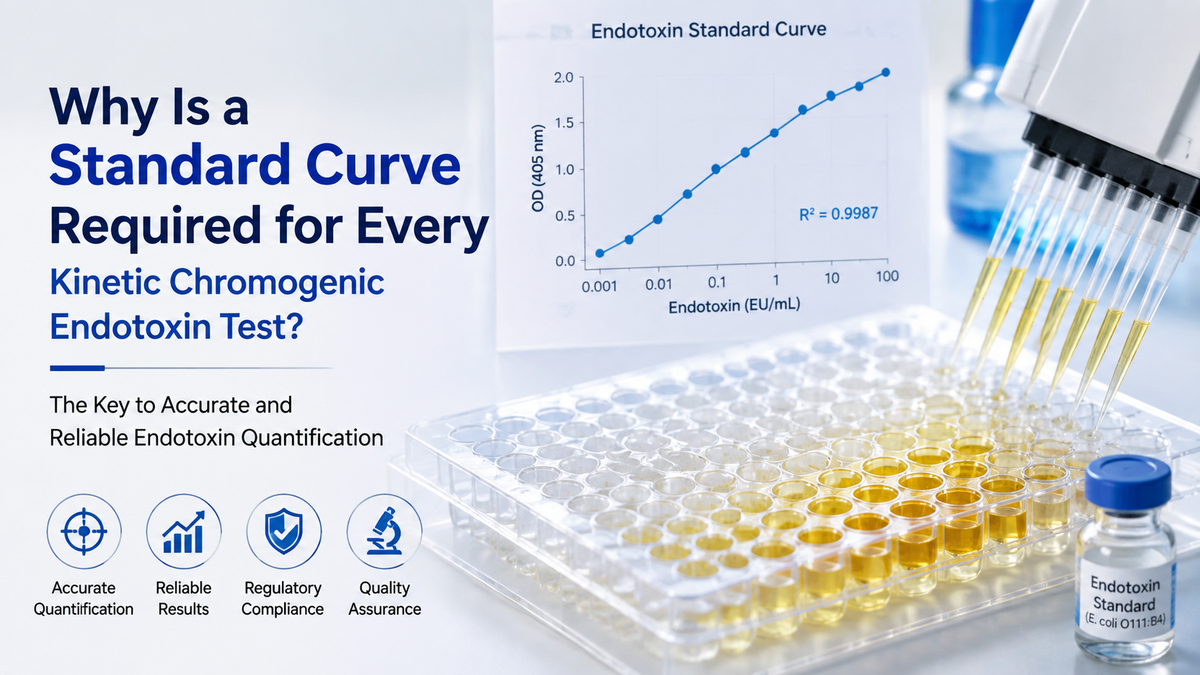
The endotoxin concentration is calculated by comparing the sample signal with an endotoxin standard curve.
A typical calculation follows:
Signal response → Standard curve → Endotoxin concentration (EU/mL)
Without a valid standard curve, the assay cannot accurately convert the measured signal into endotoxin concentration.
2. LAL/TAL Assays Are Biological Enzyme Reactions, Not Fixed Chemical Reactions
One major reason a new standard curve is required for every experiment is that LAL/TAL assays rely on biological enzyme systems.
Unlike some chemical reactions with predictable and constant behavior, enzyme-based reactions can be influenced by multiple factors, including:
· Enzyme activity
· Reagent storage conditions
· Reagent lot variation
· Incubation temperature
· Reaction time
· Instrument performance
· Sample matrix effects
Even when the same endotoxin standard is used, the response curve may slightly change between experiments.
For example:
|
Endotoxin Concentration |
Day 1 OD Response |
Day 2 OD Response |
|
0.01 EU/mL |
0.10 |
0.08 |
|
0.1 EU/mL |
0.55 |
0.46 |
|
1 EU/mL |
1.75 |
1.55 |
These small differences can significantly affect quantitative results, especially when testing samples close to endotoxin limits.
A fresh standard curve compensates for these variations and improves measurement accuracy.
3. The Standard Curve Converts Signal Changes into Accurate Endotoxin Values
The purpose of a standard curve is not only calibration—it is the mathematical foundation of quantitative endotoxin analysis.
During a kinetic chromogenic assay, the instrument detects a color change or reaction time.
However, the instrument does not directly measure:
“0.25 EU/mL endotoxin.”
It only measures:
· Absorbance
· Fluorescence-like signal changes (depending on method)
· Reaction time
The standard curve establishes the relationship between:
Known endotoxin concentrations
and
Measured assay responses
The unknown sample concentration is then calculated based on this relationship.
For example:
1. Prepare endotoxin standards:
o 0.005 EU/mL
o 0.05 EU/mL
o 0.5 EU/mL
o 5 EU/mL
2. Generate a calibration curve.
3. Measure the unknown sample.
4. Use the curve to calculate endotoxin concentration.
Without the standard curve, the measured OD value has no direct quantitative meaning.
4. Standard Curves Confirm Assay Linearity and Detection Range
Every endotoxin assay has a validated detection range.
For many kinetic chromogenic LAL/TAL assays, the working range may include:
0.005–50 EU/mL
However, the actual performance depends on:
· Reagent condition
· Sample interference
· Instrument settings
· Experimental environment
The standard curve verifies that the assay is working properly within the expected range.
A qualified standard curve should demonstrate:
Good Linearity
The response should increase proportionally with endotoxin concentration.
Acceptable Correlation
Many pharmacopoeia-based methods require:
Correlation coefficient (r) ≥ 0.980
or equivalent acceptance criteria.
Reliable Sensitivity
The lowest standard concentration should remain detectable.
If the standard curve fails acceptance criteria, sample results should not be reported.
5. Standard Curves Help Identify Experimental Problems
A standard curve acts as a quality control checkpoint for the entire endotoxin testing workflow.
5.1 Reagent Performance Monitoring
An abnormal curve may indicate:
· Reduced enzyme activity
· Improper storage
· Expired reagents
· Reagent contamination
5.2 Instrument Verification
Unexpected curve behavior may reveal:
· Incorrect incubation temperature
· Microplate reader issues
· Optical detection problems
5.3 Operator and Handling Errors
Poor standard curve performance may result from:
· Inaccurate pipetting
· Insufficient mixing
· Timing differences
· Incorrect dilution preparation
Therefore, the standard curve provides confidence that the entire assay system is functioning correctly.
6. Regulatory Requirements for Endotoxin Testing
For pharmaceutical and biotechnology applications, endotoxin testing must follow strict quality requirements.
Major regulatory guidelines include:
· USP <85> Bacterial Endotoxins Test
· European Pharmacopoeia (EP) 2.6.14 Bacterial Endotoxins
· Japanese Pharmacopoeia (JP) Bacterial Endotoxins Test
These standards require appropriate calibration and system suitability evaluation before endotoxin results can be accepted.
A valid assay generally requires:
· A qualified endotoxin standard curve
· Acceptable linearity
· Appropriate control recovery
· Confirmation of sample interference
Performing a standard curve in every assay run ensures consistency and compliance with regulatory expectations.
7. Why Cannot We Simply Use a Previous Standard Curve?
Some users may wonder:
“Can we reuse yesterday’s standard curve if the same reagent kit is used?”
In most routine endotoxin testing workflows, the answer is no.
A previous curve does not account for changes in:
· Reagent activity
· Environmental conditions
· Instrument performance
· Operator variation
Using an old standard curve may introduce calculation errors and compromise data reliability.
A new standard curve provides a real-time reference for that specific assay condition.
8. Best Practices for Generating a Reliable Endotoxin Standard Curve
To obtain accurate kinetic chromogenic endotoxin results:
1. Prepare fresh endotoxin standards
Use qualified endotoxin reference standards or control standard endotoxin (CSE).
2. Perform serial dilutions accurately
Accurate dilution preparation directly affects curve quality.
3. Maintain consistent temperature
LAL/TAL reactions are highly temperature sensitive.
4. Use endotoxin-free consumables
Water, tubes, and pipette tips should be certified endotoxin-free.
5. Verify curve acceptance criteria
Do not calculate sample results from an invalid standard curve.
9. FireGene Kinetic Chromogenic Endotoxin Test Kit for Quantitative Endotoxin Analysis
The FireGene Kinetic Chromogenic Endotoxin Test Kit is designed for quantitative bacterial endotoxin detection based on kinetic chromogenic LAL/TAL technology.
The assay provides:
· High sensitivity endotoxin detection
· Quantitative EU/mL measurement
· Compatibility with microplate readers
· Reliable standard curve-based analysis
· Applications in pharmaceutical, biotechnology, and research laboratories
By combining optimized reagent performance with a validated standard curve workflow, the kit supports accurate endotoxin monitoring from routine testing to advanced quality control applications.
Conclusion
A standard curve is a fundamental component of every kinetic chromogenic endotoxin assay. Because LAL/TAL testing relies on a sensitive biological enzyme cascade, assay responses can vary between experiments due to reagent activity, environmental conditions, and instrument factors.
Preparing a standard curve for every test run ensures:
· Accurate endotoxin quantification
· Reliable assay performance
· Detection range validation
· Regulatory compliance
For laboratories performing quantitative endotoxin testing, the standard curve is not simply a calibration step—it is the foundation of trustworthy endotoxin analysis.


