
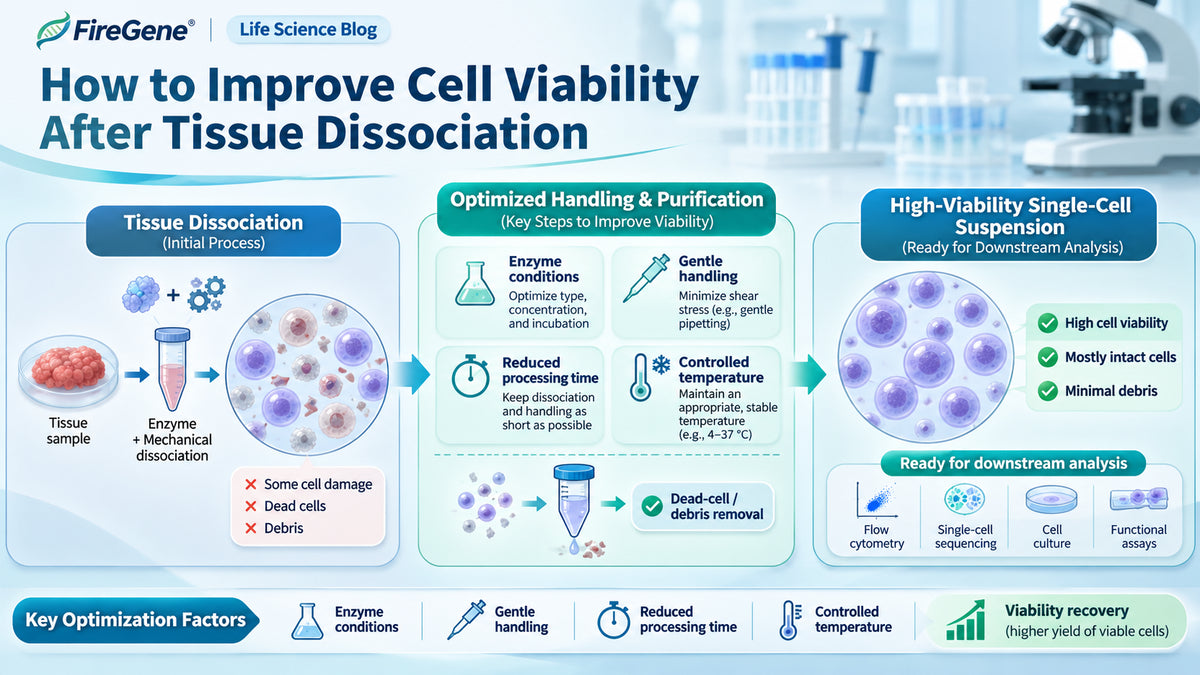
Maintaining high cell viability after tissue dissociation is essential for reliable single-cell analysis, primary cell culture, flow cytometry, and other cell-based research applications. However, converting solid tissues into single-cell suspensions often exposes cells to enzymatic digestion, mechanical stress, temperature fluctuations, and prolonged processing conditions that can compromise membrane integrity and cellular function. These challenges are particularly significant when handling fragile primary cells, fibrotic tissues, and tumor specimens containing substantial necrotic material. Improving cell viability requires careful optimization of tissue handling, dissociation conditions, centrifugation parameters, and post-dissociation purification procedures. Dead cell and debris removal can further enrich viable-cell populations, although purification does not reverse cellular damage. This article examines the major causes of low cell viability following tissue dissociation, discusses practical optimization strategies, and outlines approaches for improving viable-cell recovery and sample quality for downstream research.
1. Introduction
Tissue dissociation is a fundamental procedure in cell biology that enables researchers to isolate individual cells from complex biological tissues.
The resulting single-cell suspensions are widely used in single-cell RNA sequencing (scRNA-seq), flow cytometry, fluorescence-activated cell sorting (FACS), primary cell culture, and functional cellular assays.
Unlike established cell lines, cells isolated directly from tissues may be particularly sensitive to mechanical disruption and environmental changes.
During dissociation, extracellular matrix components must be disrupted while cell–cell interactions are weakened sufficiently to release individual cells.
However, conditions that efficiently separate cells can also compromise cell membrane integrity, alter cellular metabolism, and activate stress-associated signaling pathways.
Consequently, researchers frequently encounter reduced viability, cell aggregation, cellular debris accumulation, and inconsistent cell recovery.
These problems are especially common when processing structurally complex tissues such as liver, lung, brain, tumors, and fibrotic specimens.
Improving cell viability after tissue dissociation therefore requires a balance between effective tissue digestion and preservation of cellular integrity.
Importantly, the objective is not simply to achieve a high percentage of viable cells. Researchers must also recover sufficient cells while preserving the diversity and biological characteristics of the original tissue.
2. Why Cell Viability Decreases During Tissue Dissociation
Several biological and technical factors contribute to cell damage during tissue processing.
2.1 Excessive Enzymatic Digestion
Enzymatic dissociation commonly involves proteolytic enzymes such as collagenase, dispase, trypsin, or other tissue-specific enzyme mixtures.
These enzymes help disrupt extracellular matrix proteins and facilitate cell separation.
However, excessive enzyme concentrations or prolonged incubation can damage cell-surface proteins and compromise membrane integrity.
Different tissues require different digestion conditions because extracellular matrix composition varies substantially.
For example, fibrotic tissues may require more extensive matrix disruption than relatively soft tissues.
Therefore, applying identical digestion conditions across different tissue types may result in inconsistent viability and recovery.
2.2 Mechanical Stress
Mechanical dissociation techniques include tissue mincing, pipetting, trituration, and controlled homogenization.
Although these procedures help release individual cells, excessive mechanical force can cause membrane rupture and cellular fragmentation.
Fragile primary cells may be especially susceptible to repeated pipetting through narrow tips.
Mechanical damage can also release intracellular components, including genomic DNA, into the surrounding suspension.
This extracellular DNA may increase viscosity and promote cell aggregation, further complicating sample preparation.
2.3 Temperature-Associated Cellular Stress
Temperature influences enzymatic activity, cellular metabolism, and the stability of biological structures.
Some tissue dissociation methods require incubation at approximately physiological temperature to support enzyme activity.
However, prolonged warm incubation may induce cellular stress responses or accelerate deterioration in sensitive tissues.
Conversely, inappropriate cooling may reduce enzyme activity and lead to incomplete dissociation.
The optimal temperature therefore depends on the tissue type, enzyme formulation, and downstream experimental requirements.
2.4 Prolonged Sample Processing
Delays between tissue collection, dissociation, and downstream processing can contribute to declining cell viability.
Extended handling may expose cells to unfavorable environmental conditions, nutrient deprivation, and changes in oxygen availability.
Repeated centrifugation, excessive washing, and prolonged storage can introduce additional stress.
Efficient sample preparation is particularly important for applications requiring intact transcriptomic profiles.
2.5 Characteristics of the Starting Tissue
The biological condition of the starting material strongly influences the viability of isolated cells.
Tumor tissues may contain necrotic regions, while inflamed or injured organs may already include substantial numbers of damaged cells.
Similarly, highly fibrotic tissues may require more intensive dissociation, increasing the risk of cell damage.
These factors should be considered when selecting and optimizing a tissue dissociation method.
3. Optimize Enzymatic Dissociation Conditions
Enzyme selection and digestion optimization are among the most important strategies for improving cell viability.
3.1 Select Tissue-Appropriate Enzymes
Different tissues contain distinct extracellular matrix components, including collagen, laminin, fibronectin, elastin, and proteoglycans.
The selection of digestion enzymes should reflect these structural differences.
Collagenase-based formulations are frequently used for tissues containing substantial collagen-rich extracellular matrix.
Other enzymes may be incorporated to improve cell release or reduce the intensity of mechanical disruption.
The objective is to achieve sufficient tissue dissociation while minimizing unnecessary exposure to proteolytic activity.

3.2 Optimize Digestion Duration
Insufficient digestion may result in low cell yield because many cells remain trapped within tissue fragments.
Excessive digestion may increase cell damage and reduce viability.
A practical optimization strategy involves monitoring tissue dissociation at defined intervals and stopping digestion when adequate cell release has been achieved.
If necessary, partially dissociated tissues can be processed in stages rather than exposing all released cells to prolonged enzyme treatment.
This approach may help protect cells that become available during the early stages of digestion.
3.3 Adjust Enzyme Concentration
Higher enzyme concentrations do not necessarily produce better viable-cell recovery.
Although stronger digestion may increase the total number of released cells, it can also increase cellular damage.
Optimization should therefore consider both total cell yield and viability.
A comparison of different enzyme concentrations can help identify conditions that provide sufficient tissue dissociation without excessive cell loss.
4. Reduce Mechanical Damage During Cell Isolation
Mechanical handling should complement enzymatic digestion rather than compensate for poorly optimized digestion conditions through excessive force.
4.1 Use Gentle Pipetting Techniques
Repeated forceful pipetting can damage fragile cells and increase cellular debris.
Researchers should minimize unnecessary aspiration and dispensing cycles.
Where appropriate, wide-bore pipette tips may reduce mechanical stress when handling larger or sensitive cells.
4.2 Optimize Tissue Fragment Size
Large tissue fragments may require prolonged enzyme exposure because digestion reagents cannot penetrate efficiently.
Cutting tissue into smaller, relatively uniform fragments increases the available surface area for enzymatic action.
However, excessively aggressive mincing can produce mechanical damage before enzymatic dissociation begins.
Fragment size should therefore be optimized for the particular tissue rather than universally minimized.
4.3 Avoid Excessive Homogenization
Homogenization may facilitate tissue disruption, but excessive mechanical force can rupture cells.
When intact viable cells are required, controlled trituration or gentle dissociation is generally preferable to destructive homogenization.
The appropriate technique depends on tissue architecture and the sensitivity of the target cells.
5. Maintain Appropriate Temperature and Processing Conditions
5.1 Minimize Delays Before Dissociation
Fresh tissue should be processed within a suitable timeframe after collection.
Unnecessary delays can reduce cell quality and increase the proportion of damaged material.
If immediate dissociation is not possible, storage conditions should follow a validated tissue-specific preservation procedure.
5.2 Control Digestion Temperature
Digestion temperature should be selected according to the enzyme system.
Warm enzymatic dissociation can effectively release cells but may also induce transcriptional stress responses.
Research by van den Brink et al. demonstrated that tissue dissociation can introduce gene-expression changes in certain cellular populations.
O'Flanagan et al. subsequently reported that cold-active protease dissociation reduced some collagenase-associated stress responses in tumor single-cell preparations.
These findings highlight the importance of optimizing dissociation conditions when cells are intended for transcriptomic analysis.
However, cold dissociation is not universally superior, and appropriate conditions must be established for each tissue and enzyme formulation.
5.3 Reduce Post-Dissociation Stress
After digestion, cells should be transferred into a compatible buffer or medium and processed without unnecessary delays.
Depending on the cell type, suitable buffer composition may include protein supplements or other components that support cell stability.
Repeated washing and prolonged exposure to unfavorable conditions should be minimized.
6. Remove Dead Cells and Cellular Debris After Dissociation
Even when dissociation conditions are optimized, some degree of cellular damage is often unavoidable.
As a result, tissue-derived single-cell suspensions may contain viable cells mixed with dead cells, apoptotic fragments, membrane debris, and extracellular material.
Removing these contaminants can improve the overall quality of the recovered suspension.
6.1 Why Dead Cell Removal Matters
Dead cells may interfere with downstream experiments in several ways.
In scRNA-seq, damaged cells can release intracellular RNA, contributing to ambient RNA contamination.
In flow cytometry, cellular debris can create unwanted scattering events and complicate population identification.
In primary cell culture, residual dead cells and debris may interfere with cell counting, seeding, and interpretation of subsequent experimental results.
Therefore, purification may be particularly valuable when tissue dissociation produces substantial amounts of unwanted material.
6.2 Common Dead Cell Removal Methods
Several approaches are available for enriching viable cells after tissue dissociation.
Filtration
Cell filtration removes larger tissue fragments and cellular aggregates.
However, it generally cannot distinguish viable from nonviable cells of similar dimensions.
Differential centrifugation
Differential centrifugation can separate intact cells from some smaller cellular fragments based on sedimentation behavior.
Its ability to selectively remove intact dead cells is limited.
Density gradient centrifugation
Density gradient separation uses differences in physical properties to enrich selected cellular fractions.
Under suitable conditions, viable cells can be recovered while reducing dead cells and other impurities.
Magnetic dead cell removal
Magnetic depletion systems can selectively remove cells based on characteristics recognized by the chosen separation reagent.
The most appropriate method depends on the sample type, initial viability, available cell numbers, and downstream requirements.
6.3 Understanding Viability Enrichment
It is important to distinguish between improving the survival of cells during dissociation and enriching the percentage of viable cells after dissociation.
Dead cell removal does not restore the viability of damaged cells.
Instead, it reduces the nonviable fraction, increasing the relative proportion of surviving cells.
For example, a suspension containing 700,000 viable cells and 300,000 dead cells has an initial viability of 70%.
After purification, the recovered sample may contain 560,000 viable cells and 40,000 dead cells.
In this hypothetical example, final viability increases to approximately 93.3%, while viable-cell recovery is 80%.
This demonstrates why final viability and absolute cell recovery should be evaluated together.
7. Prevent Cell Aggregation and Additional Cell Loss
7.1 Reduce Extracellular DNA-Mediated Clumping
Damaged cells may release genomic DNA into the suspension.
Extracellular DNA can promote aggregation and interfere with filtration, cell counting, and downstream processing.
Where compatible with the experimental system, DNase treatment may reduce DNA-mediated clumping.
However, enzyme concentration and incubation conditions should be selected carefully to avoid unnecessary processing-related effects.
7.2 Optimize Centrifugation Conditions
Centrifugation is commonly used to collect, wash, and concentrate isolated cells.
Excessive centrifugal force may damage sensitive populations, while inadequate centrifugation may result in poor recovery.
Centrifugation conditions should therefore be adapted to the size, density, and fragility of the target cells.
Unnecessary washing steps should also be minimized.
7.3 Maintain Appropriate Cell Concentration
Highly concentrated cell suspensions may promote aggregation and complicate accurate cell counting.
Conversely, very dilute suspensions can increase handling-related losses.
Maintaining an appropriate concentration supports consistent cell recovery and efficient downstream preparation.
8. Evaluate Cell Viability and Recovery After Tissue Dissociation
Quantitative quality control is essential for determining whether an optimized dissociation procedure provides meaningful improvements.
8.1 Cell Viability
Cell viability can be calculated using the following equation:
Cell Viability (%) = (Number of Viable Cells / Total Number of Cells) × 100
Common measurement methods include trypan blue exclusion, fluorescence-based cell counting, and flow cytometric viability assays.
8.2 Viable-Cell Recovery
Viable-cell recovery indicates the proportion of initially viable cells retained after cleanup.
Viable-Cell Recovery (%) = (Viable Cells After Purification / Viable Cells Before Purification) × 100
A higher viability percentage does not necessarily indicate greater recovery.
Therefore, researchers should document both parameters when comparing dissociation and purification conditions.
8.3 Additional Quality Indicators
Other useful indicators include:
Total viable-cell yield per unit of tissue
Residual cellular debris
Frequency of cell aggregates
Cell morphology and membrane integrity
Recovery of target cellular populations
Compatibility with downstream assays
For primary cell culture, attachment and proliferation may provide additional information about post-isolation cell function.
For scRNA-seq, transcriptomic quality-control metrics and evidence of dissociation-induced stress should also be considered.
9. Troubleshooting Low Cell Viability After Tissue Dissociation
|
Problem |
Possible Causes |
Recommended Optimization |
|
Low cell viability |
Excessive enzyme exposure or mechanical stress |
Reduce digestion intensity and optimize handling |
|
Low total cell yield |
Incomplete tissue dissociation |
Review enzyme selection and digestion duration |
|
Excessive cellular debris |
Overdigestion or aggressive mechanical disruption |
Use gentler dissociation and appropriate cleanup |
|
Cell aggregation |
Extracellular DNA or excessive concentration |
Consider compatible DNase treatment and gentle mixing |
|
Poor recovery after centrifugation |
Unsuitable centrifugal force or excessive washing |
Optimize collection and washing conditions |
|
High dead cell fraction |
Starting tissue damage or inefficient preparation |
Assess tissue quality and consider viable-cell enrichment |
|
Altered gene-expression profiles |
Dissociation-induced cellular stress |
Evaluate temperature, processing time, and alternative dissociation methods |
A pilot optimization experiment is often valuable when working with unfamiliar tissues.
Rather than modifying all conditions simultaneously, researchers can systematically adjust enzyme concentration, digestion duration, temperature, and mechanical handling while monitoring cell viability and recovery.
10. FireGene Solutions for Tissue Dissociation and Cell Purification
The FireGene product portfolio includes tissue dissociation reagents and cell purification solutions intended to support the preparation of high-quality single-cell suspensions.
Tissue-specific dissociation kits can help researchers establish workflows suited to the structural characteristics of different tissues.
Following dissociation, the FireGene Dead Cell Debris & Impurities Removal Kit (Cat. No. FG-BA3339) provides a density-based approach for enriching viable cells and reducing unwanted cellular material.
The kit is designed for the purification of single-cell suspensions containing dead cells, cellular debris, and other impurities.
Potential downstream applications include scRNA-seq, flow cytometry, cell sorting, and primary cell culture.
An integrated workflow may involve:
Tissue Collection → Optimized Tissue Dissociation → Cell Filtration → Viability Assessment → Dead Cell and Debris Removal (if needed) → Final Quality Control → Downstream Analysis
Researchers should follow the relevant product instructions and evaluate each workflow for the tissue type and target cell population.
Actual viable-cell recovery, debris removal efficiency, and downstream compatibility should be assessed experimentally rather than assumed.
Related Product: FireGene Dead Cell Debris & Impurities Removal Kit
Catalog Number: FG-BA3339
Product Page: https://firegene.com/products/dead-cell-debris-removal-kit-fg-ba3339
For Research Use Only.
11. Frequently Asked Questions
What is the most common cause of low cell viability after tissue dissociation?
Excessive enzymatic digestion, aggressive mechanical handling, and prolonged processing are frequent causes. However, the biological condition of the starting tissue may also significantly influence cell viability.
How can cell viability be improved during enzymatic dissociation?
Optimizing enzyme concentration, digestion time, temperature, and mechanical handling can help reduce cellular damage. Conditions should be adjusted according to the tissue type and target cells.
Can dead cell removal increase cell viability?
Dead cell removal can increase the measured percentage of viable cells by enriching the surviving population. However, it cannot restore cells that have already died.
Does DNase improve cell viability?
DNase primarily helps reduce extracellular DNA-mediated aggregation. It does not directly restore cell viability, although improved suspension uniformity may reduce additional handling problems.
Is high viability always necessary for scRNA-seq?
High viability is desirable for many conventional scRNA-seq workflows, but acceptable thresholds depend on the platform and sample type. For difficult or poorly preserved tissues, single-nucleus RNA sequencing may be considered as an alternative.
12. Conclusion
Improving cell viability after tissue dissociation requires careful optimization of the entire sample preparation workflow.
Enzyme selection, digestion duration, mechanical handling, temperature control, and processing time all influence the quality of isolated cells.
Reducing cellular damage during dissociation remains the most effective strategy for preserving viable-cell numbers.
When substantial dead cells and debris remain, appropriate purification methods can enrich viable-cell populations and improve suspension cleanliness.
However, additional purification introduces the possibility of cell loss and changes in cellular composition.
Researchers should therefore evaluate cell viability together with absolute viable-cell recovery, residual debris, and downstream experimental performance.
By combining optimized tissue dissociation procedures with appropriate cell purification and quality control, laboratories can prepare more consistent single-cell suspensions for advanced biological research.


