
Introduction
Endotoxin control is an important component of pharmaceutical research, process development, and quality control. Endotoxins are lipopolysaccharide-associated components originating primarily from the outer membrane of Gram-negative bacteria. Because they can enter manufacturing processes through water systems, raw materials, fermentation-derived components, equipment, or handling procedures, sensitive analytical methods are required to evaluate endotoxin contamination in pharmaceutical samples.
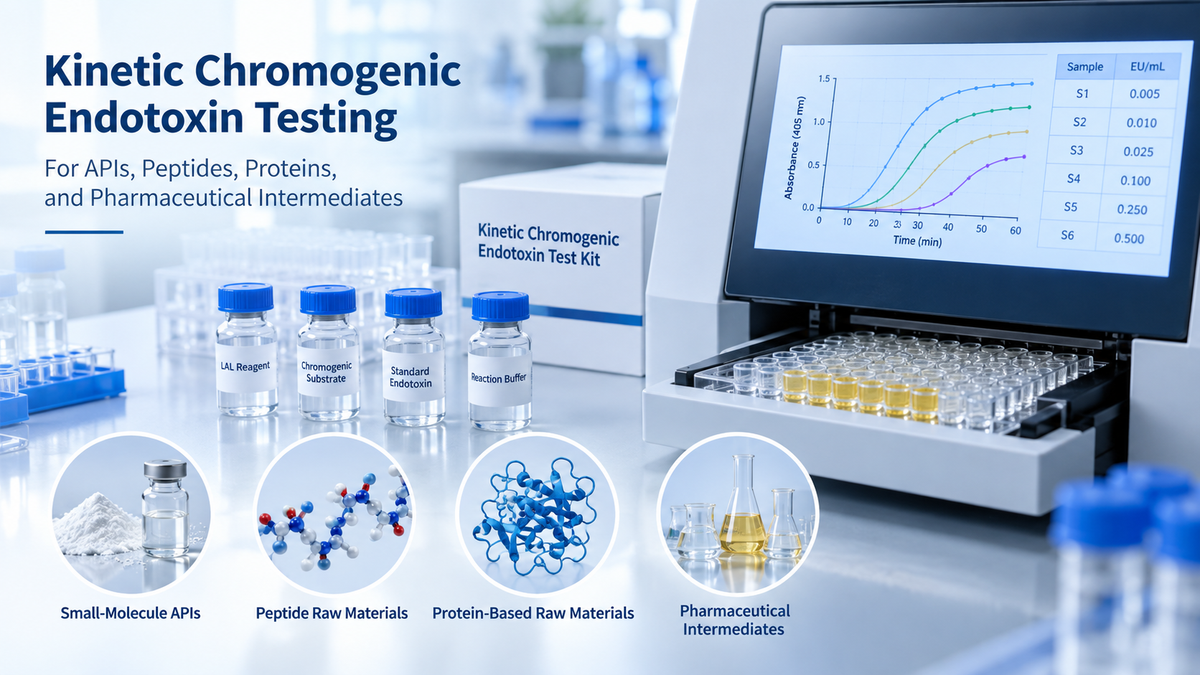
The kinetic chromogenic endotoxin test is widely used for quantitative endotoxin determination. Unlike endpoint assays that measure a single signal after a defined incubation period, the kinetic chromogenic method continuously monitors changes in absorbance during the reaction. The time required for the chromogenic signal to reach a defined threshold is related to the endotoxin concentration in the sample.
A Kinetic Chromogenic Endotoxin Test Kit can therefore be applied to a broad range of pharmaceutical matrices, including small-molecule active pharmaceutical ingredients, peptide raw materials, recombinant proteins, enzymes, and pharmaceutical synthesis intermediates.
However, each sample type presents different analytical challenges. Proper sample preparation, dilution, matrix interference evaluation, and assay validation are essential for obtaining reliable results.
1. Small-Molecule Active Pharmaceutical Ingredients
Small-molecule active pharmaceutical ingredients, or APIs, represent an important category of samples for endotoxin testing. Depending on the manufacturing process and intended application, testing may be performed on bulk API powders, API stock solutions, aqueous preparations, or intermediate process solutions.
Potential sample types include:
small-molecule APIs;
API solutions;
aqueous API preparations;
purified drug-substance solutions;
and bulk pharmaceutical materials.
Although small molecules are often chemically simpler than proteins or peptides, they can still interfere with endotoxin assays.
One important consideration is sample solubility. Some APIs dissolve readily in water, while others require specific solvents, pH adjustment, or formulation components. These conditions may influence the enzymatic reaction used in the kinetic chromogenic assay.
Sample pH is another critical variable. The reaction system used for endotoxin detection functions optimally within a defined pH range. Highly acidic or alkaline samples may therefore require dilution or controlled adjustment before analysis.
Other possible sources of interference include:
high ionic strength;
surfactants;
preservatives;
chelating compounds;
strong reducing or oxidizing substances;
sample color;
and high concentrations of organic solvents.
For these reasons, inhibition and enhancement testing is commonly performed during method development. Such testing helps determine whether the sample matrix suppresses or artificially increases the endotoxin-related chromogenic signal.
When interference is observed, controlled dilution is often the first strategy evaluated. Dilution can reduce matrix effects while maintaining the endotoxin concentration within the validated detection range of the assay.
2. Peptide Raw Materials and Peptide Intermediates
Peptide-based materials are increasingly encountered in pharmaceutical, biochemical, and life-science research. These materials may include:
synthetic peptides;
purified peptides;
peptide intermediates;
modified peptides;
peptide conjugates;
and peptide stock solutions.
The endotoxin-testing characteristics of peptide samples can vary considerably depending on peptide sequence, molecular weight, net charge, hydrophobicity, concentration, and formulation conditions.
Synthetic peptides may be produced through solid-phase or solution-phase synthesis, followed by cleavage, purification, desalting, and lyophilization. Although chemical synthesis itself does not inherently generate bacterial endotoxin, endotoxin may still be introduced through process water, equipment, handling, buffers, purification steps, or other raw materials.
Purified peptides can also contain residual components from synthesis and purification. Examples may include salts, acids, organic solvents, counterions, or buffer components. These substances may affect the kinetic chromogenic reaction if present at sufficiently high concentrations.
Another analytical consideration is peptide–endotoxin interaction. Certain peptide sequences, especially highly cationic or amphipathic peptides, may interact with negatively charged lipopolysaccharide molecules. Such interactions may influence the amount of endotoxin available to participate in the assay reaction.
Consequently, peptide samples should generally be evaluated on a product-specific basis.
A suitable method-development workflow may include:
Peptide Sample → Initial Dilution → Interference Evaluation → Spike Recovery Assessment → Optimized Dilution → Quantitative Endotoxin Measurement
This approach allows the analyst to determine whether the peptide matrix is compatible with the assay and whether additional dilution or sample-preparation steps are required.
3. Protein-Based Raw Materials and Recombinant Proteins
Protein-based pharmaceutical raw materials represent another important application area for kinetic chromogenic endotoxin testing.
Typical samples may include:
recombinant proteins;
enzymes;
growth factors;
cytokines;
fusion proteins;
protein intermediates;
purified protein solutions;
and concentrated protein preparations.
The endotoxin risk profile of recombinant proteins depends strongly on the production system.
Proteins produced in Gram-negative bacterial expression systems, particularly Escherichia coli, require careful endotoxin monitoring because lipopolysaccharide is naturally present in the bacterial outer membrane. During cell disruption and downstream processing, endotoxin can enter the process stream and may remain associated with the target protein unless effectively removed.
Downstream purification may therefore include multiple endotoxin-reduction stages, such as chromatography, membrane-based purification, phase separation, or specialized endotoxin-removal procedures.
Kinetic endotoxin testing can be performed at several stages of the purification process:
Cell Lysate → Capture Purification → Intermediate Purification → Polishing → Bulk Protein → Final Protein Preparation
Testing at multiple stages allows process-development teams to evaluate how efficiently endotoxin is reduced during purification.
Protein samples can nevertheless be analytically challenging. High protein concentrations may influence reaction kinetics, while excipients such as detergents, stabilizers, sugars, amino acids, or salts may affect assay performance.
Certain proteins may also bind endotoxin directly. This interaction may reduce the detectable fraction of endotoxin under specific assay conditions.
Dilution studies and spike-recovery experiments are therefore important when establishing a kinetic chromogenic endotoxin method for recombinant proteins.
4. Pharmaceutical Synthesis Intermediates
Pharmaceutical synthesis intermediates can also be evaluated using kinetic chromogenic endotoxin testing, especially when the manufacturing process includes aqueous processing, biological components, or steps where microbial contamination may occur.
Relevant samples may include:
soluble pharmaceutical intermediates;
purified intermediate solutions;
synthesis-stage solutions;
process concentrates;
buffer-exchanged intermediates;
and pre-formulation materials.
Testing intermediates can provide information that may not be available when only the final bulk product is analyzed.
For example, if endotoxin levels increase at a particular processing stage, the result may suggest contamination associated with raw materials, process water, equipment, filtration, holding conditions, or downstream handling.
Conversely, repeated testing during purification can demonstrate progressive endotoxin reduction.
A typical process-monitoring strategy may therefore include:
Raw Material → Reaction or Production Step → Crude Intermediate → Purification → Refined Intermediate → Bulk API
This type of stage-specific testing can support process characterization and help identify critical control points.
Matrix effects remain important. Some synthesis intermediates contain high concentrations of salts, residual solvents, reagents, catalysts, or pH-adjusting agents. These components may inhibit or enhance the chromogenic reaction.
For this reason, the analytical method should be evaluated for each representative matrix rather than assuming that all pharmaceutical intermediates behave similarly.
5. Managing Matrix Interference in Kinetic Chromogenic Testing
One of the most important aspects of endotoxin testing is distinguishing true endotoxin concentration from matrix-induced assay effects.
Two major categories of interference are commonly considered.
Inhibition
Inhibition occurs when components of the sample reduce the expected chromogenic response. This may result in underestimation of endotoxin concentration.
Potential causes include:
extreme pH;
high salt concentrations;
chelating agents;
detergents;
certain proteins or peptides;
and enzyme-inhibiting compounds.
Enhancement
Enhancement occurs when the sample produces a stronger-than-expected assay response. This may result in apparent endotoxin concentrations that are higher than the true value.
Sample dilution is often used to reduce both forms of interference.
An appropriate dilution factor should maintain the sample within the assay's validated working range while remaining below the allowable maximum valid dilution, where applicable.
Spike recovery is also an important part of method suitability assessment. A known amount of endotoxin is added to the sample, and the recovered response is compared with the expected value. Acceptable recovery indicates that the matrix is not producing unacceptable inhibition or enhancement under the selected test conditions.
Conclusion
The kinetic chromogenic endotoxin test is a versatile analytical approach for evaluating endotoxin levels in diverse pharmaceutical raw materials and process samples.
Applications include small-molecule APIs, API solutions, synthetic peptides, peptide intermediates, recombinant proteins, enzymes, purified protein preparations, and pharmaceutical synthesis intermediates.
However, successful endotoxin measurement depends on more than simply adding the sample to a test kit. Different pharmaceutical matrices may influence assay performance through pH, ionic strength, protein concentration, peptide charge, sample color, solvents, surfactants, stabilizers, or direct interactions with endotoxin.
For this reason, careful sample preparation, dilution studies, inhibition/enhancement evaluation, and spike-recovery testing are central components of method development.
A well-designed kinetic chromogenic assay can support endotoxin monitoring across multiple stages of pharmaceutical research and manufacturing, from early raw materials through purification and bulk product preparation. By combining quantitative kinetic detection with appropriate matrix-specific validation, laboratories can obtain more reliable information about endotoxin levels and process cleanliness across complex pharmaceutical workflows.


