
Introduction: A Validated Assay Is Not Automatically a Robust Assay
Kinetic chromogenic endotoxin testing has become an important quantitative approach for bacterial endotoxin detection.
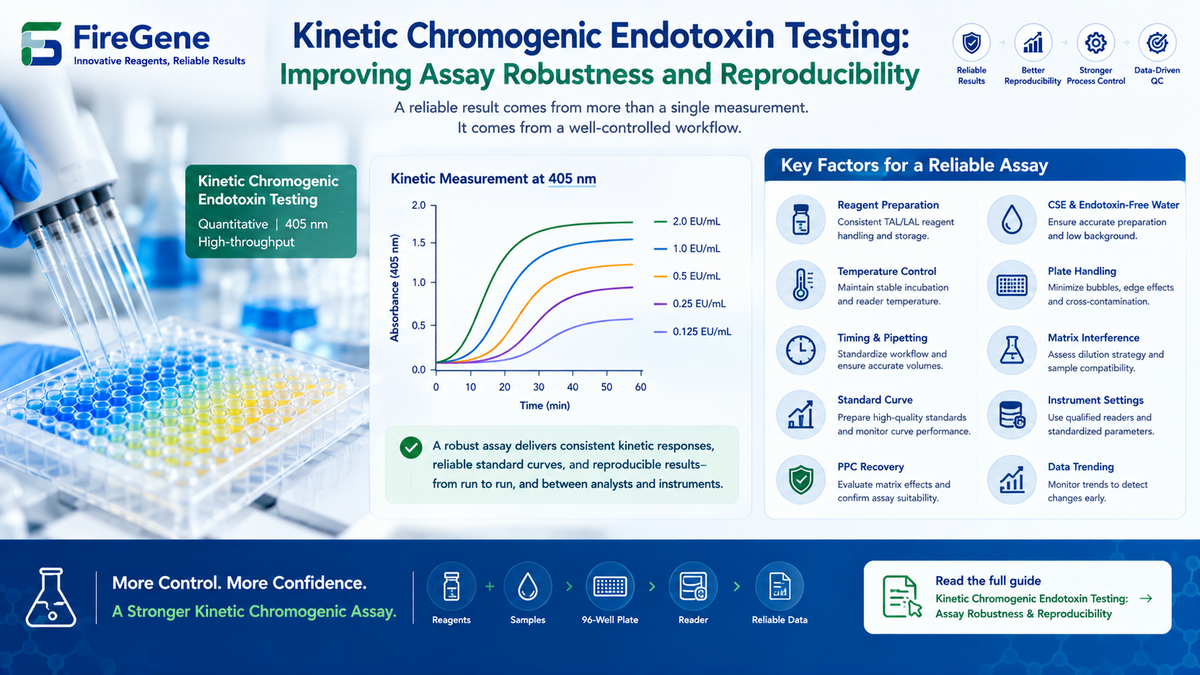
Compared with traditional endpoint-based methods, the kinetic chromogenic approach provides quantitative endotoxin measurements by monitoring the development of a chromogenic reaction over time. The reaction is typically measured spectrophotometrically, commonly at 405 nm, and the resulting kinetic response is compared with an endotoxin standard curve.
This makes the method highly attractive for laboratories that need:
- Quantitative EU/mL results
- Objective optical measurements
- Standardized data analysis
- Higher sample throughput
- Automated calculations
- Historical data trending
- Better integration with modern laboratory workflows
FireGene's current Kinetic Chromogenic Endotoxin Test Kit uses a 96-well TAL/LAL-based format with kinetic absorbance detection at 405 nm. The product is intended for Research Use Only, and FireGene specifically states that it is not licensed by FDA for end-product release of FDA-regulated pharmaceutical drugs, devices, or biologics.
However, there is an important distinction between having a quantitative assay and having a robust quantitative assay.
A laboratory can have:
- A qualified microplate reader
- A good kinetic chromogenic TAL/LAL Reagent
- Proper endotoxin standards
- An established SOP
- Experienced analysts
…and still experience unexpected variability.
Why?
Because kinetic chromogenic endotoxin testing is not controlled by a single parameter.
It is a complete analytical system.
Temperature, reaction timing, reagent preparation, pipetting, standard preparation, sample matrix, plate handling, instrument settings, and data processing can all influence the final result.
Therefore, once the basic kinetic chromogenic workflow is established, the next challenge is assay robustness.
1. What Does “Robustness” Mean in Kinetic Chromogenic Endotoxin Testing?
In analytical testing, robustness refers to the ability of a method to continue producing reliable results when small, realistic variations occur in operating conditions.
For kinetic chromogenic endotoxin testing, this means asking questions such as:
- What happens if the reaction temperature varies slightly?
- What happens if there is a small difference in pipetting time?
- How sensitive is the assay to reagent preparation?
- Can different analysts obtain comparable results?
- Does the assay behave consistently across different plate positions?
- How much does the result change when a different qualified reader is used?
- Does the sample matrix remain suitable across the intended dilution range?
- Does the standard curve remain reliable from run to run?
A robust assay should not depend on a single analyst performing every step under perfectly identical conditions.
Instead, the method should have enough control and demonstrated tolerance to normal laboratory variation.
This is particularly important when kinetic chromogenic endotoxin testing moves from early R&D into routine laboratory workflows.
2. Why Kinetic Chromogenic Assays Are Sensitive to Small Changes
The kinetic chromogenic method is based on an enzyme cascade.
In a TAL/LAL-based system, endotoxin activates Factor C, which activates downstream components of the enzymatic cascade. Ultimately, the activated system cleaves a chromogenic substrate and releases p-nitroaniline (pNA).
The resulting color development is monitored kinetically.
In simplified form:
Endotoxin → Factor C → Factor B → downstream enzyme cascade → chromogenic substrate → pNA → optical signal
The instrument then uses the kinetic response to estimate endotoxin concentration.
The important point is that this is a time-dependent enzymatic reaction.
That means assay performance can be influenced by variables that would be less obvious in a simple endpoint test.
For example:
- Temperature affects enzyme activity.
- Reaction timing affects kinetic measurements.
- Reagent preparation affects enzymatic performance.
- Pipetting consistency affects reaction initiation.
- Bubbles affect optical measurements.
- Matrix components may inhibit or enhance the reaction.
- Instrument configuration affects signal acquisition.
This is why understanding the kinetic nature of the assay is essential for controlling variability.
For a detailed introduction to the reaction mechanism, FireGene's Ultimate Guide to Kinetic Chromogenic Endotoxin Assays provides a broader technical overview.
3. The Five Most Important Variables in a Robust Kinetic Chromogenic Assay
Although laboratories may monitor dozens of parameters, five categories deserve particular attention:
1. Reagent performance
2. Temperature control
3. Timing and pipetting
4. Standard curve performance
5. Sample matrix suitability
These variables are interconnected.
A standard curve can be excellent while a sample fails because of matrix interference.
A suitable sample can produce poor results if the reagent was improperly prepared.
A good reagent and good sample can still produce variability if the plate is handled inconsistently.
Therefore, robustness should be evaluated as a system, not as isolated components.
4. Reagent Preparation: The First Layer of Assay Reproducibility
TAL/LAL Reagent is the biochemical engine of the kinetic chromogenic endotoxin assay.
Small inconsistencies during reagent preparation can therefore have an outsized effect on the reaction.
Common sources of variability include:
- Incorrect reconstitution volume
- Incomplete mixing
- Excessive vortexing when inappropriate
- Extended exposure outside recommended storage conditions
- Repeated temperature cycling
- Incorrect storage temperature
- Using reagents beyond their specified stability
- Contamination during preparation
The goal is not simply to prepare the reagent.
The goal is to prepare it consistently.
A laboratory should establish a standardized reagent preparation sequence covering:
- Storage verification
- Reagent equilibration where required
- Reconstitution
- Mixing
- Holding time
- Plate loading
- Instrument initiation
This is particularly important when multiple analysts perform the assay.
FireGene also provides a dedicated guide on How to Properly Store TAL/LAL Reagent, which can be used as a supporting reference when establishing reagent-handling procedures.
5. Temperature: One of the Most Important Variables in Kinetic Testing
Temperature control is especially important in a kinetic chromogenic endotoxin assay because the method monitors an enzymatic reaction over time.
If reaction temperature changes, the reaction rate may change as well.
This creates an important distinction:
Endpoint testing asks whether the final reaction reaches a certain state.
Kinetic testing asks how quickly the reaction develops.
Therefore, temperature stability can directly affect kinetic behavior.
A laboratory should pay attention to:
- Incubator temperature
- Microplate reader temperature control
- Plate equilibration
- Ambient laboratory temperature
- Time between reagent preparation and measurement
- Differences between instruments
FireGene's kinetic chromogenic platform is designed for microplate-reader workflows and specifies a 405 nm detection system; laboratories should verify that their instrument configuration and temperature-control capabilities are appropriate for the intended assay.
Why does this matter?
Imagine two laboratories testing the same sample.
Laboratory A maintains highly consistent assay conditions.
Laboratory B allows larger variations in reaction temperature and timing.
Even if both laboratories use the same endotoxin standard, their kinetic responses may not be identical.
That is why temperature control should be treated as an analytical parameter, not simply an equipment setting.
6. Timing Matters More in Kinetic Chromogenic Endotoxin Testing
One of the most underestimated sources of variability is timing.
In a kinetic assay, the reaction begins when the appropriate components are combined.
Therefore, the interval between:
pipetting → mixing → plate placement → measurement
can affect the recorded kinetic response.
This becomes increasingly important when testing many wells.
For example, if the first sample begins reacting several minutes before the final sample reaches the reader, the wells do not have exactly the same reaction history.
This is one reason plate layout and workflow sequencing matter.
A robust laboratory workflow should standardize:
- Plate preparation order
- Reagent addition order
- Sample addition sequence
- Mixing procedure
- Reader loading
- Measurement initiation
For larger workloads, laboratories may also consider automation or multichannel pipetting to reduce analyst-to-analyst variability.
FireGene's Step-by-Step Guide to the Kinetic Chromogenic Endotoxin Assay provides a practical overview of the overall workflow.
7. Pipetting Accuracy Is an Analytical Variable
Kinetic chromogenic endotoxin testing involves multiple dilution and reagent-transfer steps.
That means pipetting accuracy can influence both:
- The actual endotoxin concentration in the well
- The reaction conditions
This is particularly important for the preparation of the standard curve.
A small error in a high-concentration standard can propagate through serial dilution and affect multiple points.
Similarly, inconsistent sample volumes can increase variation between replicates.
Good practice includes:
- Using calibrated pipettes
- Using appropriate pipette ranges
- Using low-retention tips where appropriate
- Maintaining consistent aspiration and dispensing technique
- Avoiding excessive residual liquid
- Minimizing unnecessary transfers
- Using qualified endotoxin-controlled consumables
For laboratories running many samples, standardizing pipetting technique can sometimes produce a larger improvement in reproducibility than simply changing reagents.
8. The Standard Curve Is the Quantitative Backbone
Kinetic chromogenic endotoxin testing is fundamentally quantitative.
The instrument measures a kinetic signal, but the laboratory still needs a valid relationship between the measured response and endotoxin concentration.
That relationship comes from the endotoxin standard curve.
The standard curve therefore serves two purposes:
First: Quantification
It allows the system to translate the kinetic response of an unknown sample into an endotoxin concentration.
Second: Assay Performance Monitoring
The curve also provides information about whether the analytical run behaved as expected.
This makes standard curve performance an important indicator of assay robustness.
A laboratory should monitor:
- Curve shape
- Point-to-point consistency
- Replicate agreement
- Regression performance
- Validity of the concentration range
- Outliers
- Run-to-run behavior
However, a mathematically attractive curve does not automatically prove that the entire assay is suitable.
The sample matrix still needs to demonstrate acceptable performance.
For a deeper discussion, see FireGene's Understanding Standard Curves in Kinetic Chromogenic Endotoxin Testing.
9. Positive Product Control: The Second Half of the Story
A valid standard curve tells you that the analytical system performed appropriately.
A Positive Product Control (PPC) helps answer a different question:
Does the sample matrix interfere with endotoxin detection under the selected test conditions?
This distinction is critical.
A pharmaceutical formulation may contain:
- Proteins
- Lipids
- Surfactants
- Salts
- Buffers
- Preservatives
- Nanoparticles
- Other formulation components
Some matrices can inhibit the enzymatic reaction.
Others may enhance the response.
Therefore, a laboratory should not assume that a good standard curve automatically means the sample result is reliable.
The assay needs to demonstrate suitability for the actual matrix.
This is particularly important for modern products such as biologics and lipid-containing formulations.
FireGene's mRNA-LNP Endotoxin Testing Guide discusses why complex matrices can create additional endotoxin-testing challenges.
10. Dilution Is Not Just a Way to Lower Endotoxin Concentration
One common misconception is that dilution is primarily used to bring a sample into the analytical range.
In reality, dilution can also be a matrix-control strategy.
Suppose a formulation contains an interfering component.
Testing the undiluted sample may produce poor PPC recovery.
Diluting the sample can reduce the concentration of the interfering component and improve assay performance.
But excessive dilution introduces another problem:
The endotoxin concentration may become too low to quantify reliably.
Therefore, kinetic chromogenic testing often requires balancing:
matrix interference ↔ dilution ↔ analytical sensitivity
This is why the appropriate dilution is not necessarily the highest possible dilution.
The goal is to identify a dilution that provides:
- Acceptable matrix behavior
- Reliable PPC performance
- A measurable endotoxin concentration
- Appropriate quantitative range
FireGene's guide to sensitivity and dilution in kinetic chromogenic endotoxin testing explores this balance in greater detail.
11. Plate Position Can Affect Kinetic Chromogenic Results
A 96-well format provides significant throughput advantages.
But the plate itself introduces another potential source of variability.
Depending on the laboratory setup, differences may arise from:
- Edge effects
- Evaporation
- Temperature gradients
- Uneven reagent dispensing
- Mixing differences
- Bubbles
- Plate positioning
- Reader optics
This does not mean that every plate will experience significant edge effects.
Rather, it means laboratories should understand their own system and evaluate whether plate position influences assay performance.
A practical approach is to monitor whether standards, controls, or replicate samples located in different plate regions behave differently over time.
This is particularly useful during method development and robustness studies.
12. Bubbles Are a Small Problem With a Large Potential Impact
Because kinetic chromogenic endotoxin testing relies on optical measurement, bubbles can interfere with absorbance readings.
A bubble may:
- Scatter light
- Distort the optical path
- Produce an abnormal absorbance signal
- Increase replicate variability
- Create apparent outliers
This is especially relevant in 96-well workflows.
Good plate-handling practices include:
- Avoiding aggressive pipetting
- Using consistent dispensing technique
- Inspecting wells before measurement
- Minimizing foam formation
- Following the plate manufacturer's recommendations
A sophisticated kinetic data-analysis system cannot compensate for a physically distorted optical measurement.
Good data begins with good plate handling.
13. Instrument Settings Must Be Standardized
A microplate reader is not simply a passive measurement device.
The instrument actively determines how the kinetic reaction is captured.
Relevant parameters may include:
- Detection wavelength
- Reading interval
- Temperature
- Shaking
- Reading mode
- Plate type
- Optical configuration
- Software calculation settings
FireGene's current kinetic chromogenic kit specifies 405 nm absorbance detection and compatibility with standard microplate readers capable of the required measurement and kinetic capabilities.
For routine laboratory use, instrument settings should therefore be documented in the SOP rather than relying on individual analysts to configure them from memory.
This becomes even more important when a laboratory operates multiple readers.
14. Method Robustness Should Include Multiple Analysts
An assay that only works when performed by one highly experienced analyst is not truly robust.
A meaningful robustness evaluation should consider normal operator variation.
For example:
Analyst A → prepares standards → runs assay
Analyst B → independently follows the same SOP → runs assay
The goal is not to force the two analysts to produce mathematically identical results.
The goal is to determine whether normal operator differences cause unacceptable changes in assay performance.
This can reveal hidden weaknesses in:
- Pipetting instructions
- Reconstitution steps
- Timing instructions
- Plate-loading sequence
- Data-processing procedures
If two trained analysts consistently produce comparable results, confidence in the method increases.
15. Method Robustness Should Also Consider Different Instruments
Many laboratories eventually operate more than one microplate reader.
This creates another practical question:
Can the same kinetic chromogenic method perform consistently on different qualified readers?
The answer should not be assumed simply because both instruments can read at 405 nm.
Different readers may have differences in:
- Optical systems
- Temperature control
- Shaking
- Reading speed
- Software
- Plate handling
- Kinetic acquisition
Therefore, when transferring an assay between instruments, laboratories should evaluate whether the assay remains suitable under the new conditions.
This is especially important for laboratories with multiple sites or centralized QC networks.
16. Robustness vs. Validation: What Is the Difference?
These concepts are related but should not be treated as interchangeable.
Method validation
Method validation demonstrates that an analytical procedure is suitable for its intended purpose under defined conditions.
Method robustness
Robustness evaluates how sensitive the procedure is to small, deliberate variations in operating conditions.
In practical terms:
Validation asks:
Does the method work for its intended purpose?
Robustness asks:
How easily can normal laboratory variation disrupt the method?
This distinction becomes particularly important for kinetic chromogenic endotoxin testing because the assay combines biological reagents, sample matrices, instrumentation, and time-dependent measurements.
The FDA's March 2026 guidance discusses FDA's current thinking around pyrogen and endotoxin testing and references the fundamental gel-clot, photometric, and kinetic test methods described in USP <85>, USP <161>, and AAMI ST72.
USP also continues to provide broader guidance around bacterial endotoxin testing through <1085>, including topics such as preparatory requirements, labware and equipment qualification, PPC criteria, interference, routine testing, and OOS investigations.
17. A Practical Robustness Study for Kinetic Chromogenic Endotoxin Testing
A laboratory developing or optimizing a kinetic chromogenic method can consider evaluating several realistic variables.
For example:
Temperature
Evaluate a controlled range around the nominal assay condition.
Timing
Evaluate reasonable variation in reaction initiation and measurement timing.
Analyst
Compare results generated by different trained operators.
Pipetting
Evaluate normal variation associated with standard and sample preparation.
Instrument
Where applicable, compare qualified instruments.
Plate position
Evaluate whether different plate locations influence performance.
Sample dilution
Evaluate the selected dilution range and its effect on matrix behavior.
Reagent preparation
Evaluate realistic differences in preparation and handling.
The purpose is not to intentionally make the assay fail.
Instead, the purpose is to identify which variables have the greatest influence on assay performance.
This is the foundation of a more scientifically defensible SOP.
18. Why Control Standard Endotoxin Matters
Control Standard Endotoxin (CSE) is essential to quantitative endotoxin testing because the standard establishes the concentration-response relationship used for quantification.
But CSE also plays another important role:
It provides a controlled reference against which assay behavior can be monitored.
Consistent preparation and handling of CSE therefore matter.
Potential sources of variability include:
- Reconstitution accuracy
- Mixing
- Storage
- Dilution sequence
- Pipetting
- Holding time
- Contamination
For laboratories performing frequent kinetic chromogenic assays, standardized CSE preparation can significantly simplify troubleshooting.
When an assay changes unexpectedly, the laboratory can then systematically determine whether the cause is associated with:
standard → reagent → sample → instrument → workflow
rather than investigating everything simultaneously.
19. Endotoxin-Free Water Is Part of the Analytical System
Water is sometimes treated as an invisible background component.
In endotoxin testing, that is a mistake.
Water may be used for:
- Standard preparation
- CSE dilution
- Sample dilution
- Reagent preparation
- Control preparation
If the water itself contains endotoxin, the laboratory may introduce background contamination before the actual sample reaches the assay.
FireGene's Endotoxin Assay Water is designed for endotoxin-testing workflows including standard preparation, dilution, controls, and sample preparation.
Therefore, a robust assay should control not only the reagent but also the materials used to prepare the reagent and samples.
20. Consumables Can Affect Kinetic Chromogenic Assay Reliability
The same principle applies to tubes, tips, plates, and other laboratory consumables.
Potential issues include:
- Endotoxin contamination
- Adsorption
- Inadequate material compatibility
- Poor pipetting characteristics
- Inconsistent plate properties
For sensitive endotoxin assays, the laboratory should establish appropriate requirements for consumables rather than treating them as interchangeable commodities.
FireGene also provides Pyrogen-Free Vials and other endotoxin-testing consumables designed to support controlled sample and reagent handling.
21. Data Trending Can Reveal Problems Before an Assay Fails
One of the major advantages of kinetic chromogenic endotoxin testing is the amount of quantitative information it generates.
This information should not disappear after the final result is reported.
Laboratories can monitor historical trends such as:
- Standard curve performance
- PPC recovery
- Replicate variation
- Blank/background behavior
- Sample dilution behavior
- Analyst-to-analyst differences
- Instrument-to-instrument differences
Imagine that the assay remains technically valid, but PPC recovery gradually moves toward the lower end of the laboratory's acceptable range.
That trend may indicate that something is changing before the assay generates a clear failure.
Possible causes could include:
- Reagent performance
- Sample formulation changes
- Instrument performance
- Consumables
- Temperature
- Analyst technique
This is why quantitative kinetic chromogenic data can become a process-monitoring tool, not merely a final pass/fail number.
FireGene has also covered this broader concept in its guide to Endotoxin Testing Data Trending.
22. A Robust Kinetic Chromogenic Workflow
A practical workflow can be organized into eight stages:
Stage 1 — Reagent control
Verify storage, lot information, expiry, and preparation conditions.
Stage 2 — Standard preparation
Prepare CSE standards using controlled dilution procedures and endotoxin-free water.
Stage 3 — Sample preparation
Select the appropriate sample dilution based on expected endotoxin level and matrix behavior.
Stage 4 — Plate setup
Use a standardized plate map for standards, blanks, PPCs, samples, and replicates.
Stage 5 — Reaction initiation
Standardize pipetting order and timing.
Stage 6 — Kinetic measurement
Monitor the chromogenic reaction under controlled instrument conditions, commonly at 405 nm.
Stage 7 — Data analysis
Use the valid standard curve to calculate endotoxin concentration.
Stage 8 — Trend review
Compare current assay performance with historical data.
This approach turns kinetic chromogenic endotoxin testing from a simple instrument readout into a controlled analytical workflow.
23. Where Kinetic Chromogenic Testing Has the Greatest Practical Advantage
Kinetic chromogenic endotoxin testing is particularly attractive when laboratories need quantitative information rather than a simple qualitative endpoint.
Potential applications include:
- Biopharmaceutical research
- Injectable formulation development
- Raw material screening
- Process development
- Water monitoring
- Medical device extract studies
- High-throughput laboratory workflows
- Research involving complex biological products
The quantitative nature of the method makes it particularly useful when laboratories need to understand how endotoxin levels change, rather than simply whether endotoxin is detected.
However, method suitability must always be demonstrated for the specific product, matrix, and intended application.
24. Kinetic Chromogenic Testing and the Shift Toward Quantitative QC
Modern pharmaceutical and biotechnology laboratories are generating increasingly complex analytical datasets.
This is changing how endotoxin testing is viewed.
The traditional question was:
Does the batch pass the endotoxin limit?
The modern question is increasingly broader:
What does the endotoxin dataset tell us about the process?
Quantitative kinetic chromogenic testing can provide information that supports:
- Process monitoring
- Investigation
- Trend analysis
- Method development
- Matrix characterization
- Laboratory performance monitoring
This does not mean that every endotoxin result should be treated as a process capability metric.
Rather, the quantitative nature of kinetic testing provides laboratories with more information to evaluate when appropriate.
25. What Makes a Kinetic Chromogenic Assay Truly Reliable?
A reliable assay is not created by choosing a sensitive reagent alone.
It requires coordinated control of the entire workflow.
The most important elements are:
- Reliable TAL/LAL Reagent
- Controlled CSE preparation
- Endotoxin-free water
- Qualified consumables
- Appropriate sample dilution
- Valid standard curve
- Acceptable PPC performance
- Controlled temperature
- Consistent timing
- Accurate pipetting
- Qualified instrumentation
- Traceable data analysis
When these elements work together, the laboratory gains much more than an endotoxin concentration.
It gains confidence in the analytical process.
26. FireGene Kinetic Chromogenic Endotoxin Testing Solution
For laboratories developing quantitative endotoxin-testing workflows, FireGene provides a Kinetic Chromogenic Endotoxin Test Kit based on TAL/LAL reagent technology.
The current kit is available in 24- and 96-test formats and uses kinetic absorbance detection at 405 nm with a standard microplate reader. FireGene lists a detection range of 0.005–10 EU/mL and a reported time to result of approximately 90 minutes.
The kit includes the primary assay components needed for the workflow, including the TAL/LAL reagent system, endotoxin standard, water, reconstitution solution, and microplate.
For laboratories evaluating FireGene's platform, the Kinetic Chromogenic Endotoxin Test Kit can be used as a starting point for research and method-development workflows.
Important: FireGene identifies this product as Research Use Only and states that it is not licensed by FDA for end-product release of FDA-regulated pharmaceutical drugs, devices, or biologics. Laboratories should evaluate product suitability and applicable regulatory requirements for their intended use.
27. Kinetic Chromogenic Endotoxin Testing: A Practical Checklist
Before considering a kinetic chromogenic assay ready for routine use, laboratories should ask:
Reagents
- Are reagents stored correctly?
- Is reagent preparation standardized?
- Are lot numbers and expiry dates documented?
Standards
- Is CSE prepared consistently?
- Is endotoxin-free water used?
- Is the standard curve valid for the run?
Samples
- Is the matrix suitable?
- Has dilution been justified?
- Is PPC performance acceptable?
Equipment
- Is the microplate reader qualified?
- Is 405 nm detection available?
- Is temperature controlled?
- Are kinetic acquisition settings standardized?
Plate handling
- Are bubbles minimized?
- Is the pipetting sequence standardized?
- Is reaction timing controlled?
Analysts
- Can different trained operators reproduce the method?
- Are critical steps clearly described in the SOP?
Data
- Are raw data retained?
- Are outliers investigated appropriately?
- Are assay trends monitored over time?
If the answer to all of these questions is yes, the laboratory is much closer to a genuinely robust kinetic chromogenic endotoxin testing workflow.
Conclusion: The Future of Kinetic Chromogenic Endotoxin Testing Is Reliability, Not Just Speed
Kinetic chromogenic endotoxin testing provides laboratories with something traditional endpoint testing cannot provide to the same extent: continuous quantitative information about the reaction.
But quantitative data only creates value when that data is reliable.
The strongest kinetic chromogenic workflows therefore focus on more than:
“Can we detect endotoxin?”
They ask:
“Can we detect and quantify endotoxin consistently?”
“Can different analysts reproduce the result?”
“Can the assay tolerate normal laboratory variation?”
“Can we identify matrix interference?”
“Can we recognize assay drift before a failure occurs?”
This is the real value of assay robustness.
As endotoxin testing becomes increasingly quantitative, automated, and data-driven, laboratories that control the complete analytical workflow—from TAL/LAL Reagent and CSE preparation to temperature, timing, plate handling, PPC recovery, instrumentation, and data review—will be better positioned to generate reliable and scientifically defensible results.
For an overview of the broader technology, see FireGene's Ultimate Guide to Kinetic Chromogenic Endotoxin Assays.
For laboratories specifically troubleshooting assay variability, the Kinetic Chromogenic Endotoxin Testing Troubleshooting Guide provides a complementary reference.
The goal of kinetic chromogenic endotoxin testing is not simply faster testing.
It is reliable quantitative testing that laboratories can trust, reproduce, monitor, and continuously improve.
Frequently Asked Questions
1. What is kinetic chromogenic endotoxin testing?
Kinetic chromogenic endotoxin testing is a quantitative bacterial endotoxin assay that monitors the development of a chromogenic reaction over time. In a TAL/LAL-based system, endotoxin activates an enzymatic cascade that ultimately produces a measurable chromogenic signal.
2. Why is 405 nm commonly used?
The chromogenic reaction produces p-nitroaniline, which can be monitored spectrophotometrically. FireGene's kinetic chromogenic kit uses kinetic absorbance detection at 405 nm.
3. Why does temperature matter so much?
Because the assay is based on enzyme-driven reaction kinetics. Changes in temperature can alter reaction behavior and therefore influence kinetic measurements.
4. Why is a standard curve necessary?
The standard curve provides the relationship between known endotoxin concentrations and measured kinetic responses, allowing unknown sample concentrations to be quantified.
5. What is PPC used for?
A Positive Product Control helps evaluate whether the sample matrix interferes with endotoxin detection under the selected assay conditions.
6. Can dilution improve kinetic chromogenic endotoxin testing?
Yes. Appropriate dilution can reduce matrix interference and bring the sample into a suitable analytical range. However, excessive dilution may reduce the endotoxin concentration below the useful quantification range.
7. Does a good standard curve guarantee a valid sample result?
No. A valid standard curve demonstrates appropriate performance of the standard-response system, but sample-specific interference still needs to be evaluated.
8. How can laboratories improve assay reproducibility?
Standardize reagent preparation, CSE preparation, pipetting, timing, temperature, plate handling, instrument settings, sample dilution, and data analysis. Operator training and historical trend monitoring are also important.
9. Is kinetic chromogenic testing suitable for high-throughput laboratories?
The 96-well format and kinetic optical detection make the method well suited to workflows requiring multiple samples and quantitative data. However, high throughput should not come at the expense of controlled timing, pipetting, plate handling, and data integrity.
10. What is the biggest factor in a robust endotoxin assay?
There is rarely a single factor. Robustness comes from controlling the entire analytical system—reagents, standards, samples, consumables, temperature, timing, instrumentation, and data processing.
FireGene Endotoxin Testing
Ready to run your endotoxin assay?
FireGene offers a complete endotoxin testing toolkit — from TAL reagents and CSE standards to pyrogen-free consumables and LAL reagent water. All products are aligned with USP <85>, EP 2.6.14, and JP 4.01.


