
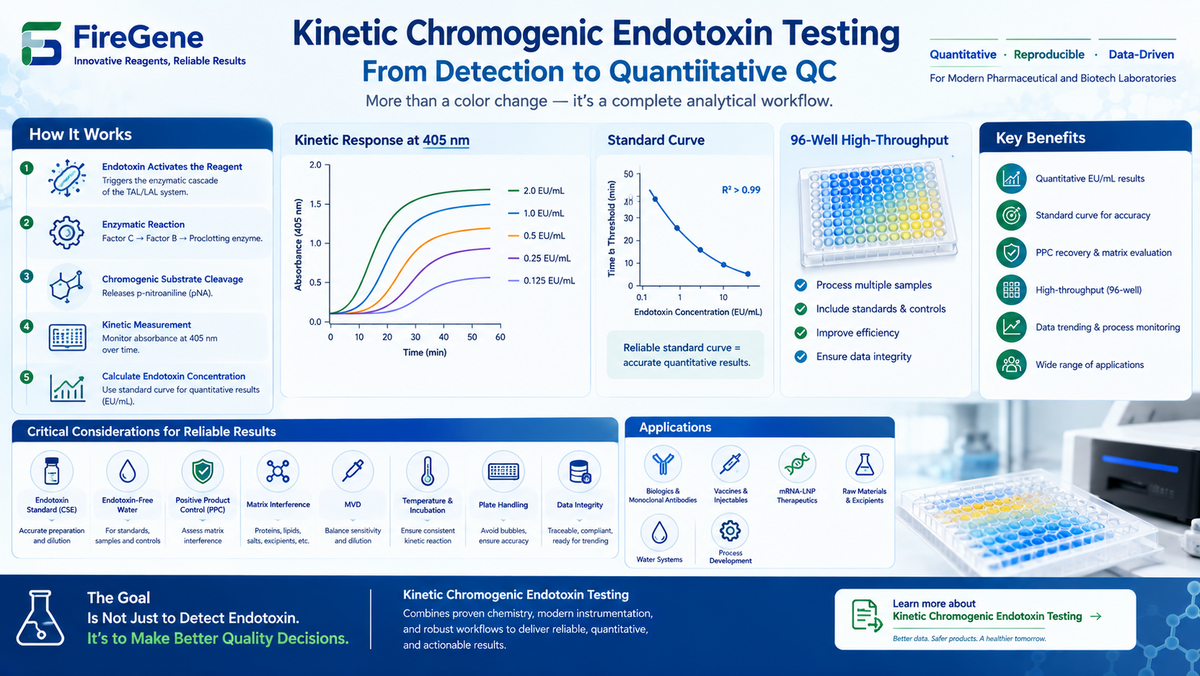
Introduction: Why Kinetic Chromogenic Endotoxin Testing Is Becoming More Important
Bacterial endotoxin testing has traditionally been associated with a simple laboratory question:
Is endotoxin present at an unacceptable level?
But modern pharmaceutical and biotechnology laboratories increasingly need more information than a simple positive or negative answer.
They may need to know:
- How much endotoxin is present?
- How does the result compare with the product limit?
- Is the sample matrix interfering with the assay?
- Is the result within the validated analytical range?
- How consistent are results between replicates?
- How do endotoxin levels change over time?
- Can dozens of samples be processed efficiently?
- Can the analytical data be documented and trended?
This is where Kinetic Chromogenic Endotoxin Testing becomes particularly valuable.
Unlike an endpoint gel-clot approach, a kinetic chromogenic assay monitors the development of color during the enzymatic reaction and uses the measured kinetic response to calculate endotoxin concentration.
The result is a quantitative dataset rather than simply a visual endpoint.
FDA's current March 2026 guidance recognizes photometric and kinetic endotoxin testing approaches alongside gel-clot methods and recommends appropriate testing of relevant components and finished products based on applicable requirements.
For laboratories looking to move toward quantitative, high-throughput, and data-driven endotoxin testing, kinetic chromogenic testing offers an important analytical platform.
What Is Kinetic Chromogenic Endotoxin Testing?
Kinetic chromogenic endotoxin testing is a quantitative bacterial endotoxin test based on an enzymatic reaction initiated by endotoxin.
In a TAL/LAL-based system, bacterial endotoxin activates a cascade involving the reagent's clotting factors.
A simplified reaction pathway is:
Endotoxin
↓
Factor C activation
↓
Factor B activation
↓
Proclotting enzyme activation
↓
Chromogenic substrate hydrolysis
↓
p-Nitroaniline (pNA) release
↓
Increase in absorbance
The resulting color development is monitored over time, commonly at approximately 405 nm.
Instead of simply asking whether a gel forms, the instrument continuously monitors the optical response.
The kinetic response is then related to endotoxin concentration through an endotoxin standard curve.
FireGene's current Kinetic Chromogenic Endotoxin Test Kit uses this general TAL/LAL enzymatic principle and kinetic absorbance detection at 405 nm.
How Does the Kinetic Chromogenic Method Work?
The core concept is relatively straightforward.
The assay contains a known amount of endotoxin in the standards and an unknown amount in the sample.
When endotoxin activates the reagent cascade, the chromogenic substrate is cleaved and produces a measurable color response.
The microplate reader monitors the absorbance change over time.
Conceptually:
Higher endotoxin concentration
→
Faster enzymatic response
→
Earlier attainment of the defined absorbance threshold
→
Higher calculated endotoxin concentration
The instrument therefore does not directly “see” EU/mL.
Instead, it measures an optical response and uses the established relationship between endotoxin concentration and kinetic response to calculate the concentration of the unknown sample.
This is one of the most important concepts for understanding kinetic chromogenic endotoxin testing.
Why 405 nm Is Important in Kinetic Chromogenic Testing
The chromogenic reaction generates p-nitroaniline, which produces a measurable optical signal.
A wavelength around 405 nm is commonly used to monitor the resulting absorbance.
This is why a suitable microplate reader must be capable of:
- Absorbance measurement
- Approximately 405 nm detection
- Kinetic monitoring
- Appropriate temperature control, where required by the validated method
- Suitable plate compatibility
FireGene's current kinetic chromogenic kit is designed for standard microplate readers capable of 405 nm absorbance detection rather than requiring a dedicated endotoxin analyzer.
This can be particularly useful for laboratories that already have a compatible microplate reader.
Kinetic Chromogenic vs. Gel-Clot: What Is the Real Difference?
The biggest difference is not simply “old method vs. new method.”
The real difference is the type of analytical information generated.
Gel-Clot
Primarily provides an endpoint response based on gel formation.
It can be useful when:
- A simple workflow is preferred
- Limit testing is sufficient
- Throughput requirements are relatively low
- Visual endpoint interpretation is acceptable
Kinetic Chromogenic
Provides quantitative kinetic information.
It can be particularly useful when laboratories need:
- Quantitative EU/mL results
- Standard curves
- Higher throughput
- Objective optical measurement
- Numerical data for trending
- Automated calculations
- Multiple dilution comparisons
FireGene's recent comparison of endotoxin testing methods also highlights quantitative results, standard curves, automated calculation, and data trending as important advantages of kinetic chromogenic testing.
The choice should ultimately be based on the product, analytical requirement, matrix, sensitivity, validated method, equipment, and applicable regulatory framework.
The Standard Curve Is the Heart of Kinetic Chromogenic Testing
A kinetic chromogenic assay cannot produce a meaningful quantitative endotoxin result without a reliable relationship between known endotoxin concentrations and their corresponding analytical responses.
That relationship is represented by the standard curve.
The basic concept is:
Known endotoxin concentrations
↓
Kinetic absorbance response
↓
Standard curve
↓
Unknown sample response
↓
Calculated endotoxin concentration
For example, a laboratory may prepare a series of known endotoxin concentrations and measure the corresponding kinetic responses.
The unknown sample is then analyzed under comparable conditions.
The software uses the standard curve to determine the endotoxin concentration represented by the sample response.
FireGene recently published a dedicated guide on Understanding Standard Curves in Kinetic Chromogenic Endotoxin Testing, covering linearity, acceptance criteria, outliers, and common standard-curve problems.
Why Standard Curve Quality Matters
A laboratory may obtain a numerical endotoxin result that looks precise.
But numerical precision does not automatically mean analytical validity.
If the standard curve is poor, the calculated sample result may also be unreliable.
Important considerations include:
- Standard preparation
- Accurate dilution
- Endotoxin-free water
- Pipetting technique
- Replicate consistency
- Concentration range
- Curve fit
- Instrument performance
- Reagent performance
This is why standard-curve preparation should be treated as a critical part of the endotoxin testing workflow rather than simply a software-generated graph.
Control Standard Endotoxin: The Foundation of Quantitative Testing
A kinetic chromogenic assay requires an appropriate endotoxin reference standard for quantitative analysis.
Control Standard Endotoxin (CSE) is used to prepare known endotoxin concentrations for the standard curve and other assay controls, according to the applicable method.
The standard provides the reference point that connects:
Analytical response
with:
Endotoxin concentration
Without a properly prepared standard, quantitative interpretation becomes impossible.
This makes accurate reconstitution and serial dilution extremely important.
For laboratories that need additional endotoxin testing components, FireGene offers a broader Endotoxin Assay Reagents and Kits portfolio, including kinetic chromogenic kits, Gel-Clot TAL/LAL Reagents, CSE, endotoxin-free water, and pyrogen-free consumables.
Why Endotoxin-Free Water Matters
The standard curve can be compromised before the assay even begins if the dilution water introduces background endotoxin.
For this reason, laboratories should use water appropriate for bacterial endotoxin testing and validated for the intended application.
Endotoxin-free water can be used for:
- CSE reconstitution
- Standard dilution
- Sample preparation
- Negative controls
- Other applicable assay steps
FireGene's Endotoxin Assay Water is designed for these types of endotoxin testing workflows.
The principle is simple:
The background must be controlled before the sample can be measured accurately.
What Is a Positive Product Control in Kinetic Chromogenic Testing?
One of the most important concepts in product-specific endotoxin testing is the Positive Product Control (PPC).
A PPC involves adding a known amount of endotoxin to the product matrix and evaluating whether the assay can recover the expected endotoxin signal.
Conceptually:
Known endotoxin
Product matrix
↓
Kinetic chromogenic assay
↓
Measured recovery
If the recovery is acceptable according to the applicable method and acceptance criteria, this supports the conclusion that the product matrix is not causing unacceptable interference under the tested conditions.
If recovery is outside the applicable criteria, the laboratory should investigate potential inhibition or enhancement and determine whether sample preparation or dilution needs to be adjusted.
This is particularly important because pharmaceutical formulations can contain complex components that affect enzymatic assays.
Matrix Interference: One of the Biggest Challenges
The biggest analytical challenge is often not detecting endotoxin.
It is detecting endotoxin reliably in the actual product matrix.
Potential interfering components include:
- Proteins
- Lipids
- Surfactants
- Salts
- Preservatives
- Buffers
- Excipients
- High or low pH
- Certain formulation components
These can potentially produce:
Inhibition
or:
Enhancement
of the endotoxin response.
A sample may therefore appear to contain less or more endotoxin than it actually does if matrix effects are not adequately addressed.
This is why a kinetic chromogenic method should never be considered suitable for a product simply because it works well with water or another simple matrix.
The method must demonstrate suitability for the actual sample.
Kinetic Chromogenic Testing and MVD
Another critical concept is the Maximum Valid Dilution (MVD).
MVD represents the maximum dilution at which a sample can be diluted while still allowing the assay to detect endotoxin at the applicable product limit, based on the selected assay sensitivity and endotoxin limit.
Conceptually:
MVD = Endotoxin Limit ÷ Assay Sensitivity
The exact application and calculation should follow the applicable pharmacopoeial requirements and validated method.
MVD is important because dilution can reduce matrix interference.
But excessive dilution can also move the sample outside the assay's ability to detect the relevant endotoxin level.
Therefore:
Dilution is not simply about making the sample “easier to test.”
It must balance:
Matrix interference
against:
Analytical sensitivity
FireGene's current product information notes that sensitivity selection should be connected to the endotoxin limit and MVD of the sample.
Why Kinetic Chromogenic Testing Is Useful for Dilution Studies
One major advantage of quantitative testing is the ability to compare multiple sample dilutions.
For example:
1:2
1:4
1:8
1:16
The laboratory can evaluate whether calculated endotoxin concentrations remain reasonably consistent after correcting for the dilution factor.
This can help investigate:
- Matrix interference
- Dilution consistency
- PPC recovery
- Analytical range
- Sample suitability
This is especially useful during method development.
For complex products, the objective is not simply to find a dilution that produces a number.
The objective is to establish a dilution strategy that provides reliable and interpretable results.
Kinetic Chromogenic Testing for Complex Biologics
Modern pharmaceutical products can present substantially more analytical challenges than simple aqueous solutions.
Examples include:
- Monoclonal antibodies
- Recombinant proteins
- Vaccines
- Peptides
- Cell and gene therapy-related materials
- mRNA formulations
- Lipid nanoparticles
- Complex injectable formulations
The more complex the formulation becomes, the more important product-specific method suitability becomes.
For example, lipid-containing formulations may interact with assay components or create sample-preparation challenges.
For mRNA-LNP products, laboratories may need to consider:
- Lipid concentration
- Particle structure
- Dilution
- Buffer composition
- Matrix interference
- PPC recovery
FireGene's Endotoxin Testing for mRNA-LNP Therapeutics: Why Matrix Suitability Matters discusses these challenges in greater detail.
Why Kinetic Chromogenic Testing Is Attractive for High-Throughput QC
One of the strongest practical advantages of the kinetic chromogenic format is its compatibility with microplate-based workflows.
A 96-well format can accommodate:
- Standards
- Blanks
- Controls
- PPCs
- Multiple samples
- Multiple dilutions
- Replicates
within the same analytical run.
This can be particularly valuable for laboratories handling:
- Large batch-release programs
- Raw-material screening
- Water monitoring
- Process development
- Method development
- CRO testing
- CDMO operations
FireGene's current Kinetic Chromogenic Endotoxin Test Kit is supplied in a 96-test format and uses kinetic absorbance detection at 405 nm.
FireGene has also published a dedicated article on Kinetic Chromogenic Endotoxin Testing for High-Throughput QC covering plate design, automation, and data integrity.
Plate Design Matters More Than It May Seem
Moving from tube-based testing to a 96-well plate does not automatically create a high-quality high-throughput workflow.
Plate layout should be carefully considered.
A typical plate may need space for:
- Standard curve
- Negative control
- Positive controls
- PPCs
- Samples
- Sample dilutions
- Replicates
Poor plate organization can increase the risk of:
- Pipetting errors
- Sample identification errors
- Cross-contamination
- Incorrect dilution assignment
- Data transcription errors
A well-designed plate map can therefore contribute significantly to assay reliability.
Replicates and Precision in Kinetic Chromogenic Testing
Because kinetic chromogenic assays generate quantitative results, replicate behavior becomes highly informative.
Suppose duplicate measurements produce:
0.045 EU/mL
and:
0.047 EU/mL
This suggests relatively close agreement.
But if the results are:
0.021 EU/mL
and:
0.093 EU/mL
the laboratory should investigate.
Potential causes include:
- Pipetting error
- Inadequate mixing
- Bubble formation
- Plate handling
- Sample heterogeneity
- Matrix effects
- Instrument issues
- Reagent problems
Replicate data therefore provide more than a final number.
They can also serve as an analytical-quality indicator.
Why Bubbles Can Be a Problem
Optical assays depend on reliable absorbance measurements.
Air bubbles can interfere with optical readings and potentially distort kinetic data.
For microplate-based kinetic chromogenic testing, laboratories should therefore pay attention to:
- Pipetting technique
- Mixing
- Plate handling
- Bubble formation
- Plate inspection
- Instrument compatibility
This is a practical detail that can become surprisingly important when running large numbers of samples.
Temperature and Kinetic Reaction Control
Kinetic assays measure a reaction over time.
That means environmental and instrument conditions can influence the reaction.
Depending on the validated method and instrument, laboratories may need to control:
- Incubation temperature
- Reaction timing
- Plate temperature
- Reader performance
- Reagent equilibration
- Sample handling time
This differs conceptually from a simple endpoint test.
The assay is not merely asking:
“Did a reaction happen?”
It is analyzing:
“How does the reaction develop over time?”
Therefore, consistent reaction conditions are fundamental to quantitative kinetic testing.
Kinetic Chromogenic Testing and Data Integrity
Another major advantage of the kinetic format is the quantity of digital data generated.
A modern workflow may include:
Raw absorbance data
↓
Kinetic response
↓
Standard curve
↓
Calculated endotoxin concentration
↓
Sample dilution correction
↓
Final result
This creates opportunities for better:
- Data storage
- Traceability
- Review
- Trending
- Automated calculation
- Audit documentation
But it also creates new responsibilities.
Laboratories need to ensure that:
- Sample IDs are correct
- Plate maps are accurate
- Calculations are traceable
- Raw data are retained appropriately
- Changes are documented
- Results are reviewed according to the laboratory's quality system
More data does not automatically mean better data.
Data integrity must be designed into the workflow.
From Endotoxin Testing to Endotoxin Data Trending
One of the most important advantages of quantitative kinetic testing is that it generates numerical results that can be compared over time.
Instead of:
PASS
PASS
PASS
PASS
a laboratory may obtain:
0.018 EU/mL
0.024 EU/mL
0.031 EU/mL
0.046 EU/mL
0.072 EU/mL
Each result may still be within specification.
But the trend may suggest process drift.
This makes kinetic chromogenic testing particularly useful when the QC strategy includes:
- Historical data analysis
- Process monitoring
- Supplier monitoring
- Water-system trending
- Raw-material trending
- Batch-to-batch comparison
FireGene's recent Endotoxin Testing Data Trending article explores how quantitative endotoxin data can be used to identify potential process drift before a batch fails.
Kinetic Chromogenic Testing in Raw Material QC
Raw materials can be an important source of endotoxin risk.
A quantitative method allows laboratories to monitor endotoxin levels rather than simply classifying samples as positive or negative.
This can support:
- Incoming QC
- Supplier qualification
- Supplier monitoring
- Material comparison
- Process development
- Long-term trending
For example, a supplier's endotoxin results may gradually increase over several lots:
0.02 → 0.03 → 0.05 → 0.07 → 0.10 EU/g
Every result may still meet specification.
But the trend could justify additional review.
FireGene's Endotoxin Testing for Raw Materials and Excipients explains how endotoxin testing can be integrated into upstream material control.
Kinetic Chromogenic Testing for Pharmaceutical Water
Water systems are another important application.
Quantitative endotoxin data can help laboratories monitor changes over time rather than relying exclusively on individual results.
Potential monitoring points may include:
- Water for Injection
- Process water
- Purified water, where applicable
- Distribution loops
- Sampling points
Trend analysis may reveal gradual changes associated with:
- Microbial growth
- Biofilm
- Sanitization
- Maintenance
- Distribution-system conditions
The analytical method must still be appropriate for the intended water system and application.
What Are the Most Common Problems With Kinetic Chromogenic Testing?
Although kinetic chromogenic testing offers many advantages, it is not automatically easier than every other method.
Common problems include:
Poor Standard Curve
Potential causes include inaccurate dilution, poor pipetting, reagent issues, or instrument problems.
PPC Recovery Failure
May indicate matrix interference or unsuitable sample dilution.
High Replicate Variability
May indicate pipetting, mixing, sample heterogeneity, or other analytical issues.
Unexpected High Results
Could originate from actual contamination, matrix effects, preparation errors, or laboratory contamination.
Unexpected Low Results
May be associated with inhibition, dilution, or other assay-performance issues.
Non-Comparable Historical Data
Method changes can complicate trend analysis.
The solution is not to assume the assay is wrong.
The correct approach is systematic investigation.
A Practical Kinetic Chromogenic Endotoxin Testing Workflow
A robust workflow can be organized into the following stages.
Step 1: Establish the Endotoxin Limit
Determine the applicable product-specific endotoxin acceptance criterion.
Step 2: Select Appropriate Assay Sensitivity
Consider the endotoxin limit and required analytical range.
Step 3: Determine an Appropriate Dilution Strategy
Consider MVD and potential matrix interference.
Step 4: Prepare the Standard Curve
Use appropriately prepared endotoxin standards.
Step 5: Prepare the Sample
Use endotoxin-controlled materials and appropriate sample handling.
Step 6: Prepare PPCs
Evaluate recovery in the actual product matrix.
Step 7: Load the Microplate
Follow the validated plate layout.
Step 8: Run the Kinetic Reaction
Monitor the absorbance response over time at the validated wavelength.
Step 9: Evaluate Controls
Review:
- Standard curve
- Negative control
- PPC
- Replicates
- Other applicable assay controls
Step 10: Calculate the Result
Determine the endotoxin concentration and apply the appropriate dilution factor.
Step 11: Evaluate Against the Applicable Limit
Determine whether the result meets the relevant acceptance criterion.
Step 12: Record and Trend the Data
Retain appropriate analytical information for ongoing quality monitoring.
How to Choose Between Kinetic Chromogenic and Gel-Clot
The answer depends on the laboratory's actual needs.
Choose a kinetic chromogenic approach when the laboratory needs:
Quantitative results
Higher throughput
Numerical data
Standard curves
Data trending
Objective optical measurement
Multiple sample dilutions
Choose a Gel-Clot approach when:
A simple endpoint is sufficient
Throughput is relatively low
A visual endpoint is acceptable
Dedicated optical equipment is not available
Neither method should automatically be considered “better.”
The best method is the one that is suitable for the product and the intended analytical purpose.
FDA's current 2026 guidance explicitly discusses gel-clot, photometric, and kinetic endotoxin methods, reinforcing that method selection should be based on appropriate application rather than simply choosing the most technologically advanced format.
Why Kinetic Chromogenic Does Not Mean “Automatic Compliance”
This is an important distinction for laboratories evaluating commercial endotoxin kits.
A kinetic chromogenic method can be scientifically appropriate while the specific commercial product may have limitations regarding its intended use.
For example, FireGene's current product page identifies the Kinetic Chromogenic Endotoxin Test Kit as Research Use Only and states that it is not FDA licensed for end-product release of FDA-regulated pharmaceutical drugs, devices, or biologics.
Therefore, marketing language should not imply that purchasing a kinetic chromogenic kit automatically makes a pharmaceutical release-testing method compliant.
The laboratory remains responsible for establishing:
- Intended use
- Method suitability
- Applicable validation
- Product-specific acceptance criteria
- Appropriate controls
- Regulatory requirements
- Documentation
This is an important point for both manufacturers and laboratories.
2026 Trend: From “Endotoxin Detection” to Quantitative Endotoxin Intelligence
The role of kinetic chromogenic testing is increasingly moving beyond simple detection.
The evolution can be summarized as:
Traditional Approach
Detect → Pass/Fail
↓
Quantitative Approach
Detect → Quantify → Compare
↓
Data-Driven Approach
Detect → Quantify → Trend → Investigate → Prevent
This shift is especially relevant as laboratories deal with:
- More samples
- More complex products
- More sophisticated manufacturing processes
- More extensive analytical datasets
- Greater demand for traceability
FireGene's broader Kinetic Chromogenic Endotoxin Testing in 2026 article explores this transition from routine BET toward quantitative and data-driven QC.
At the same time, regulatory expectations continue to evolve. FDA's March 2026 revised guidance addresses endotoxin and pyrogen testing for drugs, biologics, and devices and discusses gel-clot, photometric, and kinetic methodologies.
Frequently Asked Questions
What is kinetic chromogenic endotoxin testing?
It is a quantitative bacterial endotoxin testing method that monitors color development generated by an endotoxin-triggered enzymatic reaction and uses the kinetic response to calculate endotoxin concentration.
Why is 405 nm used?
The chromogenic reaction produces p-nitroaniline, which generates an optical signal that can be monitored around 405 nm.
Is kinetic chromogenic testing quantitative?
Yes. When properly performed, the method uses a standard curve to calculate endotoxin concentration, commonly reported in units such as EU/mL.
What is the role of the standard curve?
The standard curve establishes the relationship between known endotoxin concentrations and measured kinetic responses, allowing unknown sample concentrations to be calculated.
What is PPC recovery?
PPC recovery evaluates whether a known endotoxin spike can be recovered appropriately in the actual sample matrix and therefore helps assess matrix interference.
What causes PPC failure?
Potential causes include inhibition, enhancement, inappropriate dilution, matrix effects, sample preparation issues, or other analytical factors.
Can kinetic chromogenic testing be used for high-throughput testing?
Yes. Microplate-based kinetic chromogenic workflows can process multiple samples, standards, controls, and dilutions in a single run when appropriately designed.
Does kinetic chromogenic testing require a dedicated endotoxin reader?
Not necessarily. A compatible microplate reader capable of the required absorbance wavelength and kinetic measurements may be used, depending on the validated method and instrument requirements. FireGene's current kit specifies compatibility with standard microplate readers capable of 405 nm detection.
Is kinetic chromogenic better than Gel-Clot?
Not universally. Kinetic chromogenic testing offers quantitative and high-throughput advantages, while Gel-Clot can be advantageous for simple endpoint or limit testing. The appropriate method depends on the product and intended use.
Can kinetic chromogenic results be used for trend analysis?
Yes. Quantitative results can provide useful datasets for monitoring changes over time, provided the analytical method and testing conditions remain appropriately controlled and comparable.
Conclusion: Kinetic Chromogenic Testing Is More Than a Faster Endotoxin Test
Kinetic chromogenic endotoxin testing represents an important evolution in bacterial endotoxin analysis.
Its value comes from more than simply producing a color change.
The method connects:
Endotoxin
↓
Enzymatic Reaction
↓
Kinetic Optical Signal
↓
Standard Curve
↓
Quantitative EU Result
↓
PPC and Method Suitability
↓
Process Monitoring
↓
Data Trending
This quantitative structure can provide laboratories with more information than a simple visual endpoint.
However, the technology itself does not guarantee a reliable result.
Successful kinetic chromogenic endotoxin testing still depends on:
- Appropriate endotoxin limits
- Suitable assay sensitivity
- Correct standard preparation
- Reliable CSE
- Endotoxin-controlled water
- Appropriate sample preparation
- MVD considerations
- PPC recovery
- Matrix suitability
- Standard-curve performance
- Instrument suitability
- Proper data handling
For modern pharmaceutical QC laboratories, the real opportunity is to move from:
“Did the sample pass the endotoxin test?”
toward:
“What does the quantitative endotoxin data tell us about the product, process, and analytical system?”
That is where kinetic chromogenic endotoxin testing becomes especially powerful.
Reliable endotoxin testing is not just about detecting endotoxin.
It is about generating quantitative data that laboratories can trust, interpret, trend, and use to make scientifically justified quality decisions.
FireGene Endotoxin Testing
Ready to run your endotoxin assay?
FireGene offers a complete endotoxin testing toolkit — from TAL reagents and CSE standards to pyrogen-free consumables and LAL reagent water. All products are aligned with USP <85>, EP 2.6.14, and JP 4.01.


