
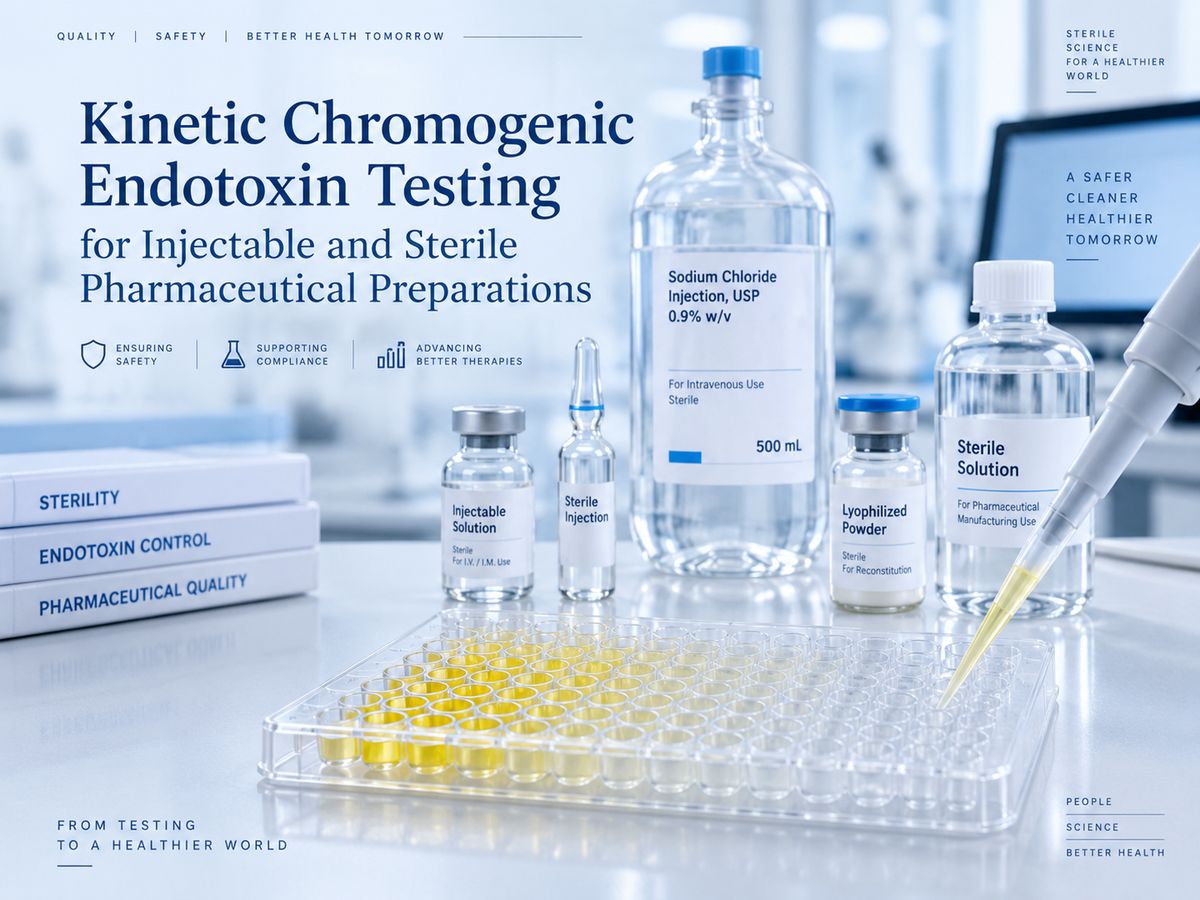
Injectable and sterile pharmaceutical preparations represent one of the most important application areas for bacterial endotoxin testing. Unlike oral or topical products, parenteral preparations are introduced directly into the body through injection or infusion, bypassing many of the natural physiological barriers that normally limit exposure to microbial contaminants. For this reason, the control of bacterial endotoxin is an essential component of pharmaceutical quality assurance, process control, and finished-product testing.
The kinetic chromogenic endotoxin assay is widely used as a quantitative approach for detecting and measuring bacterial endotoxin in pharmaceutical products. The method is based on activation of the Limulus Amebocyte Lysate, or LAL, enzymatic cascade by endotoxin. During the reaction, a chromogenic substrate is cleaved to produce a measurable color signal. The rate of color development is monitored over time and compared with an endotoxin standard curve, allowing quantitative determination of endotoxin concentration.
This method is particularly useful for injectable and sterile dosage forms because many of these products are aqueous and compatible with microplate-based kinetic analysis. However, formulation composition can strongly influence assay performance. Factors such as pH, salt concentration, proteins, preservatives, surfactants, stabilizers, color, and turbidity may cause inhibition or enhancement of the LAL reaction. Consequently, sample preparation and method suitability testing are critical before routine endotoxin analysis is established.
Small-Volume Parenteral Preparations
Small-volume parenteral preparations are among the most common sample types evaluated using kinetic chromogenic endotoxin testing. These products are generally supplied in ampoules, vials, cartridges, or prefilled syringes and are intended for administration in relatively small volumes.
Common examples include:
aqueous injections
small-volume injectable solutions
sterile drug solutions
injectable peptide formulations
injectable protein preparations
reconstituted injectable products
prefilled syringe formulations
Clear aqueous injections are often relatively straightforward to test because they can frequently be diluted directly in endotoxin-free water or another validated diluent. If the formulation has a near-neutral pH and contains only moderate levels of salts and excipients, kinetic chromogenic analysis may require minimal sample preparation.
However, some small-volume injections contain concentrated active pharmaceutical ingredients, antimicrobial preservatives, complexing agents, or solubilizing excipients. These substances may interfere with the enzymatic cascade used in LAL testing. High concentrations of organic compounds may also affect optical absorbance during chromogenic detection.
For these reasons, laboratories commonly evaluate several sample dilutions during method development. The objective is to identify a dilution level that sufficiently reduces matrix interference while still maintaining sensitivity below the required endotoxin limit.
Large-Volume Parenteral Preparations
Large-volume parenteral preparations include infusion solutions and other sterile products administered in relatively high volumes. Because the total administered volume can be substantial, endotoxin control is particularly important for these products.
Typical examples include:
saline infusion solutions
glucose-containing infusions
electrolyte replacement solutions
sterile irrigation solutions
nutrient-containing infusion products
sterile bulk infusion preparations
These products are often predominantly aqueous and may therefore be well suited to kinetic chromogenic endotoxin testing.
Simple formulations such as isotonic saline may require only limited dilution. In contrast, more complex infusion products may contain multiple electrolytes, sugars, amino acids, or other functional components that influence the assay environment.
High ionic strength can affect enzyme activity, while elevated glucose or other dissolved solids may change viscosity or optical properties. Consequently, even apparently simple aqueous infusion products should undergo appropriate method suitability evaluation before routine testing.
Because large-volume parenteral products may have stringent endotoxin limits, assay sensitivity is also important. The kinetic chromogenic method offers a broad quantitative range and can support testing where low endotoxin concentrations must be reliably measured.
Lyophilized Injectable Products
Lyophilized pharmaceutical products are commonly used when an active ingredient has limited stability in aqueous solution. Freeze-drying can improve shelf stability for proteins, peptides, biologics, and certain small-molecule drugs.
Typical samples include:
lyophilized powder for injection
freeze-dried peptide formulations
freeze-dried recombinant proteins
lyophilized monoclonal antibody preparations
reconstituted biologic products
reconstituted small-molecule injectable products
These materials cannot usually be introduced directly into the assay in solid form. Instead, the lyophilized product must first be reconstituted using an appropriate endotoxin-free diluent.
The reconstitution procedure is an important part of sample preparation. The product should dissolve completely and produce a homogeneous solution before testing. Incomplete dissolution may lead to inconsistent endotoxin recovery or variable results.
Lyophilized formulations often contain sugars, amino acids, bulking agents, stabilizers, or surfactants to protect the active ingredient during freezing and drying. These excipients can influence the LAL reaction.
For example, high concentrations of sucrose or trehalose may increase solution viscosity, while surfactants may alter interactions among proteins, endotoxin, and assay reagents. Therefore, reconstituted lyophilized products frequently require dilution before kinetic chromogenic analysis.
Sterile Solution Preparations
Sterile solution preparations include both finished pharmaceutical products and manufacturing intermediates produced under controlled aseptic conditions.
Representative sample types include:
sterile buffer solutions
formulation solutions
bulk drug solutions
pre-filling drug solutions
sterile process intermediates
sterile holding solutions
product-contact rinse solutions
These samples are highly relevant to in-process endotoxin monitoring.
Testing before the filling stage can help manufacturers evaluate endotoxin control during formulation, filtration, holding, and aseptic processing. If elevated endotoxin levels are detected before final filling, corrective actions may be taken before a larger batch progresses further through production.
Sterile bulk solutions are often relatively compatible with kinetic chromogenic analysis, particularly when they are clear and aqueous. Nevertheless, excipient concentration, buffer composition, and active ingredient characteristics should be considered.
In-process testing can also be useful for identifying trends in endotoxin levels over time and for evaluating the effectiveness of cleaning, purification, or filtration procedures.
Complex Injectable Formulations
Not all injectable products are simple aqueous solutions. Increasingly complex pharmaceutical formulations may contain proteins, lipids, polymers, nanoparticles, or other specialized delivery components.
Examples may include:
high-concentration protein formulations
peptide formulations
lipid-containing preparations
nanoparticle-based formulations
polymer-containing injectables
formulations containing surfactants
highly buffered sterile solutions
These matrices may require additional method development because they can interfere with either the LAL reaction or the optical measurement system.
Strongly colored products may absorb light near the wavelength used for chromogenic detection, while turbid or particulate-containing formulations may scatter light. In such cases, dilution, clarification, or alternative sample preparation approaches may be necessary.
For particularly challenging matrices, the suitability of the kinetic chromogenic method should be demonstrated experimentally rather than assumed based solely on product category.
Method Suitability and Matrix Interference
Method suitability testing is a fundamental part of bacterial endotoxin analysis.
A sample may be sterile and visually clear but still inhibit or enhance the endotoxin-induced reaction. Therefore, laboratories typically perform a spike recovery assessment using a known amount of endotoxin.
The sample is tested both with and without added endotoxin. Recovery of the added endotoxin is then evaluated to determine whether the matrix interferes with the assay.
Potential sources of interference include:
extreme pH
high salt concentrations
preservatives
surfactants
sugars
proteins
chelating agents
organic solvents
strongly absorbing compounds
turbid or particulate-containing formulations
Dilution is one of the most common strategies used to reduce matrix interference. As the sample is diluted, interfering substances become less concentrated while endotoxin remains measurable.
However, excessive dilution can reduce endotoxin concentration below the required detection capability. Therefore, the selected dilution must remain compatible with the assay sensitivity and the applicable endotoxin specification.
Role in Pharmaceutical Quality Control
Kinetic chromogenic endotoxin testing can support multiple stages of sterile pharmaceutical manufacturing.
Applications may include:
raw material evaluation
formulation development
process intermediate testing
bulk solution monitoring
pre-filling quality control
finished-product testing
investigation of atypical results
cleaning and process verification
The quantitative nature of the assay also makes it useful for monitoring changes in endotoxin levels throughout a manufacturing process.
For example, endotoxin concentrations can be measured before and after purification, filtration, or other process steps to assess how effectively the manufacturing process controls pyrogenic contamination.
Conclusion
The kinetic chromogenic endotoxin assay is a versatile and sensitive method for evaluating bacterial endotoxin in a wide range of injectable and sterile pharmaceutical preparations.
Applicable sample types include small-volume parenteral preparations, large-volume infusion products, lyophilized injectable products, sterile buffer solutions, bulk drug solutions, pre-filling solutions, and other sterile manufacturing intermediates.
Clear aqueous formulations are usually the easiest to analyze, whereas high-protein, strongly buffered, highly concentrated, colored, turbid, or surfactant-containing products may require additional dilution and method optimization.
Regardless of formulation type, reliable endotoxin testing depends on appropriate sample preparation, method suitability assessment, and confirmation that the sample matrix does not significantly inhibit or enhance the LAL reaction.
When properly developed, kinetic chromogenic endotoxin testing can support routine quality control, manufacturing process monitoring, formulation development, and endotoxin risk management throughout the lifecycle of injectable and sterile pharmaceutical products.


