
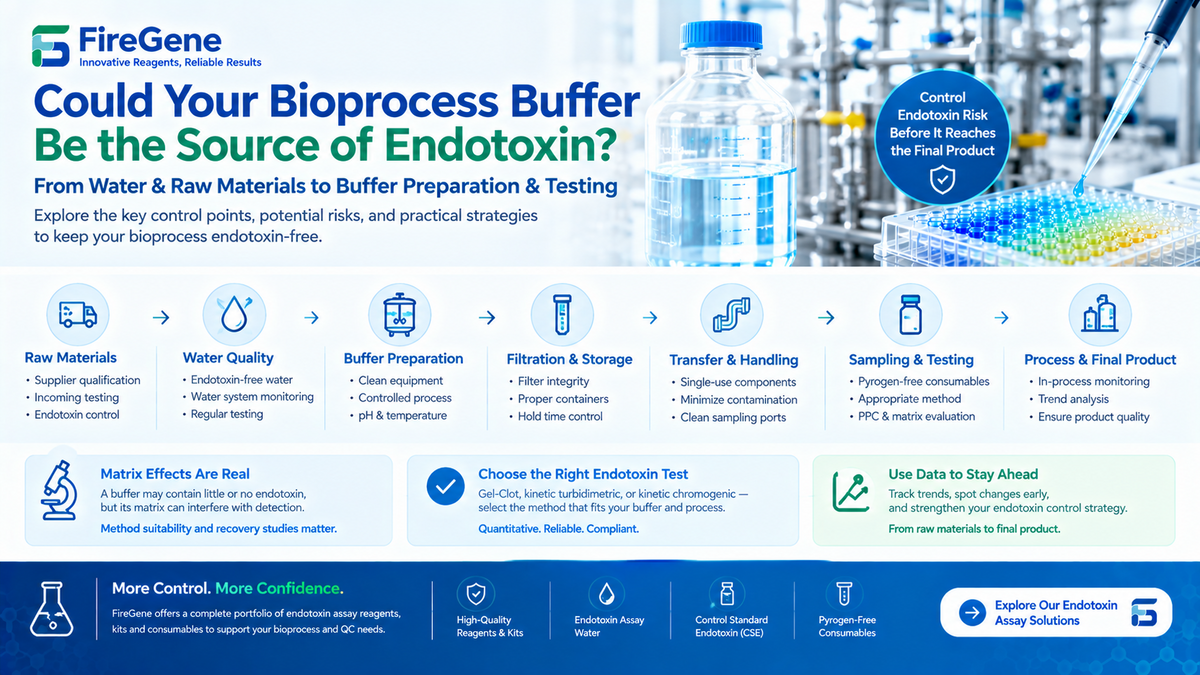
Introduction: Why Buffer Endotoxin Control Matters More Than Many Laboratories Realize
When pharmaceutical and biopharmaceutical manufacturers investigate endotoxin contamination, the first focus is often the final drug product.
But the final product is rarely where endotoxin risk begins.
Throughout a bioprocess, large volumes of buffers are prepared, transferred, filtered, stored, and used in chromatography, purification, formulation, and cleaning operations. These buffers can come into contact with product intermediates, process equipment, membranes, chromatography systems, tubing, and single-use assemblies.
If endotoxin enters the process through a buffer, it may be distributed across multiple manufacturing steps.
That makes buffer preparation and buffer monitoring an important part of an overall endotoxin-control strategy.
This is especially relevant for modern biopharmaceutical manufacturing, where processes can involve:
- Monoclonal antibodies
- Recombinant proteins
- Vaccines
- Cell and gene therapy products
- Viral vectors
- Protein-based therapeutics
- Nucleic-acid-based products
- Other complex biological products
The FDA's March 2026 guidance continues to emphasize appropriate testing of components and finished products for pyrogens and endotoxins and discusses gel-clot, photometric, and kinetic test methods.
For manufacturers, the practical question is therefore not simply:
“Does the final product pass the endotoxin test?”
A better question is:
“Where could endotoxin enter the process, and how can we detect and control it before it reaches the final product?”
This article explains how endotoxin testing can be integrated into a bioprocess buffer control strategy, from water and raw materials to preparation, storage, sampling, and investigation.
1. What Are Bioprocess Buffers?
Bioprocess buffers are aqueous solutions used to maintain appropriate chemical and physical conditions during biological manufacturing.
Depending on the manufacturing process, buffers may be used for:
- Protein purification
- Chromatography
- Washing
- Elution
- Diafiltration
- Ultrafiltration
- Viral clearance
- Formulation
- Process intermediate preparation
- Equipment rinsing
- Hold steps
- Final formulation
Common buffer components include:
- Phosphate salts
- Histidine
- Tris
- Citrate
- Acetate
- Sodium chloride
- Sugars
- Amino acids
- Other stabilizers or process-specific additives
A buffer may appear chemically simple, but its endotoxin risk depends on much more than its chemical formula.
The actual risk is influenced by:
Water quality + raw materials + preparation equipment + handling + storage + transfer + sampling
This is why buffer endotoxin control should be considered a process-level activity rather than simply a laboratory testing activity.
2. Where Can Endotoxin Enter a Buffer?
Endotoxin contamination can occur at multiple points.
A simplified risk pathway is:
Raw materials → Water → Mixing system → Preparation → Filtration → Storage → Transfer → Process use
Each stage represents a potential control point.
Raw Materials
Buffer components may be supplied as powders, concentrates, or prepared solutions.
Although chemical purity does not automatically mean endotoxin-free status, supplier qualification and appropriate incoming controls can reduce the risk of introducing endotoxin through raw materials.
This is particularly important when buffer components are used in large quantities.
For a broader discussion of incoming material controls, see FireGene's guide to endotoxin testing for raw materials and excipients.
3. Water Is Often the Most Important Buffer Ingredient
A buffer may contain several carefully controlled chemical components, but water is frequently the largest component by volume.
That makes water quality one of the most important factors in buffer endotoxin control.
If endotoxin-free water is not used appropriately, contamination can be introduced before the buffer preparation process is even complete.
Depending on the manufacturing application, water systems may be monitored for:
- Microbial contamination
- Endotoxin
- Conductivity
- Total organic carbon
- Temperature
- Other water-quality parameters
For endotoxin testing specifically, laboratories should use water appropriate for bacterial endotoxin testing when preparing standards, controls, reagents, or test samples.
FireGene's Endotoxin Assay Water is designed for CSE reconstitution, sample dilution, and endotoxin assay workflows and is specified at less than 0.005 EU/mL.
The important principle is simple:
The water used to prepare an endotoxin test should not become the source of the endotoxin being measured.
This becomes particularly important when laboratories are working near the lower end of the assay range.
4. Buffer Preparation Equipment Can Become an Endotoxin Source
The next potential risk is the equipment used to prepare and transfer the buffer.
Depending on the facility, this may include:
- Mixing tanks
- Stainless-steel vessels
- Single-use bags
- Tubing
- Connectors
- Pumps
- Filters
- Sampling ports
- Transfer lines
Endotoxin can persist on surfaces even when viable microorganisms are no longer present.
This is an important distinction.
Sterilization and endotoxin control are not the same thing.
A process can successfully eliminate viable microorganisms while still requiring specific controls for bacterial endotoxin.
For reusable equipment, cleaning and depyrogenation strategies must therefore be appropriately defined.
For single-use systems, supplier specifications and qualification data can be important parts of the contamination-control strategy.
5. Why Buffer Preparation Procedures Matter
Even when raw materials and water meet specifications, the preparation process itself can introduce variability.
Important factors include:
Accurate weighing
Incorrect material quantities can alter buffer concentration and potentially change the behavior of the final solution.
Appropriate mixing
Incomplete mixing can produce concentration gradients and inconsistent samples.
Controlled addition sequence
Some components may need to be added in a specific sequence to prevent precipitation, pH shifts, or other formulation problems.
pH adjustment
pH can influence the behavior of analytical assays and may contribute to matrix interference during endotoxin testing.
Temperature
Temperature changes can affect both the physical characteristics of the buffer and the performance of the endotoxin assay.
Hold time
Longer storage periods create additional opportunities for contamination or changes in sample characteristics.
Therefore, buffer preparation should be treated as a controlled manufacturing operation rather than simply a chemical mixing step.
6. Should Every Buffer Be Tested for Endotoxin?
Not necessarily.
A scientifically useful endotoxin-control program should be based on risk assessment, rather than automatically testing every solution at every stage.
Factors that can influence the testing strategy include:
- Where the buffer is used
- Whether the buffer contacts the drug substance
- Whether the buffer is used upstream or downstream
- Whether it is part of purification
- Whether it contacts the final product
- Buffer volume
- Process duration
- Potential contamination sources
- Existing process controls
- Historical endotoxin data
- Product endotoxin requirements
For example, a buffer used early in a process may have a different risk profile from a buffer used immediately before final formulation.
This is why buffer testing should be integrated into the overall endotoxin risk assessment rather than treated as an isolated laboratory activity.
7. In-Process Buffer Testing vs. Final Product Testing
One of the biggest advantages of monitoring buffers is that it can provide information before the manufacturing process reaches the final product.
Consider two scenarios.
Scenario A: Final-product testing only
A batch fails the final endotoxin test.
The investigation must then consider:
- Water
- Raw materials
- Buffers
- Equipment
- Filters
- Transfer systems
- Manufacturing environment
- Sampling
- Packaging
- Final formulation
The potential investigation scope can become very large.
Scenario B: Strategic in-process monitoring
The manufacturer has endotoxin data from:
- Water
- Selected buffers
- Process intermediates
- Critical purification stages
- Final product
Now investigators can compare endotoxin levels across the process.
This can make it easier to identify where an excursion may have occurred.
In other words:
Final-product testing tells you whether the product passed.
Strategic in-process testing can help explain why.
8. Choosing an Endotoxin Test Method for Buffers
Several bacterial endotoxin testing approaches are available depending on the application and validated laboratory procedure.
Common approaches include:
- Gel-Clot
- Kinetic Turbidimetric
- Kinetic Chromogenic
- Other appropriately validated endotoxin methods
The FDA's current guidance discusses gel-clot, photometric, and kinetic approaches for pyrogen and endotoxin testing.
For relatively simple buffer matrices, quantitative photometric methods can provide useful information about endotoxin concentration and process trends.
A kinetic chromogenic assay measures the rate of color development generated by the endotoxin-triggered enzymatic cascade.
FireGene's Kinetic Chromogenic Endotoxin Test Kit uses 405 nm kinetic absorbance measurement and provides a quantitative detection range of 0.005–10 EU/mL.
However, the correct method should always be determined by the laboratory's validated procedure and the specific characteristics of the material being tested.
9. Why Buffer Composition Can Affect Endotoxin Testing
A major challenge is that the buffer itself may influence assay performance.
This is known as matrix interference.
Potential sources include:
- Extreme pH
- High salt concentration
- Chelating agents
- Surfactants
- High concentrations of proteins
- Certain organic components
- Strongly acidic or alkaline formulations
- Other substances that interact with the endotoxin assay system
A buffer can therefore contain little or no endotoxin while still producing an unexpected assay response.
Conversely, the matrix may suppress the assay response and cause an apparently low endotoxin result.
This is why a negative endotoxin result should not automatically be interpreted as proof that the analytical method worked perfectly.
The laboratory must also establish that the method can reliably detect endotoxin in the specific buffer matrix.
For a detailed discussion of this issue, see FireGene's guide to endotoxin method suitability testing and matrix interference.
10. The Role of Positive Product Controls
A Positive Product Control, or PPC, is particularly useful when evaluating whether a buffer matrix interferes with endotoxin detection.
The basic concept is straightforward.
A known amount of endotoxin is added to the buffer sample.
The assay then measures how much of that endotoxin can be recovered.
Conceptually:
Known endotoxin spike → Buffer matrix → Endotoxin assay → Recovery assessment
If the expected endotoxin signal is not recovered appropriately, the problem may not be contamination.
The buffer itself may be interfering with the assay.
This distinction is critical.
Without an appropriate recovery assessment, a low endotoxin result could potentially be misinterpreted as a true low-endotoxin sample when the analytical system is actually experiencing inhibition.
FireGene's Control Standard Endotoxin (CSE) is designed for applications including interference testing, sensitivity confirmation, and positive controls in Gel-Clot and Kinetic Chromogenic endotoxin workflows.
11. Endotoxin Dilution and Maximum Valid Dilution
When a buffer interferes with the endotoxin assay, dilution may help reduce matrix effects.
But dilution should not be treated as an arbitrary troubleshooting step.
The laboratory needs to consider:
- Endotoxin limit
- Assay sensitivity
- Expected endotoxin concentration
- Maximum Valid Dilution
- PPC recovery
- Quantitation range
- Sample concentration
The objective is to find a dilution that reduces matrix interference while maintaining sufficient analytical sensitivity.
For a broader explanation of sample preparation, dilution, and interference, see FireGene's practical guide to endotoxin testing sample preparation.
A dilution that solves inhibition but pushes the expected endotoxin concentration below the useful assay range is not necessarily a successful solution.
12. Buffer Hold Time Can Change the Risk Profile
A freshly prepared buffer and a buffer that has been stored for several days should not automatically be considered equivalent from an endotoxin-control perspective.
The longer a buffer is held, the more important it becomes to control:
- Storage temperature
- Container integrity
- Sampling frequency
- Transfer operations
- Exposure to equipment
- Microbial control
- Hold-time limits
This is particularly important for large-volume buffer systems.
A buffer prepared under controlled conditions may later be exposed to multiple transfer steps before it reaches the point of use.
Each additional handling step creates another potential contamination opportunity.
Therefore, buffer hold-time studies and storage controls should be aligned with the intended manufacturing process.
13. Sampling Can Introduce False Endotoxin Results
Sampling is sometimes treated as a simple operational step.
Analytically, however, it can be one of the most important parts of the workflow.
Potential problems include:
- Non-pyrogen-free sampling containers
- Contaminated pipette tips
- Improper sample transfer
- Environmental contamination
- Inadequate flushing of sampling ports
- Poor sample identification
- Long delays between sampling and analysis
A contaminated sampling container can produce a false-positive endotoxin result.
An improperly handled sample can also produce data that do not accurately represent the original buffer.
This means that endotoxin control extends beyond the manufacturing vessel and into the analytical laboratory.
14. Why Endotoxin-Free Consumables Matter
At low endotoxin concentrations, small sources of contamination can become analytically significant.
Laboratories should therefore evaluate the endotoxin suitability of:
- Tubes
- Vials
- Pipette tips
- Microplates
- Dilution containers
- Sample bottles
- Glassware
FireGene offers Pyrogen-Free Vials for applications where sample and standard preparation require controlled endotoxin background.
The principle is the same as with water:
The analytical system should not contribute the contamination that it is designed to measure.
15. Using Endotoxin Testing for Process Trending
Buffer testing becomes even more valuable when results are evaluated over time.
Instead of asking only:
“Did this buffer pass today?”
manufacturers can ask:
“Is endotoxin behavior changing over time?”
Trending can help identify gradual changes such as:
- Increasing water-system endotoxin
- Recurring buffer preparation excursions
- Equipment-related contamination
- Supplier-related variability
- Changes after process modifications
- Seasonal or facility-related trends
For example, if the endotoxin concentration of a specific process buffer gradually increases over several manufacturing campaigns, the trend may provide an early warning before a final product fails.
This is one reason quantitative endotoxin testing can be useful in process monitoring.
FireGene has also discussed endotoxin testing data trending and process drift as part of a broader data-driven quality strategy.
16. What Should Happen When a Buffer Fails?
An endotoxin excursion should not automatically lead to immediate batch rejection.
The first step should be a structured investigation.
A useful investigation pathway is:
Step 1: Confirm the analytical result
Review:
- Raw data
- Controls
- Standard curve
- PPC
- Replicates
- Instrument performance
- Analyst records
Step 2: Review sample handling
Check:
- Sampling container
- Sampling location
- Sample storage
- Sample preparation
- Dilution
- Pipetting
- Test timing
Step 3: Review water
Evaluate:
- Water-system monitoring
- Recent endotoxin results
- Microbial results
- Sanitization history
- Sampling records
Step 4: Review raw materials
Check:
- Supplier
- Lot number
- Certificate of Analysis
- Incoming endotoxin data
- Recent supplier changes
Step 5: Review equipment
Evaluate:
- Cleaning
- Depyrogenation
- Equipment status
- Single-use components
- Filters
- Tubing
- Transfer paths
Step 6: Compare with historical data
Ask whether the result represents:
- A one-time excursion
- A recurring pattern
- A gradual trend
- A new process behavior
A structured investigation is generally more informative than simply repeating the endotoxin test multiple times.
17. Why Repeated Testing Is Not the Same as Root-Cause Investigation
When a buffer produces an unexpected endotoxin result, one tempting response is to repeat the test.
But repeating the same analytical procedure without investigating the source may simply generate more data without explaining the problem.
For example, if the original result was caused by contaminated sample tubes, repeating the assay using the same tubes does not resolve the underlying issue.
Similarly, if the buffer matrix inhibits endotoxin recovery, repeated testing at the same dilution may continue to produce misleadingly low results.
A better approach is:
Result → Confirm → Investigate → Identify cause → Correct → Verify
rather than:
Result → Repeat → Repeat → Repeat
This principle is especially important in regulated manufacturing environments where analytical records and investigation rationale must be defensible.
18. How Buffer Endotoxin Control Fits Into a Modern Biopharmaceutical Workflow
An effective strategy can be visualized as a series of control points:
1. Supplier qualification
↓
2. Raw material control
↓
3. Water-system monitoring
↓
4. Controlled buffer preparation
↓
5. Equipment and single-use component control
↓
6. Buffer sampling
↓
7. Endotoxin testing
↓
8. In-process monitoring
↓
9. Final product testing
This approach moves endotoxin control upstream.
Instead of relying exclusively on final-product testing, manufacturers can identify contamination risks earlier in the process.
This philosophy is consistent with broader biopharmaceutical endotoxin-control strategies described in FireGene's guide to critical endotoxin control points from raw materials to final product release.
19. Regulatory Perspective: Why Method Suitability Still Matters
USP <85> remains a central reference for bacterial endotoxin testing, while USP <1085> provides additional guidance on the performance and application of endotoxin testing methods. USP <1085> also notes the addition of USP <86>, which covers bacterial endotoxin testing using recombinant reagents.
USP <86> provides additional techniques using recombinant reagents such as recombinant Factor C and recombinant cascade reagents. The chapter states that, unless otherwise specified in an individual monograph, these are considered alternative tests subject to the applicable USP requirements.
For laboratories working with bioprocess buffers, the important lesson is not simply which reagent technology is selected.
The method must be demonstrated to be appropriate for the material being tested.
A test method that performs well with endotoxin-free water may behave differently when applied to a concentrated process buffer.
Therefore, method suitability, interference assessment, recovery, dilution strategy, and appropriate controls remain central to reliable endotoxin testing.
20. A Practical Buffer Endotoxin Control Checklist
Before implementing routine endotoxin testing for a process buffer, laboratories should consider the following questions.
Buffer preparation
- Are all raw materials appropriately qualified?
- Is the water suitable for the intended application?
- Is the preparation procedure controlled?
- Are mixing and pH adjustment appropriately documented?
Equipment
- Are product-contact surfaces appropriately controlled?
- Are reusable components adequately cleaned and depyrogenated?
- Are single-use components appropriately qualified?
- Are transfer paths included in the risk assessment?
Sampling
- Are sampling containers suitable for endotoxin testing?
- Are sampling ports appropriately controlled?
- Is the sample stored under defined conditions?
- Is the time between sampling and testing controlled?
Analytical method
- Is the selected endotoxin method appropriate for the buffer?
- Has method suitability been demonstrated?
- Is PPC recovery acceptable?
- Is the dilution strategy appropriate?
- Is the assay range appropriate?
Data review
- Are controls acceptable?
- Are replicates consistent?
- Are historical results available for comparison?
- Are trends monitored?
This checklist can help laboratories move from simple endpoint testing toward a more comprehensive endotoxin-control strategy.
21. Buffer Testing Should Be Part of the Process, Not an Afterthought
Biopharmaceutical manufacturing depends on thousands of individual process steps working together.
Buffers may appear to be relatively simple components, but they can connect multiple stages of the manufacturing process.
A contaminated buffer can potentially introduce endotoxin into:
- Chromatography systems
- Process intermediates
- Filtration systems
- Formulation vessels
- Drug substance
- Final drug product
For that reason, endotoxin control should begin well before final product release.
The most reliable strategy combines:
Controlled raw materials
Appropriate water quality
Controlled preparation and handling
Qualified equipment and consumables
Method suitability
Appropriate endotoxin testing
Data trending
Together, these controls create a more robust approach to preventing and detecting endotoxin contamination.
Conclusion
Endotoxin testing for bioprocess buffers is not simply a question of choosing an assay kit.
The quality of the final result depends on the entire workflow surrounding the test.
Water, raw materials, equipment, sampling, storage, dilution, matrix effects, and analytical controls can all influence the reliability of endotoxin measurements.
For biopharmaceutical manufacturers, the goal should therefore be to establish endotoxin control as a process-wide strategy rather than relying exclusively on final-product testing.
When strategically applied, buffer endotoxin testing can help manufacturers identify contamination risks earlier, investigate excursions more efficiently, and build stronger control over the entire manufacturing process.
For laboratories developing or optimizing endotoxin testing workflows, FireGene provides endotoxin assay reagents and kits, including Gel-Clot and Kinetic Chromogenic solutions, Control Standard Endotoxin, Endotoxin Assay Water, and pyrogen-free consumables.
The most effective endotoxin strategy is not simply to detect contamination at the end. It is to control where contamination can enter—and detect it before it becomes a larger manufacturing problem.
Frequently Asked Questions
What is the purpose of endotoxin testing for bioprocess buffers?
The purpose is to monitor and control bacterial endotoxin contamination in buffers that may contact process materials, equipment, intermediates, or final products.
Can endotoxin enter a buffer through water?
Yes. Because water is often the largest component of a buffer, inappropriate water quality or inadequate water-system control can introduce endotoxin into the preparation.
Does sterilization remove endotoxin?
Sterilization and endotoxin control are different processes. Eliminating viable microorganisms does not necessarily eliminate bacterial endotoxin.
Can buffer composition interfere with endotoxin testing?
Yes. pH, salts, chelating agents, surfactants, proteins, and other formulation components may affect assay performance. Method suitability and recovery studies are therefore important.
Is dilution always the solution for buffer interference?
No. Dilution may reduce matrix interference, but the selected dilution must remain within the validated analytical range and satisfy the applicable sensitivity and MVD requirements.
Which endotoxin test method is best for process buffers?
There is no universal answer. Gel-Clot, kinetic turbidimetric, and kinetic chromogenic approaches may all be appropriate depending on the material, required sensitivity, throughput, instrumentation, and validated method.
Why is Positive Product Control important?
PPC helps demonstrate that a known amount of endotoxin can be recovered from the specific buffer matrix. Poor recovery can indicate assay inhibition or other matrix effects.
Should every process buffer be tested?
Not necessarily. Testing frequency and sampling points should be determined through a risk-based assessment of the manufacturing process and the role of each buffer.
Can buffer endotoxin results be used for process trending?
Yes. When quantitative and comparable data are generated under a controlled analytical procedure, endotoxin results can contribute to process and contamination-control trending.
What is the role of Endotoxin Assay Water?
Endotoxin Assay Water is used for applications such as reagent preparation, CSE reconstitution, standard dilution, and sample dilution. Its low endotoxin background helps prevent the analytical system from introducing contamination into the test.
FireGene Endotoxin Testing
Ready to run your endotoxin assay?
FireGene offers a complete endotoxin testing toolkit — from TAL reagents and CSE standards to pyrogen-free consumables and LAL reagent water. All products are aligned with USP <85>, EP 2.6.14, and JP 4.01.


