
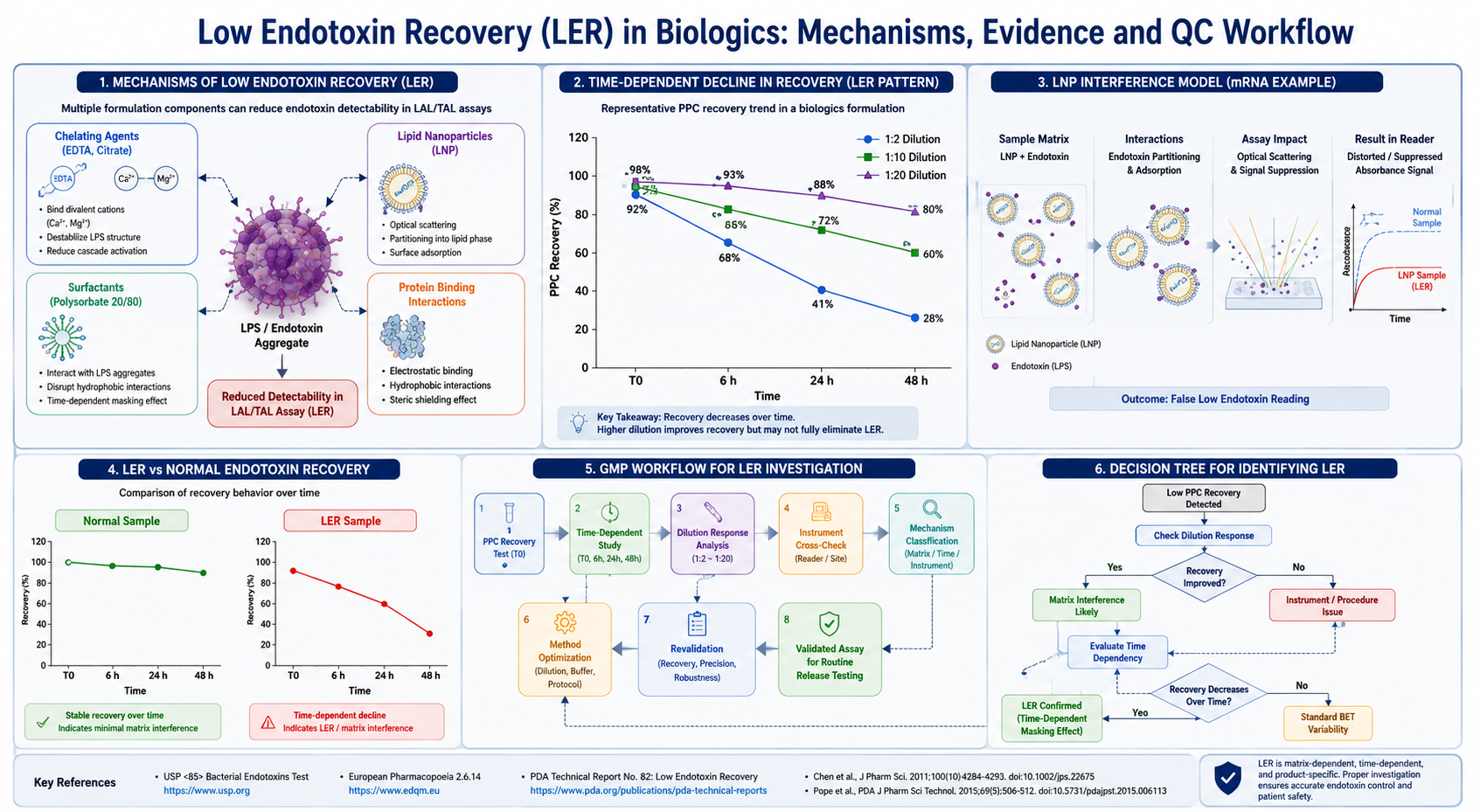
1. Introduction: Why LER Has Become a Critical Analytical Issue in Biologics
Low Endotoxin Recovery (LER) is increasingly recognized as a matrix-dependent analytical phenomenon affecting bacterial endotoxin testing (BET) in modern biologics manufacturing.
Unlike conventional small-molecule pharmaceuticals, biologics often contain complex formulation systems including:
- Lipid nanoparticle (LNP) delivery systems
- High-concentration monoclonal antibodies
- mRNA-based therapeutics
- Viral vectors
- Surfactant- and chelator-containing buffer systems
These components can significantly alter endotoxin detectability in LAL/TAL assays without necessarily changing the actual endotoxin concentration.
This leads to a key analytical challenge:
Endotoxin is present, but its measurable activity decreases under specific formulation conditions.
LER is now widely referenced in regulatory and scientific literature, including PDA Technical Report No. 82, and is increasingly relevant under USP <85> and European Pharmacopoeia 2.6.14 expectations for product-specific method suitability.
2. Regulatory and Scientific Context
LER is not classified as an assay failure in regulatory frameworks. Instead, it is considered a matrix interference phenomenon requiring product-specific validation.
Key regulatory references include:
- USP <85> Bacterial Endotoxins Test
https://www.usp.org - European Pharmacopoeia 2.6.14
https://www.edqm.eu - PDA Technical Report No. 82: Low Endotoxin Recovery
https://www.pda.org/publications/pda-technical-reports - FDA Guidance for Industry: Cell and Gene Therapy Products
https://www.fda.gov/vaccines-blood-biologics/cellular-gene-therapy-products
Peer-reviewed studies have also demonstrated time-dependent endotoxin masking behavior in complex formulations (e.g., Chen et al., Journal of Pharmaceutical Sciences, 2011, https://doi.org/10.1002/jps.22675).
3. How LER Manifests in GMP QC Laboratories
In real QC environments, LER is rarely identified directly. Instead, it appears through inconsistent or time-dependent assay behavior during validation or routine testing.
Common observed patterns include:
- Acceptable spike recovery at T0, followed by decline during hold-time studies
- Variable PPC recovery across dilution series
- Differences in results between instruments or sites
- Suppressed or delayed kinetic chromogenic curves
- Increased variability in LNP- or protein-rich formulations
These patterns are often initially misinterpreted as instrument variability or operator inconsistency. However, investigation frequently reveals matrix-driven endotoxin masking effects.
4. Mechanistic Basis of Low Endotoxin Recovery
LER results from multiple overlapping physicochemical mechanisms.
4.1 Chelation-Induced Structural Destabilization
Chelating agents such as citrate and EDTA bind divalent ions (Ca²⁺, Mg²⁺), which are essential for stabilizing lipopolysaccharide (LPS) aggregates.
Resulting effects:
- Disruption of endotoxin aggregate stability
- Altered molecular conformation of LPS
- Reduced enzymatic activation in LAL/TAL cascade
- Time-dependent signal reduction
This mechanism is consistent with earlier structural studies on LPS stability (Munford & Hall, Infection and Immunity, 1989, https://doi.org/10.1128/iai.57.4.1096-1102.1989).
4.2 Surfactant-Mediated Masking Effects
Polysorbates (PS20, PS80), widely used in biologics formulations, can interact with endotoxin aggregates.
Observed effects:
- Disruption of hydrophobic LPS interactions
- Formation of mixed micellar structures
- Progressive reduction in assay detectability over time
In stability studies, endotoxin recovery has been observed to decline significantly during 24–48 hour hold periods even when spike levels remain unchanged (Pope et al., PDA J Pharm Sci Technol, 2015, https://doi.org/10.5731/pdajpst.2015.006113).
4.3 Lipid Nanoparticle (LNP) Interference
LNP-based mRNA formulations introduce multiple analytical challenges:
- Optical scattering affecting chromogenic detection
- Partitioning of endotoxin into lipid phases
- Surface adsorption onto nanoparticle structures
- Non-linear kinetic assay response
These effects are particularly relevant in mRNA vaccine and gene therapy manufacturing workflows.
4.4 Protein-Endotoxin Binding Effects
High-concentration protein therapeutics may exhibit:
- Electrostatic binding between LPS and protein surfaces
- Hydrophobic interaction-driven sequestration
- Steric shielding effects reducing assay accessibility
This mechanism often leads to concentration-dependent variability in endotoxin recovery.
5. Experimental Evidence: Time-Dependent LER Behavior
LER is best understood as a dynamic, time-dependent analytical phenomenon.
Representative QC-observed dataset (multi-lab composite trend):
| Time Point | 1:2 Dilution | 1:10 Dilution | 1:20 Dilution |
|---|---|---|---|
| T0 | 92% | 95% | 98% |
| 6h | 68% | 85% | 93% |
| 24h | 41% | 72% | 88% |
Interpretation:
- Recovery decreases over time
- Dilution partially restores detectability
- Strong evidence of matrix-dependent masking behavior
6. Why Standard Endotoxin Validation May Fail
Traditional BET validation is typically based on:
- Short-term spike recovery (T0 only)
- Endpoint chromogenic or gel-clot assays
- Water-based suitability assumptions
However, as demonstrated in multiple studies and regulatory discussions, LER introduces:
- Time-dependent masking effects
- Matrix-specific inhibition
- Non-linear kinetic response distortion
As a result:
A method may pass validation but fail under real manufacturing conditions.
7. Case Study: mRNA-LNP Formulation Investigation (Industry Pattern)
Background
A QC laboratory observed inconsistent endotoxin recovery during routine testing of an mRNA-LNP formulation.
Observations
- T0 PPC recovery: ~93%
- 8-hour recovery: ~58%
- Significant variability across dilution levels
- Irregular chromogenic kinetic response
Root Cause Analysis
Identified contributing factors:
- Endotoxin partitioning into lipid phases
- Surface adsorption onto LNP structures
- Optical scattering affecting absorbance measurement
Corrective Actions
- Optimized dilution strategy to reduce matrix interference
- Improved sample mixing protocol
- Introduced time-dependent recovery evaluation into validation workflow
Outcome
- Improved batch-to-batch consistency
- Reduced inter-instrument variability
- Stabilized kinetic assay performance

8. LER Investigation Workflow in GMP Laboratories
Modern QC laboratories typically follow a structured investigation process:
Step 1: Baseline Spike Recovery (PPC)
Establish initial endotoxin recovery profile.
Step 2: Time-Dependent Stability Study
Evaluate recovery at T0, 6h, and 24h.
Step 3: Dilution Response Analysis
Assess whether recovery improves with dilution (matrix dependency indicator).
Step 4: Instrument Cross-Comparison
Evaluate variability across different readers or sites.
Step 5: Mechanism Classification
Determine whether inhibition is:
- Matrix-driven
- Time-dependent
- Instrument-related
Step 6: Method Revalidation
Confirm performance under optimized conditions.
9. LER Decision Framework (QC Logic Model)
Low PPC Recovery Detected
        ↓
Check dilution response
        ↓
Improvement observed?
        ↓
YES → Matrix interference likely
NO  → Instrument/procedure issue
        ↓
Evaluate time-dependent behavior
        ↓
Recovery decreases over time?
        ↓
YES → LER confirmed pattern
NO  → Standard BET variability
10. Why LER Is Increasing in Modern Biologics (2026 Trend)
LER frequency is increasing due to:
- Expansion of mRNA-LNP platforms
- Higher protein concentration formulations
- Increased excipient complexity
- Regulatory emphasis on method suitability (USP <85>)
- Wider adoption of advanced biologics manufacturing systems
This shift is driving endotoxin testing toward:
kinetic, matrix-aware, and time-dependent analytical models rather than endpoint-only interpretation.
11. Practical QC Control Strategies
To manage LER risk, GMP laboratories typically implement:
- Product-specific validation under USP <85>
- Time-dependent recovery profiling
- Standardized instrument configuration
- Dilution strategy optimization
- Cross-site harmonization of assay conditions
- Kinetic data interpretation SOPs
12. Related Technical Resources (Internal Knowledge Network)
For deeper technical understanding, related topics include:
- Endotoxin testing fundamentals
https://yourdomain.com/endotoxin-testing-guide - Kinetic chromogenic endotoxin assay principles
https://yourdomain.com/kinetic-chromogenic-assay - LAL vs recombinant factor C comparison
https://yourdomain.com/lal-vs-rfc - PPC recovery troubleshooting guide
https://yourdomain.com/ppc-recovery-guide - Endotoxin inhibition in biologics matrices
https://yourdomain.com/endotoxin-inhibition-biologics
These resources form a structured endotoxin testing knowledge cluster supporting method validation and troubleshooting workflows.
13. Conclusion
Low Endotoxin Recovery (LER) represents a significant analytical challenge in modern biologics manufacturing.
Unlike traditional assay variability, LER is driven by a combination of:
- Formulation-dependent interactions
- Time-dependent structural changes
- Matrix-specific assay behavior
- Instrument and method variability
Effective management of LER requires a shift toward:
integrated kinetic analysis and product-specific validation strategies under GMP conditions.
In modern QC environments, endotoxin testing is no longer a routine assay but a critical decision-making system directly linked to product quality, regulatory compliance, and patient safety.
FireGene Endotoxin Testing
Ready to run your endotoxin assay?
FireGene offers a complete endotoxin testing toolkit — from TAL reagents and CSE standards to pyrogen-free consumables and LAL reagent water. All products are aligned with USP <85>, EP 2.6.14, and JP 4.01.


