
Introduction
Nanomedicine is transforming modern drug delivery by enabling targeted therapy, improved pharmacokinetics, and enhanced therapeutic efficacy. However, the increasing complexity of nanomaterials has also created new challenges for endotoxin test procedures.
Nanoparticles used in drug delivery systems—such as liposomes, polymeric nanoparticles, and lipid nanoparticles—may carry bacterial endotoxins that can trigger strong immune responses. Therefore, accurate and sensitive endotoxin test methods are essential during nanomedicine development.
Among the available analytical approaches, the kinetic chromogenic endotoxin test using TAL/LAL Reagent is widely recognized as a reliable solution for endotoxin detection in nanotechnology-based pharmaceuticals.
I. Why Endotoxin Testing Is Critical for Nanomedicine
Nanomedicine products interact directly with the immune system. Even trace levels of endotoxin contamination can cause severe inflammatory responses.
Therefore, rigorous endotoxin test procedures are required throughout the development lifecycle.
Key stages where endotoxin testing is necessary include:
I. Nanoparticle synthesis
II. Drug formulation development
III. Preclinical studies
IV. Clinical manufacturing
V. Quality control release testing
Reliable endotoxin detection ensures the safety and regulatory compliance of nanomedicine products.
II. Challenges of Endotoxin Test in Nanoparticle Systems
Performing an endotoxin test in nanomedicine samples can be more complicated than testing conventional pharmaceuticals.
Common challenges include:
I. Nanoparticle interference with TAL/LAL enzymes
II. Adsorption of endotoxin onto nanoparticle surfaces
III. Optical interference in spectrophotometric assays
IV. Complex sample matrices
To address these challenges, laboratories often perform interference testing before routine endotoxin analysis.
Validated TAL/LAL reagent kits can help improve assay reliability.
https://firegene.com/products/kinetic-chromogenic-endotoxin-test-kit-tal-assay
III. Why the Kinetic Chromogenic Method Is Ideal for Nanomedicine
The kinetic chromogenic endotoxin test offers several advantages when analyzing nanoparticle formulations.
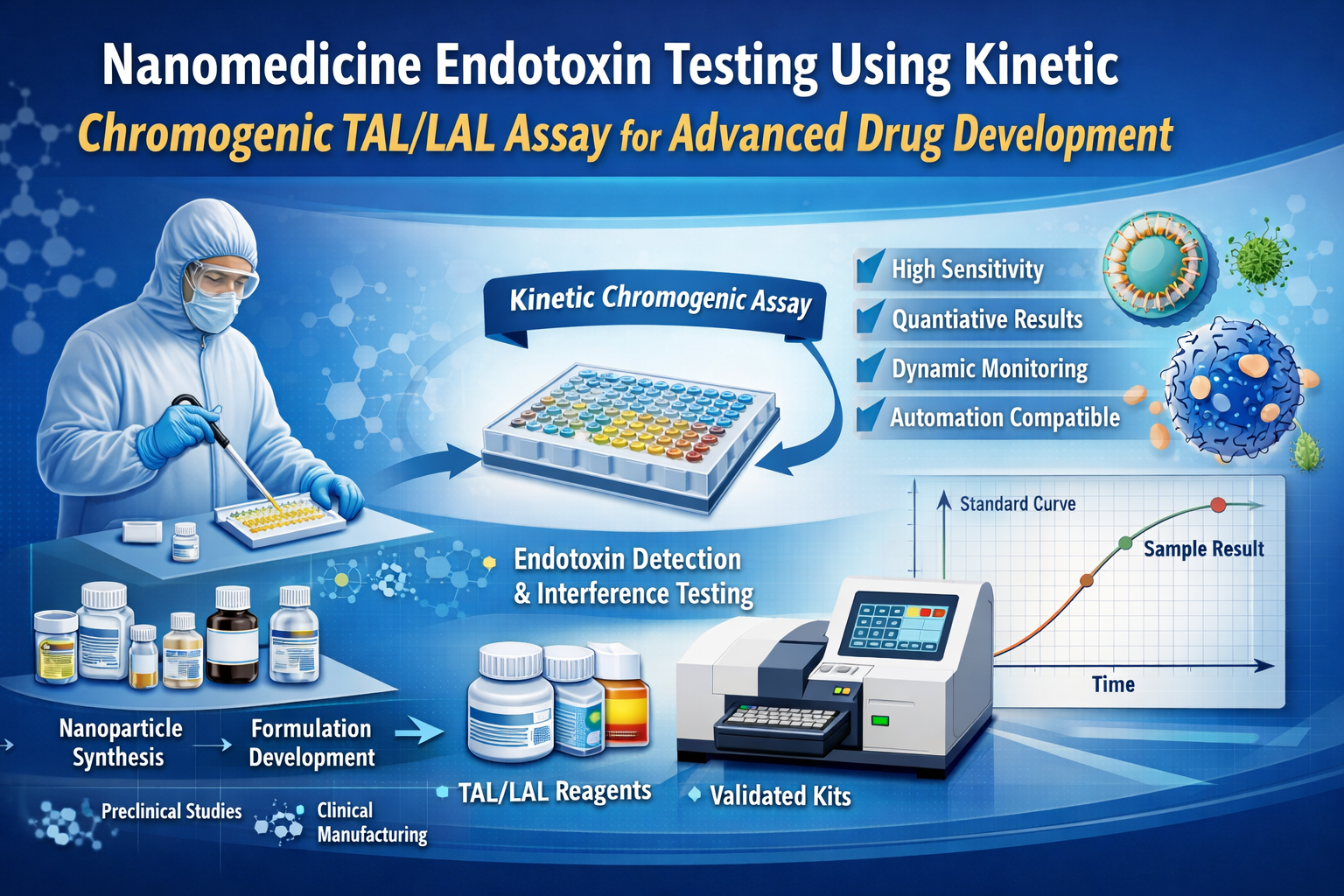
I. High sensitivity for detecting trace endotoxin levels
II. Quantitative results for accurate risk assessment
III. Dynamic monitoring of reaction kinetics
IV. Compatibility with automated microplate readers
These features make the method suitable for advanced nanotechnology-based drug development.
Researchers working in nanomedicine frequently use optimized TAL/LAL reagent systems such as those provided by FireGene.
Learn more here:
https://firegene.com/products/kinetic-chromogenic-endotoxin-test-kit-tal-assay
IV. Typical Workflow for Nanomedicine Endotoxin Testing
The endotoxin test workflow for nanomedicine samples generally includes the following steps.
I. Sample Pretreatment
Depending on nanoparticle composition, sample preparation may include:
Dilution
pH adjustment
Surfactant addition
Depyrogenation of containers
These steps help minimize interference during the endotoxin test.
II. Interference Test
An interference test determines whether the sample matrix affects TAL/LAL activity.
The process typically involves:
I. Spiking endotoxin into the test sample
II. Measuring recovery rate
III. Ensuring recovery between 50% and 200%
This validation step is essential before performing routine endotoxin test analysis.
III. Kinetic Chromogenic Reaction
The endotoxin test reaction is performed in a microplate format.
Steps include:
I. Add sample and endotoxin standards to the plate
II. Add TAL/LAL reagent
III. Incubate at 37°C
IV. Monitor absorbance changes dynamically
The reaction kinetics allow precise quantification of endotoxin levels.
FireGene provides high-sensitivity kits designed for these workflows:
https://firegene.com/products/kinetic-chromogenic-endotoxin-test-kit-tal-assay
IV. Data Interpretation
The instrument software calculates endotoxin concentration based on the kinetic standard curve.
Accurate data interpretation ensures that the nanomedicine formulation meets regulatory endotoxin limits.
Consistent use of validated reagents improves endotoxin test reproducibility.
V. Future Trends in Nanomedicine Endotoxin Testing
As nanotechnology continues to evolve, endotoxin test methods must adapt to increasingly complex formulations.
Future trends include:
I. High-throughput endotoxin detection platforms
II. Improved TAL/LAL reagent sensitivity
III. Automated endotoxin test workflows
IV. Integration with pharmaceutical QC systems
These innovations will help laboratories maintain strict endotoxin control in advanced drug products.
Conclusion
The rapid development of nanomedicine has increased the importance of reliable endotoxin test strategies. The kinetic chromogenic TAL/LAL assay provides a sensitive, quantitative, and scalable solution for endotoxin detection in nanoparticle-based drug formulations.
By implementing validated endotoxin test workflows and using high-quality TAL/LAL reagent systems, researchers and pharmaceutical manufacturers can ensure product safety and regulatory compliance.
To support nanomedicine research and pharmaceutical quality control, FireGene provides advanced endotoxin detection solutions designed for modern laboratories.
Explore the FireGene kinetic chromogenic endotoxin test kit:
https://firegene.com/products/kinetic-chromogenic-endotoxin-test-kit-tal-assay
FireGene, light your research with passion, innovation, and profession.


