
Why Cardiomyocyte Isolation Remains a Critical Challenge in Cardiac Research
Cardiovascular diseases remain the leading cause of mortality worldwide, driving continuous demand for more accurate and physiologically relevant cardiac research models. At the center of this effort are cardiomyocytes, the contractile cells responsible for heart function. Whether in drug discovery, disease modeling, or regenerative medicine, access to high-quality cardiomyocytes is essential.
However, isolating viable cardiomyocytes from native heart tissue is far from straightforward. The heart is a densely structured, fibrotic organ, composed of tightly interconnected cells embedded within a complex extracellular matrix. Conventional dissociation methods often result in:
· Low cardiomyocyte yield
· Significant cell damage or death
· Loss of structural and functional integrity
· Biased recovery toward non-myocyte populations such as fibroblasts
These limitations can compromise downstream analyses, particularly in single-cell sequencing or functional assays where cell quality directly affects data reliability. As a result, optimized dissociation strategies have become a critical bottleneck in cardiac research workflows.
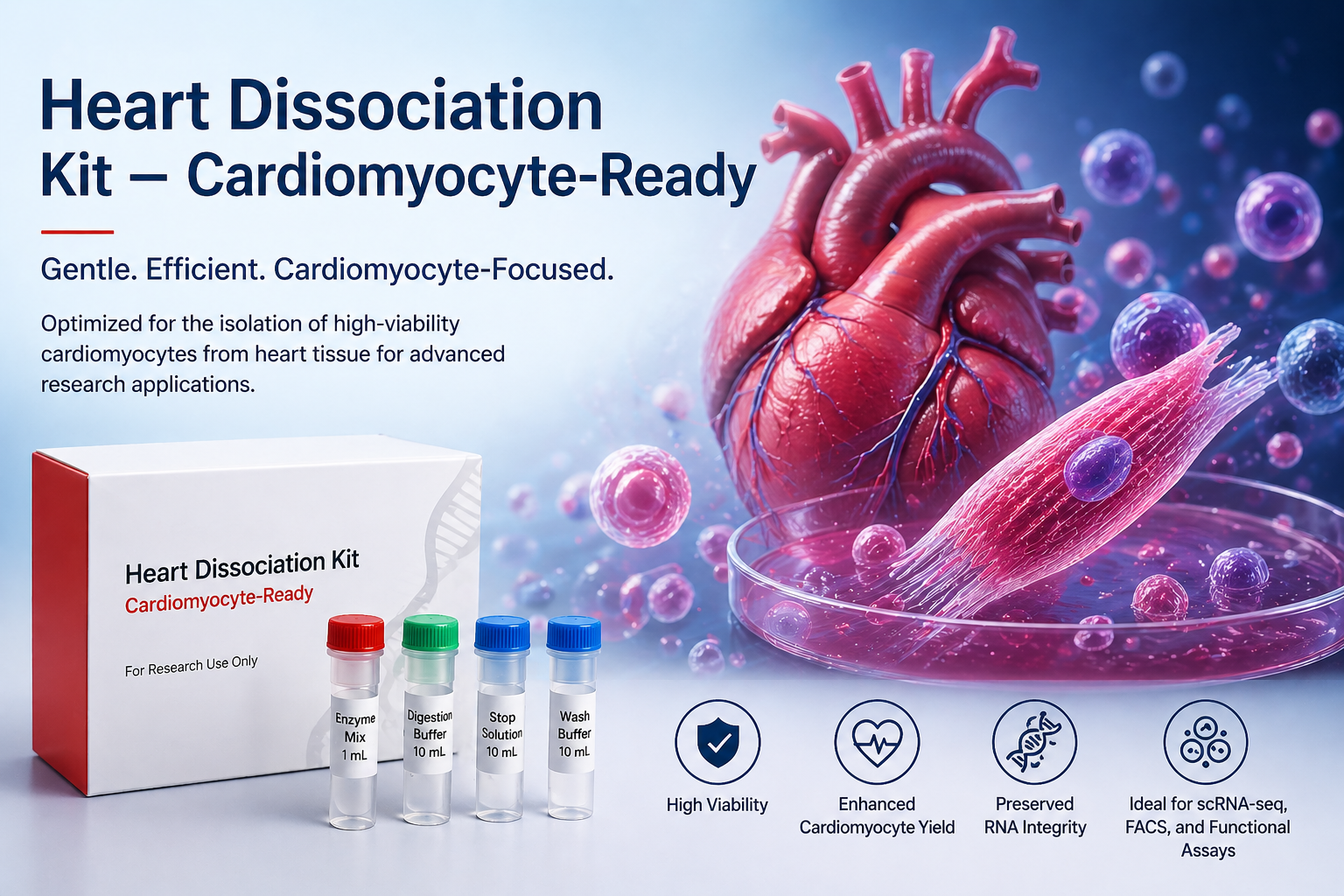
The FireGene Heart Dissociation Kit – Cardiomyocyte-Ready is designed to address these challenges by enabling efficient and gentle isolation of cardiomyocytes while preserving their viability and biological characteristics.
What Is the FireGene Heart Dissociation Kit – Cardiomyocyte-Ready?
The FireGene Heart Dissociation Kit – Cardiomyocyte-Ready is a specialized tissue dissociation system developed to process heart tissue into high-quality single-cell suspensions, with a particular emphasis on cardiomyocyte preservation.
Unlike generic dissociation kits, this system is optimized for the unique structural and biological properties of cardiac tissue. It integrates:
· A carefully balanced enzymatic formulation targeting extracellular matrix components
· Conditions designed to minimize mechanical and enzymatic stress
· A workflow that supports consistent and reproducible results
The “Cardiomyocyte-Ready” designation reflects a key advantage: the protocol is tuned to improve the recovery of intact, functional cardiomyocytes, rather than simply maximizing total cell yield. This is particularly important because cardiomyocytes are larger, more fragile, and more sensitive to enzymatic over-digestion compared to other cardiac cell types.
In practical terms, this means researchers can obtain cell populations that are better suited for:
· Transcriptomic profiling
· Functional assays
· High-content imaging
· Downstream cell sorting or enrichment
From Tissue to Single Cells: How the Workflow Supports Cell Integrity
Efficient heart tissue dissociation requires a delicate balance between thorough digestion and cell preservation. The FireGene Cardiomyocyte-Ready workflow is structured to achieve both.
 Step 1: Tissue Preparation
Fresh or appropriately preserved heart tissue is first processed into smaller fragments to increase enzyme accessibility. Proper handling at this stage is essential to minimize mechanical stress.
Step 2: Enzymatic Digestion
The kit employs an optimized enzyme blend—typically involving collagenase and complementary proteases—to break down the extracellular matrix without excessively damaging cells. The digestion conditions are calibrated to:
· Maintain cell membrane integrity
· Prevent excessive degradation of surface markers
· Reduce cardiomyocyte fragmentation
Step 3: Gentle Mechanical Dissociation
Following enzymatic treatment, mild mechanical disruption helps release individual cells. The protocol avoids harsh trituration, which can shear large cardiomyocytes.
Step 4: Filtration and Cleanup
The resulting suspension is filtered to remove debris and undigested tissue, yielding a uniform single-cell population suitable for downstream applications.
Technical Advantages
This workflow offers several key benefits:
· High cell viability, particularly for fragile cardiomyocytes
· Preservation of RNA integrity, critical for single-cell omics
· Reduced batch-to-batch variability
· Compatibility with both human and animal heart tissues
By maintaining both structural and molecular integrity, the kit supports more accurate biological interpretation.
Enabling Advanced Applications in Cardiac Research
High-quality cardiomyocyte isolation is foundational to a wide range of modern research applications. The FireGene Heart Dissociation Kit – Cardiomyocyte-Ready is particularly well-suited for the following:
Single-Cell and Spatial Transcriptomics
Single-cell RNA sequencing (scRNA-seq) requires intact, viable cells with minimal transcriptional artifacts. Poor dissociation can lead to:
· RNA degradation
· Stress-induced gene expression changes
· Underrepresentation of cardiomyocytes
By preserving cell quality, the kit enables more accurate cellular profiling and better resolution of cardiac cell heterogeneity.
Cardiotoxicity and Drug Screening
Cardiomyocytes are a primary target in safety pharmacology. Reliable isolation of functional cells allows researchers to:
· Assess drug-induced electrophysiological changes
· Evaluate contractility and calcium handling
· Detect early signs of cardiotoxicity
High-quality primary cardiomyocytes improve the predictive value of in vitro assays.
Cardiac Disease Modeling
From hypertrophy and fibrosis to heart failure, many cardiac diseases involve complex cellular interactions. Access to well-preserved cardiomyocytes supports:
· Mechanistic studies
· Biomarker discovery
· Validation of therapeutic targets
Regenerative Medicine and Stem Cell Research
Primary cardiomyocytes serve as a benchmark for evaluating stem cell-derived cardiac cells. Accurate comparisons require:
· Authentic cellular morphology
· Preserved gene expression profiles
The ability to isolate native cardiomyocytes with high fidelity enhances the development of regenerative strategies.
Why Cardiomyocyte-Optimized Dissociation Matters
Not all dissociation methods are created equal. Standard protocols often prioritize total cell yield, which can come at the expense of cell quality and subtype representation. For cardiomyocytes, this trade-off is particularly problematic.
 Limitations of Conventional Methods
· Over-digestion leading to cell fragmentation
· Low recovery of large, delicate cardiomyocytes
· Enrichment of more resilient cell types (e.g., fibroblasts)
· Reduced reproducibility across experiments
Advantages of a Cardiomyocyte-Ready Approach
A targeted dissociation strategy offers clear benefits:
· Improved cardiomyocyte yield and viability
· Better preservation of functional and molecular characteristics
· Enhanced consistency across samples and studies
· More reliable downstream data
Positioning the FireGene Solution
The FireGene Heart Dissociation Kit – Cardiomyocyte-Ready addresses a critical gap in cardiac research workflows by combining:
· Tissue-specific optimization
· Gentle yet effective dissociation
· Compatibility with advanced analytical platforms
In an era where data quality is paramount, the importance of upstream sample preparation cannot be overstated. The choice of dissociation method directly influences experimental outcomes, from sequencing accuracy to functional assay reliability.
Conclusion
As cardiac research continues to evolve toward higher resolution and greater complexity, the need for robust, cardiomyocyte-focused sample preparation tools becomes increasingly clear. The FireGene Heart Dissociation Kit – Cardiomyocyte-Ready provides a refined solution for researchers seeking to isolate high-quality cardiomyocytes from heart tissue.
By prioritizing cell integrity, viability, and reproducibility, it supports more reliable insights across applications ranging from single-cell genomics to drug discovery. For researchers aiming to unlock the full potential of cardiac biology, optimized dissociation is not just a preparatory step—it is a decisive factor in experimental success.
FireGene, light your research with passion, innovation, and profession.
FireGene Single-Cell Sample Prep
Looking for validated dissociation kits?
FireGene's tissue dissociation kits are optimized for specific organ types — brain, tumor, liver, GI, reproductive, and more. Validated for 10x Genomics Chromium and BD Rhapsody workflows.


