
Introduction
Single-cell analysis has transformed how researchers study vascular biology, tumor angiogenesis, and cardiovascular disease. However, one persistent bottleneck remains: efficiently isolating high-quality single cells from blood vessel tissues.
Unlike softer tissues, vascular samples present a unique challenge. Their dense extracellular matrix (ECM), structural integrity, and multiple cell populations make dissociation both technically demanding and highly sensitive to protocol variations.
As a result, many researchers struggle with:
- Low cell yield
- Poor cell viability
- Cell aggregation
- Irreproducible results
This guide provides a complete, practical framework for improving vascular tissue dissociation outcomes—while introducing a smarter strategy:
👉 Validate first with a 2-test trial pack, then scale with confidence.
Understanding the Complexity of Blood Vessel Tissue
Blood vessels are not simple structures. They are composed of multiple tightly organized layers:
- Endothelial cells (ECs): Line the inner surface
- Smooth muscle cells (SMCs): Provide structural support
- Pericytes: Regulate capillary stability
- Extracellular matrix (ECM): Rich in collagen and elastin
The ECM acts as a protective scaffold, but it also creates a major barrier during tissue dissociation.
Traditional enzymatic digestion often fails because:
- Collagen is not fully degraded
- Elastin remains intact
- Cells remain trapped in matrix fragments
This leads to incomplete dissociation and low-quality samples.
Why Traditional Methods Fall Short
Many labs still rely on:
- Manual enzyme preparation
- Non-optimized digestion conditions
- Generic protocols
These approaches introduce variability and risk:
1. Under-Digestion
- Tissue remains clumped
- Low cell recovery
2. Over-Digestion
- Cell membrane damage
- Reduced viability
- Loss of surface markers
3. Operator Variability
- Inconsistent results across experiments
The Key to Success: Controlled, Optimized Dissociation
A successful vascular dissociation workflow depends on:
✔ Balanced Enzyme Composition
Efficiently breaks down ECM without harming cells
✔ Standardized Protocol
Reduces variability across users
✔ Controlled Incubation Conditions
Maintains cell integrity
👉 A validated solution designed specifically for vascular tissue:
🔗 https://firegene.com/products/blood-vessel-dissociation-kit-fg-ba3310
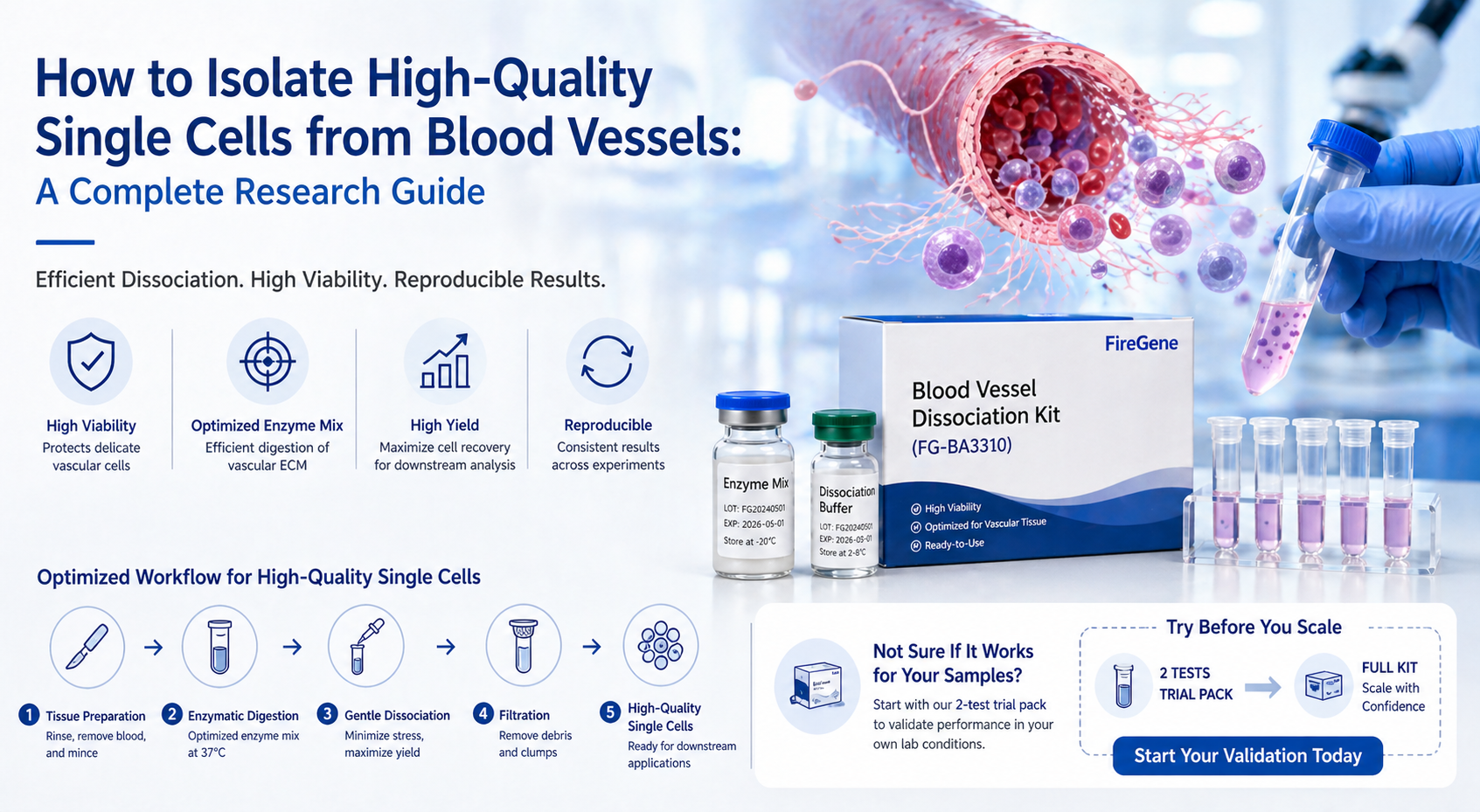
Step-by-Step Optimized Workflow
Step 1: Tissue Preparation
- Rinse with PBS
- Remove blood contamination
- Mince into small fragments
Step 2: Enzymatic Digestion
- Add optimized enzyme mix
- Incubate at 37°C
- Avoid over-digestion
Step 3: Gentle Mechanical Dissociation
- Pipette slowly
- Avoid vortexing
Step 4: Filtration
- Use cell strainers (40–70 μm)
Step 5: Collection and Analysis
For similar workflows in neural tissues:
🔗 https://firegene.com/products/mouse-brain-dissociation-kit-fg-ba3305
Why Validation Matters More Than Ever
Even with optimized protocols, sample variability remains a major factor:
- Species differences
- Disease states
- Storage conditions
This means:
👉 A protocol that works in one lab may fail in another.
The Smarter Approach: Start with 2 Tests
Instead of committing to a full kit upfront, leading labs now adopt a validation-first strategy.
Benefits of a 2-Test Trial Pack
- Test compatibility with your samples
- Optimize workflow without risk
- Avoid wasting expensive reagents
- Make data-driven purchasing decisions
👉 Start your validation here:
🔗 https://firegene.com/products/blood-vessel-dissociation-kit-fg-ba3310
Applications of High-Quality Vascular Cell Suspensions
Once properly dissociated, vascular cells can be used for:
- Single-cell RNA sequencing
- Flow cytometry
- Cell culture
- Drug screening
For downstream preservation:
🔗 https://firegene.com/products/universal-cell-freezing-kit-fg-ba3309
Scaling After Validation
Once your workflow is confirmed:
- Transition to full-size kits
- Standardize your protocol
- Increase throughput
This ensures:
- Consistent results
- Reduced repeat experiments
- Lower long-term costs
Conclusion
Efficient blood vessel dissociation is not just about technique—it’s about strategy.
👉 Validate your workflow with a 2-test trial pack
👉 Optimize your protocol
👉 Scale with confidence
Start here:
🔗 https://firegene.com/products/blood-vessel-dissociation-kit-fg-ba3310
FireGene, light your research with passion, innovation, and profession.


