
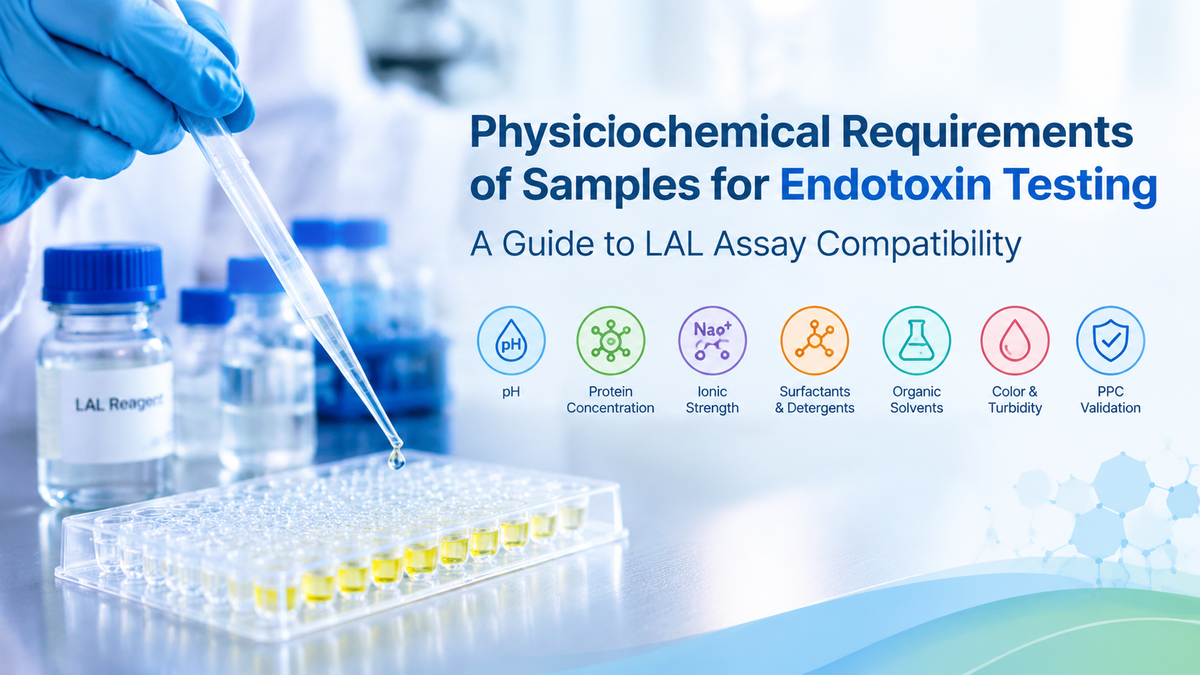
Endotoxin testing is a critical quality control step in pharmaceutical, biotechnology, and medical device manufacturing. Although Limulus Amebocyte Lysate (LAL) and recombinant Factor C (rFC) assays are highly sensitive methods for endotoxin detection, the physicochemical properties of samples can significantly influence assay performance. Parameters such as pH, protein concentration, ionic strength, surfactants, organic solvents, turbidity, and sample color may cause endotoxin inhibition or enhancement, leading to inaccurate results. Understanding sample compatibility requirements and performing interference testing are essential for reliable endotoxin quantification. This article discusses key sample preparation considerations for successful endotoxin testing using LAL-based methods.
1. Introduction to Sample Compatibility in Endotoxin Testing
Endotoxin testing is widely used to detect bacterial endotoxins in injectable drugs, biologics, vaccines, medical devices, and pharmaceutical raw materials.
The most commonly used methods include:
· Gel Clot LAL assay
· Kinetic Turbidimetric LAL assay
· Kinetic Chromogenic LAL assay
· Recombinant Factor C (rFC) assay
These methods rely on biological or enzymatic reactions that are highly sensitive to endotoxin molecules. However, this sensitivity also means that the assay system can be affected by components present in the sample matrix.
A sample may contain substances that:
· Inhibit endotoxin detection
· Enhance endotoxin activity
· Interfere with optical measurement
· Affect enzyme reaction kinetics
Therefore, evaluating the physicochemical properties of samples is an essential step before endotoxin quantification.
2. pH Requirements for Endotoxin Testing
2.1 Why Sample pH Matters
The LAL reaction depends on a cascade of enzymatic activation involving:
· Factor C
· Factor B
· Proclotting enzyme
These enzymes require suitable environmental conditions to maintain activity.
Generally, LAL assays perform optimally when sample pH is within:
pH 6.0–8.0
with a preferred range around:
pH 6.5–7.5
2.2 Effects of Extreme pH
Acidic Samples
Low pH samples may:
· Reduce enzyme activity
· Alter endotoxin structure
· Decrease endotoxin recovery
Examples:
· Organic acid solutions
· Acidic pharmaceutical formulations
Alkaline Samples
High pH samples may:
· Affect protein stability
· Alter enzymatic reactions
· Generate inaccurate endotoxin results
2.3 Solutions for pH-Related Interference
When sample pH is outside the acceptable range:
· Dilute the sample with endotoxin-free water
· Adjust pH using endotoxin-free reagents
· Perform Positive Product Control (PPC) testing
3. Sample Solubility and Homogeneity
A suitable endotoxin testing sample should be:
✔ Fully dissolved
✔ Uniformly mixed
✔ Free of visible particles or precipitation
3.1 Why Homogeneity Is Important
Endotoxin molecules may:
· Bind to particles
· Associate with aggregates
· Adsorb onto surfaces
Uneven distribution can cause:
· Poor reproducibility
· High variation between replicates
· False low or high results
3.2 Challenging Sample Types
Some samples require special preparation:
|
Sample Type |
Potential Challenge |
|
Protein therapeutics |
Aggregation and endotoxin binding |
|
Lipid nanoparticles |
Endotoxin adsorption |
|
Cell lysates |
High turbidity |
|
Tissue extracts |
Complex matrix effects |
|
Vaccine formulations |
Protein and adjuvant interference |
4. Influence of Protein Concentration on Endotoxin Detection
Biological products often contain high concentrations of proteins, including:
· Monoclonal antibodies
· Recombinant proteins
· Plasma-derived products
· Vaccines
High protein levels may interfere with LAL assays through:
· Endotoxin binding
· Enzyme inhibition
· Increased sample viscosity
Protein-Related Interference Control
To confirm assay compatibility, laboratories should perform:
Inhibition/Enhancement Testing (IET)
or:
Positive Product Control (PPC)
A valid assay typically requires endotoxin recovery within:
50%–200%
This confirms that the sample matrix does not significantly interfere with endotoxin detection.
5. Effects of Salt Concentration and Ionic Strength
Many pharmaceutical samples contain buffers such as:
· Sodium chloride
· Phosphate-buffered saline (PBS)
· Tris buffer
· Citrate buffer
High ionic strength may affect:
· Endotoxin release
· Protein interactions
· Enzyme activity
Best Practice
For endotoxin testing:
· Avoid excessive salt concentration
· Validate sample dilution conditions
· Use endotoxin-free water for sample preparation
6. Surfactants and Detergents in Endotoxin Assays
Surfactants are frequently used in pharmaceutical formulations to improve stability and solubility.
Common examples include:
· Tween-20
· Tween-80
· Triton X-100
· SDS
· CHAPS
However, these compounds can influence LAL reactions.

Potential Effects
Surfactants may:
Inhibit endotoxin detection
Result:
False-negative results
or:
Enhance endotoxin activity
Result:
False-positive results
Sample Types Requiring Special Attention
· Liposomal drugs
· Nanomedicine formulations
· Protein formulations
· Drug delivery systems
7. Impact of Organic Solvents
Organic solvents may damage the biological components of LAL reagents.
Examples:
· Ethanol
· Methanol
· DMSO
· Acetonitrile
High concentrations may:
· Denature enzymes
· Reduce assay sensitivity
· Affect endotoxin recovery
Recommended Approach
When organic solvents are present:
· Minimize solvent concentration
· Validate compatibility through PPC testing
· Use appropriate sample dilution
8. Sample Color and Optical Interference
Kinetic chromogenic LAL assays measure color development through absorbance detection.
Therefore, strongly colored samples may interfere with optical measurement.
Examples:
· Plant extracts
· Blood-derived products
· Colored pharmaceutical formulations
Possible Problems
Sample color may cause:
· Increased background absorbance
· Incorrect endotoxin calculation
· Poor standard curve correlation
Recommended Controls
Use:
· Sample blank wells
· Appropriate dilution
· Matrix validation
9. Turbidity and Particle Interference
Sample turbidity is especially important for:
Kinetic Turbidimetric LAL assays
Particles can influence light transmission and create inaccurate readings.
Common problematic samples:
· Cell suspensions
· Tissue homogenates
· Lipid-based formulations
Solutions
Possible strategies include:
· Centrifugation
· Filtration (when appropriate)
· Sample dilution
· Alternative endotoxin detection methods
10. Importance of Endotoxin-Free Materials
Even if the sample itself is compatible, contamination from laboratory materials can affect results.
Common contamination sources:
· Pipette tips
· Tubes
· Water
· Containers
Recommended Materials
Use:
· Endotoxin-free tubes
· Pyrogen-free pipette tips
· LAL Reagent Water (LRW)
· Depyrogenated glassware
11. Maximum Valid Dilution (MVD) Considerations
Sample dilution is commonly used to reduce interference.
The maximum valid dilution is calculated as:
MVD=Endotoxin Limit×Sample ConcentrationλMVD = \frac{Endotoxin\ Limit \times Sample\ Concentration}{\lambda}
Where:
· MVD = Maximum Valid Dilution
· Endotoxin Limit = Product-specific endotoxin acceptance limit
· λ = Sensitivity of LAL reagent
Proper dilution helps balance:
· Interference reduction
· Detection sensitivity
12. PPC Recovery: The Key Validation Step
Positive Product Control (PPC) is essential for confirming sample compatibility.
During PPC testing:
A known amount of endotoxin standard is added to the sample matrix.
The expected recovery range is:
50%–200%
PPC Results Interpretation
|
PPC Recovery |
Interpretation |
|
<50% |
Sample inhibition |
|
50–200% |
Acceptable compatibility |
|
>200% |
Sample enhancement |
13. Best Practices for Endotoxin Sample Preparation
A reliable workflow includes:
Step 1: Evaluate Sample Properties
Check:
· pH
· Protein concentration
· Buffer composition
· Solvent content
· Color
· Turbidity
Step 2: Optimize Sample Dilution
Determine:
· Appropriate dilution factor
· MVD range
· Detection sensitivity
Step 3: Perform Interference Testing
Conduct:
· PPC recovery testing
· Matrix validation
Step 4: Perform Endotoxin Quantification
Use:
· Gel clot LAL
· Kinetic chromogenic LAL
· Kinetic turbidimetric LAL
· Recombinant Factor C assays
14. Conclusion
The physicochemical properties of samples play a critical role in endotoxin testing accuracy. Factors including pH, protein concentration, ionic strength, surfactants, organic solvents, turbidity, and sample color can significantly influence LAL assay performance.
Proper sample preparation, appropriate dilution, and PPC recovery validation are essential to ensure reliable endotoxin measurement.
For pharmaceutical and biotechnology applications, successful endotoxin testing is not only dependent on the sensitivity of the assay kit but also on understanding and controlling sample matrix effects.
A well-designed sample compatibility strategy ensures accurate bacterial endotoxin detection and supports compliance with global quality standards.


