
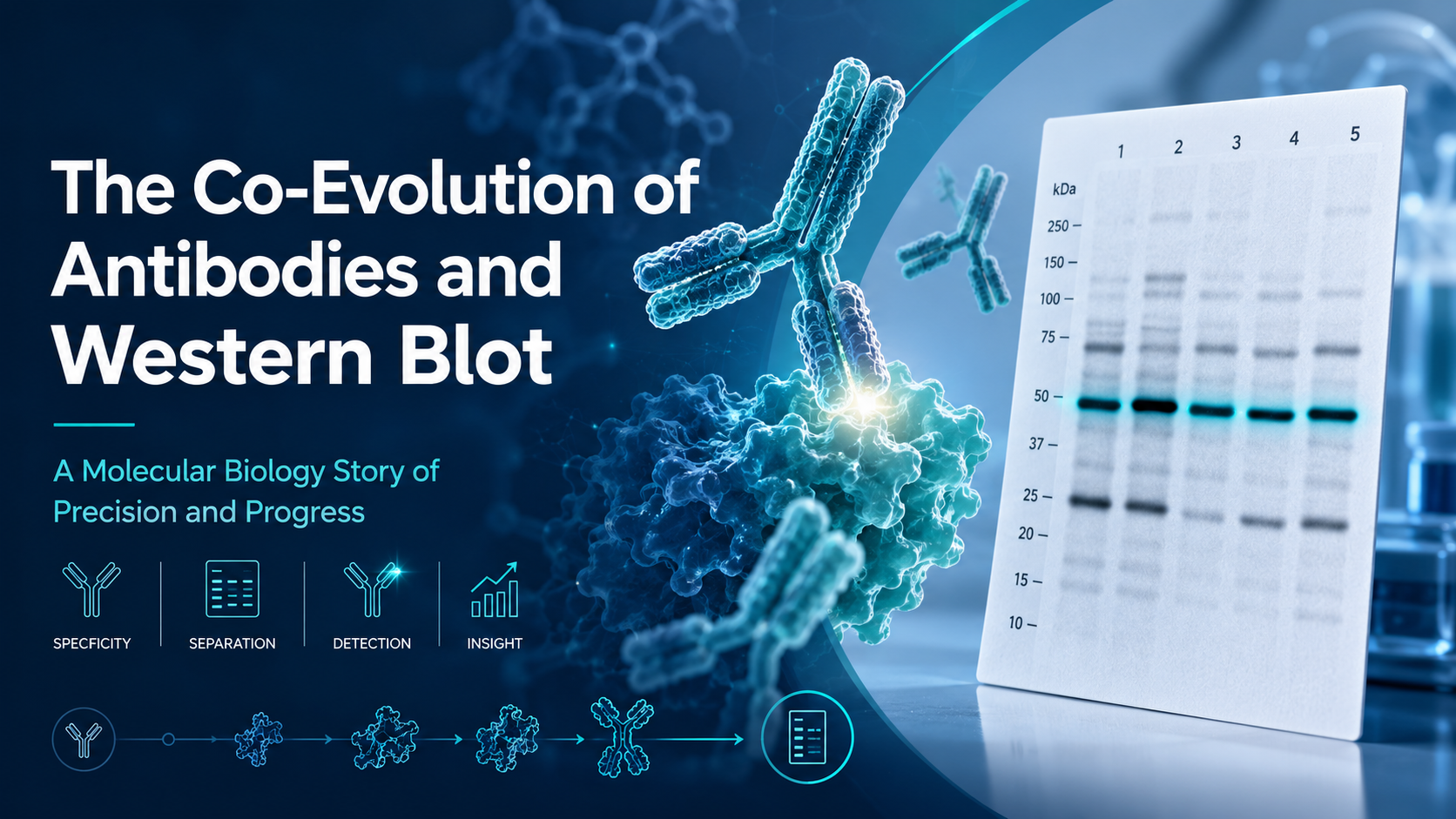
Introduction: Why Antibodies Define the Power of Western Blot
Antibodies are immunoglobulin proteins produced by plasma cells in response to antigen exposure. Their defining feature is high specificity binding to target antigens, making them indispensable molecular recognition tools in biological systems.
Western Blot (WB), also known as immunoblotting, is a widely used analytical technique for detecting specific proteins within complex biological samples such as cell lysates or tissue extracts. It is one of the most fundamental and widely adopted methods in molecular biology, biomedical research, drug discovery, and clinical diagnostics.
At the core of Western Blot lies a simple but powerful principle:
Protein separation followed by antibody-based detection.
In this system, antibodies determine the specificity, sensitivity, and reliability of the entire assay. Conversely, Western Blot has provided a standardized and scalable platform for antibody validation and application, driving continuous innovation in antibody engineering.
The two have therefore evolved in a tightly coupled, mutually reinforcing relationship—antibodies enable Western Blot, and Western Blot accelerates antibody advancement.
1. The Foundation of Antibodies: From Immune Response to Molecular Tools
1.1 Early Discovery of Humoral Immunity
The concept of antibodies originated from studies on immune protection in the late 19th century. In 1890, Emil von Behring and Shibasaburo Kitasato demonstrated that serum from immunized animals could neutralize toxins, establishing the foundation of humoral immunity.
This discovery marked the first evidence that blood contains specific factors capable of recognizing and neutralizing pathogens—what we now call antibodies.
1.2 Structural Understanding of Immunoglobulins
By the mid-20th century, antibodies were identified as gamma globulin proteins (IgG). In 1959, the structural model of antibodies was elucidated, revealing a Y-shaped molecule composed of:
· Variable regions (Fab): responsible for antigen recognition
· Constant region (Fc): mediates immune effector functions
This modular architecture explained the molecular basis of antigen specificity and laid the theoretical foundation for immunodetection technologies.
1.3 From Polyclonal to Monoclonal Antibodies
Early antibody preparations were polyclonal, derived directly from animal serum. Although easy to produce, they suffered from batch variability and cross-reactivity, limiting their precision in analytical applications.
A major breakthrough came in 1975, when Köhler and Milstein developed hybridoma technology, enabling the production of monoclonal antibodies (mAbs). These antibodies are derived from a single B-cell clone and recognize a single epitope, offering:
· High specificity
· Batch-to-batch consistency
· Reduced background noise
Monoclonal antibodies became the cornerstone of modern Western Blot assays.
2. The Emergence of Western Blot: From Molecular Separation to Protein Identification
2.1 The Blotting Technology Revolution
Blotting techniques introduced a conceptual shift in molecular biology: separating biomolecules by electrophoresis and transferring them onto membranes for targeted detection.
· Southern blot (1975): DNA detection
· Northern blot: RNA detection
These methods established a universal principle:
Molecules can be separated, immobilized, and probed with specific molecular recognition tools.
2.2 Birth of Western Blot
In 1979, Towbin and colleagues developed protein transfer from SDS-PAGE gels to nitrocellulose membranes, enabling antibody-based protein detection. This method was later named “Western Blot” in 1981 by W. Neal Burnette.
Western Blot integrates three essential components:
1. Protein separation (SDS-PAGE)
2. Protein transfer to membrane (NC or PVDF)
3. Antibody-based detection
This workflow allowed researchers to identify specific proteins within complex mixtures for the first time with high specificity.
3. Antibodies as the Core Determinant of Western Blot Performance
Western Blot relies entirely on antibody-antigen interactions. The quality of antibodies directly determines:
· Band specificity
· Signal-to-noise ratio
· Detection sensitivity
· Reproducibility
Without high-quality antibodies, even optimized electrophoresis and imaging systems cannot produce reliable results.
3.1 Primary and Secondary Antibodies
Western Blot typically employs a two-antibody system:
· Primary antibody: binds specifically to the target protein epitope
· Secondary antibody: recognizes the primary antibody and carries a detection label (HRP, fluorescent dye, etc.)
This design provides signal amplification, significantly improving sensitivity.
3.2 Signal Amplification Systems
Enzyme-linked detection systems, particularly HRP-based chemiluminescence (ECL), enable detection of proteins at extremely low abundance levels. Modern ultra-sensitive substrates have pushed detection limits from nanogram to picogram ranges.
4. Technological Co-Evolution: Antibodies and Western Blot Advancing Together
4.1 Evolution of Antibody Technologies
Antibody engineering has undergone three major stages:
1. Polyclonal antibody era
· High variability and background noise
· Limited specificity
2. Monoclonal antibody era
· Single epitope recognition
· High specificity and reproducibility
· Became the standard for Western Blot
3. Recombinant and engineered antibody era
Modern advances include:
· Recombinant antibodies with zero batch variability
· Humanized antibodies for improved compatibility
· Nanobodies with small size and high tissue penetration
· Antibodies targeting post-translational modifications (phosphorylation, acetylation)
These innovations significantly expand the analytical capability of Western Blot.

4.2 Improvements in Western Blot Workflows
Western Blot has also evolved into a highly standardized analytical platform.
Protein Transfer Technology
Transition from slow capillary transfer to:
· Wet transfer systems
· Semi-dry transfer systems
· Rapid dry transfer systems
Transfer time has been reduced from overnight incubation to as little as 5–30 minutes.
Detection Systems
Modern Western Blot now uses:
· Enhanced chemiluminescence (ECL)
· Fluorescent multiplex detection
· Digital imaging systems
These allow multi-target detection and improved quantification.
Automation and Standardization
Automation has transformed Western Blot into a reproducible platform:
· Pre-cast gels
· Automated washing and incubation systems
· Digital imaging and analysis software
These improvements reduce operator variability and improve data consistency.
5. Antibody Validation: Western Blot as the Gold Standard
Western Blot is widely regarded as the gold standard for antibody validation.
Before commercialization, antibodies are typically tested using Western Blot to confirm:
· Target specificity
· Absence of non-specific bands
· Performance in denatured protein conditions
This validation process ensures reliability in downstream applications.
As a result, Western Blot has directly driven the standardization of antibody production and quality control across the biotechnology industry.
6. Future Trends: Toward High-Throughput and Digital Protein Analysis
Despite its maturity, Western Blot continues to evolve.
6.1 Next-Generation Antibodies
Future antibody technologies will focus on:
· Multi-epitope engineered antibodies
· Highly specific low-abundance protein detection
· Improved antibodies for membrane proteins and modified proteins
6.2 Fully Automated Western Blot Systems
Emerging platforms aim to integrate:
· Sample preparation
· Electrophoresis
· Transfer
· Detection
into a single automated workflow, eliminating manual variability.
6.3 Digital and Quantitative Western Blot
Digital imaging systems now enable:
· Pixel-based quantification
· Linear dynamic range expansion
· More accurate relative protein quantification
This moves Western Blot closer to absolute quantification capabilities.
6.4 Integration with Omics Technologies
Western Blot is increasingly integrated with:
· Mass spectrometry
· Single-cell sequencing
· AI-based protein network analysis
These integrations expand its role from single-protein detection to systems-level biological interpretation.
Conclusion: A Mutual Evolution Driving Life Science Innovation
The history of antibodies and Western Blot represents a classic example of co-evolution between molecular tools and analytical technologies.
Antibodies provide the molecular specificity required for protein detection, while Western Blot offers a structured platform that has driven antibody refinement, standardization, and industrialization.
Today, despite the emergence of high-throughput proteomics and sequencing-based technologies, Western Blot remains a gold-standard protein detection method due to its:
· High specificity
· Cost-effectiveness
· Operational flexibility
· Visual interpretability
Together, antibodies and Western Blot continue to form the backbone of protein analysis in life science research, biomedical innovation, and therapeutic development.
FireGene, light your research with passion, innovation, and profession.


