
Introduction
Monoclonal antibodies (mAbs) have become one of the most important classes of biological therapeutics, transforming modern medicine in areas such as cancer treatment, autoimmune diseases, infectious disease research, and targeted therapies. The foundation of successful monoclonal antibody development is the ability to efficiently identify and isolate high-quality antibody-producing hybridoma clones.
Traditional hybridoma screening methods often involve multiple rounds of cell culture, antibody detection, and limiting dilution cloning. Although effective, these workflows can be labor-intensive, time-consuming, and limited in throughput. With the increasing demand for high-affinity antibodies, researchers require faster and more efficient screening technologies.
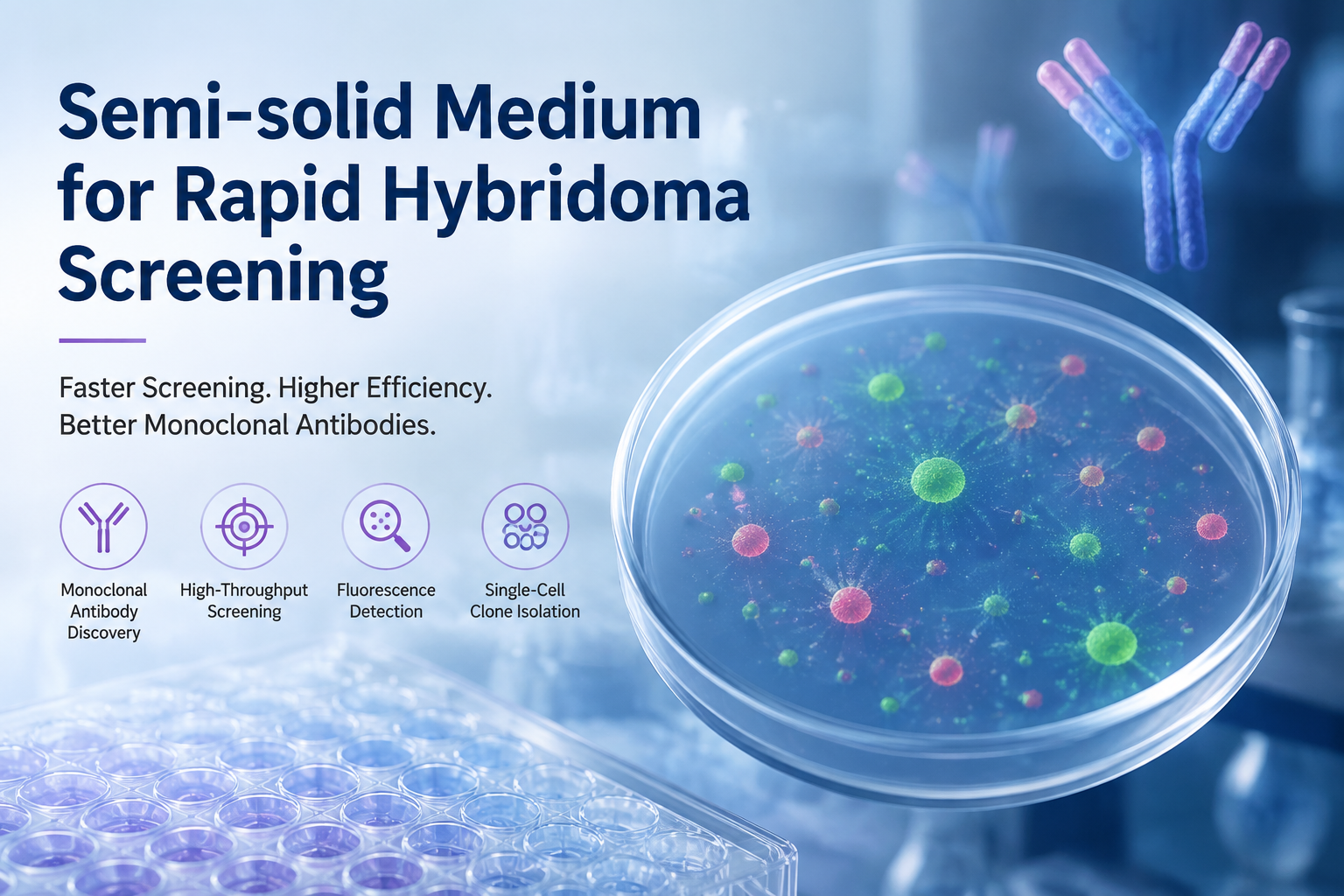
Semi-solid Medium for Rapid Hybridoma Screening provides an advanced solution by enabling researchers to grow individual hybridoma clones in a semi-solid environment while simultaneously identifying antibody-producing colonies. This technology improves screening efficiency, reduces workflow complexity, and accelerates monoclonal antibody discovery.
What Is Semi-solid Medium for Hybridoma Screening?
Semi-solid hybridoma screening medium is a specialized cell culture system that contains a semi-solid matrix capable of immobilizing individual cells or small colonies. Unlike traditional liquid culture methods where hybridoma cells remain suspended and mixed together, semi-solid media allow each hybridoma clone to grow in a physically separated location.
During hybridoma development, antibody-producing cells can be detected directly within the semi-solid environment using screening methods such as fluorescence-based detection or antibody-binding assays.
The basic workflow includes:
Hybridoma generation
B cells are fused with myeloma cells to generate antibody-producing hybridoma cells.
Cell distribution in semi-solid medium
Hybridoma cells are embedded into semi-solid screening medium.
Colony formation
Individual hybridoma cells proliferate into isolated colonies.
Antibody-producing clone identification
Positive colonies are detected through fluorescence or other screening methods.
Clone recovery and expansion
Selected hybridoma clones are expanded for antibody production and characterization.
This approach enables researchers to identify valuable antibody-producing clones more rapidly compared with conventional screening strategies.
Applications of Semi-solid Medium for Rapid Hybridoma Screening
1. Monoclonal Antibody Discovery
The primary application of semi-solid hybridoma screening is accelerating monoclonal antibody discovery.
Hybridoma technology remains one of the most widely used approaches for generating monoclonal antibodies. However, after fusion, researchers may obtain thousands of hybridoma clones, and only a small percentage produce antibodies with the desired specificity and affinity.
Semi-solid screening helps researchers efficiently identify:
· Antigen-specific hybridomas
· High antibody-producing clones
· Functional antibody candidates
· Rare positive antibody-secreting cells
By reducing the number of unnecessary screening steps, this technology supports faster antibody discovery workflows.
2. Therapeutic Antibody Development
The development of therapeutic monoclonal antibodies requires highly specific and functional antibody candidates.
Semi-solid hybridoma screening is widely applied in the early stages of therapeutic antibody research, including:
Cancer Immunotherapy
Monoclonal antibodies targeting tumor-associated antigens have become important tools in cancer treatment. Rapid identification of high-quality antibody clones helps researchers develop:
· Tumor-targeting antibodies
· Immune checkpoint antibodies
· Antibody-drug conjugate (ADC) candidates
Autoimmune Disease Research
Antibodies targeting immune-related molecules are being developed for autoimmune disorders. Efficient hybridoma screening enables researchers to identify antibodies with improved specificity and biological activity.
Infectious Disease Research
During infectious disease studies, hybridoma screening can help generate antibodies against:
· Viral proteins
· Bacterial antigens
· Pathogen-associated molecules
Faster antibody identification supports diagnostic and therapeutic research.
3. Diagnostic Antibody Production
Monoclonal antibodies are essential components of many diagnostic technologies.
Semi-solid hybridoma screening can support the development of antibodies used in:
· Enzyme-linked immunosorbent assays (ELISA)
· Immunohistochemistry (IHC)
· Immunofluorescence analysis
· Flow cytometry
· Rapid diagnostic testing platforms
High-quality diagnostic antibodies require excellent specificity and reproducibility. By selecting superior hybridoma clones at an early stage, researchers can improve the performance of diagnostic reagents.
4. High-throughput Hybridoma Screening
One major challenge in antibody discovery is screening large numbers of hybridoma clones.
Traditional screening methods often require:
· Individual culture wells
· Supernatant collection
· Multiple detection assays
· Repeated clone confirmation
These steps increase labor requirements and extend development timelines.
Semi-solid hybridoma screening enables:
· Screening of thousands of colonies
· Rapid identification of positive clones
· Reduced manual handling
· Improved screening efficiency
This makes it particularly valuable for pharmaceutical companies, biotechnology companies, and research institutions performing large-scale antibody discovery.
5. Fluorescence-based Hybridoma Screening
Modern semi-solid screening platforms often combine semi-solid culture technology with fluorescence detection.
Fluorescence-based screening allows researchers to visualize antibody-producing colonies directly.
The workflow typically includes:
· Hybridoma colony growth in semi-solid medium
· Fluorescent labeling of secreted antibodies
· Imaging-based colony detection
· Selection of high-performing clones
Advantages include:
· Rapid identification of antibody-positive colonies
· Visual screening without extensive liquid culture testing
· Improved screening accuracy
· Compatibility with automated imaging systems
This approach represents an important advancement in hybridoma technology.
6. Single-cell Clone Isolation and Monoclonality Assurance
Obtaining a truly monoclonal antibody-producing cell line is critical for reliable antibody production.
Semi-solid media provide physical separation between individual hybridoma colonies, helping researchers:
· Track individual clones
· Reduce mixed cell populations
· Improve monoclonality assurance
· Minimize repeated cloning procedures
Compared with traditional limiting dilution methods, semi-solid screening can simplify clone isolation and improve efficiency.
7. Cell Line Development and Recombinant Protein Production
Although commonly associated with hybridoma antibody discovery, semi-solid screening principles are also useful in mammalian cell line development.
Applications include:
· CHO cell clone screening
· Recombinant protein expression
· Stable producer cell selection
· Biopharmaceutical manufacturing research
By identifying high-producing clones early, researchers can improve downstream production efficiency.
Advantages of Semi-solid Medium for Rapid Hybridoma Screening
Faster Screening Process
Semi-solid screening reduces the time required for identifying antibody-producing clones by enabling direct colony detection.
Higher Screening Capacity
Researchers can analyze significantly more hybridoma colonies compared with traditional screening approaches.
Improved Clone Selection
The technology allows identification of clones with:
· Higher antibody secretion levels
· Better specificity
· Desired biological activity
Reduced Labor Requirements
By simplifying clone identification, semi-solid screening reduces repetitive culture and testing steps.
Compatibility with Advanced Detection Technologies
Semi-solid platforms can integrate with:
· Fluorescence imaging
· Automated colony analysis
· High-throughput screening systems
Semi-solid Screening Compared with Traditional Hybridoma Screening
|
Feature |
Traditional Screening |
Semi-solid Screening |
|
Clone identification |
Requires culture supernatant testing |
Direct colony screening |
|
Throughput |
Moderate |
High |
|
Screening speed |
Longer workflow |
Faster identification |
|
Clone separation |
Additional cloning steps |
Natural colony isolation |
|
Automation compatibility |
Limited |
Strong compatibility |
|
Positive clone recovery |
Multiple confirmation steps |
More efficient selection |
Future Perspectives of Semi-solid Hybridoma Screening
As demand for monoclonal antibodies continues to increase, antibody discovery technologies are moving toward faster, more automated, and higher-throughput solutions.
Future developments may include:
· AI-assisted colony identification
· Automated fluorescence screening platforms
· Integration with single-cell technologies
· Improved antibody secretion analysis
· High-throughput antibody engineering workflows
The combination of semi-solid culture technology and advanced screening platforms will continue to accelerate the discovery of next-generation antibodies.
Conclusion
Semi-solid Medium for Rapid Hybridoma Screening is an innovative technology that improves the efficiency of monoclonal antibody discovery by enabling rapid identification and isolation of antibody-producing hybridoma clones. Its applications extend across therapeutic antibody development, diagnostic reagent production, fluorescence-based screening, high-throughput antibody discovery, and cell line development.
Compared with conventional hybridoma screening approaches, semi-solid screening provides faster clone selection, improved workflow efficiency, and better scalability. As biotechnology research continues to demand more powerful antibody discovery platforms, semi-solid hybridoma screening will remain an important tool for accelerating the development of high-quality monoclonal antibodies.


