
Introduction
Hearing loss research is entering a transformative era. With the rapid adoption of single-cell RNA sequencing (scRNA-seq), spatial transcriptomics, AI-assisted omics analysis, and regenerative medicine, researchers can now study the cochlea at unprecedented cellular resolution. In 2026, the focus of auditory neuroscience has shifted from simply identifying damaged tissues to understanding how individual cochlear cell populations behave, communicate, regenerate, and degenerate over time.
However, despite the explosive growth of omics technologies, one critical bottleneck remains: obtaining viable single-cell suspensions from delicate cochlear tissue.
The cochlea is one of the most structurally fragile and biologically complex organs in the body. Hair cells, spiral ganglion neurons, supporting cells, and immune-related populations are tightly embedded within extracellular matrix structures. Traditional mechanical dissociation methods often damage these cells, leading to low viability, poor RNA quality, and distorted sequencing data.
This challenge has accelerated demand for specialized dissociation systems optimized specifically for auditory tissue preparation.
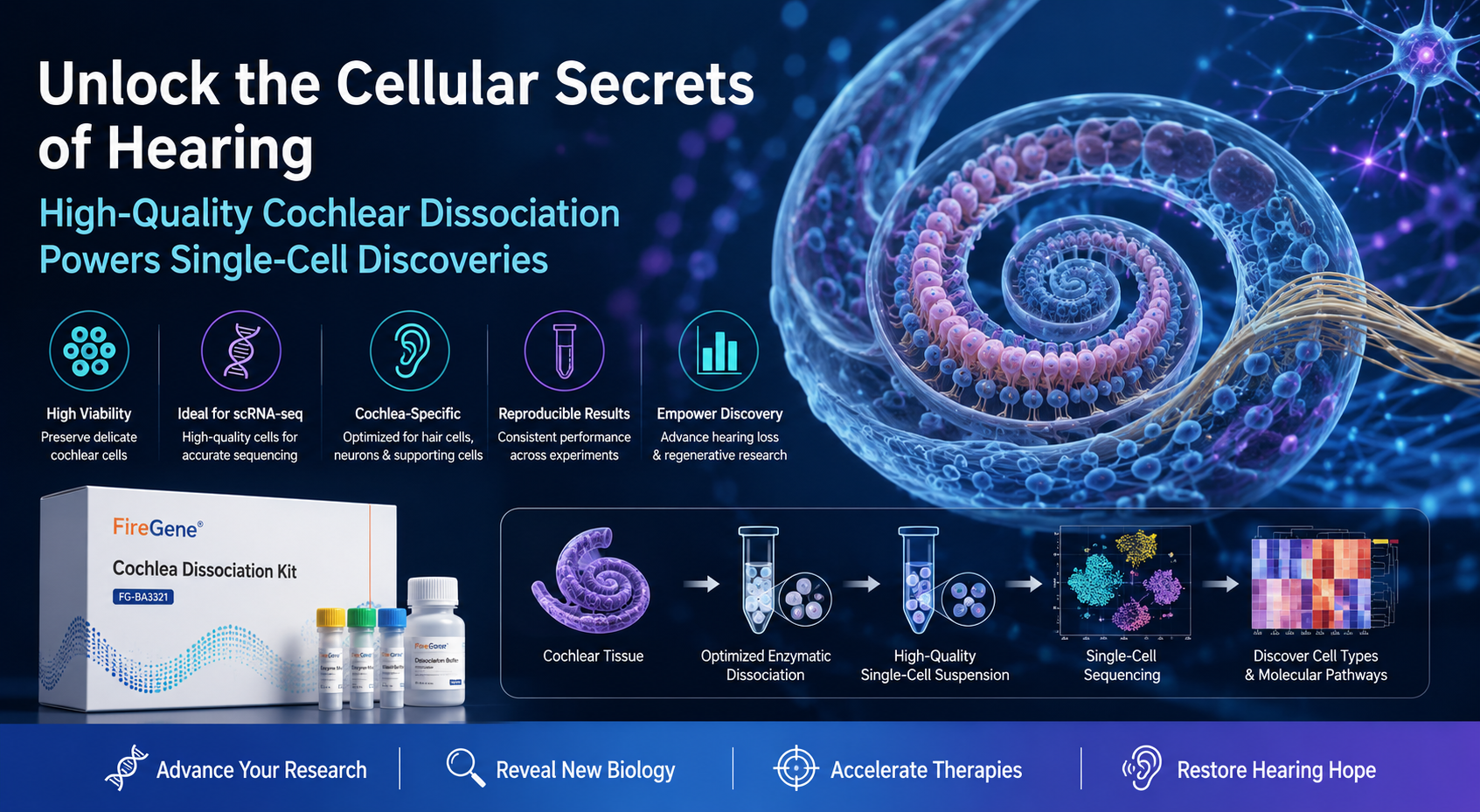
The FireGene Cochlea Dissociation Kit was developed to address these issues by enabling efficient and reproducible single-cell isolation from cochlear tissues while preserving cell viability for downstream applications such as:
- Single-cell RNA sequencing
- Spatial biology workflows
- Cochlear organoid research
- Gene expression profiling
- Regenerative hearing studies
- Cell culture experiments
As single-cell technologies become central to hearing restoration research, cochlear dissociation quality is becoming more important than ever.
Why Cochlear Tissue Is Difficult to Dissociate
Unlike many soft tissues, the cochlea contains highly specialized structures that are exceptionally sensitive to enzymatic and mechanical stress.
Researchers face several major challenges during cochlear cell isolation:
1. Extremely Fragile Hair Cells
Hair cells are among the most delicate sensory cells in mammals. Overdigestion or harsh pipetting can rapidly destroy stereocilia structures and compromise RNA integrity.
2. Dense Extracellular Matrix
The cochlear extracellular matrix contains complex structural proteins that strongly bind surrounding cells together. Insufficient digestion leads to cell clumping and low yield.
3. Low Cell Numbers
The cochlea contains relatively few target cells compared to organs like liver or spleen. Losing even a small percentage of cells can significantly affect experimental outcomes.
4. High Sensitivity for scRNA-seq
Single-cell sequencing requires:
- High viability
- Minimal debris
- Low doublet formation
- Preserved transcriptomic signatures
Suboptimal dissociation protocols can introduce stress-response genes that distort biological interpretation.
Because of these challenges, general-purpose tissue dissociation kits are often insufficient for inner ear applications.
The Rise of Single-Cell Cochlear Atlases
One of the biggest trends in hearing research is the construction of comprehensive cochlear single-cell atlases.
Recent studies have mapped:
- Hair cell subtypes
- Supporting cell heterogeneity
- Spiral ganglion neuron populations
- Immune cell infiltration
- Developmental transcriptional programs
- Cross-species cochlear conservation
A 2026 cross-species cochlear atlas study identified 19 major cochlear cell populations and revealed conserved gene regulatory networks involved in hearing loss.
These discoveries rely heavily on high-quality tissue dissociation.
Poor dissociation quality can:
- Reduce cell diversity
- Eliminate fragile populations
- Bias sequencing datasets
- Trigger artificial inflammatory pathways
- Reduce reproducibility between experiments
As a result, tissue preparation is now recognized as one of the most critical steps in auditory omics workflows.
How the FireGene Cochlea Dissociation Kit Supports Modern Auditory Research
The FireGene Cochlea Dissociation Kit is specifically optimized for cochlear tissue processing.
According to the product overview, the kit uses a carefully tuned enzymatic strategy designed for:
- Hair cell preservation
- Auditory neuron isolation
- ECM digestion
- High-viability single-cell preparation
Unlike generalized dissociation methods, cochlea-specific optimization is essential because auditory tissues are highly susceptible to enzymatic damage.
Key advantages include:
Optimized Enzyme Balance
The kit uses enzyme concentrations tailored for cochlear extracellular matrix composition, helping preserve fragile cell populations.
Improved Cell Viability
High viability is essential for:
- scRNA-seq
- Cell culture
- Organoid generation
- Gene expression analysis
Reduced Mechanical Stress
The protocol minimizes aggressive handling steps that commonly damage sensory hair cells.
Reproducible Results
Reproducibility is increasingly important for:
- Multi-center collaborations
- Drug screening studies
- AI-assisted transcriptomic analysis
- Longitudinal experiments
Cochlear Organoids Are Driving Demand for Better Dissociation Methods
Another major trend in 2026 is the rapid rise of cochlear organoid research.
Inner ear organoids allow researchers to:
- Model hearing loss
- Test drug candidates
- Study hair cell differentiation
- Investigate developmental biology
- Evaluate regenerative therapies
Recent publications highlight the growing importance of organoid-based auditory platforms.
However, organoid workflows often begin with viable single-cell isolation.
Researchers need:
- Healthy progenitor populations
- Intact auditory neurons
- Minimal RNA degradation
- Preserved differentiation potential
Poor-quality dissociation can compromise entire organoid experiments before culture even begins.
For this reason, cochlea-specific dissociation systems are becoming foundational tools for next-generation hearing research.
AI and Spatial Transcriptomics Are Expanding Inner Ear Research
Artificial intelligence is increasingly being integrated into transcriptomic interpretation.
Modern hearing research now combines:
- Single-cell sequencing
- Spatial transcriptomics
- Machine learning
- Cross-species analysis
- Multi-omics integration
The Hearing Restoration Project recently highlighted the importance of AI-assisted single-cell analysis and cross-species comparisons in auditory regeneration research.
But AI models are only as reliable as the input data.
High-quality dissociation directly impacts:
- Cell clustering accuracy
- Marker gene identification
- Pathway analysis
- Cell trajectory inference
- Therapeutic target discovery
As datasets grow larger, standardized sample preparation becomes increasingly critical.
Cochlear Dissociation and Hearing Loss Therapeutics
Gene therapy and regenerative medicine are among the hottest topics in auditory science.
Companies and research institutions are actively developing:
- Hair cell regeneration therapies
- OTOF gene therapy
- GJB2-targeted therapies
- Cochlear stem cell strategies
- Neuroprotective interventions
Recent clinical updates from Sensorion demonstrate growing momentum in hearing loss gene therapy development.
To evaluate these therapies, researchers require accurate cellular profiling of:
- Hair cells
- Spiral ganglion neurons
- Supporting cells
- Immune responses
This makes reliable cochlear dissociation indispensable for translational research.
Best Practices for Cochlear Dissociation Workflows
To maximize success in cochlear cell isolation experiments:
Use Fresh Tissue Whenever Possible
Fresh tissue generally provides:
- Higher viability
- Better RNA quality
- Lower apoptosis rates
Avoid Overdigestion
Excessive enzymatic digestion may:
- Damage hair cells
- Reduce membrane integrity
- Alter gene expression profiles
Minimize Mechanical Pipetting
Gentle handling helps preserve fragile auditory cell populations.
Process Samples Consistently
Standardized timing improves reproducibility between experiments.
Validate Cell Viability Before Sequencing
Always assess:
- Viability
- Cell concentration
- Debris levels
- Doublet rates
before proceeding to sequencing workflows.
Future Outlook
The future of hearing research will increasingly depend on:
- Single-cell biology
- Precision transcriptomics
- Regenerative medicine
- AI-assisted analytics
- Organoid engineering
- Gene therapy
All of these technologies rely on one foundational step: obtaining high-quality viable cochlear cells.
As auditory science advances, specialized preparation tools such as the FireGene Cochlea Dissociation Kit will continue to play a critical role in enabling reproducible and biologically meaningful discoveries.
Researchers seeking reliable cochlear single-cell preparation workflows should prioritize:
- Tissue-specific dissociation strategies
- Viability preservation
- RNA integrity
- Reproducibility
- Compatibility with next-generation sequencing applications
In modern auditory research, dissociation quality is no longer just a preparation step — it is a determining factor in experimental success.
Related Articles
- FireGene Microbial DNA Extraction Kit
- FireGene Endotoxin Detection Solutions
- FireGene Cell Biology Products
- FireGene Life Science Research Products
FireGene, light your research with passion, innovation, and profession.


