
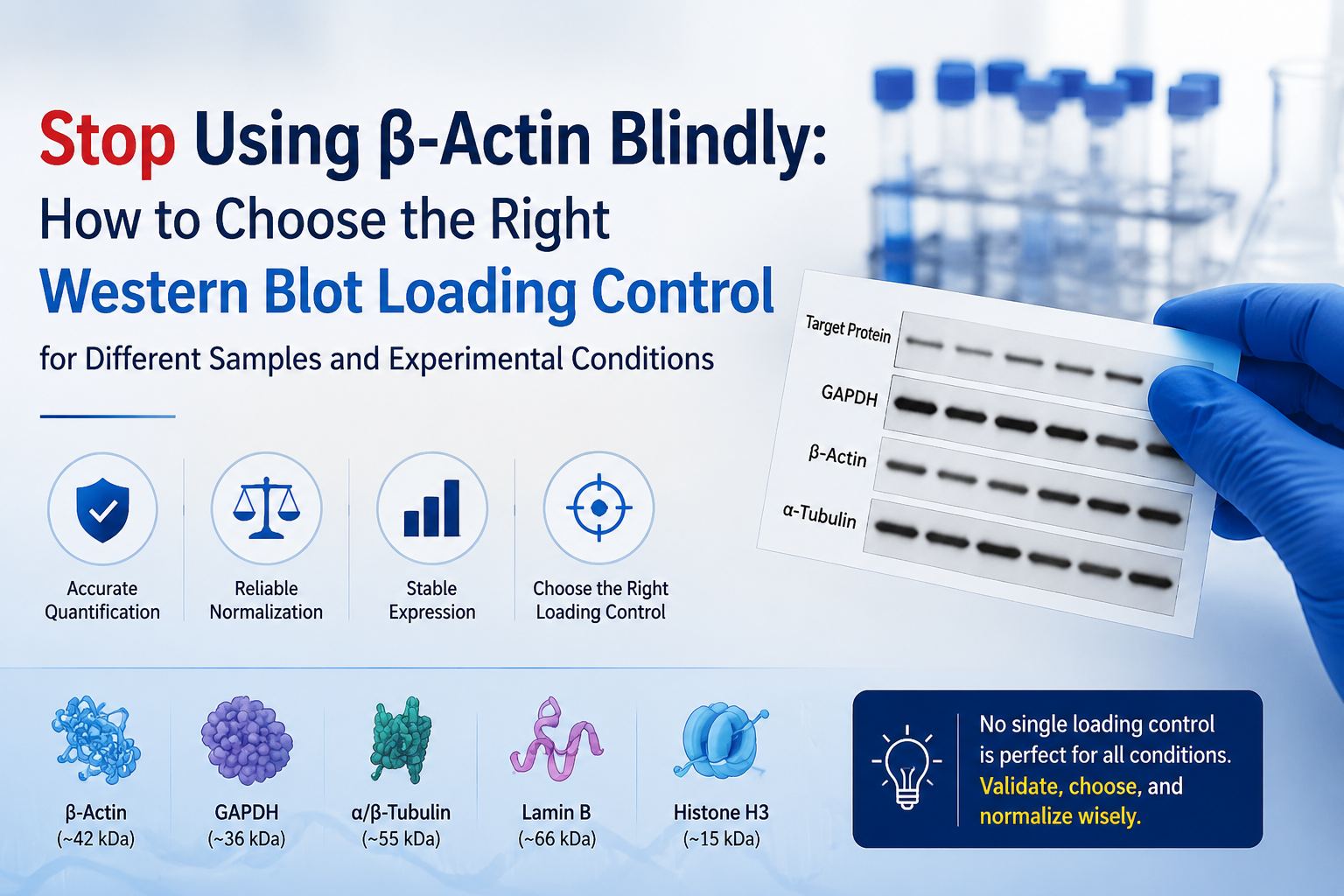
Western blotting (WB) is one of the most widely used techniques for protein expression analysis. However, accurate quantification depends heavily on selecting an appropriate loading control. Although β-actin and GAPDH are commonly used as reference proteins, no single internal control is suitable for all experimental conditions. Factors such as tissue type, cellular localization, treatment conditions, and target protein characteristics can significantly affect reference protein stability. This article discusses the principles of Western blot loading control selection and provides practical recommendations for choosing suitable reference proteins for different research applications.
1. What Is a Western Blot Loading Control?
A Western blot loading control, also called an internal reference protein or normalization protein, is a protein used as a standard reference during protein expression analysis.
Most loading controls are encoded by housekeeping genes, which are generally expected to maintain relatively stable expression across different samples.
Common Western blot loading controls include:
· β-Actin
· GAPDH
· β-Tubulin
· α-Tubulin
· Lamin A/C
· Lamin B
· Histone H3
· Total target protein (for phosphorylation studies)
An ideal loading control should have two essential characteristics:
1. High expression abundance
A highly expressed protein produces clear and reliable signals, allowing accurate detection.
2. Stable expression under experimental conditions
The protein level should remain unchanged after treatments, genetic modifications, environmental stress, or disease modeling.
However, no loading control is universally stable under every experimental condition.
2. Why Is a Loading Control Essential in Western Blot?
Using a proper loading control is not simply an optional step. It is essential for reliable protein quantification.
2.1 Monitoring Experimental Quality
A stable loading control helps evaluate the overall quality of the Western blot workflow.
If the loading control band is:
· Clear
· Consistent
· Similar in intensity among samples
it indicates that major experimental steps are likely reliable, including:
· Protein extraction
· Protein quantification
· SDS-PAGE separation
· Transfer efficiency
· Antibody detection
Abnormal loading control signals may indicate problems during sample preparation or membrane transfer.
2.2 Correcting Loading and Transfer Variations
Western blot experiments often involve small differences in:
· Protein concentration measurement
· Sample loading volume
· Transfer efficiency
· Membrane binding efficiency
A loading control corrects these technical variations.
Importantly:
Equal loading volume does not always mean equal protein loading.
Normalization should be based on total protein amount rather than simply comparing sample volumes.
2.3 Normalizing Protein Expression Levels
Western blot quantification requires normalization.
The commonly used calculation is:
Relative Protein Expression=Loading Control Signal IntensityTarget Protein Signal Intensity
For example:
· Target protein: 50 kDa
· β-actin: 42 kDa
The target protein signal is normalized against the β-actin signal from the same lane.
This allows researchers to compare protein expression differences between:
· Control groups
· Treatment groups
· Disease models
· Genetic modification experiments
3. Why β-Actin Is Not a Universal Loading Control
β-actin is one of the most frequently used Western blot reference proteins because it is:
· Highly abundant
· Easy to detect
· Conserved among mammalian species
However, using β-actin blindly can introduce inaccurate conclusions.
β-actin is a cytoskeletal protein involved in:
· Cell structure maintenance
· Cell migration
· Cytoskeleton remodeling
Therefore, experiments involving cytoskeletal changes may directly affect β-actin expression.
Examples:
· Cell migration studies
· EMT (epithelial–mesenchymal transition)
· Cytoskeleton-related signaling
· Muscle differentiation
In these cases, β-actin may not represent a stable baseline.
4. Key Principles for Selecting a Western Blot Loading Control
4.1 Consider Molecular Weight Compatibility
The molecular weight difference between the loading control and target protein should ideally be:
≥5 kDa
Why?
If two proteins have very similar molecular weights:
· Bands may overlap
· Signal extraction becomes difficult
· Quantification accuracy decreases
For example:
|
Target Protein |
Recommended Loading Control |
|
40–45 kDa protein |
Avoid β-actin (42 kDa) if bands overlap |
|
60–70 kDa protein |
GAPDH (36 kDa) may be suitable |
|
Nuclear proteins |
Lamin or Histone proteins |
Selecting proteins with appropriate molecular separation improves quantification reliability.
4.2 Match the Loading Control to Sample Species
Reference protein selection should consider sample origin.
Mammalian samples
Common choices:
· β-actin
· GAPDH
· Tubulin
Used for:
· Human cells
· Mouse tissues
· Rat models
Plant samples
Recommended:
· Plant Actin
· Plant-specific housekeeping proteins
Rare species
Researchers should select reference proteins based on:
· Published literature
· Protein conservation
· Expression stability validation
4.3 Consider Experimental Conditions
The most important question is:
Does the experimental treatment influence the loading control?
A housekeeping protein may change significantly under certain conditions.
Therefore, loading control selection must be experimentally validated.
5. Choosing Loading Controls for Different Experimental Applications
5.1 Phosphorylation Studies: Use Two Controls
For phosphorylation-related Western blot experiments, one loading control is often insufficient.
Example:
Detection of phosphorylated Akt:
Required:
1. Total Akt protein
2. Phosphorylated Akt (p-Akt)
Calculation:
p−Akt/Total−Akt
Why?
An increase in p-Akt may result from:
· Increased phosphorylation activity
or
· Increased total Akt protein expression
Only normalization against total protein can distinguish these possibilities.
5.2 Hypoxia and Diabetes Models: Avoid GAPDH
GAPDH is commonly used as a loading control.
However, GAPDH participates directly in glycolysis.
Under metabolic stress conditions:
· Hypoxia
· High glucose exposure
· Diabetes models
GAPDH expression may increase.
Therefore:
Avoid GAPDH when studying:
· Oxygen deprivation
· Metabolic regulation
· Diabetes-related pathways
Alternative choices:
· β-actin
· α-Tubulin
· Lamin B
5.3 Drug Treatment Experiments
Tubulin is widely used as a loading control.
However, some drugs directly target microtubules.
Examples:
· Paclitaxel
· Vinblastine
· Antifungal compounds targeting microtubules
These treatments may alter:
· Tubulin expression
· Tubulin polymerization
· Cytoskeleton structure
Therefore, Tubulin may become unstable.
Alternative loading controls:
· β-actin
· GAPDH
· Histone H3
· Lamin B
5.4 Cell Proliferation and Apoptosis Studies
Some proteins related to cell growth and nuclear regulation are unsuitable as reference proteins.
Examples:
Cell proliferation studies
Avoid:
· c-Jun
because c-Jun expression changes during proliferation signaling.
Apoptosis studies
Avoid:
· TBP
· Lamin proteins
because apoptosis can alter nuclear structure and protein localization.
6. Tissue-Specific Loading Control Selection
Different tissues have different protein expression patterns.
Adipose Tissue
β-actin expression may be relatively low.
Alternative options should be evaluated.
Multi-Tissue Comparison Studies
For comparing different tissues:
GAPDH is often preferred because metabolic activity-related expression can remain relatively consistent in many tissues.
β-actin and β-tubulin may vary because cytoskeletal composition differs among tissues.
Muscle Tissue
For:
· Skeletal muscle
· Cardiac muscle
· Smooth muscle
Tubulin may not be ideal because cytoskeletal remodeling can affect expression.
Secreted Samples
Examples:
· Plasma
· Milk
· Tissue fluids
These samples lack intact cellular structures.
Traditional cellular loading controls may not be appropriate.
Secreted proteins such as:
· Transferrin
may be considered depending on experimental design.
7. GAPDH vs β-Actin vs Tubulin: Which One Should You Choose?
|
Loading Control |
Advantages |
Limitations |
|
β-Actin |
High abundance, widely used |
Sensitive to cytoskeleton changes |
|
GAPDH |
Strong signal, commonly validated |
Affected by metabolic changes |
|
Tubulin |
Good for many cell lysates |
Unsuitable for microtubule-targeting treatments |
|
Lamin B |
Good nuclear protein marker |
Not suitable for apoptosis studies |
|
Histone H3 |
Useful for nuclear proteins |
Limited to nuclear samples |
8. Best Practices for Reliable Western Blot Quantification
To obtain reliable Western blot results:
1. Do not choose a loading control by habit
β-actin and GAPDH are popular, but popularity does not equal suitability.
2. Validate reference protein stability
Check whether expression remains unchanged under:
· Treatment conditions
· Disease models
· Tissue types
3. Consider target protein characteristics
Evaluate:
· Molecular weight
· Cellular localization
· Biological pathway
4. Use appropriate normalization strategies
For phosphorylation studies:
Use total protein normalization.
For nuclear proteins:
Choose nuclear reference proteins.
For membrane proteins:
Use membrane-associated controls.
Conclusion
A reliable Western blot experiment depends not only on antibodies and detection systems but also on choosing the correct internal reference protein.
Although β-actin and GAPDH are widely used, they are not universal solutions. Experimental conditions, tissue characteristics, and biological pathways can influence reference protein stability.
The best loading control is not the most commonly used one—it is the one that remains stable under your specific experimental conditions.
By carefully selecting appropriate reference proteins, researchers can achieve more accurate protein quantification and generate stronger, more reproducible Western blot data.


