
Introduction
Adeno-associated virus (AAV) vectors have become one of the most important delivery platforms in modern gene therapy.
AAV-based products are being investigated and developed for a wide range of inherited and acquired diseases, including neurological disorders, ophthalmic diseases, metabolic disorders, hematological conditions, and other serious diseases where long-term gene expression may provide therapeutic benefit.
As AAV programs move from research laboratories into clinical development and commercial manufacturing, analytical control becomes increasingly important.
Among the critical quality attributes that must be evaluated, bacterial endotoxin remains a key safety concern.
Endotoxins are lipopolysaccharide-associated components originating primarily from Gram-negative bacteria. Unlike viable microorganisms, endotoxins can remain present even after microbial cells have been removed or destroyed. This makes endotoxin control fundamentally different from sterility control.
For AAV manufacturers, the challenge is even more complicated because the vector is produced through a biological manufacturing process involving cell substrates, plasmids, transfection reagents, culture media, harvest materials, purification buffers, chromatography systems, filtration steps, and formulation components.
Every additional material and processing step creates another potential opportunity for endotoxin introduction.
At the same time, AAV products are often available only in relatively small quantities, making analytical sample consumption an important consideration during method development.
FDA's current gene therapy CMC framework emphasizes that sponsors need appropriate manufacturing and testing controls to assure the safety, identity, quality, purity, and strength of human gene therapy products. FDA's 2026 CGT guidance also describes a lifecycle-oriented approach to CMC development and validation.
FDA: Frequently Asked Questions — Developing Potential Cellular and Gene Therapy Products
This makes AAV endotoxin testing more than a final-product laboratory test.
It should be considered part of an integrated contamination-control and analytical strategy covering:
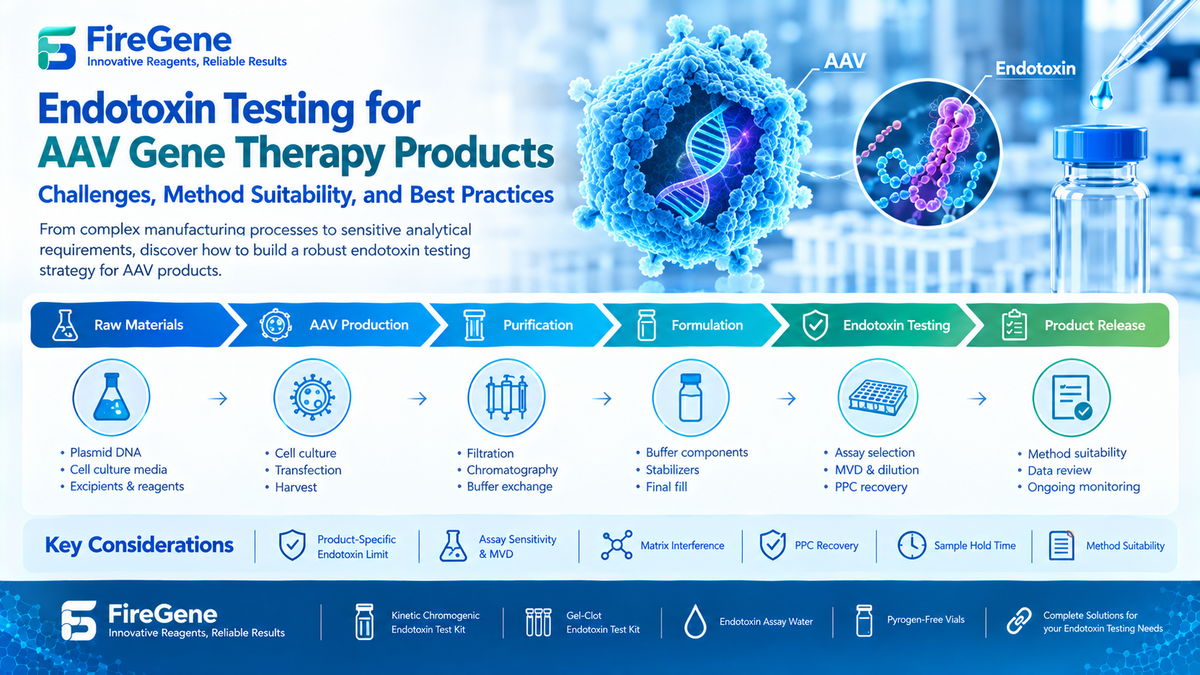
Raw Materials → AAV Production → Harvest → Purification → Formulation → Sample Preparation → Endotoxin Testing → Product Release
This article explains the major endotoxin testing challenges associated with AAV gene therapy products and provides a practical framework for developing a reliable testing strategy.
1. Why Endotoxin Control Matters in AAV Gene Therapy
AAV products are biological medicines administered to patients through different routes depending on the therapeutic application.
Potential administration routes include:
-
Intravenous administration
-
Intravitreal administration
-
Intramuscular administration
-
Subretinal administration
-
Intrathecal administration
-
Other localized administration routes
The applicable endotoxin requirement depends on the product, dose, route of administration, and relevant regulatory framework.
This means that manufacturers should not assume that every AAV product can use the same endotoxin acceptance criterion.
The first analytical question should therefore be:
What is the product-specific endotoxin limit based on its intended route and maximum dose?
For a broader discussion of endotoxin limits, K/M calculations, dose, and Maximum Valid Dilution, see FireGene's How to Set Endotoxin Limits for Pharmaceutical Products: A Practical Guide to K/M, Dose, MVD, and Method Selection.
This is particularly important for AAV products intended for specialized routes of administration.
For example, FDA materials identify a maximum recommended endotoxin exposure of 0.2 EU/kg within one hour for intrathecal and epidural drug products.
FDA: Pyrogen and Endotoxins Testing — Questions and Answers
Therefore, an AAV product intended for CNS administration may require a substantially different endotoxin testing strategy from an AAV product administered through another route.
2. Where Can Endotoxin Enter an AAV Manufacturing Process?
AAV manufacturing involves multiple biological and chemical inputs.
Potential endotoxin sources include:
-
Cell culture media
-
Plasmid DNA
-
Transfection reagents
-
Cell culture supplements
-
Process buffers
-
Water
-
Chromatography materials
-
Filtration components
-
Single-use assemblies
-
Manufacturing equipment
-
Sampling containers
-
Formulation materials
The complexity of the manufacturing process means that final-product testing alone may not always provide enough information to understand where contamination originated.
Cell Culture Materials
AAV production commonly uses producer cell systems in which multiple biological components are introduced during vector production.
Media and supplements can represent potential endotoxin sources.
Supplier qualification should therefore consider not only identity and purity, but also relevant microbial and endotoxin specifications.
FireGene's Endotoxin Testing for Raw Materials and Excipients provides a broader framework for controlling endotoxin risk before raw materials enter pharmaceutical manufacturing.
Plasmid DNA
AAV manufacturing frequently involves plasmids encoding vector components or helper functions.
Although plasmid DNA may be highly purified, the manufacturing process itself can introduce bacterial endotoxin.
This is particularly relevant when plasmids are produced using bacterial fermentation and downstream purification.
Supplier COAs can provide useful information, but critical materials may require additional qualification depending on how they are used in the AAV process.
Transfection Reagents
Transfection reagents are another potential source of contamination.
Depending on the manufacturing platform, transfection systems may introduce additional raw materials, handling steps, and process complexity.
These inputs should therefore be incorporated into the overall endotoxin risk assessment.
Process Water
Water is another critical variable.
Endotoxin contamination can originate from:
-
Water-generation systems
-
Storage tanks
-
Distribution loops
-
Biofilms
-
Dead legs
-
Inadequate sanitization
-
Maintenance activities
FireGene's Why Water System Monitoring Is the Foundation of Reliable Endotoxin Testing provides additional information on water-system monitoring and endotoxin control.
The important principle is simple:
The cleaner the manufacturing process, the less endotoxin the final purification process has to remove.
3. AAV Purification Does Not Eliminate Endotoxin Risk
AAV manufacturing commonly includes several purification operations designed to remove process-related impurities and enrich the desired vector population.
Typical downstream operations may include:
-
Clarification
-
Filtration
-
Chromatography
-
Buffer exchange
-
Concentration
-
Ultrafiltration/diafiltration
-
Final formulation
These processes can substantially reduce contaminants, but endotoxin control should not depend exclusively on downstream purification.
Endotoxin is not simply another protein impurity.
Its physicochemical behavior can be complicated by:
-
Aggregation
-
Surface adsorption
-
Interactions with proteins
-
Buffer composition
-
Ionic strength
-
Other formulation components
As a result, a process that removes one class of impurities efficiently may not necessarily provide equivalent endotoxin clearance.
This is one reason endotoxin should be monitored as a distinct quality attribute.
FireGene's broader article on Endotoxin Risk Assessment and Contamination Control in Cell and Gene Therapy Manufacturing discusses how viral-vector manufacturing, raw materials, water systems, and single-use components can contribute to endotoxin risk.
4. Why AAV Samples Can Be Difficult for Endotoxin Testing
One of the biggest analytical challenges is that an AAV sample is not simply a dilute aqueous solution.
Depending on the manufacturing platform and formulation, an AAV drug product may contain:
-
Viral particles
-
Capsid proteins
-
Residual host-cell proteins
-
Residual nucleic acids
-
Buffer components
-
Sugars
-
Salts
-
Surfactants
-
Stabilizers
-
Cryoprotectants
-
Other formulation components
These components can potentially interfere with endotoxin detection.
Interference may appear as either:
Inhibition
The product suppresses the endotoxin response.
The measured endotoxin concentration may therefore be lower than the actual concentration.
Enhancement
The product increases the observed assay response.
The measured endotoxin concentration may therefore be higher than expected.
Both situations can compromise analytical reliability.
For AAV products, this means that a standard curve passing system suitability does not automatically demonstrate that the product matrix is compatible with the assay.
The actual AAV formulation must be evaluated.
FireGene's Endotoxin Testing Sample Preparation: A Practical Guide to Dilution, Interference, Recovery, and Reliable Results provides a detailed framework for evaluating matrix effects and sample preparation.
5. Method Suitability Is Essential for AAV Endotoxin Testing
For a complex biological product such as an AAV vector, method suitability should answer a fundamental question:
Can the selected endotoxin test accurately detect endotoxin in the actual AAV product matrix?
This requires more than testing the reagent alone.
A typical method-development workflow may include:
Product → Dilution Series → Endotoxin Spike → Recovery Assessment → Method Selection
The laboratory may evaluate multiple sample dilutions to determine whether dilution reduces matrix interference while maintaining sufficient analytical sensitivity.
The selected dilution should remain within the applicable Maximum Valid Dilution.
FireGene's How to Validate an Endotoxin Test Method discusses MVD, inhibition/enhancement, PPC recovery, and method suitability in greater detail.
For AAV products, this assessment may be especially important because the available sample volume can be limited.
A method that consumes large amounts of product during development may create unnecessary material pressure.
A well-designed method therefore needs to balance:
-
Sensitivity
-
Sample volume
-
Dilution
-
Matrix interference
-
PPC recovery
-
MVD
-
Routine testing requirements
6. Understanding PPC Recovery in AAV Testing
Positive Product Control (PPC) recovery is one of the most useful tools for evaluating whether the AAV matrix interferes with endotoxin detection.
The basic concept is straightforward.
A known amount of endotoxin is added to the product matrix.
The laboratory then measures the response.
If the recovered endotoxin is within the applicable acceptance range, the result supports the suitability of the selected sample condition.
If recovery is poor, possible causes may include:
-
Excessive product concentration
-
Protein interference
-
Buffer effects
-
pH
-
Ionic strength
-
Surfactants
-
Chelating agents
-
Sample preparation errors
-
Reagent problems
AAV method development should therefore evaluate PPC performance across scientifically justified sample conditions.
For example:
Undiluted Sample
↓
Low Dilution
↓
Intermediate Dilution
↓
Higher Dilution Within MVD
The objective is not simply to maximize dilution.
The objective is to identify a condition where:
Matrix Interference Is Reduced + Required Sensitivity Is Maintained
FireGene's Endotoxin Recovery Studies Explained provides additional guidance on recovery experiments and their interpretation.
7. MVD Can Become a Limiting Factor
Maximum Valid Dilution is particularly important when working with low endotoxin limits.
The basic relationship is:
MVD = Endotoxin Limit × Sample Concentration ÷ Assay Sensitivity
The exact calculation should be performed using the units and requirements applicable to the product and selected method.
The analytical challenge is easy to understand.
If the AAV formulation produces inhibition, the laboratory may want to dilute the sample.
But:
More Dilution → Less Matrix Interference
while:
More Dilution → Lower Effective Endotoxin Detectability
If the dilution exceeds the MVD, the laboratory may no longer be able to demonstrate that the product complies with its endotoxin limit.
Therefore, MVD should be calculated before finalizing the dilution strategy.
FireGene's Endotoxin Testing: Sensitivity, LOD, LOQ, and MVD Explained provides a deeper explanation of the relationship between endotoxin limits, assay sensitivity, and dilution.
8. Could AAV Formulations Cause Low Endotoxin Recovery?
Another issue that may require consideration is Low Endotoxin Recovery (LER).
LER describes a situation in which measurable endotoxin recovery decreases over time even though the endotoxin has not necessarily disappeared from the sample.
Certain formulation components can interact with endotoxin and reduce its detectability.
This can be particularly relevant to complex biologic formulations.
AAV products should not automatically be assumed to exhibit LER.
However, when the formulation contains components known or suspected to affect endotoxin behavior, laboratories may need to evaluate recovery over scientifically justified storage or hold conditions.
Important variables may include:
-
Formulation composition
-
Storage temperature
-
Sample concentration
-
Hold time
-
Surfactant concentration
-
Chelating agents
-
Protein concentration
FireGene's Understanding Low Endotoxin Recovery (LER): Mechanisms, Regulatory Perspectives, and Practical Solutions in 2026 provides a dedicated discussion of endotoxin masking and time-dependent recovery.
This is especially relevant when AAV samples are prepared at one location and tested later in another laboratory.
9. Gel-Clot vs. Kinetic Chromogenic Testing for AAV Products
The selected endotoxin test method should be based on the product, required sensitivity, intended use, matrix characteristics, and demonstrated suitability.
FDA's March 2026 guidance discusses gel-clot, photometric, and kinetic endotoxin test methods and provides FDA's current recommendations concerning USP <85>, USP <161>, and AAMI ST72.
Gel-Clot Testing
Gel-clot testing provides a visually determined endpoint based on gel formation.
Potential advantages include:
-
Simple workflow
-
Minimal instrumentation
-
Established methodology
-
Straightforward qualitative interpretation
FireGene's Gel-Clot Endotoxin Test Kit provides multiple sensitivity options for endotoxin testing.
However, when AAV sample availability is limited or when quantitative information across multiple dilutions is useful during method development, a quantitative approach may offer additional analytical flexibility.
Kinetic Chromogenic Testing
Kinetic chromogenic testing measures the development of color over time and can provide quantitative endotoxin results.
For AAV method development, this can be useful when laboratories need to compare:
-
Multiple dilutions
-
PPC recovery
-
Standard curves
-
Matrix effects
-
Different sample preparations
-
Different sample hold times
FireGene's Kinetic Chromogenic Endotoxin Test Kit is a 96-well quantitative assay with 405 nm detection and a listed analytical range of 0.005–10 EU/mL.
For additional technical background, see The Ultimate Guide to Kinetic Chromogenic Endotoxin Assays.
The key point is that method selection should follow product requirements and demonstrated suitability—not simply the preference for one assay format.
10. Sample Preparation Matters When AAV Material Is Limited
AAV manufacturing programs often work with expensive and limited product material.
This creates an important analytical-development principle:
Use the minimum amount of product necessary to establish a scientifically defensible method.
A carefully designed dilution series can help laboratories evaluate interference without consuming unnecessary quantities of vector.
Sample preparation should consider:
Mixing
The sample should be homogeneous before testing.
Dilution
Serial dilution should be performed accurately using appropriate endotoxin-controlled materials.
Container Selection
Sample containers should be suitable for endotoxin testing and should not introduce additional endotoxin.
Water Quality
Endotoxin-controlled assay water should be used where applicable.
FireGene's Endotoxin Assay Water can be used for negative controls, endotoxin standard preparation and dilution, and sample preparation for bacterial endotoxin testing.
Sample Hold Time
The laboratory should understand how long a prepared AAV sample can be held before analysis without compromising the intended testing strategy.
FireGene's Endotoxin Sample Hold Time discusses how storage conditions and delayed testing can influence endotoxin recovery.
11. Endotoxin Control Should Start Before AAV Harvest
A common mistake is to treat endotoxin testing as something that happens only after the AAV product has been manufactured.
A more effective strategy begins much earlier.
A practical control framework is:
Stage 1 — Raw Material Qualification
Evaluate critical materials such as:
-
Media
-
Supplements
-
Plasmids
-
Transfection reagents
-
Buffers
-
Process chemicals
Stage 2 — Water System Control
Monitor water quality and control potential microbial growth and biofilm formation.
Stage 3 — Manufacturing Process Control
Evaluate:
-
Equipment
-
Single-use components
-
Processing vessels
-
Tubing
-
Filters
-
Chromatography systems
Stage 4 — Intermediate Monitoring
Where appropriate, endotoxin testing of selected process intermediates can help determine where contamination enters or accumulates.
Stage 5 — Final Product Testing
The final AAV drug product should be evaluated using the validated or otherwise appropriately qualified endotoxin method.
This lifecycle strategy allows manufacturers to distinguish between:
Contamination Prevention
and
Contamination Detection
Both are necessary.
FireGene's Endotoxin Testing Data Trending: How to Detect Process Drift Before a Batch Fails explains how historical endotoxin results can be used to identify changes in process performance before they become obvious failures.
12. What Does FDA Expect From Gene Therapy CMC?
FDA's gene therapy CMC guidance provides a broader framework for demonstrating product safety, identity, quality, purity, and strength during development.
FDA: Chemistry, Manufacturing, and Control Information for Human Gene Therapy INDs
The guidance specifically addresses viral-vector manufacturing considerations, including AAV-related product and process controls.
For example, FDA notes that AAV vectors can contain non-vector DNA such as plasmid-derived or cellular DNA and recommends that sponsors carefully select manufacturing systems and provide appropriate quality data, risk assessments, and process/product controls to address relevant risks.
This is important because endotoxin control should be considered within the larger CMC framework rather than as an isolated microbiological assay.
FDA's 2026 CGT guidance also emphasizes lifecycle thinking around manufacturing and method validation.
FDA: Flexible Requirements for Cell and Gene Therapies to Advance Innovation
For AAV developers, this supports a practical approach:
Build the endotoxin-control strategy early, then refine it as product and process knowledge increases.
13. Common AAV Endotoxin Testing Mistakes
Mistake 1: Testing Only the Final Product
Final-product testing can identify contamination, but it may not identify its source.
Mistake 2: Assuming Purification Eliminates Endotoxin Risk
Downstream purification can reduce contamination but should not replace upstream contamination control.
Mistake 3: Using a Generic Endotoxin Limit
The applicable limit should be based on the specific product, dose, route, and regulatory requirements.
Mistake 4: Choosing Dilution Without Considering MVD
A dilution that improves PPC recovery may still be analytically unsuitable if it exceeds the MVD.
Mistake 5: Assuming a Passing Standard Curve Means the Product Is Suitable
The AAV matrix itself must be evaluated.
Mistake 6: Ignoring Sample Hold Time
Changes in endotoxin recovery may occur during storage or delayed testing.
Mistake 7: Using Ordinary Laboratory Consumables
Low-level endotoxin testing requires appropriate water, containers, and consumables.
Mistake 8: Consuming Too Much AAV During Method Development
A carefully planned dilution and recovery strategy can reduce unnecessary sample consumption.
Mistake 9: Treating Sterility as Equivalent to Endotoxin Control
A sterile product can still contain endotoxin.
Mistake 10: Failing to Trend Endotoxin Data
A single passing result may not reveal gradual process drift.
14. A Practical AAV Endotoxin Testing Workflow
For laboratories developing an endotoxin method for an AAV product, the following workflow provides a practical starting framework:
1. Define the AAV Product
Document vector type, formulation, concentration, route, and intended dose.
↓
2. Establish the Product-Specific Endotoxin Limit
Use the applicable route, dose, and regulatory framework.
↓
3. Select an Appropriate Assay Sensitivity
Ensure the method can demonstrate compliance with the established limit.
↓
4. Calculate MVD
Determine the maximum permissible dilution.
↓
5. Characterize the Matrix
Identify formulation components that may cause inhibition, enhancement, or masking.
↓
6. Develop a Dilution Series
Evaluate multiple conditions within the applicable analytical range and MVD.
↓
7. Evaluate PPC Recovery
Determine whether the product matrix interferes with endotoxin detection.
↓
8. Assess Hold-Time Effects
Where scientifically justified, evaluate whether recovery changes during storage.
↓
9. Confirm Method Suitability
Establish that the method performs reliably with the actual AAV product.
↓
10. Establish Routine Monitoring
Define sampling, testing frequency, acceptance criteria, data review, and trending.
This approach turns endotoxin testing from a single release assay into a controlled analytical lifecycle.
15. FireGene Solutions for AAV Endotoxin Testing
FireGene provides a portfolio of endotoxin-testing products that can support research and analytical-development workflows involving complex biological samples.
These include:
Kinetic Chromogenic Endotoxin Test Kit
The FireGene Kinetic Chromogenic Endotoxin Test Kit provides quantitative 96-well endotoxin testing with 405 nm detection and a listed range of 0.005–10 EU/mL.
It can be useful for evaluating dilution series, PPC recovery, standard curves, and matrix effects during method development.
Gel-Clot Endotoxin Test Kit
The FireGene Gel-Clot Endotoxin Test Kit provides multiple sensitivity options for bacterial endotoxin testing.
Control Standard Endotoxin
FireGene Control Standard Endotoxin can support standard preparation and recovery studies.
Endotoxin Assay Water
FireGene Endotoxin Assay Water supports endotoxin-controlled dilution and sample preparation.
Pyrogen-Free Vials
FireGene Pyrogen-Free Vials provide endotoxin-controlled containers for endotoxin standard preparation, dilution, and related workflows.
The complete portfolio can be viewed in FireGene's Endotoxin Assay Reagents and Kits collection.
Conclusion
AAV gene therapy has introduced a new generation of complex biological products into pharmaceutical development.
With that complexity comes a more demanding quality-control environment.
Endotoxin testing should therefore not be treated as an isolated final-product assay.
A robust AAV endotoxin strategy connects:
Raw Material Control
→ Process Contamination Control
→ Purification Monitoring
→ Product-Specific Endotoxin Limits
→ Assay Sensitivity
→ MVD
→ Sample Dilution
→ Matrix Interference
→ PPC Recovery
→ Sample Hold Time
→ Method Suitability
→ Routine Testing and Trending
The most important analytical principle is simple:
The method must be demonstrated to work with the actual AAV product—not merely with the endotoxin reagent and standard curve.
As AAV programs progress from early development toward clinical and commercial manufacturing, endotoxin testing strategies should evolve alongside the product and process.
By combining upstream contamination prevention with product-specific method suitability, appropriate sample preparation, controlled materials, and reliable quantitative or qualitative endotoxin assays, manufacturers can build a more robust approach to AAV product quality.
For AAV developers, the objective is not simply to obtain a passing endotoxin result.
The objective is to establish a testing system that can reliably demonstrate that the product meets its endotoxin requirement under the conditions in which it will actually be manufactured, stored, tested, and administered.
FireGene Endotoxin Testing
Ready to run your endotoxin assay?
FireGene offers a complete endotoxin testing toolkit — from TAL reagents and CSE standards to pyrogen-free consumables and LAL reagent water. All products are aligned with USP <85>, EP 2.6.14, and JP 4.01.


