
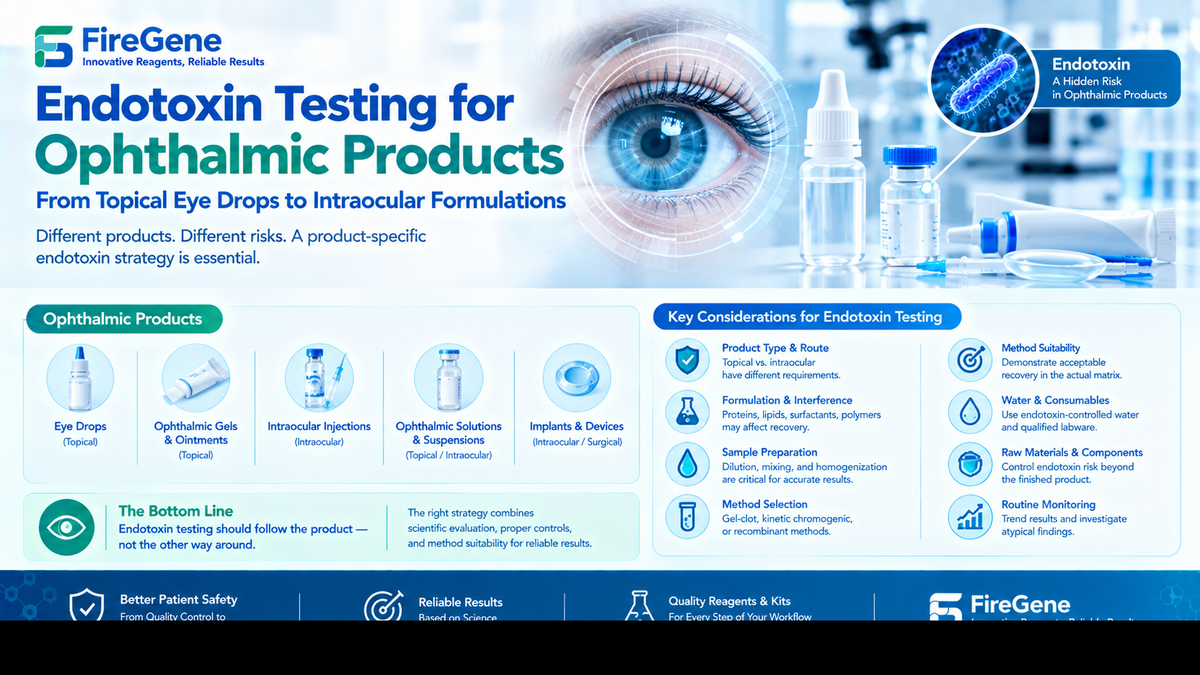
Why Ophthalmic Products Require a Product-Specific Endotoxin Strategy
Ophthalmic products are often associated with sterility, particulate control, preservative effectiveness, and container-closure integrity. Endotoxin control is another important consideration—but it should not be treated as a simple checkbox that applies identically to every ophthalmic formulation.
An ophthalmic product may be administered topically to the ocular surface, injected into or around the eye, delivered through an implantable device, or formulated as a complex suspension, gel, emulsion, or drug-device combination. These differences can substantially change the risk profile and the appropriate testing strategy.
For quality control laboratories, the key question is therefore not simply:
“Does this ophthalmic product require an endotoxin test?”
A more useful question is:
“What is the appropriate endotoxin control strategy for this specific ophthalmic product, route of administration, formulation, and intended use?”
FDA guidance and quality-related Q&A documents illustrate this product-specific approach. For example, FDA states that topical ophthalmic drug products are generally not required to include bacterial endotoxin testing unless specific circumstances apply, such as labeling indicating that the product is nonpyrogenic or certain uses involving an abraded eye or surgery. By contrast, endotoxin considerations become much more direct for products administered intraocularly.
This distinction makes ophthalmic endotoxin testing an especially useful example of why risk assessment, product characteristics, and method suitability must work together.
1. What Makes Ophthalmic Endotoxin Testing Different?
Ophthalmic formulations can look relatively simple compared with injectable biologics, but their testing environment can be surprisingly complex.
Common ophthalmic dosage forms include:
- Sterile aqueous eye drops
- Suspensions
- Ophthalmic gels
- Ointments
- Emulsions
- Intraocular solutions
- Ophthalmic injections
- Intravitreal formulations
- Ophthalmic inserts
- Implants
- Drug-device combination products
USP <771> describes ophthalmic products as sterile products intended for application to ocular structures and surrounding spaces, covering a broad range of dosage forms and routes.
From an endotoxin-testing perspective, this diversity matters because the product matrix, route of administration, sample volume, excipients, viscosity, optical properties, and intended use can all influence the analytical strategy.
A clear aqueous eye drop, for example, may behave very differently in an endotoxin assay from a highly viscous ophthalmic gel or a formulation containing surfactants, lipids, polymers, or preservatives.
Therefore, laboratories should avoid assuming that a method validated for one ophthalmic formulation can automatically be transferred to another.
2. Topical Ophthalmic Products vs. Intraocular Products
One of the most important distinctions in ophthalmic endotoxin control is the route of administration.
Topical ophthalmic products
Topical products are applied to the ocular surface rather than directly introduced into intraocular tissues.
FDA's current quality-related guidance indicates that topical ophthalmic drug products are generally not required to have bacterial endotoxin testing in their release and stability specifications unless particular circumstances apply. FDA specifically notes that a bacterial endotoxin specification may be appropriate when labeling indicates that the product is nonpyrogenic or when the product is intended for use on an abraded eye and/or during surgery.
This means that laboratories should not automatically apply an endotoxin requirement to every conventional topical eye drop.
Instead, the testing strategy should be connected to:
- Intended route of administration
- Labeling claims
- Patient or clinical risk
- Product-specific regulatory expectations
- Manufacturing process
- Raw-material controls
- Sterility and microbial controls
- Formulation characteristics
Intraocular products
Products administered directly into the eye present a different risk profile.
For intraocular products, endotoxin limits and testing can become critical components of product safety control. FDA materials discussing ophthalmic products identify endotoxins as a safety concern for intraocular products and state that an endotoxin limit is necessary for intraocular products such as products administered by injection.
This distinction is particularly important for products such as:
- Intravitreal injections
- Intracameral formulations
- Ophthalmic surgical solutions
- Intraocular fluids
- Ophthalmic implants and devices
- Other products introduced directly into ocular tissues or spaces
The closer a product is administered to sensitive intraocular tissues, the more important it becomes to establish a scientifically justified endotoxin control strategy.
3. Endotoxin Control Starts Before the Finished Product
A common mistake is to treat endotoxin testing as something that happens only at final release.
In reality, endotoxin control for ophthalmic products should begin much earlier.
Potential endotoxin sources include:
- Purified water systems
- Process water
- Active pharmaceutical ingredients
- Excipients
- Polymers
- Surfactants
- Buffers
- Processing equipment
- Holding vessels
- Filling components
- Containers and closures
- Single-use manufacturing materials
- Laboratory consumables
Because endotoxin can be introduced at multiple points, a finished-product test cannot replace upstream process controls.
For example, if a polymer used to increase ophthalmic formulation viscosity has a variable endotoxin burden, simply testing the finished product may reveal the problem late in the manufacturing process.
A stronger control strategy combines:
Raw-material qualification → water-system control → process controls → equipment controls → component controls → finished-product testing
This lifecycle approach is consistent with the broader principles described in USP guidance on bacterial endotoxin testing, which discusses preparation requirements, laboratory materials, equipment, product interference, routine testing, sampling, and OOS investigations.
4. Raw Materials Can Be a Hidden Endotoxin Risk
Ophthalmic formulations often contain materials that may appear chemically clean but can still introduce endotoxin risk.
Examples include:
- Polysorbates and surfactants
- Cellulose derivatives
- Hyaluronic acid
- Carbomers
- Proteins
- Peptides
- Biological excipients
- Amino acids
- Sugars
- Salts
- Buffers
- Water-soluble polymers
The chemical purity of a raw material does not automatically mean that it is low in endotoxin.
This distinction is particularly important for biologically derived or fermentation-derived materials.
A raw material may meet:
- Assay requirements
- Identity requirements
- Purity requirements
- Appearance requirements
while still requiring separate endotoxin control.
For ophthalmic products, the risk assessment should therefore consider endotoxin specifications for critical raw materials—not just the finished formulation.
FireGene's previous guide on Endotoxin Testing for Raw Materials and Excipients provides a broader framework for incorporating raw-material testing into an endotoxin-control program.
5. Water Quality Is Especially Important
Water is one of the most common components of ophthalmic formulations.
That makes water-system control an essential part of endotoxin risk management.
A laboratory may have an excellent endotoxin assay and still generate unreliable results if the water used for dilution, reagent preparation, sample preparation, or controls is not appropriately controlled.
For endotoxin testing, laboratories should distinguish between:
Process water used in manufacturing
and
Endotoxin-free assay water used in analytical testing.
The two serve different purposes.
For laboratory endotoxin testing, water used for reagent reconstitution, sample dilution, and control preparation must be suitable for the intended assay.
FireGene's Endotoxin Assay Water is designed for use in bacterial endotoxin testing workflows, including sample dilution and preparation of assay controls.
For laboratories developing or troubleshooting ophthalmic endotoxin methods, water quality should be investigated whenever unexpected background, inconsistent controls, or poor recovery is observed.
6. Ophthalmic Formulations Can Cause Assay Interference
One of the most important analytical challenges is that the ophthalmic formulation itself may interfere with endotoxin detection.
Depending on the formulation, interference can arise from:
- Extreme pH
- High or low ionic strength
- Surfactants
- Chelating agents
- Preservatives
- Lipids
- Polymers
- High viscosity
- Protein binding
- Optical interference
- Enzyme inhibition
- Enzyme enhancement
This is why a product cannot be assumed to be compatible with an endotoxin method simply because another formulation was successfully tested using the same assay.
The appropriate question is:
Does the selected method recover endotoxin reliably in the actual ophthalmic matrix?
This is where Product Positive Control (PPC) or equivalent spike-recovery testing becomes essential during method suitability work.
A method that produces a negative result is not necessarily demonstrating that the product is endotoxin-free.
The laboratory must first demonstrate that the analytical system can detect endotoxin in the presence of the product matrix.
7. Why Sample Dilution Matters
Sample dilution is often one of the most practical tools for reducing matrix interference.
However, excessive dilution can create another problem: the endotoxin concentration may fall below the effective detection capability of the assay.
This creates a balance between:
Reducing interference
and
Maintaining sufficient analytical sensitivity.
For a quantitative endotoxin assay, laboratories should consider:
- Endotoxin limit
- Assay sensitivity
- Sample concentration
- Maximum Valid Dilution
- Expected endotoxin concentration
- Matrix interference
- Recovery performance
FireGene's guide on Endotoxin Testing Sensitivity, LOD, LOQ, and MVD provides additional background on the relationship between these parameters.
For ophthalmic formulations, dilution may be particularly important when the formulation contains polymers, proteins, surfactants, or other components that interfere with the assay reaction.
8. Choosing Gel-Clot vs. Kinetic Chromogenic Testing
There is no universal endotoxin method that is automatically appropriate for every ophthalmic product.
Two commonly used approaches are:
Gel-Clot Endotoxin Testing
Gel-clot testing provides a straightforward qualitative or semi-quantitative approach based on gel formation.
It can be useful when:
- The laboratory needs a simple limit test
- Sample throughput is moderate
- Visual interpretation is acceptable
- The formulation is relatively straightforward
- A robust screening workflow is desired
FireGene's Gel-Clot Endotoxin Test Kit provides a TAL-based option for endotoxin testing at different sensitivity levels.
Kinetic Chromogenic Endotoxin Testing
Kinetic chromogenic testing provides quantitative endotoxin measurement based on the development of a chromogenic signal over time.
It can be especially useful when laboratories need:
- Quantitative results
- Greater sensitivity
- Standard-curve-based analysis
- Higher sample throughput
- Trend analysis
- More detailed analytical information
FireGene's Kinetic Chromogenic Endotoxin Test Kit covers a broad analytical range and uses a 405 nm detection system.
The important point is that method selection should follow the product and testing objective, rather than simply choosing the most sophisticated instrument-based assay.
9. Why Method Suitability Is the Real Test
For ophthalmic products, method suitability can be more important than simply selecting a highly sensitive reagent.
A method may work well with water but fail with the actual formulation.
A method may produce an acceptable standard curve but show poor recovery after the ophthalmic product is added.
A method may produce apparently low endotoxin results because the formulation suppresses the assay response.
These situations illustrate an important principle:
A technically successful assay is not necessarily a product-suitable assay.
A practical method suitability workflow should evaluate:
- Product preparation
- Sample dilution
- Endotoxin spike recovery
- Positive product control performance
- Negative controls
- Standard curve performance when applicable
- Replicate consistency
- Potential inhibition or enhancement
- Appropriate acceptance criteria
- Robustness under realistic testing conditions
USP guidance specifically identifies product interference and PPC criteria among important considerations for bacterial endotoxin testing.
10. Ophthalmic Gels and High-Viscosity Formulations Need Extra Attention
Not all ophthalmic products behave like water.
Ophthalmic gels may contain polymers that substantially increase viscosity.
This creates several potential analytical challenges:
- Difficult pipetting
- Incomplete mixing
- Nonuniform sampling
- Air bubbles
- Poor recovery
- Inconsistent dilution
- Adsorption to containers
- Increased operator variability
For a viscous formulation, sample preparation should be carefully standardized.
Laboratories should define:
- Mixing procedure
- Dilution sequence
- Pipetting technique
- Equilibration time
- Container type
- Sample hold time
- Replicate strategy
The goal is to make the sample entering the endotoxin assay representative of the actual product.
A technically perfect assay cannot compensate for an inconsistent sample-preparation process.
11. Ophthalmic Suspensions and Emulsions Present Another Challenge
Suspensions and emulsions can introduce additional variability because the product may not be physically homogeneous at every moment.
Potential problems include:
- Settling
- Phase separation
- Droplet-size effects
- Adsorption
- Incomplete resuspension
- Sampling variability
If the sample is not adequately homogenized, two aliquots taken from the same container may not represent the same formulation.
This can produce apparent assay variability that is actually caused by sample preparation.
For these formulations, the analytical procedure should clearly define how the sample is mixed or resuspended before testing.
The objective is not simply to make the assay easier.
It is to ensure that the aliquot tested accurately represents the product being evaluated.
12. Container and Closure Components Should Not Be Ignored
Endotoxin control does not stop with the formulation.
Ophthalmic products can come into contact with:
- Plastic containers
- Glass containers
- Rubber components
- Elastomeric closures
- Droppers
- Caps
- Syringes
- Needles
- Delivery devices
- Single-use surgical components
For products that are intended to be sterile or pyrogen-free, the manufacturing and packaging system should be evaluated as part of the overall contamination-control strategy.
This becomes especially important for intraocular products and ophthalmic devices.
FDA's medical-device resources identify specific guidance addressing endotoxin testing for single-use intraocular ophthalmic devices, demonstrating that endotoxin control can extend beyond the drug formulation itself.
13. Do Not Confuse Sterility With Endotoxin Control
One of the most persistent misconceptions in pharmaceutical microbiology is:
“If the product passed sterility testing, it should also be endotoxin-free.”
That conclusion does not follow.
Sterility testing and endotoxin testing answer different analytical questions.
Sterility testing evaluates whether viable microorganisms are detected under the conditions of the test.
Endotoxin testing addresses the presence or quantity of bacterial endotoxin.
A manufacturing process can therefore control viable microorganisms without automatically eliminating endotoxin that was already introduced into the process.
For ophthalmic products, this distinction is particularly important because a sterile product may still require appropriate pyrogen/endotoxin controls depending on its route of administration and intended use.
FDA's current guidance separately addresses pyrogen and bacterial endotoxin testing within the broader quality framework for drugs, biologics, and devices.
14. How to Build an Ophthalmic Endotoxin Testing Workflow
A practical workflow can be organized into seven stages.
Step 1: Define the product and route
Determine whether the product is:
- Topical
- Periocular
- Intraocular
- Injectable
- Implantable
- A combination product
The route determines the risk assessment.
Step 2: Establish the applicable endotoxin requirement
Determine whether an endotoxin specification is required or appropriate based on:
- Product type
- Intended use
- Route
- Labeling
- Regulatory expectations
- Product-specific risk
Step 3: Establish the endotoxin limit
The endotoxin limit should be scientifically justified for the intended product and administration route.
Step 4: Evaluate the formulation
Identify possible interference from:
- pH
- Salts
- Surfactants
- Preservatives
- Proteins
- Polymers
- Lipids
- Chelators
- Other formulation components
Step 5: Select the assay format
Consider whether gel-clot, kinetic chromogenic, or another appropriate endotoxin-testing approach provides the right balance of sensitivity, quantitative information, throughput, and practical usability.
Step 6: Perform method suitability
Demonstrate acceptable endotoxin recovery in the actual product matrix.
Step 7: Establish routine monitoring
Once the method is qualified, establish appropriate:
- Sampling
- Controls
- Testing frequency
- Trending
- OOS investigation procedures
- Change-control requirements
This converts endotoxin testing from an isolated laboratory assay into a controlled analytical process.
15. Common Endotoxin Testing Mistakes in Ophthalmic QC
Several recurring mistakes can undermine an otherwise well-designed testing program.
Mistake 1: Applying the same strategy to every ophthalmic product
A topical eye drop and an intraocular injection do not necessarily have the same endotoxin risk profile.
Mistake 2: Assuming sterility means endotoxin-free
Microbial sterility and endotoxin control are different quality attributes.
Mistake 3: Testing only the finished product
Upstream raw materials, water, equipment, and components can all contribute to endotoxin risk.
Mistake 4: Ignoring formulation interference
A negative endotoxin result is only meaningful when the assay has demonstrated adequate performance in the actual matrix.
Mistake 5: Over-diluting the sample
Dilution may reduce interference but can also reduce the measurable endotoxin concentration.
Mistake 6: Using inconsistent sample preparation
Especially with gels, suspensions, and emulsions, poor homogenization can create artificial variability.
Mistake 7: Treating the standard curve as proof of product suitability
A passing standard curve demonstrates assay-system performance. It does not automatically demonstrate that the product matrix is compatible with the method.
Mistake 8: Ignoring laboratory consumables
Water, tubes, pipette tips, glassware, and other materials can introduce background endotoxin.
FireGene's Pyrogen-Free Vials can be incorporated into workflows where endotoxin-controlled sample handling is required.
16. Where Kinetic Chromogenic Testing Can Add Value
For laboratories testing multiple ophthalmic formulations or monitoring process trends, quantitative kinetic methods can provide additional information beyond a simple positive/negative result.
Instead of asking only:
“Did the sample pass?”
quantitative testing can help laboratories evaluate:
- Measured endotoxin concentration
- Lot-to-lot variation
- Process trends
- Raw-material differences
- Dilution behavior
- Recovery patterns
- Potential analytical drift
This can be particularly useful during formulation development and process characterization.
FireGene's Kinetic Chromogenic Endotoxin Test Kit is designed for quantitative endotoxin analysis using a 405 nm detection platform.
For laboratories already using kinetic chromogenic methods, FireGene's resources on standard-curve interpretation and kinetic assay troubleshooting can provide additional guidance.
17. Recombinant Endotoxin Testing and the Changing Regulatory Landscape
Endotoxin testing is also evolving beyond traditional lysate-based approaches.
USP <86>, Bacterial Endotoxins Test Using Recombinant Reagents, provides additional techniques using non-animal-derived reagents, including recombinant Factor C and recombinant cascade approaches. USP describes these as additional techniques to the methods in USP <85>.
FDA's March 2026 guidance also reflects the changing endotoxin-testing landscape and discusses bacterial endotoxin testing in the context of USP <85>, USP <161>, and AAMI ST72.
For ophthalmic laboratories, this development means that method selection may increasingly involve a broader range of analytical technologies.
However, the underlying principle remains unchanged:
The selected method must be suitable for the product and its intended purpose.
New assay technology does not eliminate the need to evaluate:
- Sensitivity
- Matrix effects
- Recovery
- Controls
- Specificity
- Reproducibility
- Method transfer
- Routine performance
18. A Risk-Based Ophthalmic Endotoxin Strategy
A practical endotoxin-control program can be visualized as a risk chain:
Raw Materials
↓
Water and Utilities
↓
Manufacturing Equipment
↓
Formulation and Processing
↓
Filling and Packaging
↓
Finished Product
↓
Analytical Testing
↓
Trend Monitoring
This approach helps laboratories move away from a narrow “test the final product” mentality.
Instead, endotoxin control becomes part of the complete contamination-control strategy.
For high-risk ophthalmic products, especially those administered directly into the eye, this broader approach can help identify potential contamination sources before they become finished-product failures.
19. Practical Checklist for Ophthalmic Endotoxin Testing
Before implementing or transferring an endotoxin method, QC laboratories should ask:
Product
- What is the dosage form?
- What is the route of administration?
- Is the product topical, periocular, or intraocular?
- Is it a drug, device, or combination product?
Regulatory
- Is an endotoxin specification required or appropriate?
- What pharmacopoeial or regulatory requirements apply?
- Is the product labeled as nonpyrogenic?
Method
- What endotoxin sensitivity is required?
- Is gel-clot or quantitative testing more appropriate?
- Could a recombinant method be suitable?
- Is the selected method compatible with the product?
Matrix
- Does the formulation inhibit or enhance the assay?
- Is dilution necessary?
- Can the sample be prepared reproducibly?
- Is endotoxin recovery acceptable?
Laboratory
- Is assay water appropriate?
- Are tubes and vials endotoxin-controlled?
- Are pipettes and other consumables properly qualified?
- Are controls performing as expected?
Process
- Are critical raw materials controlled?
- Is the water system monitored?
- Are equipment and components appropriately controlled?
- Are endotoxin trends reviewed over time?
A laboratory that can answer these questions has a much stronger foundation for reliable ophthalmic endotoxin testing.
Conclusion: Endotoxin Testing Should Follow the Product
Ophthalmic endotoxin testing is not simply a matter of selecting a reagent and running a test.
The appropriate strategy depends on the product, formulation, route of administration, endotoxin risk, matrix characteristics, regulatory expectations, and intended use.
For topical ophthalmic products, endotoxin testing requirements may differ from those applicable to intraocular products. FDA's current materials demonstrate that this distinction matters.
For products that do require endotoxin control, reliable testing depends on more than the assay itself.
Successful implementation requires:
Appropriate raw-material control
Reliable water and consumables
Controlled sample preparation
Demonstrated matrix suitability
Appropriate endotoxin sensitivity
Qualified controls
Consistent analytical execution
Ongoing trend monitoring
As ophthalmic formulations become more sophisticated—and as endotoxin testing technologies continue to evolve—the strongest QC strategy will not necessarily be the one using the most complex assay.
It will be the strategy that can demonstrate, with appropriate scientific evidence, that the selected method is fit for the specific product being tested.
For laboratories developing, validating, or troubleshooting ophthalmic endotoxin methods, FireGene provides TAL-based gel-clot and kinetic chromogenic endotoxin testing solutions, as well as endotoxin assay water and pyrogen-free laboratory consumables to support controlled testing workflows.
FireGene Endotoxin Testing
Ready to run your endotoxin assay?
FireGene offers a complete endotoxin testing toolkit — from TAL reagents and CSE standards to pyrogen-free consumables and LAL reagent water. All products are aligned with USP <85>, EP 2.6.14, and JP 4.01.


