Introduction: Cleaning Validation Is Also an Endotoxin Control Strategy
In pharmaceutical manufacturing, cleaning validation is often discussed in terms of removing product residues, cleaning agents, microbial contamination, and cross-contamination.
But for sterile and parenteral manufacturing, there is another question that deserves equal attention:
Can the cleaning process consistently remove endotoxin from product-contact surfaces?
This question becomes particularly important when manufacturing equipment, tanks, filling systems, transfer lines, filters, chromatography systems, or other process-contact components are used for products with stringent endotoxin requirements.
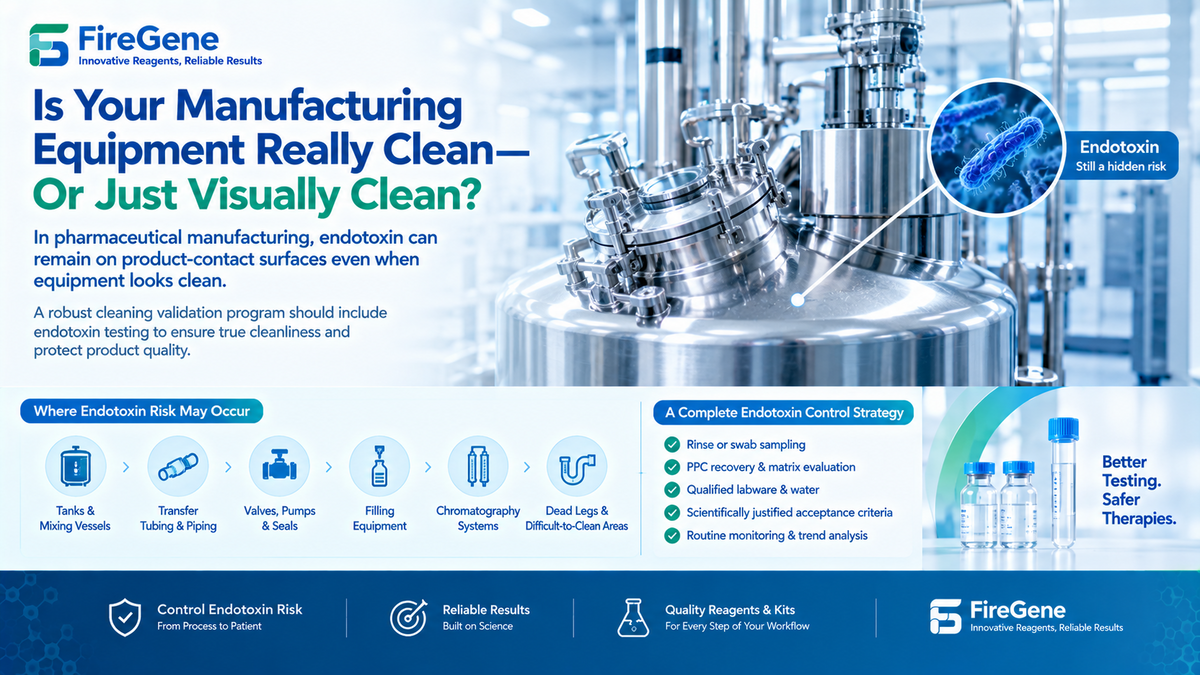
A piece of equipment may appear visually clean and may pass routine chemical residue testing while still presenting an endotoxin-control risk.
The reason is straightforward: sterilization and cleaning do not automatically guarantee endotoxin removal.
Endotoxins are lipopolysaccharide components associated with Gram-negative bacteria, and they can remain biologically active after microorganisms have been killed. FDA guidance therefore distinguishes endotoxin control from ordinary microbial control and recognizes the importance of appropriate cleaning procedures where endotoxin contamination is a concern.
For manufacturers, this means endotoxin testing should not necessarily be viewed only as a final-product release test.
It can also be an important analytical tool for demonstrating that a cleaning process is capable of controlling endotoxin contamination on manufacturing equipment.
This article explains how to approach endotoxin testing during cleaning validation, including:
- Where endotoxin risk can occur on manufacturing equipment
- When rinse or swab sampling may be appropriate
- How to select sampling locations
- How to establish scientifically justified acceptance criteria
- How to avoid false-positive or false-negative results
- How to evaluate TAL/LAL method suitability for cleaning samples
- How to integrate endotoxin testing into routine monitoring
- When cleaning validation should be reassessed
1. Why Endotoxin Matters During Equipment Cleaning
Cleaning validation has traditionally focused on demonstrating that residues from previous manufacturing operations are adequately removed.
Depending on the manufacturing process, these residues may include:
- Active pharmaceutical ingredients
- Excipients
- Proteins
- Peptides
- Process intermediates
- Cleaning agents
- Microbial residues
- Endotoxins
For sterile pharmaceutical manufacturing, endotoxin deserves specific attention because removing viable microorganisms does not necessarily eliminate endotoxin.
A sterilization step may reduce viable microbial contamination while leaving biologically active endotoxin behind.
FDA guidance has specifically noted that sterilizing-grade filtration and moist heat sterilization should not be assumed to remove endotoxin from equipment surfaces. Cleaning or validated high-temperature depyrogenation may be necessary depending on the equipment and process.
This creates an important distinction:
Microbial control asks whether microorganisms are controlled.
Endotoxin control asks whether pyrogenic bacterial components are controlled.
The two objectives can overlap, but they are not interchangeable.
For manufacturers producing injectable biologics, vaccines, peptides, monoclonal antibodies, cell and gene therapy products, or other sensitive products, endotoxin control should therefore be considered during equipment cleaning strategy development.
2. Where Can Endotoxin Accumulate on Manufacturing Equipment?
Endotoxin contamination is not necessarily distributed evenly across an entire manufacturing system.
Certain locations may have substantially greater contamination risk.
Common examples include:
Product-contact tanks
Mixing tanks and holding vessels can develop contamination risks when residual liquid remains on internal surfaces.
Dead legs, low points, poorly drained areas, and difficult-to-clean geometries deserve particular attention.
Transfer tubing
Flexible tubing and transfer assemblies may retain small amounts of process fluid.
If cleaning and drying are inadequate, these areas can become potential sources of microbial growth and endotoxin accumulation.
Pumps and valves
Complex internal geometries can make pumps, valves, and seals more difficult to clean than simple flat surfaces.
Filling equipment
Filling needles, manifolds, product-contact tubing, and associated components are especially important because contamination introduced late in the manufacturing process may be difficult to remove downstream.
Chromatography systems
Columns, chromatography skids, tubing, valves, and buffer lines may present additional contamination-control challenges in biologics manufacturing.
Cleaning validation should therefore consider not only the easiest surfaces to sample, but also the hardest-to-clean and highest-risk locations.
This principle is consistent with FDA cleaning-validation guidance, which emphasizes that sampling and analytical methods should be appropriate to the equipment and cleaning process being evaluated.
3. Rinse Sampling vs. Swab Sampling for Endotoxin Testing
One of the most important decisions in a cleaning validation study is how to collect samples.
Two common approaches are:
- Rinse sampling
- Swab sampling
The appropriate strategy depends on the equipment design, surface characteristics, cleaning process, and analytical objective.
Rinse Sampling
Rinse sampling uses a suitable rinse solution to recover residues from internal equipment surfaces.
A simplified workflow is:
Clean equipment → introduce qualified rinse solution → contact relevant surfaces → collect rinse → perform endotoxin testing
Rinse sampling can be particularly useful for:
- Large tanks
- Closed systems
- Transfer lines
- Tubing
- Equipment with complex internal pathways
- Surfaces that are difficult to access physically
One advantage is that a rinse can potentially sample a relatively large surface area.
However, rinse recovery must be understood.
A negative rinse result does not automatically prove that every surface inside the equipment is free of endotoxin.
The sampling procedure must be designed so that the rinse actually contacts the surfaces relevant to the cleaning validation objective.
Swab Sampling
Swab sampling involves collecting material directly from defined surface areas.
It can be useful for:
- Hard-to-clean locations
- Seals and gaskets
- Corners
- Valves
- Accessible tank surfaces
- Equipment areas identified as worst-case locations
Swabbing can provide more localized information than a bulk rinse.
However, recovery depends on:
- Swab material
- Surface material
- Sampling pressure
- Sampling pattern
- Area sampled
- Extraction procedure
- Endotoxin adsorption
- Operator technique
Therefore, the swab procedure itself should be qualified rather than treated as a simple collection step.
For complex equipment, a combined strategy may sometimes provide more information than relying exclusively on either rinse or swab samples.
4. How to Select Cleaning Validation Sampling Locations
A common mistake is to select sampling points simply because they are easy to reach.
A stronger strategy is to select locations based on risk.
Consider the following factors:
1. Difficult-to-clean areas
Examples include:
- Dead legs
- Narrow tubing
- Valves
- Gaskets
- Seals
- Welded joints
- Low points
- Internal corners
2. Areas with prolonged product contact
Surfaces exposed to product for extended periods may deserve additional attention.
3. Areas where liquid can accumulate
Standing water or residual process solution can increase microbial growth and endotoxin risk.
4. Areas with limited cleaning-agent flow
Poor flow can reduce the effectiveness of CIP procedures.
5. Areas identified by previous deviations
Historical contamination events should influence future sampling strategies.
6. Worst-case equipment locations
Cleaning validation should generally focus on locations that provide a meaningful challenge to the cleaning process rather than sampling only easily cleaned surfaces.
FDA's GMP guidance states that cleaning validation should reflect actual equipment use and that sampling can include swabbing, rinsing, or alternative approaches as appropriate.
5. Endotoxin Acceptance Criteria: What Should a Cleaning Validation Study Demonstrate?
One of the most important questions is:
What endotoxin level should be considered acceptable after cleaning?
There is no universal single value that automatically applies to every piece of pharmaceutical equipment.
Acceptance criteria should be scientifically justified based on factors such as:
- Intended product
- Maximum acceptable endotoxin exposure
- Equipment surface area
- Subsequent product volume
- Process design
- Sampling method
- Recovery characteristics
- Product endotoxin specification
- Risk to the next manufactured batch
The acceptance criterion should therefore be connected to the actual manufacturing process rather than selected simply because it is convenient for laboratory testing.
For example, a manufacturing system used for a highly sensitive parenteral product may require a more stringent endotoxin-control strategy than equipment used for a non-parenteral application.
Cleaning validation protocols should clearly define:
- Sampling locations
- Sampling method
- Extraction or rinse solution
- Analytical method
- Method sensitivity
- Recovery expectations
- Acceptance criteria
- Number of samples
- Replicate requirements
- Investigation procedures
The analytical method should also be demonstrated to be suitable for the actual sample matrix.
6. Why Method Suitability Matters for Cleaning Validation Samples
Cleaning samples are not necessarily simple aqueous samples.
Depending on the cleaning process, a rinse or swab extract may contain:
- Detergent residues
- Acidic or alkaline cleaning agents
- Surfactants
- Salts
- Process residues
- Solvents
- Protein residues
- Extractable materials from sampling devices
Any of these components may affect endotoxin detection.
TAL/LAL-based assays are highly sensitive, but that sensitivity means the assay can also be affected by sample chemistry.
Potential effects include:
- Inhibition
- Enhancement
- Optical interference
- Adsorption
- Reduced endotoxin recovery
This is why a cleaning validation laboratory should not assume that a method validated for the finished drug product automatically works for every equipment-rinse or swab-extract sample.
FireGene's guide on endotoxin test method validation and USP <85> method suitability discusses how product and sample matrices can interfere with endotoxin detection and why suitability must be demonstrated under actual conditions of use.
For cleaning-validation samples, the same analytical principle applies:
The method should be shown to work in the sample matrix being tested.
7. PPC Recovery Is Particularly Important
Positive Product Control, or PPC, is one of the most useful tools for evaluating endotoxin assay suitability.
In a cleaning validation study, PPC testing can help answer a fundamental question:
If a known amount of endotoxin is present in this rinse or extract, can the assay recover it appropriately?
If the spike is not recovered as expected, several possibilities should be considered:
- Matrix inhibition
- Matrix enhancement
- Sample preparation problems
- Endotoxin adsorption
- Incorrect dilution
- Reagent problems
- Pipetting variability
- Contaminated or unsuitable sampling materials
This is particularly important when a cleaning sample produces an unexpectedly low endotoxin result.
A low result is not automatically evidence that the equipment is exceptionally clean.
It may indicate that the analytical method is unable to recover endotoxin effectively from the sample.
FireGene's guide on endotoxin recovery studies provides a more detailed framework for understanding recovery experiments and their role in endotoxin method suitability.
8. Control the Sampling Materials
The cleaning process may be perfectly controlled while the sampling process introduces the problem.
For example, endotoxin can potentially be introduced by:
- Sampling tubes
- Swabs
- Pipette tips
- Containers
- Rinse water
- Glassware
- Microplates
- Transfer equipment
For low-level endotoxin testing, even a small contribution from laboratory materials can complicate interpretation.
This is why qualified pyrogen-free consumables are important.
FireGene's Pyrogen-Free Vials can be incorporated into sample collection and preparation workflows where appropriate.
Similarly, the water used for rinsing, dilution, negative controls, or sample preparation should be appropriately qualified for endotoxin testing.
FireGene's Endotoxin Assay Water is specified for bacterial endotoxin testing applications, including sample preparation, standard preparation, and negative-control use.
The basic principle is simple:
Do not allow the sampling system to become a new source of endotoxin.
9. Cleaning Validation Should Evaluate the Entire Sampling Workflow
An endotoxin cleaning validation study is not simply:
Clean → collect sample → test sample
A more realistic analytical workflow is:
Cleaning process
↓
Equipment drying / storage
↓
Defined sampling location
↓
Qualified rinse or swab material
↓
Sample extraction
↓
Sample dilution
↓
PPC / interference evaluation
↓
TAL/LAL endotoxin assay
↓
Data review
↓
Acceptance decision
Each step can introduce variability.
For example, changing the rinse volume can change the calculated endotoxin concentration.
Changing the swab material can affect recovery.
Changing the dilution can alter matrix interference.
Changing the sample container can influence endotoxin adsorption or contamination.
Changing the time between sampling and analysis can also affect sample integrity in certain matrices.
Therefore, the cleaning validation protocol should define these conditions in advance.
10. Gel-Clot vs. Kinetic Chromogenic Testing for Cleaning Samples
Different endotoxin assay formats can potentially be used depending on the analytical objective.
Gel-Clot Endotoxin Testing
Gel-clot testing provides a qualitative or semi-quantitative approach based on clot formation.
It can be useful when the primary objective is to determine whether endotoxin is above or below a defined sensitivity threshold.
FireGene's Gel-Clot Endotoxin Test Kit provides a straightforward TAL/LAL-based format for laboratories performing gel-clot endotoxin testing.
Kinetic Chromogenic Testing
Kinetic chromogenic testing provides quantitative results based on reaction kinetics and color development.
This can be useful when a cleaning validation program needs to:
- Quantify endotoxin levels
- Compare multiple equipment locations
- Monitor cleaning performance over time
- Generate numerical trend data
- Evaluate changes between cleaning cycles
FireGene's Kinetic Chromogenic Endotoxin Test Kit is designed for quantitative endotoxin analysis using a 405 nm kinetic chromogenic format.
The choice should be based on the validated analytical objective rather than simply selecting the method with the lowest labeled sensitivity.
11. Control Standard Endotoxin and Cleaning Validation
Quantitative endotoxin testing depends on appropriate endotoxin standards and controls.
Control Standard Endotoxin, or CSE, can be used to prepare endotoxin standards and support quantitative testing and recovery studies when appropriately qualified.
For cleaning validation, CSE can be especially useful for:
- PPC preparation
- Recovery studies
- Method suitability
- Standard curve preparation
- Analytical performance verification
FireGene's Control Standard Endotoxin (CSE) is part of the company's endotoxin testing portfolio for these analytical applications.
The key is traceability.
Laboratories should document:
- CSE lot
- Assigned potency
- Preparation date
- Reconstitution procedure
- Dilution factors
- Analyst
- Relevant storage conditions
- Use in PPC or calibration
Consistent documentation becomes especially important when cleaning-validation data are later reviewed during investigations or regulatory inspections.
12. What If the Cleaning Validation Sample Tests Positive?
A positive endotoxin result does not automatically mean that the cleaning process has failed.
The laboratory should first confirm that the analytical system is valid.
A systematic investigation can begin with:
Step 1: Check the negative control
Was background endotoxin introduced during sample preparation or testing?
Step 2: Review PPC recovery
Does the sample matrix allow reliable endotoxin detection?
Step 3: Review sample preparation
Were the rinse volume, dilution factor, extraction procedure, and sample transfers correct?
Step 4: Review sampling location
Was the sample collected from the intended location?
Step 5: Review cleaning records
Were:
- Cleaning-agent concentration
- Temperature
- Contact time
- Flow rate
- Rinse volume
- CIP cycle
- Drying conditions
within the validated range?
Step 6: Review equipment history
Check for:
- Recent maintenance
- Equipment modifications
- Long storage periods
- Extended equipment hold times
- Previous contamination events
Step 7: Compare historical data
A single elevated result may be important, but a gradual increase across multiple cleaning cycles may provide even stronger evidence of process drift.
FireGene's Endotoxin Testing Trend Analysis guide discusses how laboratories can use historical endotoxin data to identify developing process changes before they become major quality events.
13. Cleaning Validation Should Not End After Initial Qualification
Initial cleaning validation demonstrates that a defined cleaning process can achieve the intended outcome under specified conditions.
But manufacturing conditions can change.
Potential triggers for reassessment include:
- New products
- New formulations
- New cleaning agents
- Equipment modifications
- New tubing or components
- Changes to CIP parameters
- Process scale-up
- Extended equipment hold time
- New manufacturing locations
- Repeated endotoxin excursions
- Significant changes in historical endotoxin trends
FDA's GMP guidance describes cleaning validation as a process that should reflect actual equipment use and should be monitored at appropriate intervals after validation.
This supports a lifecycle approach rather than treating cleaning validation as a one-time paperwork exercise.
14. Integrating Endotoxin Testing Into Routine Cleaning Monitoring
After validation, manufacturers should determine how endotoxin monitoring fits into the ongoing contamination-control strategy.
Depending on the manufacturing process, routine monitoring may include:
Periodic rinse testing
Useful for closed systems and large equipment.
Targeted swab testing
Useful for known worst-case or difficult-to-clean locations.
Post-maintenance verification
Particularly important after equipment disassembly or modification.
Trend monitoring
Track endotoxin results across time rather than evaluating every result in isolation.
Investigation-triggered sampling
Additional testing may be appropriate after deviations, contamination events, or unexpected analytical trends.
The exact monitoring frequency should be justified according to the equipment, product, process risk, historical performance, and quality system.
A risk-based approach is generally more meaningful than applying the same sampling frequency to every piece of equipment.
15. Five Common Mistakes in Endotoxin Cleaning Validation
Mistake 1: Assuming Sterilization Removes Endotoxin
Sterilization and depyrogenation are not equivalent.
Endotoxin control requires its own scientific justification.
Mistake 2: Sampling Only Easy-to-Reach Surfaces
The easiest surface to sample is not necessarily the highest-risk surface.
Worst-case locations should be considered.
Mistake 3: Ignoring Rinse or Swab Recovery
A negative result is meaningful only when the sampling and analytical recovery process has been appropriately evaluated.
Mistake 4: Using Ordinary Laboratory Water
Background endotoxin from water can compromise low-level testing.
Use appropriately qualified endotoxin-control water.
Mistake 5: Treating Cleaning Validation as a One-Time Event
Equipment, products, cleaning processes, and manufacturing conditions change.
The cleaning-control strategy should evolve with them.
16. A Practical Workflow for Endotoxin Cleaning Validation
A practical program can be organized into the following sequence:
Step 1 — Map the equipment
Identify product-contact surfaces, dead legs, low points, valves, tubing, tanks, and other difficult-to-clean locations.
Step 2 — Perform an endotoxin risk assessment
Identify where endotoxin could originate, accumulate, or remain after cleaning.
FireGene's Endotoxin Risk Assessment Throughout the Pharmaceutical Manufacturing Lifecycle provides a broader framework for connecting equipment, water, raw materials, cleaning, formulation, and analytical controls.
Step 3 — Define sampling locations
Select representative and worst-case locations.
Step 4 — Select rinse or swab strategy
Match the sampling approach to equipment design and analytical objectives.
Step 5 — Qualify the sampling process
Evaluate recovery, materials, extraction conditions, and potential contamination.
Step 6 — Establish analytical suitability
Demonstrate appropriate PPC recovery and evaluate matrix interference.
Step 7 — Define acceptance criteria
Link acceptance limits to the actual product and manufacturing process.
Step 8 — Execute validation
Perform the study under representative and appropriately challenging conditions.
Step 9 — Document results
Maintain traceability for equipment, samples, analysts, reagents, standards, and analytical results.
Step 10 — Trend and periodically reassess
Use historical data to identify gradual changes in cleaning performance.
17. The Bigger Picture: Endotoxin Testing Is Part of Cleaning Control
The most important concept is that endotoxin testing should not be treated as an isolated laboratory activity.
A reliable endotoxin-control strategy connects:
Water quality
→ Raw material control
→ Manufacturing equipment
→ Cleaning validation
→ Sampling
→ TAL/LAL assay
→ Data trending
→ Process improvement
This approach is consistent with the broader lifecycle perspective increasingly used in pharmaceutical contamination-control programs.
FDA's 2026 Pyrogen and Endotoxins Testing: Questions and Answers guidance addresses testing recommendations and acceptance criteria within the framework of USP <85>, USP <161>, and AAMI ST72.
USP's guidance on bacterial endotoxin testing also emphasizes preparatory requirements, labware and equipment qualification, PPC criteria, interference, routine testing, and OOS considerations.
For manufacturers, the practical message is straightforward:
The quality of an endotoxin test depends not only on the reagent, but also on where the sample comes from, how it is collected, how it is prepared, and whether the analytical method is suitable for that sample.
Conclusion
Endotoxin testing during cleaning validation provides an important layer of assurance for pharmaceutical manufacturing systems where pyrogen control is critical.
A robust program should address more than simply obtaining a negative test result.
It should demonstrate that:
- High-risk equipment locations have been identified
- Sampling locations are scientifically justified
- Rinse and/or swab recovery is understood
- Sampling materials do not introduce unacceptable endotoxin
- The analytical method is suitable for the sample matrix
- PPC recovery supports reliable detection
- Acceptance criteria are scientifically justified
- Cleaning parameters are controlled
- Results are documented and traceable
- Long-term endotoxin data are appropriately trended
- Significant process or equipment changes trigger reassessment
Ultimately, the objective is not simply to prove that equipment looks clean.
It is to demonstrate that the cleaning process consistently controls endotoxin risk under actual manufacturing conditions.
For pharmaceutical QC laboratories, integrating reliable TAL/LAL endotoxin testing solutions with a scientifically designed cleaning-validation program can help create a more complete and defensible contamination-control strategy.
FireGene Endotoxin Testing
Ready to run your endotoxin assay?
FireGene offers a complete endotoxin testing toolkit — from TAL reagents and CSE standards to pyrogen-free consumables and LAL reagent water. All products are aligned with USP <85>, EP 2.6.14, and JP 4.01.


