
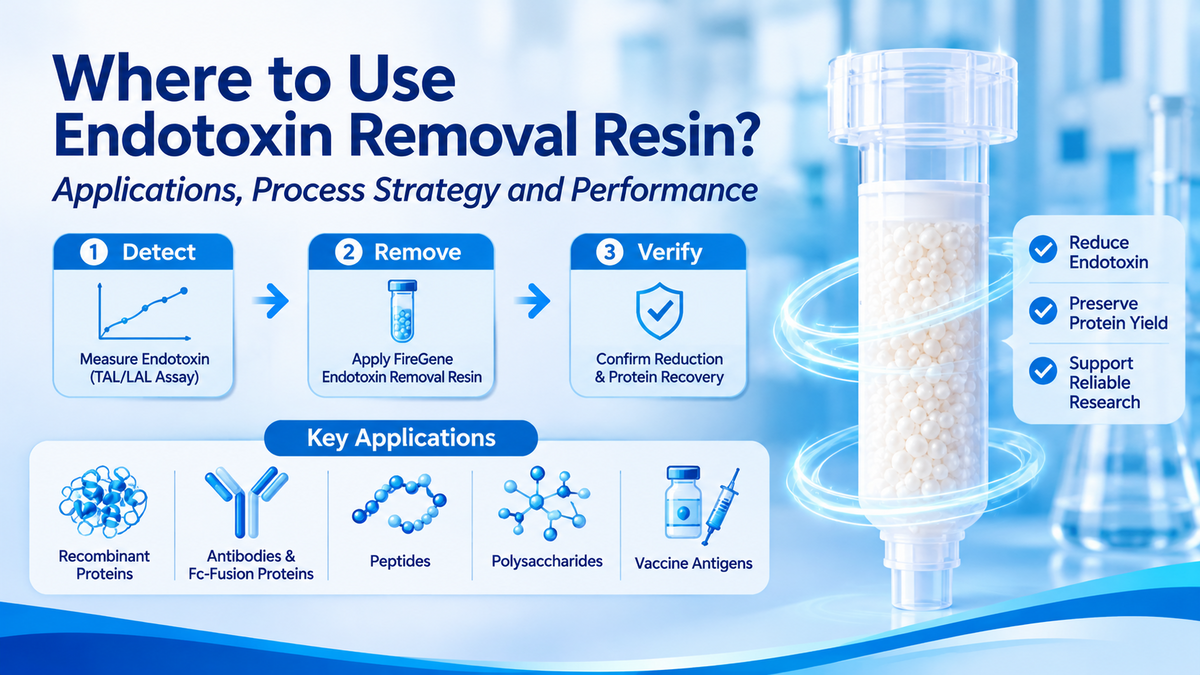
Introduction: Choosing the Right Stage for Endotoxin Removal
Endotoxin contamination is a persistent challenge in recombinant protein purification and biological sample preparation. Even after affinity chromatography, filtration, and buffer exchange, residual endotoxin may remain in a purified protein preparation.
For researchers, this creates an important question: At what stage should endotoxin removal be introduced into a purification workflow?
Adding an additional purification step too early may complicate downstream processing. Waiting until the final stage without understanding the initial endotoxin burden may also result in unnecessary sample loss or repeated purification.
The most effective strategy is to consider endotoxin removal as a targeted polishing operation, introduced when analytical results and application requirements indicate that additional endotoxin control is necessary.
FireGene's High-Efficiency Endotoxin Removal Purification Resin is designed for endotoxin reduction in compatible protein-based preparations, including proteins, peptides, antibodies, and polysaccharides.
The resin uses modified Polymyxin B immobilized on 4% agarose microspheres. Its adsorption-based mechanism provides an additional option for removing endotoxin from suitable biological samples.
However, the right process depends on more than the resin itself. Researchers need to consider the target molecule, purification stage, buffer composition, endotoxin concentration, and recovery requirements.
This guide explains where resin-based endotoxin removal can fit into different purification workflows and how to evaluate its performance through appropriate TAL/LAL testing.
I. Why Conventional Protein Purification May Not Remove Enough Endotoxin
Protein purification and endotoxin removal are related but different objectives.
Conventional purification methods are generally designed to separate the target protein from host-cell proteins, aggregates, nucleic acids, and other impurities. Endotoxin, however, has distinct physicochemical properties that can make its removal challenging.
Endotoxins are lipopolysaccharides (LPS) associated with the outer membrane of Gram-negative bacteria. They can enter protein preparations through bacterial expression systems, particularly during cell disruption and lysate preparation.
For example, recombinant proteins expressed in Escherichia coli may contain residual LPS after initial purification.
A sample can therefore demonstrate:
-
High target-protein purity by SDS-PAGE
-
A satisfactory chromatographic profile
-
An acceptable protein concentration
-
Yet still contain measurable endotoxin
This distinction matters because residual endotoxin can interfere with cell-based assays, immune-response studies, and other sensitive biological experiments.
Sterile filtration should not be assumed to remove endotoxin, and a high protein purity result does not establish a low endotoxin concentration.
When endotoxin is relevant to the intended application, a dedicated bacterial endotoxins test is needed to determine whether additional removal is necessary.
II. Where Should Endotoxin Removal Resin Be Integrated Into a Purification Workflow?
The appropriate treatment stage depends on the target molecule and the existing purification process.
In many protein workflows, resin-based endotoxin removal can be evaluated after the main purification steps, when the target protein has already been enriched and the remaining endotoxin burden can be assessed.
1. After Affinity Chromatography
Affinity chromatography is commonly used as an initial capture step for recombinant proteins and antibodies.
Examples include:
-
His-tag affinity chromatography for tagged recombinant proteins
-
Protein A or Protein G chromatography for antibodies
-
Other ligand-based affinity methods for specific target molecules
Although these techniques can effectively enrich the target, they are not automatically sufficient for endotoxin removal.
An endotoxin removal resin may be evaluated after affinity purification when testing indicates that residual endotoxin remains above the desired level.
This placement can be useful because the sample has already undergone primary purification, making it easier to evaluate the relationship between endotoxin reduction and target recovery.
2. After Ion-Exchange Chromatography
Ion-exchange chromatography separates molecules according to differences in charge and is widely used in protein purification.
Depending on the target molecule and process conditions, ion-exchange chromatography may contribute to endotoxin reduction. However, the outcome can vary with pH, ionic strength, and interactions between endotoxin and the target protein.
If residual endotoxin remains after ion-exchange purification, an additional resin-based polishing step can be evaluated.
The main consideration is buffer compatibility. Before loading a sample, researchers should confirm that its pH and salt concentration are appropriate for both the resin and the target molecule.
3. Before Final Formulation or Buffer Exchange
A final purification or formulation stage may be an appropriate point to evaluate endotoxin removal, particularly when the sample is being prepared for sensitive downstream research.
However, resin treatment should be planned together with subsequent buffer exchange and formulation steps.
Researchers should determine whether the treatment introduces changes in pH, ionic strength, sample concentration, or other characteristics that may affect the final preparation.
The final sample should be tested after the complete processing workflow rather than relying exclusively on an intermediate result.
4. During Process Development
For new recombinant proteins or biologics research materials, the most suitable treatment stage may not be known in advance.
Small-scale process-development experiments can compare different treatment positions and operating conditions.
For example, researchers may evaluate resin treatment after affinity purification versus after ion-exchange chromatography, comparing:
-
Initial and final endotoxin concentrations
-
Target-protein recovery
-
Sample volume and concentration
-
Protein integrity
-
Biological activity, where relevant
This approach helps identify a practical treatment position without introducing unnecessary steps into the final workflow.
III. Application One: Recombinant Protein Purification
Recombinant proteins expressed in bacterial systems are a major application area for endotoxin removal.
During bacterial growth and cell disruption, LPS-containing material can enter the crude lysate. Subsequent purification may reduce many impurities, but residual endotoxin can remain associated with the target-containing fraction.
1. Cytokines and Immune-Related Proteins
Cytokines and immune-related proteins are widely used in studies of inflammation, immune-cell activation, and cell signaling.
Because endotoxin can independently activate innate immune pathways, contamination may produce misleading experimental results.
For example, when researchers evaluate the biological activity of a recombinant cytokine, residual LPS may contribute to changes in cytokine release or immune-cell activation.
An endotoxin removal step may help reduce this source of experimental interference.
After treatment, researchers should measure endotoxin levels and assess target recovery. If biological function is important, an appropriate functional assay should also be performed.
2. Growth Factors and Cell Culture Proteins
Growth factors and cell culture proteins are used in cell proliferation, differentiation, and functional studies.
Residual endotoxin may influence cell behavior and introduce unwanted variation into experimental results.
When endotoxin testing identifies contamination, resin treatment can be evaluated as an additional polishing step.
The selected conditions should preserve the target protein's stability, solubility, and biological activity.
3. Recombinant Enzymes
Recombinant enzymes may be used in biochemical assays, molecular biology research, and other experimental workflows.
For these samples, endotoxin reduction should be evaluated alongside enzyme activity.
A successful treatment should not only reduce measured endotoxin but also preserve an acceptable level of target recovery and functional performance.
Practical recommendation: For recombinant proteins, begin by measuring the endotoxin burden after the main purification step. If additional reduction is needed, evaluate resin treatment on a small scale before incorporating it into the routine process.
IV. Application Two: Antibody and Fc-Fusion Protein Purification
Antibodies and Fc-fusion proteins are widely used in immunological research, target validation, and cell-based studies.
Protein A/G affinity chromatography is commonly used for antibody capture, but affinity purification alone does not establish that the final preparation meets its endotoxin requirements.
1. Why Antibody Preparations May Need Endotoxin Polishing
Residual endotoxin can interfere with immune-cell assays and other experiments involving inflammatory signaling.
For antibody preparations intended for these applications, an additional endotoxin removal step may be worth evaluating when analytical results indicate contamination.
2. Evaluating Resin Compatibility
Antibodies and Fc-fusion proteins can differ in structure, aggregation tendency, and buffer requirements.
When evaluating resin treatment, consider:
-
Antibody concentration and sample volume
-
Buffer pH and ionic strength
-
Potential nonspecific adsorption
-
Aggregation or precipitation
-
Binding activity or other relevant functional properties
A small-scale compatibility study can help determine whether the treatment provides sufficient endotoxin reduction without unacceptable antibody loss.
3. Assessing the Final Antibody Preparation
After treatment, measure endotoxin concentration and total antibody recovery.
Where applicable, use an appropriate analytical method to assess aggregation, structural integrity, or antigen-binding activity.
The treatment should be considered successful only when the final sample meets its predefined endotoxin and product-quality requirements.
V. Application Three: Peptides and Other Compatible Biological Preparations
Peptides are used in cell signaling studies, biochemical research, and other biological applications.
Although peptides differ from larger proteins in molecular size and structure, endotoxin contamination may still affect sensitive downstream experiments.
1. Peptide Preparation and Endotoxin Control
Peptide contamination risks depend on the production route, raw materials, purification procedure, and sample handling.
For compatible peptide preparations, resin-based endotoxin removal may be evaluated as an additional treatment step.
2. Important Factors to Evaluate
Peptides can differ considerably in charge, hydrophobicity, and solubility. These properties may influence nonspecific adsorption and recovery during resin treatment.
Researchers should evaluate:
-
Peptide solubility under the proposed conditions
-
Recovery after treatment
-
Buffer compatibility
-
Potential nonspecific adsorption
-
Biological activity, where relevant
A pilot-scale study is recommended before processing valuable or limited-quantity samples.
3. Polysaccharide Preparations
FireGene also identifies polysaccharides among the intended sample categories for its resin.
Because polysaccharides vary in molecular weight, charge, viscosity, and solubility, their compatibility should be evaluated individually.
For these preparations, endotoxin reduction should be assessed together with target recovery and relevant sample-quality attributes.
VI. How FireGene Endotoxin Removal Resin Works
FireGene's High-Efficiency Endotoxin Removal Purification Resin uses modified Polymyxin B immobilized on 4% agarose microspheres.
Polymyxin B has an affinity for bacterial lipopolysaccharides. Immobilizing the modified ligand on agarose microspheres provides a solid-phase adsorption approach for endotoxin removal from compatible sample preparations.
According to the product specifications, the resin has the following characteristics:
-
SKU: FG-YS20518
-
Matrix: 4% agarose microspheres
-
Ligand: Modified Polymyxin B
-
Bead size: 45–165 μm
-
Listed binding capacity: Greater than 2,000,000 EU/mL of resin matrix
-
Operating pH range: 5–10
-
Maximum pressure: 0.1 MPa (1 bar)
-
Storage condition: 2–8°C
-
Shelf life: 2 years
-
Storage solution: 20% ethanol
The listed resin volume refers to the gel matrix rather than the combined gel-and-storage-solution volume.
FireGene reports that endotoxin levels can be reduced to as low as 0.1 EU/mL under suitable conditions. The product FAQ also reports endotoxin removal of up to 99% and protein recovery of up to 90%.
These are manufacturer-reported performance figures, not guaranteed outcomes for every sample. Actual performance depends on the initial endotoxin burden, sample composition, target molecule, pH, buffer conditions, resin loading, and contact time.
For full product information, visit the FireGene High-Efficiency Endotoxin Removal Purification Resin page.
VII. Optimizing Resin Treatment Conditions
A resin that performs well with one protein may not produce identical results with another.
For this reason, treatment conditions should be optimized according to the specific sample.
1. pH
The product lists an operating pH range of 5–10.
If endotoxin removal efficiency is lower than expected, FireGene's product guidance recommends investigating pH and suggests 7–8 as a troubleshooting starting point where compatible with the target molecule.
This range should not be interpreted as universally optimal.
Always consider the target protein's stability, solubility, and aggregation risk before adjusting pH.
2. Salt Concentration
Low protein recovery may result from nonspecific adsorption onto the resin.
FireGene's product FAQ suggests evaluating increased NaCl concentration in both the sample and equilibration buffer when recovery is low.
However, salt concentration can also influence target stability and endotoxin binding. Small-scale comparisons are recommended before changing the routine process.
3. Resin-to-Sample Ratio
The required resin volume depends on the sample volume, initial endotoxin burden, and process conditions.
When endotoxin content is unknown, FireGene's product guidance suggests a resin-to-sample volume ratio of 1:1 or 1:2 as an initial experimental starting point.
This is not a universal operating requirement. Where possible, measure the initial endotoxin concentration and use the listed binding capacity to guide process development.
4. Contact Time and Flow Rate
For column-based treatment, sufficient contact between the sample and resin is important.
FireGene's product FAQ provides a specific example: for a 40 mL resin bed, a flow rate not exceeding 4 mL/min is recommended to maintain a contact time greater than 10 minutes under the described setup.
This example should not be automatically applied to different column dimensions, sample viscosities, or operating configurations.
The stated maximum pressure is 0.1 MPa (1 bar).
5. Buffer Compatibility
Buffer composition can influence both endotoxin removal and target recovery.
FireGene indicates that HEPES buffer can be used. Its product guidance also recommends keeping glycerol at no more than 5%, because higher concentrations may increase viscosity and negatively affect sample recovery.
The manufacturer lists compatibility with several other reagents, but compatibility should not be confused with guaranteed performance in every combination.
Always evaluate the actual sample formulation and refer to the current product instructions.
VIII. Verify Resin Performance With TAL/LAL Endotoxin Testing
Resin treatment alone does not establish that the final sample meets its endotoxin requirements.
A suitable TAL/LAL assay should be used to measure endotoxin before and after treatment.
1. Initial Endotoxin Measurement
Measure the initial endotoxin concentration before applying the resin whenever the selected assay and sample matrix permit reliable quantification.
Record:
-
Initial endotoxin concentration
-
Sample volume
-
Protein concentration
-
Buffer composition and pH
-
Assay dilution and relevant controls
This information helps establish a baseline for evaluating treatment performance.
2. Quantitative Testing With Kinetic Chromogenic Assays
Kinetic chromogenic testing measures color development over time and uses the assay calibration relationship to estimate endotoxin concentration.
It can be useful for quantitative comparison of pre-treatment and post-treatment samples when the method is suitable for the matrix.
Explore the FireGene Kinetic Chromogenic Endotoxin Test Kit.
3. Gel-Clot Testing
The gel-clot method can be used for limit-based endotoxin assessment when its sensitivity is appropriate for the intended application.
Explore the FireGene Gel-Clot Endotoxin Test Kit.
4. Calculate Endotoxin Reduction
The percentage reduction can be calculated using the initial and post-treatment endotoxin concentrations.
Endotoxin Reduction (%) = [(C0 − C1) / C0] × 100
Where:
-
C0 = Initial endotoxin concentration (EU/mL)
-
C1 = Post-treatment endotoxin concentration (EU/mL)
For example, if the initial concentration is 50 EU/mL and the post-treatment concentration is 5 EU/mL:
Endotoxin Reduction (%) = [(50 − 5) / 50] × 100 = 90%
This represents a 90% reduction in measured endotoxin concentration.
If sample volume changes during processing, a concentration-based calculation does not independently represent the change in total endotoxin amount.
5. Calculate Protein Recovery
Protein recovery should be evaluated alongside endotoxin reduction.
Protein Recovery (%) = (Recovered Protein Amount / Initial Protein Amount) × 100
For example, if a sample initially contains 100 mg of protein and 80 mg is recovered after treatment:
Protein Recovery (%) = (80 / 100) × 100 = 80%
When the initial and final sample volumes differ, calculate the total protein amount using:
Protein Amount (mg) = Protein Concentration (mg/mL) × Sample Volume (mL)
This avoids relying on concentration alone when evaluating process yield.
6. Confirm Assay Suitability
Protein solutions and buffer components may inhibit or enhance the endotoxin assay response.
A post-treatment result should therefore be interpreted only after considering method suitability for the treated matrix.
Depending on the method and applicable requirements, this may involve positive product control recovery, dilution studies, and other appropriate controls.
An apparently low endotoxin result should not be accepted as proof of successful removal if the assay is inhibited.
IX. Common Process Challenges and Troubleshooting
Low Endotoxin Removal Efficiency
Possible factors include unsuitable pH, insufficient contact time, excessive resin loading, or matrix-related effects.
Review the initial endotoxin result, pH, resin-to-sample ratio, and operating conditions. Confirm that the analytical method is suitable for the sample.
Low Protein Recovery
Potential causes include nonspecific adsorption, protein aggregation, precipitation, or unsuitable buffer conditions.
Compare total protein amounts before and after treatment. Investigate compatible changes in salt concentration and other process parameters.
Unexpected Endotoxin Results
Recontamination may occur through water, buffers, containers, or sample-handling procedures.
Use endotoxin-controlled consumables and follow the manufacturer's preparation and handling instructions.
FireGene's product FAQ advises against using previously used resin to remove endotoxin from different samples.
High Sample Viscosity
High glycerol concentrations may increase viscosity and negatively affect sample recovery.
FireGene recommends using no more than 5% glycerol for this resin. Confirm compatibility for other additives before processing.
X. Important Application Limitations
A resin suitable for protein-based sample preparation should not automatically be assumed to work with every biological material.
FireGene's product page describes applications involving proteins, peptides, antibodies, and polysaccharides. Its FAQ explicitly states that the resin cannot remove endotoxin from nucleic acid samples such as plasmids or DNA.
Although the page's application list also mentions plasmid preparation, this conflicts with the FAQ. Researchers should confirm the intended scope directly with FireGene before considering any nucleic-acid application.
This article therefore focuses on protein-based products and other compatible biological samples.
For clinical manufacturing, therapeutic product release, or regulated applications, additional process qualification, validation, and regulatory requirements may apply. Research-grade resin treatment should not be interpreted as proof of clinical or manufacturing suitability.
Conclusion: Integrate Endotoxin Removal Where It Adds Measurable Value
Endotoxin removal is not necessarily required at every stage of protein purification. The most appropriate position depends on the initial endotoxin burden, the target molecule, the existing purification process, and the intended downstream application.
For recombinant proteins, antibodies, Fc-fusion proteins, peptides, and other compatible biological preparations, resin-based endotoxin removal can be evaluated as an additional polishing step.
FireGene's High-Efficiency Endotoxin Removal Purification Resin uses modified Polymyxin B immobilized on 4% agarose microspheres to support endotoxin reduction in suitable samples.
To establish a reliable process, researchers should:
-
Measure the initial endotoxin level.
-
Identify the most appropriate treatment stage.
-
Optimize pH, buffer composition, resin loading, and contact time.
-
Measure endotoxin reduction and target recovery.
-
Confirm assay suitability and final sample quality.
The best purification strategy is not simply the one that removes the most endotoxin. It is the one that achieves the required endotoxin control while preserving the target molecule's recovery, integrity, and intended function.
Explore FireGene Endotoxin Testing and Removal Solutions
For research use only. Application suitability and process performance should be established experimentally for the intended sample and downstream use.
FireGene Endotoxin Testing
Ready to run your endotoxin assay?
FireGene offers a complete endotoxin testing toolkit — from TAL reagents and CSE standards to pyrogen-free consumables and LAL reagent water. All products are aligned with USP <85>, EP 2.6.14, and JP 4.01.


