
Introduction
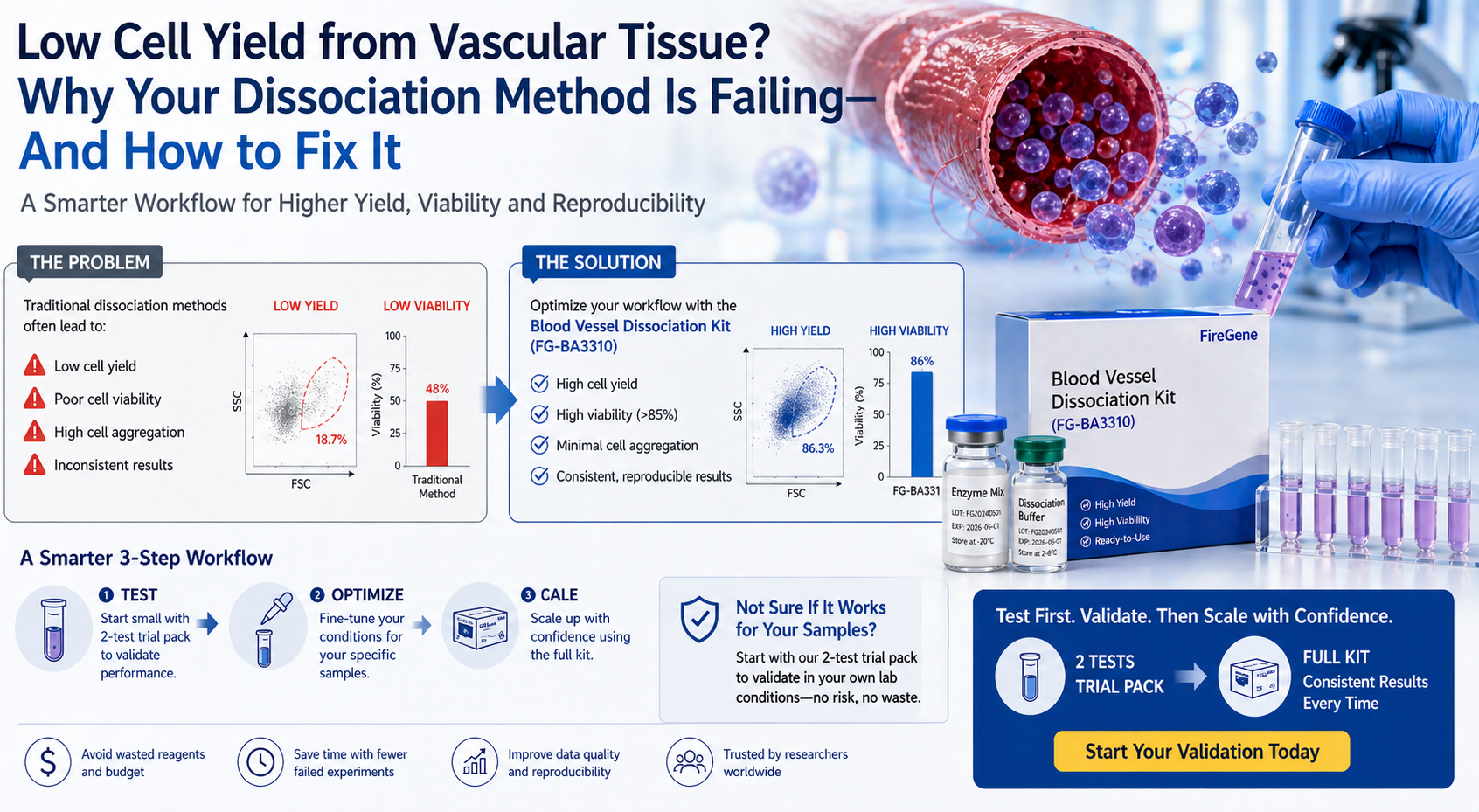
Vascular tissue dissociation is one of the most failure-prone steps in single-cell workflows. Despite advances in enzymatic technologies, many labs still report inconsistent outcomes.
If you're experiencing:
- Low cell yield
- Poor viability
- Batch-to-batch variability
The issue is not just your protocol—it’s your workflow strategy.
Hidden Causes of Failure
Inadequate Enzyme Systems
Most generic enzymes are not designed for vascular ECM
Overprocessing
Excessive digestion destroys cells
Lack of Validation
Skipping validation leads to failed experiments
The Cost of Getting It Wrong
Failed dissociation leads to:
- Lost samples
- Repeated experiments
- Increased costs
- Delayed research timelines
A Smarter Workflow Strategy
Instead of jumping directly into full-scale experiments:
👉 Adopt a Test → Validate → Scale model
Step 1: Test with a Trial Pack
Use a 2-test configuration to:
- Assess performance
- Adjust digestion time
- Evaluate cell viability
👉 Try here:
🔗 https://firegene.com/products/blood-vessel-dissociation-kit-fg-ba3310
Step 2: Optimize Conditions
Fine-tune:
- Incubation time
- Mixing intensity
- Filtration steps
Step 3: Scale Confidently
Once validated:
- Switch to full kits
- Standardize workflow
Supporting Tools
- Tissue dissociation alternatives
🔗 https://firegene.com/products/mouse-brain-dissociation-kit-fg-ba3305 - Cell storage
🔗 https://firegene.com/products/universal-cell-freezing-kit-fg-ba3309
Conclusion
The difference between failed and successful experiments often comes down to one thing:
👉 Validation before scaling
Start here:
🔗 https://firegene.com/products/blood-vessel-dissociation-kit-fg-ba3310
FireGene, light your research with passion, innovation, and profession.


