
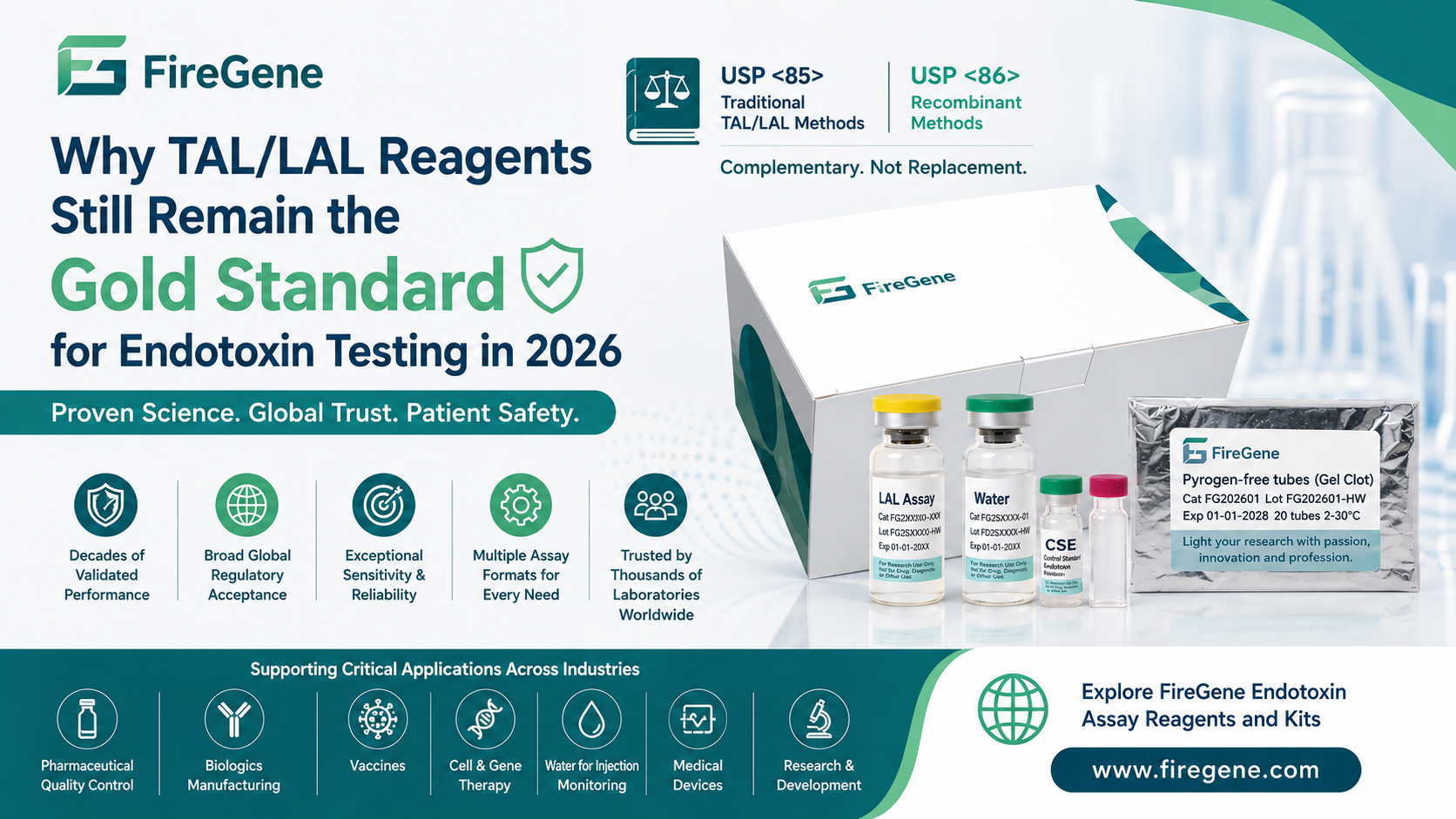
Understanding Why Pharmaceutical QC Laboratories, Biotech Companies, and Research Institutions Continue to Trust TAL/LAL Reagents Despite the Rise of Recombinant Endotoxin Testing
The field of bacterial endotoxin testing is undergoing one of its most significant transitions in decades.
The publication and increasing adoption of USP <86> Bacterial Endotoxins Test Using Recombinant Reagents has sparked widespread discussion across the pharmaceutical, biotechnology, medical device, and life science industries. Regulatory agencies, quality control laboratories, contract testing organizations, and research institutions are all evaluating how recombinant endotoxin detection technologies fit into existing quality systems.
This shift has also generated a common question among scientists:
Are TAL/LAL Reagents becoming obsolete?
At first glance, the answer may seem obvious. Recombinant methods offer several attractive advantages, including animal-free production, improved sustainability, and growing regulatory recognition. Many industry headlines have even suggested that recombinant assays will soon replace traditional horseshoe crab–derived reagents.
However, the reality is considerably more nuanced.
Despite the growing availability of recombinant technologies, TAL/LAL Reagents remain the most widely used and globally accepted endotoxin testing methods in pharmaceutical quality control, biologics manufacturing, medical device testing, and life science research.
Across thousands of laboratories worldwide, traditional TAL/LAL-based assays continue to support:
- Pharmaceutical product release
- Vaccine manufacturing
- Injectable drug quality control
- Cell and gene therapy manufacturing
- Medical device validation
- Water system monitoring
- Raw material qualification
- Academic research
For many organizations, TAL/LAL Reagents remain the benchmark against which newer technologies are evaluated.
This continued confidence is not based on tradition alone.
It is supported by decades of accumulated validation data, global pharmacopoeial acceptance, regulatory familiarity, proven analytical performance, and an unparalleled history of successful implementation across virtually every segment of the pharmaceutical industry.
As endotoxin testing continues to evolve, the discussion is shifting away from a simple comparison between "old" and "new" technologies.
Instead, today's quality professionals are asking a more important question:
Which endotoxin testing method is most appropriate for my specific application?
Understanding why TAL/LAL Reagents continue to occupy a central role in modern endotoxin testing requires examining not only technological innovation, but also regulatory expectations, validation requirements, analytical performance, and real-world laboratory practice.
The Endotoxin Testing Landscape Is Changing
Few analytical methods have experienced as much recent attention as bacterial endotoxin testing.
For more than forty years, TAL/LAL Reagents have served as the foundation of endotoxin detection throughout the pharmaceutical industry.
From small academic laboratories to multinational vaccine manufacturers, these assays have become deeply integrated into quality systems worldwide.
During this period, several analytical formats have been successfully developed, including:
- Gel Clot TAL/LAL Reagent
- Kinetic Chromogenic TAL/LAL Reagent
- Kinetic Turbidimetric TAL/LAL Reagent
Together, these methods have supported countless product approvals while helping ensure the safety of injectable medicines used by millions of patients.
In recent years, however, the conversation surrounding endotoxin testing has expanded.
Several factors have contributed to this evolution.
Increased Interest in Sustainability
One of the primary drivers has been increased awareness of horseshoe crab conservation.
Because traditional TAL/LAL Reagents are produced using amebocyte lysate derived from horseshoe crabs, researchers and regulatory organizations have shown growing interest in alternative technologies that reduce dependence on animal-derived materials.
This interest has accelerated development of recombinant endotoxin detection reagents produced through biotechnology rather than natural lysate extraction.
Although sustainability remains an important consideration, analytical performance and patient safety continue to be the primary priorities for regulated pharmaceutical testing.
The Introduction of USP <86>
Another major milestone was the publication of USP <86> Bacterial Endotoxins Test Using Recombinant Reagents.
Unlike USP <85>, which describes traditional bacterial endotoxins testing using TAL/LAL Reagents, USP <86> provides guidance for recombinant technologies capable of detecting bacterial endotoxin through alternative biochemical mechanisms.
The publication of USP <86> represents an important expansion of available analytical tools.
However, one common misunderstanding quickly emerged.
Many researchers interpreted USP <86> as evidence that traditional TAL/LAL Reagents were being phased out.
That interpretation is incorrect.
USP <86> adds another validated testing option.
It does not replace USP <85>.
Both chapters now coexist within the United States Pharmacopeia, allowing laboratories to select the method most appropriate for their specific products, validation strategies, and regulatory environments.
Growing Complexity of Modern Biopharmaceuticals
Today's pharmaceutical products differ dramatically from those manufactured twenty years ago.
Modern pipelines increasingly include:
- Monoclonal antibodies
- Cell therapies
- Gene therapies
- mRNA therapeutics
- Lipid nanoparticles
- Viral vectors
- Bispecific antibodies
- Personalized medicines
These products often possess highly complex biological matrices capable of interfering with analytical methods.
Consequently, laboratories require endotoxin assays that have demonstrated reliable performance across a wide variety of sample types.
Because TAL/LAL Reagents have accumulated decades of validation data in these environments, they continue to provide a high level of confidence for many quality control laboratories.
Regulatory Expectations Continue to Emphasize Scientific Justification
Perhaps the most important trend is that regulators increasingly encourage science-based method selection rather than promoting a single universal testing technology.
Whether laboratories choose:
- Gel Clot TAL/LAL Reagent
- Kinetic Chromogenic TAL/LAL Reagent
- Kinetic Turbidimetric TAL/LAL Reagent
- Recombinant endotoxin assays
they are expected to demonstrate:
- Method suitability
- Appropriate validation
- Matrix compatibility
- Analytical robustness
- Ongoing quality assurance
The emphasis is therefore shifting from which technology is newest to which technology is best validated for the intended application.
This distinction explains why TAL/LAL Reagents continue to occupy such a prominent position throughout global pharmaceutical quality systems.
Why This Discussion Matters in 2026
The rapid expansion of biologics manufacturing, advanced therapies, and precision medicine means that endotoxin testing has never been more important.
Every year, thousands of new biological products enter preclinical and clinical development.
Each requires robust endotoxin control to protect patient safety and satisfy regulatory expectations.
As laboratories evaluate new technologies, many are discovering that innovation does not necessarily require abandoning proven analytical methods.
Instead, the future of endotoxin testing increasingly involves using the right assay for the right application.
For many routine quality control workflows, TAL/LAL Reagents continue to provide unmatched experience, extensive validation history, and broad global acceptance.
These advantages explain why they remain the reference standard against which emerging endotoxin detection technologies are frequently compared.
Are TAL/LAL Reagents Being Replaced? The Short Answer Is No.
Since the publication of USP <86>, one question has repeatedly surfaced in pharmaceutical quality control laboratories, biotechnology companies, and scientific conferences:
"Are TAL/LAL Reagents being replaced by recombinant endotoxin testing?"
The short answer is:
No.
The longer—and more accurate—answer is that the endotoxin testing landscape is expanding, not replacing.
Recombinant technologies represent an important advancement in bacterial endotoxin detection, particularly in laboratories seeking animal-free analytical methods. However, they do not invalidate the decades of scientific evidence supporting traditional TAL/LAL Reagents, nor do they eliminate existing regulatory expectations surrounding method validation and suitability.
In fact, in 2026, the overwhelming majority of commercial pharmaceutical manufacturing facilities continue to perform routine endotoxin testing using validated TAL/LAL-based assays.
Understanding why requires looking beyond marketing claims and examining current regulatory practice.
USP <86> Did Not Replace USP <85>
Perhaps the most common misconception is that USP <86> supersedes USP <85>.
It does not.
These two chapters serve different—but complementary—purposes.
USP <85> remains the official compendial chapter describing the Bacterial Endotoxins Test (BET) using traditional TAL/LAL Reagents.
USP <86> introduces guidance for Bacterial Endotoxins Test Using Recombinant Reagents, providing laboratories with an additional scientifically acceptable option when appropriately validated.
Importantly:
- USP <85> remains fully effective.
- USP <86> does not invalidate existing TAL/LAL methods.
- Laboratories may continue using TAL/LAL Reagents exactly as before, provided they meet validation requirements.
The introduction of USP <86> should therefore be viewed as an expansion of analytical flexibility rather than a replacement strategy.
FDA Has Not Required Laboratories to Abandon TAL/LAL Reagents
Another misunderstanding frequently encountered online is that the U.S. Food and Drug Administration (FDA) now "prefers" recombinant endotoxin testing.
Current FDA guidance does not state this.
Instead, the FDA continues to emphasize:
- Appropriate method validation
- Scientific justification
- Product-specific suitability
- Reliable analytical performance
Regardless of whether a laboratory uses:
- Gel Clot TAL/LAL Reagent
- Kinetic Chromogenic TAL/LAL Reagent
- Kinetic Turbidimetric TAL/LAL Reagent
- Recombinant Factor C–based methods
the expectation remains the same:
The selected method must demonstrate that it is suitable for the intended product matrix and capable of reliably detecting bacterial endotoxin.
This principle has remained remarkably consistent across decades of pharmaceutical quality regulation.
Global Pharmacopoeias Continue to Support TAL/LAL Reagents
The continued importance of TAL/LAL Reagents is not limited to the United States.
Major international pharmacopoeias continue to recognize traditional bacterial endotoxin testing methods.
These include:
- United States Pharmacopeia (USP)
- European Pharmacopoeia (Ph. Eur.)
- Japanese Pharmacopoeia (JP)
- Chinese Pharmacopoeia (ChP)
Collectively, these standards govern pharmaceutical manufacturing across the vast majority of the global market.
Because multinational manufacturers frequently distribute products worldwide, analytical methods must satisfy regulatory expectations across multiple jurisdictions.
TAL/LAL Reagents therefore remain the most universally accepted approach for routine endotoxin testing.
Pharmaceutical Manufacturers Value Proven Validation Histories
Introducing a new analytical method into a GMP environment is far more complex than purchasing new instrumentation.
Every analytical change may require:
- Method development
- Method suitability studies
- Validation
- Comparability assessments
- SOP revision
- Analyst retraining
- Regulatory documentation
- Quality system updates
For manufacturers operating dozens or even hundreds of validated products, replacing an established endotoxin testing platform represents a significant investment.
Unless a clear scientific or operational advantage exists, most organizations prefer to maintain well-characterized analytical methods that already demonstrate consistent regulatory compliance.
Because TAL/LAL Reagents possess decades of accumulated validation data, they continue to represent a low-risk, highly reliable solution for routine quality control.
Decades of Clinical Experience Matter
Few analytical technologies have accumulated as much real-world experience as TAL/LAL Reagents.
For more than forty years, these assays have supported the release of:
- Injectable pharmaceuticals
- Vaccines
- Monoclonal antibodies
- Plasma-derived therapeutics
- Intravenous solutions
- Medical devices
- Cell therapy products
- Gene therapy materials
Every successful batch released using validated TAL/LAL methods contributes additional confidence in their analytical reliability.
This enormous body of practical experience is difficult for any newly introduced analytical technology to replicate in a short period.
For many quality professionals, this historical performance remains one of the strongest arguments for continued use.
Regulatory Acceptance Is Built on Evidence, Not Novelty
Scientific innovation plays an essential role in pharmaceutical quality control.
However, regulatory agencies evaluate analytical methods based on evidence—not novelty.
A newer technology is not automatically considered superior simply because it is more recent.
Instead, regulators ask questions such as:
- Has the method been validated?
- Does it demonstrate acceptable accuracy?
- Is precision acceptable?
- Is the assay robust?
- Has interference been adequately evaluated?
- Can the laboratory consistently reproduce results?
Traditional TAL/LAL Reagents continue to answer these questions successfully across countless validated manufacturing processes.
Consequently, they remain a cornerstone of bacterial endotoxin testing despite the emergence of newer technologies.
Why Many QC Laboratories Continue to Choose TAL/LAL Reagents
When pharmaceutical quality control managers evaluate analytical platforms, they typically prioritize:
- Regulatory confidence
- Long-term reproducibility
- Established SOPs
- Analyst familiarity
- Supplier reliability
- Global acceptance
- Robust validation history
Traditional TAL/LAL Reagents perform exceptionally well across all of these criteria.
This explains why many organizations adopting recombinant assays for selected projects still retain TAL/LAL-based workflows for routine product release and validated manufacturing processes.
Rather than viewing these technologies as competitors, many laboratories now regard them as complementary tools within a broader endotoxin testing strategy.
FireGene Supports Modern Endotoxin Testing with Proven TAL/LAL Reagents
As endotoxin testing continues to evolve, laboratories need reliable partners capable of supporting both established workflows and emerging analytical requirements.
FireGene offers a comprehensive portfolio of validated endotoxin testing solutions, including:
- Gel Clot TAL/LAL Reagent for straightforward qualitative bacterial endotoxin testing.
- Kinetic Chromogenic TAL/LAL Reagent for highly sensitive quantitative analysis.
- Kinetic Turbidimetric TAL/LAL Reagent for automated, high-throughput workflows.
- Control Standard Endotoxin (CSE) for assay calibration.
- Endotoxin Assay Water and pyrogen-free accessories to support consistent analytical performance.
Whether your laboratory performs routine GMP release testing, biologics manufacturing, recombinant protein research, or advanced cell and gene therapy development, FireGene provides dependable TAL/LAL solutions built upon globally accepted testing principles.
Learn more about FireGene Endotoxin Assay Reagents and Kits:
https://firegene.com/collections/endotoxin-assay-reagents-and-kits
Why TAL/LAL Reagents Continue to Be the Gold Standard
The continued leadership of TAL/LAL Reagents is not simply the result of historical adoption.
Rather, it reflects decades of scientific validation, extensive regulatory acceptance, proven analytical performance, and continuous optimization across virtually every sector of pharmaceutical manufacturing.
Although recombinant endotoxin detection technologies are becoming increasingly important, TAL/LAL-based assays continue to set the benchmark for routine bacterial endotoxin testing because they combine analytical reliability with unparalleled real-world experience.
The following factors explain why TAL/LAL Reagents remain the preferred choice for thousands of quality control laboratories worldwide.
1. More Than Four Decades of Scientific Validation
Very few analytical technologies have accumulated the depth of validation data available for TAL/LAL Reagents.
Since bacterial endotoxin testing was introduced into modern pharmaceutical quality control during the 1970s and 1980s, TAL/LAL assays have been incorporated into:
- Pharmaceutical manufacturing
- Vaccine production
- Biologics development
- Medical device testing
- Injectable drug release
- Water system monitoring
- Raw material qualification
- Contract analytical laboratories
Over several decades, these assays have supported the release of countless commercial pharmaceutical batches across every major therapeutic category.
This extensive history provides laboratories with something that cannot be rapidly generated through new technology alone:
Confidence built upon long-term practical experience.
Every validated manufacturing process contributes additional evidence supporting the robustness, repeatability, and reliability of TAL/LAL-based endotoxin detection.
For quality professionals responsible for product release, this accumulated experience represents an invaluable asset.
2. Unmatched Global Regulatory Acceptance
One of the greatest strengths of TAL/LAL Reagents is their broad international regulatory recognition.
Today, TAL/LAL-based bacterial endotoxin testing is accepted throughout virtually every major pharmaceutical market.
These include:
- United States Pharmacopeia (USP)
- European Pharmacopoeia (Ph. Eur.)
- Japanese Pharmacopoeia (JP)
- Chinese Pharmacopoeia (ChP)
In addition, regulatory agencies such as:
- U.S. Food and Drug Administration (FDA)
- European Medicines Agency (EMA)
- Pharmaceuticals and Medical Devices Agency (PMDA)
- National Medical Products Administration (NMPA)
continue to recognize validated TAL/LAL methods for routine pharmaceutical quality control.
This broad acceptance offers significant advantages for manufacturers distributing products internationally.
Rather than maintaining multiple analytical platforms for different regulatory regions, organizations can implement harmonized endotoxin testing strategies supported by globally recognized TAL/LAL methodologies.
For multinational pharmaceutical companies, this consistency simplifies validation, documentation, training, and regulatory compliance.
3. Proven Performance Across Complex Pharmaceutical Matrices
Modern pharmaceutical products are becoming increasingly sophisticated.
Today's quality control laboratories routinely analyze samples such as:
- Monoclonal antibodies
- Antibody-drug conjugates (ADCs)
- Recombinant proteins
- Cell therapy products
- Gene therapy vectors
- Lipid nanoparticles
- Vaccines
- Plasma-derived biologics
Each product presents unique analytical challenges.
Proteins may interfere with assay performance.
Nanoparticles can complicate sample preparation.
Cell therapy formulations often contain complex biological components.
For decades, TAL/LAL Reagents have been evaluated across these diverse sample matrices.
This enormous body of application data enables laboratories to develop robust method suitability protocols that account for product-specific characteristics.
Consequently, TAL/LAL assays continue to provide dependable performance even as pharmaceutical products become increasingly complex.
4. Multiple Validated Assay Formats for Different Laboratory Needs
Another major advantage of TAL/LAL technology is its versatility.
Rather than relying on a single analytical format, laboratories can choose among several well-established methods depending on their specific workflow.
Gel Clot TAL/LAL Reagent
The Gel Clot method remains one of the simplest and most widely recognized bacterial endotoxin assays.
Advantages include:
- Straightforward procedure
- Minimal instrumentation
- Excellent regulatory familiarity
- Cost-effective routine testing
Because of its simplicity and long history of successful implementation, Gel Clot testing continues to be widely used for qualitative endotoxin detection throughout pharmaceutical manufacturing.
Kinetic Chromogenic TAL/LAL Reagent
As laboratories increasingly require quantitative endotoxin measurements, kinetic chromogenic assays have become one of the fastest-growing analytical formats.
Benefits include:
- High analytical sensitivity
- Quantitative results
- Wide dynamic range
- Automated data acquisition
- Excellent reproducibility
- High-throughput capability
These characteristics make kinetic chromogenic assays particularly valuable for:
- Biologics manufacturing
- Cell and gene therapy research
- Recombinant protein production
- Contract testing laboratories
- Pharmaceutical QC laboratories handling multiple daily samples
Kinetic Turbidimetric TAL/LAL Reagent
Kinetic turbidimetric assays provide another highly effective quantitative approach.
They are commonly selected for laboratories requiring:
- Continuous absorbance monitoring
- Automated workflows
- High sample throughput
- Integration with laboratory information management systems (LIMS)
Together, these three TAL/LAL formats allow laboratories to select the analytical method that best aligns with their workflow while maintaining consistent scientific principles.
5. Exceptional Analytical Sensitivity
One reason TAL/LAL Reagents have remained the industry standard is their ability to detect extremely low concentrations of bacterial endotoxin.
Depending on assay format and reagent sensitivity, TAL/LAL methods can reliably detect endotoxin at levels appropriate for highly regulated pharmaceutical applications.
This sensitivity is particularly important for:
- Injectable drugs
- Ophthalmic products
- Implantable medical devices
- Cell therapies
- Gene therapies
- Biopharmaceutical intermediates
Reliable detection of trace endotoxin helps protect patient safety while ensuring compliance with pharmacopoeial requirements.
Furthermore, decades of accumulated performance data have demonstrated that TAL/LAL assays maintain excellent analytical precision when properly validated and performed according to established procedures.
6. Extensive Standardization Across GMP Quality Systems
Analytical performance alone does not determine whether a testing method becomes widely adopted.
Equally important is the ability to integrate that method into regulated quality systems.
Over the past four decades, pharmaceutical manufacturers have developed comprehensive infrastructures around TAL/LAL-based endotoxin testing.
These include:
- Standard operating procedures (SOPs)
- Method suitability protocols
- Analyst training programs
- Equipment qualification procedures
- Validation templates
- Investigation workflows
- Out-of-specification (OOS) procedures
- Corrective and preventive action (CAPA) systems
Because these quality systems are already well established, TAL/LAL Reagents provide operational stability that many laboratories value highly.
Replacing an analytical method involves far more than changing reagents—it requires updating the entire supporting quality framework.
For many organizations, maintaining validated TAL/LAL workflows remains the most efficient and scientifically justified approach.
Proven Science Continues to Drive Confidence
Perhaps the greatest reason TAL/LAL Reagents remain the gold standard is that they have consistently demonstrated reliable performance where it matters most: protecting product quality and patient safety.
Their continued use is not based on resistance to innovation, but on a strong foundation of:
- Scientific evidence
- Regulatory acceptance
- Analytical robustness
- Practical laboratory experience
- Proven performance across millions of endotoxin tests
As recombinant technologies continue to evolve, TAL/LAL Reagents will undoubtedly coexist with newer approaches. However, their extensive validation history and unmatched integration into global pharmaceutical quality systems ensure they will remain an essential component of endotoxin testing for years to come.
TAL/LAL Reagents vs. Recombinant Reagents: Understanding Their Complementary Roles
As recombinant endotoxin detection technologies continue to gain attention, discussions within the pharmaceutical industry often become framed as a competition:
TAL/LAL Reagents versus recombinant reagents.
In reality, this comparison oversimplifies the current regulatory and scientific landscape.
Most pharmaceutical quality experts no longer view these technologies as direct competitors.
Instead, they increasingly recognize that both approaches have valuable roles, depending on the product being tested, the regulatory environment, and the laboratory's validation strategy.
The key question is no longer:
"Which technology is better?"
It is:
"Which technology is the most appropriate for this specific application?"
This shift in perspective explains why many leading pharmaceutical companies are adopting a dual-track endotoxin testing strategy, in which both traditional TAL/LAL Reagents and recombinant assays coexist within the same quality system.
Different Technologies, the Same Objective
Regardless of analytical methodology, every bacterial endotoxin assay has the same ultimate goal:
To reliably detect endotoxin before contaminated products reach patients.
Patient safety—not analytical novelty—remains the highest priority.
Whether laboratories select:
- Gel Clot TAL/LAL Reagent
- Kinetic Chromogenic TAL/LAL Reagent
- Kinetic Turbidimetric TAL/LAL Reagent
- Recombinant Factor C (rFC)-based assays
- Other recombinant reagent technologies
the expectation remains identical:
The assay must demonstrate acceptable:
- Accuracy
- Precision
- Sensitivity
- Specificity
- Robustness
- Method suitability
No analytical platform is exempt from these validation requirements.
Where TAL/LAL Reagents Continue to Excel
Traditional TAL/LAL assays continue to offer several unique advantages that explain their dominant position in regulated pharmaceutical environments.
These include:
Extensive Historical Validation
Perhaps the greatest strength of TAL/LAL Reagents is the enormous body of accumulated scientific evidence supporting their use.
Unlike newer technologies, TAL/LAL assays have been successfully applied across decades of pharmaceutical manufacturing involving virtually every injectable product category.
This historical experience provides regulators and manufacturers with exceptional confidence in routine quality control.
Global Regulatory Familiarity
Although recombinant assays are increasingly accepted, TAL/LAL methodologies remain the analytical platform with which regulators have the greatest practical experience.
Inspection teams are highly familiar with:
- Validation approaches
- Investigation procedures
- Method suitability studies
- Positive Product Controls (PPC)
- Out-of-specification investigations
This familiarity simplifies regulatory communication during inspections and product submissions.
Broad Product Compatibility
Traditional TAL/LAL methods have demonstrated reliable performance across numerous product classes, including:
- Small-molecule injectables
- Vaccines
- Monoclonal antibodies
- Recombinant proteins
- Cell therapy products
- Gene therapy materials
- Medical devices
- Water-for-Injection systems
The availability of extensive application data significantly reduces uncertainty during method development.
Where Recombinant Technologies Offer Advantages
Recombinant endotoxin detection methods have also introduced meaningful innovations.
Potential advantages include:
Animal-Free Manufacturing
Because recombinant reagents are produced using biotechnology rather than horseshoe crab lysate, they support sustainability initiatives aimed at reducing dependence on natural biological resources.
This consideration has become increasingly important for some organizations pursuing environmental sustainability goals.
Supply Chain Diversification
The availability of recombinant technologies provides manufacturers with additional sourcing options and may improve long-term supply chain resilience.
Rather than depending upon a single analytical platform, laboratories now have greater flexibility when developing endotoxin testing programs.
Emerging Applications
Certain organizations have begun evaluating recombinant assays for:
- Research applications
- Early-stage product development
- Internal process monitoring
- Selected commercial products
As additional validation data become available, these applications may continue to expand.
Why Many Pharmaceutical Companies Use Both
Perhaps the most important trend emerging in recent years is that many organizations are no longer choosing one technology.
Instead, they are implementing both.
For example, a pharmaceutical manufacturer may:
- Continue using validated Gel Clot TAL/LAL Reagent for commercial batch release.
- Implement recombinant assays during early research projects.
- Evaluate both methods during analytical development.
- Introduce recombinant testing for selected products while maintaining TAL/LAL testing for established commercial processes.
This flexible strategy allows organizations to benefit from innovation without unnecessarily disrupting validated GMP manufacturing operations.
Method Selection Should Be Driven by Science
Selecting an endotoxin testing method should never be based solely on marketing claims or industry trends.
Instead, laboratories should evaluate several practical considerations.
Questions to ask include:
- What product matrix is being tested?
- Has the method demonstrated suitability?
- Does regulatory guidance support the proposed approach?
- Is the laboratory equipped to validate and maintain the method?
- Will the method remain appropriate throughout the product lifecycle?
Answering these questions often leads laboratories toward different solutions depending on the application.
Consequently, there is rarely a single universal answer.
FireGene Supports Both Scientific Confidence and Practical Laboratory Workflows
At FireGene, we recognize that today's laboratories require analytical flexibility while maintaining confidence in established quality systems.
Our portfolio of TAL/LAL Reagents is designed to support laboratories performing:
- Pharmaceutical quality control
- Biologics manufacturing
- Cell and gene therapy development
- Recombinant protein production
- Medical device testing
- Academic research
- CRO and CDMO analytical services
Available solutions include:
- Gel Clot TAL/LAL Reagent — ideal for routine qualitative bacterial endotoxin testing with straightforward implementation.
- Kinetic Chromogenic TAL/LAL Reagent — quantitative, highly sensitive, and well suited for modern QC laboratories requiring automated workflows.
- Control Standard Endotoxin (CSE) — supporting standardized calibration and assay verification.
- Endotoxin Assay Water and pyrogen-free accessories — helping maintain consistent analytical performance throughout the testing process.
As the endotoxin testing landscape continues to evolve, FireGene remains committed to providing reliable TAL/LAL solutions built upon decades of proven scientific principles while supporting laboratories as they evaluate future analytical innovations.
Learn more about FireGene Endotoxin Assay Reagents and Kits:
https://firegene.com/collections/endotoxin-assay-reagents-and-kits
The Future of Endotoxin Testing Is Choice—Not Replacement
The future of bacterial endotoxin testing is unlikely to be defined by one technology replacing another.
Instead, it will be characterized by scientifically justified method selection, where laboratories choose the most appropriate assay based on product characteristics, validation evidence, regulatory expectations, and operational requirements.
Traditional TAL/LAL Reagents have earned their reputation through decades of reliable performance, while recombinant technologies continue to broaden the analytical toolbox available to modern laboratories.
Together, these complementary approaches provide greater flexibility for pharmaceutical quality systems without compromising the fundamental objective of endotoxin testing: protecting patient safety through accurate, reliable, and validated detection of bacterial endotoxins.How to Choose the Right TAL/LAL Reagent for Your LaboratoryOne of the most common questions quality control laboratories ask is:
FireGene Endotoxin Testing
Ready to run your endotoxin assay?
FireGene offers a complete endotoxin testing toolkit — from TAL reagents and CSE standards to pyrogen-free consumables and LAL reagent water. All products are aligned with USP <85>, EP 2.6.14, and JP 4.01.


